
Read the first chapter
The whole of chapter one, free. About 9 min. Turn the pages with the arrows, your keyboard, or a swipe.
Chapter 1
Why Tourism Is Nigeria's Hidden Goldmine
If you can run errands, manage cash, and talk to people on WhatsApp, you can sell weekend tourism in Nigeria. The “hidden goldmine” part is not hype. It’s simple: people already spend money on transport, food, and fun every weekend, but many of them don’t get a clean plan, reliable places, and clear pricing. Your job is to package that demand into a service they can trust.
Globally, tourism keeps growing because people want more than a bed for the night. They want a change of environment that feels worth their money. That shift shows up in how people book today: they look for experiences, not just locations. Nigeria sits right in the middle of that trend with culture, nature, cities, and communities that most Nigerians rarely package properly for visitors.
The Global Tourism Economy: Why People Pay for Experiences, Not Just Places
Tourism worldwide moves on one thing: people spend to feel something. They pay for safety, convenience, and a schedule that removes stress. When a traveller lands in a new place, they don’t want to spend the weekend searching for “what to do next.” They want a route, a guide, and a smooth flow from one stop to another.
That’s why experience-led tourism performs well. An experience can be small and still feel valuable: a guided market walk, a curated food trail, a cultural show with context, a beach morning with transport sorted, or a day trip with clear timing. People call it “fun,” but the real driver is relief. You remove the confusion and give them a weekend that runs.
Here is what you should notice as a working professional: this economy rewards organisers, not only hoteliers. A small tour operator, a transport coordinator, a guide team, or a “weekend planner” can capture value because they control the plan. You don’t need a big office to sell that. You need a repeatable way to build itineraries and manage movement.
Nigeria’s Untapped Opportunities: What Most People Underuse
Nigeria has three big advantages that most people overlook because they only see them as “places,” not as products.
First, Nigeria has variety. One weekend can include coastal scenery, craft markets, city museums, waterfalls, cultural villages, and local food. Most buyers don’t want to travel far and still feel they missed something. You can combine multiple “interest points” into one clean weekend.
Second, Nigerians already travel. On Fridays after work, you’ll hear the same conversations: “Where are we going Saturday?” “Let’s find something close.” “I don’t want wahala.” That demand exists every week. The opportunity is that many organisers still run without clear packages, proper timing, or dependable communication.
Third, Nigeria has communities that can earn without waiting for government. When you build a weekend plan that includes local guides, local transport arrangements, and local food stops, you help people who already know the place earn more. That makes your tours more than a trip. It makes your weekend a mini-economy.
I’ve seen how this plays out in real business circles. A gym owner in Lagos told me they used to lose staff on weekends because people begged for “something to do.” They didn’t start a tourism business at first; they started by recommending day trips to members with a simple WhatsApp message and a fixed meeting point. Within weeks, people stopped asking for recommendations and started paying for booked spots. The gym owner didn’t change their skills. They just turned their customer relationship into a weekend product.
The lesson is direct: your customer base already exists. You don’t need to invent demand. You need to organise it.
Weekend Tourism: The Sweet Spot for Working Professionals
Weekend tourism works because your buyers also work. They need a plan that fits their time and energy. That means your tour must start and end at predictable times, with transport and feeding handled clearly. If your schedule depends on “we’ll see when we get there,” you will lose customers who have Monday deadlines.
Weekend tourism also rewards speed. You can test an itinerary within a month without overhauling your life. You can run a short trip, collect feedback, adjust, and run again. You don’t need to wait for long holiday seasons to earn.
Here’s the practical mindset: your weekend tour behaves like a product you refine. You choose a destination theme, lock the sequence of activities, confirm the partners you depend on, and sell a fixed package. When customers know what they get, they trust you, and trust turns into repeat bookings.
And because you’re working, you need low complexity. Start with what you can manage after office hours: meet-up points, transport coordination, simple ticketing, and a clear WhatsApp updates routine. You’ll learn faster with fewer moving parts.
The Experience Economy: How to Package Nigeria Like a “Weekend Result”
The experience economy means people pay to get a result from their time. A weekend result could look like this: they return home relaxed, they took photos without stress, they ate well, they learned something about where they went, and they felt safe.
To package that result, you must build your itinerary around three things: arrival comfort, a clear “main activity,” and an easy wrap-up. Arrival comfort means you handle meeting time and transport details. The main activity gives the weekend its identity, like a guided cultural experience, a nature walk, a craft market session, or a food trail. The wrap-up means you end with something that doesn’t force people into late-night uncertainty.
You also need a simple way to explain value. Many first-time tour sellers talk like they’re listing places. Customers don’t buy lists; they buy outcomes. Instead of saying “we will visit A, B, C,” you should say what the weekend feels like and what they will do at each stop.
A quick quote I hear often from travellers who book through local organisers: “Just tell me where to meet and what time we start. I will handle my money, but I don’t want to start planning on Friday night.” That single sentence explains why weekend tourism wins. People want your planning brain on their behalf.
Why Now Is the Best Time: Timing, Trust, and Demand You Can Capture
Timing matters because customer habits keep changing. Today, many working Nigerians discover trips through social media, WhatsApp groups, and direct messages. If you act now, you ride the same channels people already use to decide weekends.
Another reason “now” works is that trust gaps keep widening. Customers complain about tours that change dates, delay pickup, or communicate badly. You don’t have to be perfect. You only have to be consistent. When you show up on time, communicate clearly, and deliver the core activities you promised, you win in a market that still struggles with reliability.
There is also money in the fact that people want affordable fun with control. Many buyers don’t want to pay for a luxury experience they can’t verify. They want a fair price, clear inclusions, and an itinerary they can read. If you build that clarity, you make buying easier.
Success stories in Nigeria often follow the same pattern: a small operator starts with one reliable route, one core customer group, and repeat bookings through referrals. A tour seller in Abuja I spoke with started by taking a small group to a single cultural stop every weekend. They didn’t chase everybody. They built “regulars” first. Within a short time, those regulars brought friends because they trusted the schedule and the guide. That trust became their marketing.
The lesson: you don’t need a big launch. You need a dependable first offer and a way to keep customers coming back.
Action Steps: Your First Move to Start Selling Weekend Tourism
Start with one weekend package you can deliver with the partners you already know. Don’t try to build ten destinations at once. Pick one route, one theme, and one way to communicate.
• Choose one destination within easy travel for your target customers (focus on low travel stress).
• Build one simple itinerary with a start time, main activity time, and end time.
• Confirm your key inputs: transport arrangement, food options, and the local guide or activity contact.
• Create a fixed WhatsApp message you will send to every buyer (same structure, same inclusions).
• Set a trial price for the first few bookings and keep the package consistent.
If you do this week, you’ll stop treating tourism like an idea and start treating it like a service you can sell.
Checklist: The “No Wahala” Weekend Test
Use this checklist before you advertise your weekend tour:
• I can explain the weekend in one paragraph without listing too many places.
• Customers know where to meet and at what time.
• I know the main activity and how long it takes.
• I can confirm food arrangements or clear lunch stops.
• I can handle changes without breaking the schedule.
• My WhatsApp updates plan stays simple: when they travel, when they arrive, and when you meet again.
• My price matches what I actually deliver.
If you can’t tick most of these boxes, don’t sell yet. Fix the plan first. Weekend tourism rewards clarity more than fancy marketing.
Common Mistakes: How People Kill Their Weekend Tours Before They Start
Most beginners lose money because they break trust or overload themselves.
• They sell a “flexible” itinerary but can’t manage delays.
• They take bookings without confirming transport and activity contacts.
• They promise too much in one day and stretch the schedule until people get tired and angry.
• They don’t communicate early enough, so customers feel you’re hiding details.
• They change prices, inclusions, or meeting points every time they run the tour.
Another common mistake: they focus on destinations instead of delivery. Customers don’t only buy where you go. They buy how you run the weekend.
Success Tips: Build Reliability, Then Build Volume
To succeed fast, build a weekend system that stays steady.
Keep your first package narrow. Repeat it until you can deliver it smoothly. Then add one improvement at a time: better meeting instructions, clearer inclusions, or a stronger main activity. When you deliver consistent weekends, customers refer you without you begging.
Also, treat your communication like part of the product. Many tour sellers lose deals because they respond late or answer questions differently each time. If you reply consistently and confirm details early, you reduce buyer anxiety and increase bookings.
Finally, track your outcomes in simple terms: how many people booked, how many paid, how many turned up, and what customers said after the trip. You don’t need complex tools. You need feedback that helps you tighten the next weekend.
Action Steps
• Pick one destination theme and one weekend route you can deliver reliably.
• Confirm transport, activity contacts, and food stops before you advertise.
• Write one fixed WhatsApp message and one clear itinerary with meeting time and end time.
• Test with a small group, keep the package consistent, and adjust only after feedback.
• Start collecting referrals from your first customers and repeat the same package.
Checklist
• Meeting point and start time are clear.
• Main activity time and duration are clear.
• Food arrangement or lunch stop is included.
• Communication plan exists (updates before travel and during the weekend).
• Price matches inclusions and you don’t change it randomly.
• You can deliver the schedule even if traffic slows (with realistic timing).
Common Mistakes
• Selling before confirming partners and logistics.
• Overstuffing the itinerary and causing fatigue.
• Inconsistent meeting points, timings, or inclusions.
• Weak communication that makes customers feel unsure.
• Trying to run too many routes at once.
Success Tips
• Start small and repeat a dependable weekend package.
• Use clear pricing and clear inclusions so customers trust you.
• Improve one element per run, not everything at once.
• Build regulars through referrals by delivering exactly what you promised.
• Let your reliability market your next weekend for you.
End of chapter one. 9 more chapters in the full book.
Swipe or use the arrows to turn the page


What's inside: 10 chapters
- 1. Why Tourism Is Nigeria's Hidden Goldmine
- 2. Choosing Your Tourism Business Model
- 3. Finding Profitable Tour Destinations
- 4. Planning Your First Weekend Tour
- 5. Pricing for Maximum Profit
- 6. Getting Customers Without Spending Much Money
- 7. Using AI to Build Your Tourism Business Faster
- 8. Building Systems That Run The Business
- 9. Growing From Side Hustle To Full Business
- 10. Your 30-Day Launch Plan
About this book
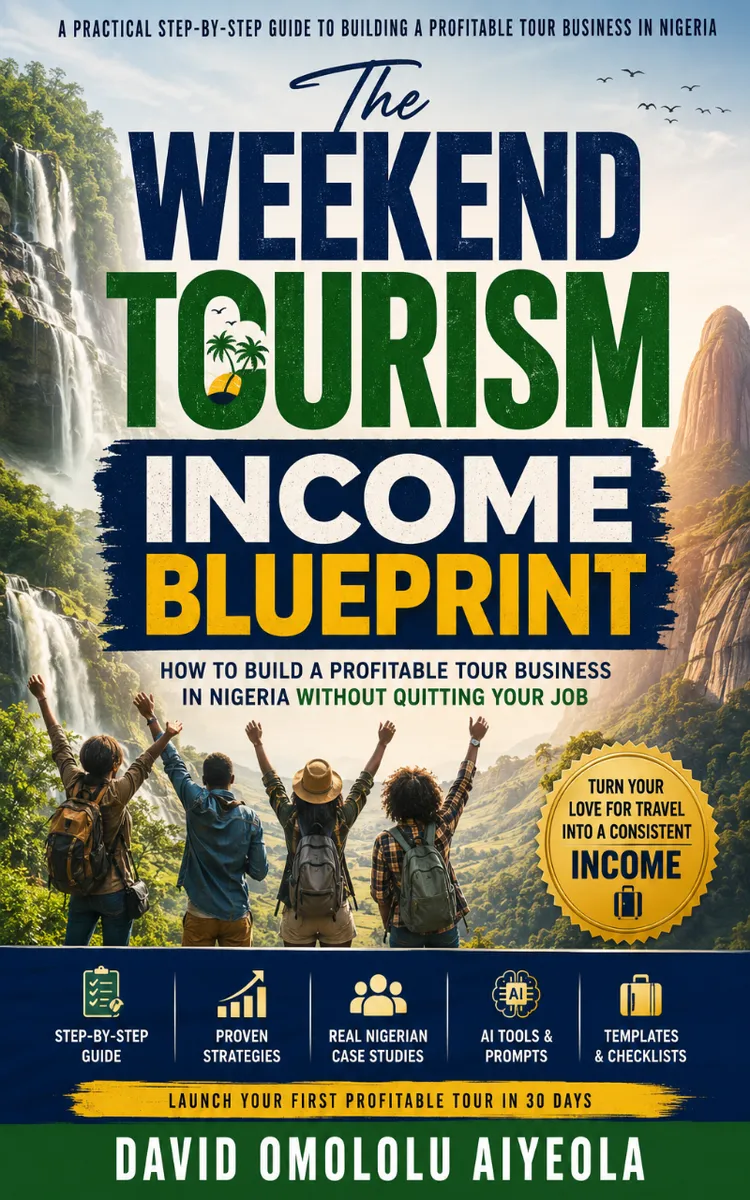
"The Weekend Tourism Income Blueprint" is a business book by Omololu David Aiyeola with 10 chapters and approximately 18,709 words. Launching a weekend tour business for working professionals.
This book was created using Inkfluence AI, an AI-powered book generation platform that helps authors write, design, and publish complete books. It was made with the AI Business Book Writer.
Frequently Asked Questions
What is "The Weekend Tourism Income Blueprint" about?
Launching a weekend tour business for working professionals
How many chapters are in "The Weekend Tourism Income Blueprint"?
The book contains 10 chapters and approximately 18,709 words. Topics covered include Why Tourism Is Nigeria's Hidden Goldmine, Choosing Your Tourism Business Model, Finding Profitable Tour Destinations, Planning Your First Weekend Tour, and more.
Who wrote "The Weekend Tourism Income Blueprint"?
This book was written by Omololu David Aiyeola and created using Inkfluence AI, an AI book generation platform that helps authors write, design, and publish books.
How can I create a similar business book?
You can create your own business book using Inkfluence AI. Describe your idea, choose your style, and the AI writes the full book for you. It's free to start.
Write your own business book with AI
Describe your idea and Inkfluence writes the whole thing. Free to start.
Start writingCreated with Inkfluence AI


