

Read the first chapter
The whole of chapter one, free. About 8 min. Turn the pages with the arrows, your keyboard, or a swipe.
Chapter 1
The Surveyor’s Broken Route
The compass needle trembled over the brass face as Thomas Hale knelt in the farm lane, its point wavering between north and the distant guns.
“Hold the chain steady,” he said.
Private Mercer tightened his grip on the surveyor’s rod. Behind him, two infantrymen watched the tree line with their rifles angled low, while the morning sun flashed between bare branches and struck the white stones of the lane. Hale bent over his field book, marking the last bend in the road, the shallow ditch beside it, and the rise beyond the orchard.
He had been sent to map Pennsylvania borderland terrain. The work had begun with fences, wells, and wagon tracks. Now every line he drew might become a road for men carrying muskets.
“Lieutenant,” Mercer said, “those guns are nearer.”
Hale heard it then - not the steady mutter from the west, but sharp rifle fire cracking through the woods ahead. Birds burst from the branches. A horse screamed somewhere beyond the orchard.
“Pack the instruments,” Hale said. “We’re moving.”
Mercer stared at the unfinished page. “Toward the firing?”
“Toward the Union line.”
“If there is one.”
Hale closed the book and slid it beneath his coat. His sketches were folded inside a leather case at his hip, protected by oilskin and tied with a narrow cord. The case held every lane and wall he had measured since leaving Philadelphia: drainage cuts hidden by weeds, farm roads that did not appear on any military map, the low ground behind the orchard where wagons could pass unseen.
He had to reach Union lines with the sketches intact. That was all. The rest could be abandoned.
A bullet struck the fence post beside Mercer. Splinters slapped Hale’s cheek.
“Move!” he shouted.
The escort broke toward the trees. Hale followed, clutching the leather case as the lane erupted around them. Rifles answered from the woods. Smoke drifted low between the trunks, turning the familiar Pennsylvania farmland into a shifting gray maze.
Mercer stumbled over the ditch and fell hard. One of the infantrymen seized his collar and dragged him upright.
“Leave the rod,” Hale called.
“It’s government property,” Mercer gasped.
“So are you.”
Another volley cracked. The second infantryman folded against the fence, his rifle dropping into the grass. Mercer shoved Hale forward.
“Go, Lieutenant!”
Hale ran.
The wooded approach swallowed him. Branches tore at his sleeves, and the ground pitched beneath his boots where roots knotted through the soil. He heard Mercer behind him, then heard nothing but the gunfire and the pounding of his own breath.
At the next rise, Hale turned.
The lane lay empty. Smoke crawled between the fence posts. A blue cap rested in the mud beside the fallen infantryman, but Mercer had vanished.
“Mercer!”
No answer came. A musket ball struck a tree above Hale’s head, scattering bark across his neck.
He dropped behind a fallen trunk and pressed one hand to the leather case. The cord had loosened. He retied it with fingers that would not stop shaking.
A voice called from the woods.
“Blue lieutenant! Come out where we can see you!”
Hale kept still.
The voice came again, closer this time. “You’ve lost your road.”
The words struck harder than the gunfire. He had not lost the road. He had surveyed it. He knew the lane ran east, dipped behind the orchard, then crossed a shallow stream before joining the farm road toward Gettysburg.
But the route was no longer a line on paper. It was contested ground.
Hale crawled from the trunk and moved downslope, keeping beneath the brush. The leather case bumped against his ribs. Each step carried him farther from command, yet the woods behind him filled with movement - men shouting, branches snapping, the dull thud of boots crossing the lane.
He reached the stream and found it swollen with runoff. Water rushed over stones beneath a skin of brown foam. On the far bank, a gray-coated soldier crouched beside a tree, reloading.
Hale froze.
The soldier looked up. For one suspended instant neither man fired.
Then the Confederate raised his rifle.
Hale threw himself sideways. The shot tore through the brush. He hit the water shoulder-first, plunging into the cold current. His field book slipped from inside his coat.
He seized it before it floated away.
The current dragged him beneath the bank. Mud filled his mouth. His fingers found a root, and he held on while boots hammered along the edge above him.
“Search the water!”
“He went down.”
“He’s carrying papers.”
Hale clung to the root until the voices passed. Water soaked through his coat and turned the pages of his book soft at the edges. He tucked it beneath his shirt and crawled along the streambed, scraping his palms against stone.
When he finally emerged, he was behind the orchard.
The trees stood in orderly rows, their branches black against the bright sky. Beyond them, the land opened toward Gettysburg. Smoke rose over the town in thick columns. Somewhere ahead, Union soldiers were trying to form a line. Somewhere behind, the Confederate advance pressed through the farms.
Hale pulled the map case free and checked the clasp. It held.
A shout sounded from the woods.
He ran between the trees.
The orchard floor was uneven, furrowed by roots and scattered with fallen fruit from an earlier season. His boots slipped. Twice he went down. Each time he rose with the case clutched beneath his arm.
At the last row, he found a farm road leading toward a stone wall. He recognized the wall from his own survey: shoulder-high, built from rough limestone, with a break where wagons passed through. Beyond it, the road curved toward the higher ground west of town.
A Union corporal stepped into the road with his rifle leveled.
“Stop there!”
Hale raised both hands. “Topographical Engineers.”
“Name?”
“Lieutenant Thomas Hale.”
“Where is your escort?”
“Gone.”
The corporal glanced toward the orchard. “Gone where?”
“Into the fighting.”
“Any gray behind you?”
“Likely.”
The corporal’s mouth tightened. “Then you brought them here.”
Hale looked at the wall. “I brought a route.”
The corporal crossed the road and seized the case. Hale caught his wrist.
“Don’t open it.”
“Why not?”
“Because you cannot read what’s inside, and they can.”
The corporal stared at him. “You expect me to trust a wet lieutenant who crawled out of a creek?”
“I expect you to understand that if those sketches are captured, every blind approach between here and the Union line goes with them.”
A shell burst somewhere beyond the orchard. The wall shuddered beneath their boots. The corporal ducked, and Hale tore the case free.
“Get behind the wall,” the corporal shouted.
Hale did not need telling. He crossed the road and dropped into the cover of the stones. Two Union soldiers followed, firing toward the trees. Their shots vanished into the smoke.
The corporal crouched beside him. “We’re falling back to the town.”
“Then take me to your commander.”
“Which one?”
The question silenced him.
Men moved along the far side of the wall, some limping, some carrying wounded comrades. A wagon came grinding down the road, one wheel broken, its driver whipping the horse until blood marked its flank. The world had lost its direction. North, south, east, west - Hale’s careful points had been swallowed by smoke and shouting.
He opened the case just enough to see the folded sketches within. The ink had blurred at one corner but remained legible. The route to the Union position was still there.
The corporal watched him. “Can you lead us?”
“To where?”
“To safety.”
Hale looked toward the rise beyond the wall. A line of blue uniforms flickered there, then disappeared beneath a fresh burst of smoke.
“That isn’t safety,” he said. “It’s only the next place they’ll shoot.”
The corporal gave a humorless laugh. “You surveyors always talk like that?”
“Only when the ground proves us right.”
A rifle cracked from the orchard.
The corporal jerked backward. Blood appeared beneath his collar. He fell against the stones, eyes wide, hands searching for the wound.
Hale caught him before his head struck the wall.
“Corporal?”
The man tried to speak, but blood ran down his chin. One of the soldiers fired blindly into the trees.
“Keep down!” Hale shouted.
He lowered the corporal behind the wall and pressed a hand to the wound. The blood came hot between his fingers. There was no bandage, no surgeon, no time. The remaining soldiers had already begun moving east, dragged by the retreat.
“Hale,” the corporal whispered.
“I’m here.”
“Take the road.”
“Which road?”
The corporal’s eyes shifted toward the orchard. “The one you made.”
Then his grip loosened.
Hale stayed crouched beside him until another volley struck the stones. Chips of limestone cut his cheek. He rose with the map case under his coat and moved along the wall alone.
At the break, he stopped.
The road beyond ran open for nearly a hundred yards. To reach the next rise, he would have to cross it in full view of the orchard. His sketches told him there was a drainage ditch halfway across, deep enough to hide a man if he reached it.
He stepped into the road.
The first shot missed wide.
The second struck the wall behind him.
Hale ran for the ditch. His soaked boots dragged at every step. He heard the distant shouts of Union soldiers, but no one fired from the rise. Perhaps they had not seen him. Perhaps they had mistaken him for the enemy.
He reached the ditch and fell into it, landing among reeds and broken fence rails. For several seconds he could not move. His hands shook against the map case.
The orchard had gone quiet.
That silence was worse than the volleys.
Hale lifted his head above the ditch’s edge.
Between two trees, a rifle barrel rested against a forked branch. He could not see the man behind it, only the dark muzzle and a pale hand adjusting its aim.
The marksman had watched him cross. He had watched him reach the wall. He had let Hale keep the sketches.
Hale lowered himself into the ditch and drew the case beneath his shirt.
Ahead, the Union line waited somewhere beyond the rise. Behind him, the road he had measured belonged to the Confederates now.
He pressed his back to the cold earth and listened as the rifleman shifted position, patient as a surveyor taking a reading.
Thomas Hale had reached the stone wall with his sketches intact.
But he was no longer carrying a map through the battle.
He was carrying the battle’s attention.
End of chapter one. 39 more chapters and about 76,436 words in the full book.
Swipe or use the arrows to turn the page


What's inside: 40 chapters
- 1. The Surveyor’s Broken Route
- 2. A Cellar Becomes a Ward
- 3. The Boy’s Unsent Letter
- 4. The Road Through Town
- 5. A Promise Against the Hills
- 6. The Map Case in the Cellar
- 7. Blind Spots in the Stone
- 8. The High Ground Closes
- 9. The Cost of Staying
- 10. Orders for Devil’s Den
- 11. Who Holds the Cipher
- 12. The Orchard’s False Shelter
- 13. A Teacher’s Measure
- 14. The Ridge Erupts
- 15. The Marksman’s Pattern
- 16. Water Beyond the Lines
- 17. The Brother’s Last Words
- 18. The Case Changes Hands
- 19. The Wall at the Wheatfield
- 20. The Cipher’s Missing Key
- 21. A Shot Held Back
- 22. The Farmhouse Is Searched
- 23. The Orderly’s Trail
- 24. Across the Open Yard
- 25. The Marksman’s Choice
- 26. The Hospital Under Fire
- 27. A Message in the Rocks
- 28. The Spring Beyond the Fence
- 29. The Case in the Hayloft
- 30. The Letter Nearly Lost
- 31. The Route to Little Round Top
- 32. The Ditch and the Ridge
- 33. The Mapmaker’s Measure
- 34. The Missing Cipher Key
- 35. The Sprint Before the Guns
- 36. The Letter Given Over
- 37. The Farmhouse After the Barrage
- 38. The Sharpshooter’s Last Position
- 39. The Letter Reaches the Rear
- 40. What the Stones Remember
About this book
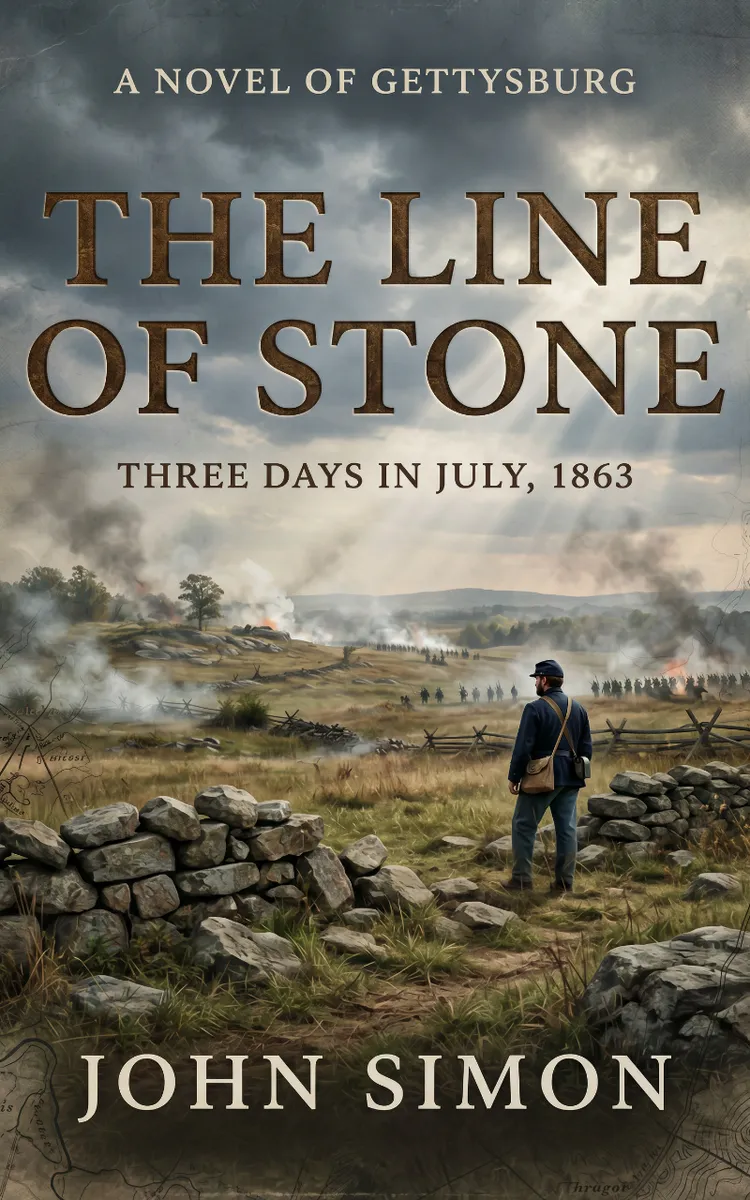
"The Line Of Stone" is a fiction book by John Simon with 40 chapters and approximately 76,436 words. Three intersecting lives during the Battle of Gettysburg in July 1863.
This book was created using Inkfluence AI, an AI-powered book generation platform that helps authors write, design, and publish complete books. It was made with the AI Novel Writer.
Frequently Asked Questions
What is "The Line Of Stone" about?
Three intersecting lives during the Battle of Gettysburg in July 1863
How many chapters are in "The Line Of Stone"?
The book contains 40 chapters and approximately 76,436 words. Topics covered include The Surveyor’s Broken Route, A Cellar Becomes a Ward, The Boy’s Unsent Letter, The Road Through Town, and more.
Who wrote "The Line Of Stone"?
This book was written by John Simon and created using Inkfluence AI, an AI book generation platform that helps authors write, design, and publish books.
How can I create a similar fiction book?
You can create your own fiction book using Inkfluence AI. Describe your idea, choose your style, and the AI writes the full book for you. It's free to start.
Write your own fiction book with AI
Describe your idea and Inkfluence writes the whole thing. Free to start.
Start writingCreated with Inkfluence AI


