

Read the first chapter
The whole of chapter one, free. About 9 min. Turn the pages with the arrows, your keyboard, or a swipe.
Chapter 1
The Phone Was Already There
The Childhood That Came With a Signal
In 2007, when Apple introduced the first iPhone, most children still encountered the internet through a family computer, a school machine, or a shared gaming console. By the time many members of Generation Z were old enough to read fluently, the internet had moved from a place they visited to an environment that followed them.
That change was not announced with a single cultural ceremony. There was no morning when childhood officially became smartphone-based. Instead, phones entered through ordinary doors: a parent’s old device, a group chat about homework, a camera used for school projects, a map opened on the way to practice. The remarkable part is how quickly an object once associated with business and novelty became as unremarkable as a backpack.
The Always-On Childhood Map traces that shift without treating Gen Z as one uniform population. Shared technology does not produce identical childhoods. A young person in a rural area, a child whose parents restrict phone use, and a teenager whose friendships depend heavily on online communities may all belong to the same generation while experiencing very different digital landscapes.
When the phone became ordinary, what exactly changed: childhood itself, or only the background against which it unfolded?
From Family Computer to Personal Screen
The first generations to use the web usually had to approach it physically. A desktop computer sat in a study, a library, or a school laboratory. Its location made online activity visible. Someone walking past could see the screen; someone waiting to use the machine knew that internet time had a beginning and an end.
Smartphones dissolved that boundary. The internet became available in a pocket, at a bus stop, in a bedroom, and between conversations. The change was partly technical and partly social. Faster mobile networks made websites, video, messaging, and maps practical away from home. App stores turned the phone into a container for tools that had once been separate: camera, calendar, music player, television, address book, game console, and newsstand.
For children born during the late 1990s and 2000s, this transition overlapped with other familiar milestones. Many remember the household computer, early video-sharing websites, or the period when texting was still tied to a monthly limit. Others encountered smartphones almost immediately, particularly when a parent handed over a used device. The phrase “digital native” suggests a smooth, universal experience, but the reality was more uneven. Access depended on household income, geography, school policy, disability, family rules, and whether a reliable connection existed at home.
A phone could be a bridge to school materials or a source of distraction. It could help a young person maintain contact with distant relatives, translate a message, find a bus route, or enter a community that did not exist nearby. The same device could also make it difficult to leave social pressure behind. These possibilities were present at once, even when adults noticed only one of them.
The device itself was not the whole story. What mattered was the removal of the old stopping points. Logging off became less obvious when messages arrived continuously and content refreshed without a natural ending.
The Always-On Childhood Map
The Always-On Childhood Map describes four overlapping features of this environment: the phone as a tool, the phone as a social doorway, the phone as a record of experience, and the phone as a background signal. These are not stages that every young person passes through in the same order. They are layers that may be more or less important depending on circumstance.
As a tool, the smartphone extended practical independence. A young person could check a timetable, contact a parent after a schedule changed, photograph an assignment, or search for an explanation when a lesson moved too quickly. Access to information became immediate, although immediate access did not guarantee accurate information. The phone reduced the friction between a question and a possible answer.
As a social doorway, it changed how friendship could continue outside school. Group messages carried jokes, plans, arguments, and small updates across the day. Online communities allowed people to find others who shared an interest, identity, language, or experience that was uncommon in their immediate surroundings. For some young people, this was not an optional extra to “real” social life. It was part of where social life happened.
As a record, the phone altered memory. Childhood events could be photographed, filmed, posted, saved, and revisited. A school trip no longer existed only in recollection or a family album; it might survive as a sequence of images viewed by classmates. The camera also changed behavior. A moment could become evidence, entertainment, embarrassment, or a permanent reference point within seconds.
The background signal is quieter. It is the expectation that information may arrive at any time. A phone on a table does not need to ring to influence attention. Its presence can create the possibility of interruption: a new message, a changing conversation, a notification from a service, or a request that appears without warning.
A useful comparison is the difference between living beside a railway line and taking a train. A train journey is an event with a clear start and finish. Living beside the tracks means the possibility of movement is built into the setting, even when no train is passing. For many Gen Z children, connection became part of the setting.
The Myth of One Digital Childhood
The shared milestone is real: smartphones became common during the years when Gen Z was growing up. The assumption that follows - that every member of the generation experienced the same change in the same way - is not.
Some children received a phone mainly for safety and transport. Others used one to manage schoolwork, entertainment, and friendships. Some had strict limits on apps and screen time. Others lived in households where adults were also learning the rules as they went. A teenager with a stable home connection and a private bedroom encountered the internet differently from one who relied on a prepaid phone or shared device.
Schools added another layer. During periods of remote learning, a smartphone could become a lifeline when a laptop was unavailable, but it was not an equal substitute for a larger screen, a quiet workspace, or reliable broadband. The phrase “online learning” can hide these differences. Being technically connected is not the same as having comfortable access to the tools required for sustained learning.
The same caution applies to social media. Not every young person posts publicly. Some use private messages, gaming platforms, or small interest-based groups. Others remain mostly observers. A person may own a smartphone without building a visible online identity, while another may participate intensely through an account that adults never encounter.
Even the meaning of “screen time” is unstable. Twenty minutes spent looking up a medical term, two hours playing with friends, and twenty minutes watching short videos are all counted as time on a screen, but they do not represent the same activity. Treating them as interchangeable can make the phone appear simpler than it is.
The important distinction is between a generation that shares a historical condition and a generation that shares one personality. Gen Z grew up during the normalization of mobile connection. That does not mean every young person is constantly online, socially confident on the internet, or comfortable with technology in every setting.
The Counterintuitive Arrival of the Smartphone
The surprising fact is that smartphones did not make childhood uniformly more social or less social. They made social contact more available while also making solitude harder to recognize.
This matters because availability and participation are different things. A young person may be surrounded by messages yet feel excluded from a particular conversation. Another may use a phone to preserve a friendship that would otherwise disappear. The device increases the number of possible connections, but it does not decide whether those connections are supportive, exhausting, shallow, or meaningful.
The older idea of “online versus offline” also becomes less useful here. A message can arrange an in-person meeting; a photo can preserve an offline event; a school assignment can move between paper and a platform; a friendship can begin in a physical room and continue through a screen. The phone is not simply a second world. It is a hinge between worlds that used to be separated more clearly.
That reframing changes how adult observers interpret phone use. Looking at a young person absorbed in a screen does not reveal whether they are isolated, connected, learning, creating, avoiding, coordinating, or doing several of these at once. The visible behavior is the same; the surrounding purpose may be entirely different.
A Phone in the School Corridor
The most concrete version of this transformation can be found in the school corridor, where the phone became both ordinary and contested. A student may arrive with it in a pocket, place it face down during a lesson, use it to check a timetable, and reach for it again when the bell rings. Teachers may see a distraction; families may see a safety link; students may see the main channel through which the day is organized.
School phone policies reveal the unsettled status of the device. Some schools ban phones during lessons or require them to be stored away. Others permit limited use for research, accessibility, translation, or classroom tasks. These differences are not minor details. They show that adults are still negotiating whether the smartphone belongs to childhood as a tool, a risk, a social object, or all three.
A corridor also exposes the gap between possession and power. Two students may carry similar devices while having very different control over them. One may have generous data, a private account, and family support when something goes wrong online. Another may share a device, worry about running out of data, or avoid reporting a problem because adults might remove the phone entirely. The same object can represent freedom for one young person and surveillance or dependence for another.
What appears to be a generation-wide habit is therefore partly an arrangement of institutions and households. Schools decide when phones are acceptable. Parents decide how much independence they signal. Platforms decide what notifications appear. Young people adapt to all of these decisions, often without being asked to describe the system they are navigating.
The phone was already there, but it was never there in exactly the same way.
The Background That Became Part of Growing Up
Smartphones did not replace childhood with technology. They threaded technology through childhood’s existing places: kitchens, classrooms, bedrooms, buses, playgrounds, and waiting rooms. Their influence lies less in any single app than in the disappearance of clear borders around communication and information.
That is why the most revealing question is not whether Gen Z is “addicted” to phones or unusually skilled with them. Such labels flatten a complicated historical change into a judgment about character. The more useful question is what happens when a tool designed to connect adults becomes part of the environment in which children learn independence, friendship, privacy, and attention.
A generation can share a backdrop without sharing a script. The phone supplied the backdrop; families, communities, institutions, and young people filled the foreground differently. Somewhere in that difference is the part of the story still unfolding: how much of a person’s childhood can remain private when the background is always capable of recording, transmitting, and remembering?
End of chapter one. 19 more chapters and about 34,218 words in the full book.
Swipe or use the arrows to turn the page


What's inside: 20 chapters
- 1. The Phone Was Already There
- 2. Who Are You When You Post?
- 3. The Feed That Knows Your Mood
- 4. When Likes Become a Score
- 5. Mental Health Without the Hashtag
- 6. Finding People Beyond Your Zip Code
- 7. The Group Chat Is the Gathering
- 8. Dating in the Screenshot Era
- 9. Learning From a Thousand Tabs
- 10. How to Spot a Viral Lie
- 11. Activism After the Share Button
- 12. The Data Trail You Leave
- 13. Growing Up Under Financial Pressure
- 14. Side Hustles, Real Trade-Offs
- 15. Work Must Mean Something
- 16. The Classroom Meets the Screen
- 17. Parents in the Privacy Debate
- 18. Logging Off Without Disappearing
- 19. What the Surveys Actually Say
- 20. A Generation Still Becoming
About this book
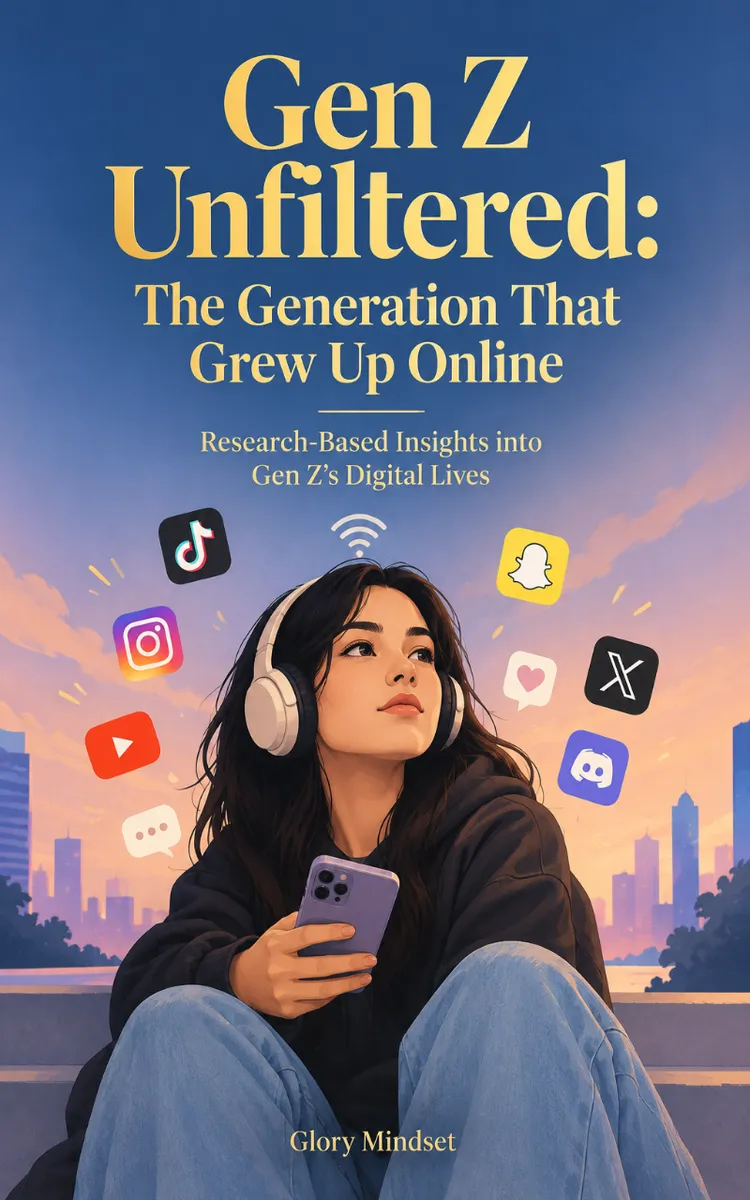
"Gen Z Unfiltered: The Generation That Grew Up Online" is a curiosity book by Glory Mindset with 20 chapters and approximately 34,218 words. Generation Z’s digital identity, mental health, relationships, work, and economic pressures.
This book was created using Inkfluence AI, an AI-powered book generation platform that helps authors write, design, and publish complete books.
Frequently Asked Questions
What is "Gen Z Unfiltered: The Generation That Grew Up Online" about?
Generation Z’s digital identity, mental health, relationships, work, and economic pressures
How many chapters are in "Gen Z Unfiltered: The Generation That Grew Up Online"?
The book contains 20 chapters and approximately 34,218 words. Topics covered include The Phone Was Already There, Who Are You When You Post?, The Feed That Knows Your Mood, When Likes Become a Score, and more.
Who wrote "Gen Z Unfiltered: The Generation That Grew Up Online"?
This book was written by Glory Mindset and created using Inkfluence AI, an AI book generation platform that helps authors write, design, and publish books.
Write your own curiosity book with AI
Describe your idea and Inkfluence writes the whole thing. Free to start.
Start writingCreated with Inkfluence AI


