
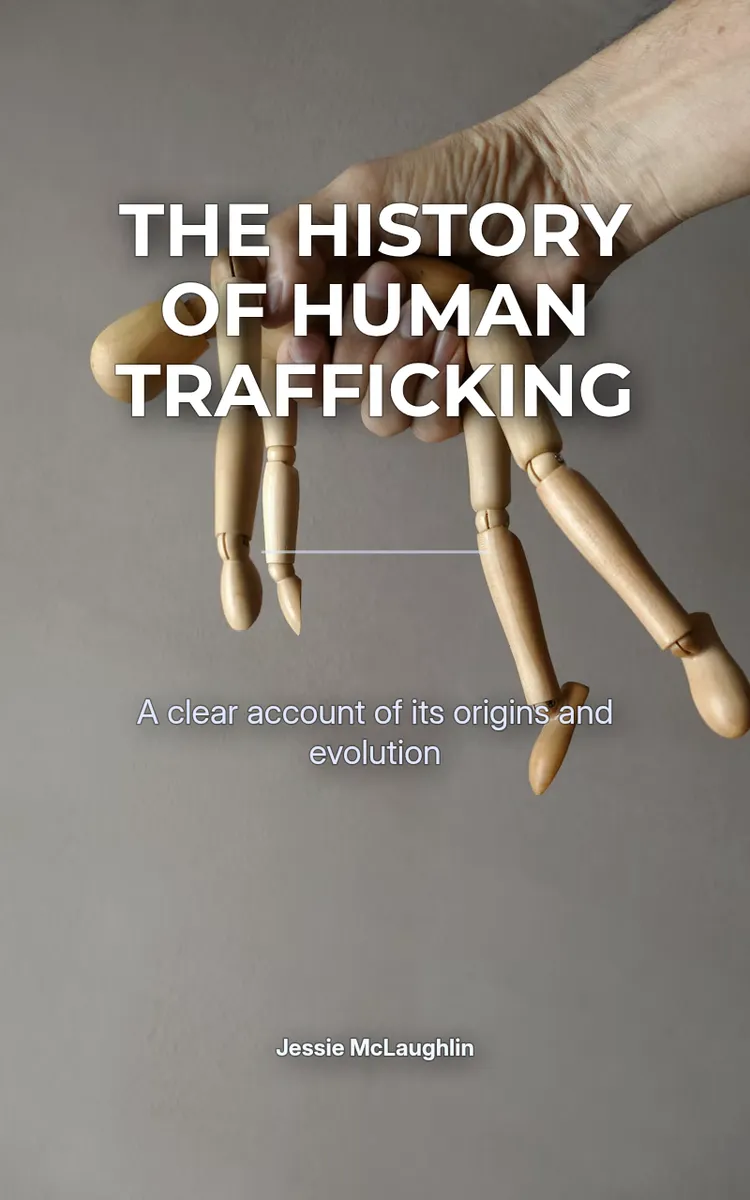
Read the first chapter
The whole of chapter one, free. About 8 min. Turn the pages with the arrows, your keyboard, or a swipe.
Chapter 1
The Chains Hidden in Plain Sight
The Ordinary Transaction
A delivery arrives at a restaurant, a cleaner enters an apartment building, and a shipment of clothing moves through a warehouse. Each event looks routine. Yet somewhere behind these ordinary transactions, a worker may be unable to leave a job because an employer holds the worker’s passport, controls the wages, threatens deportation, or has created a debt that cannot realistically be repaid.
Human trafficking is often pictured as abduction: a stranger, a locked room, a dramatic escape. That image describes some cases, but it hides a more common and less visible mechanism. Modern forced labor frequently begins with an apparently lawful arrangement - a job offer, a recruitment fee, a domestic work contract, a farm placement - and becomes coercive through control over money, movement, housing, documents, or legal status.
The Visibility Gap Map helps locate the distance between what a transaction shows and what it depends upon. At the visible edge are products, services, invoices, and paychecks. Farther inside are recruiters, subcontractors, labor brokers, households, farms, factories, and workers whose choices may have narrowed until “employment” is no longer meaningfully voluntary.
How much coercion can an ordinary transaction conceal before society stops calling it work?
From Ownership to Control
The history of forced labor is not a straight line from slavery to freedom. Older systems made domination explicit. Enslaved people were treated as property under law; colonial labor regimes compelled work through violence, taxation, land seizure, and racial hierarchy. After formal emancipation, many systems changed their vocabulary without surrendering their basic power.
In the nineteenth-century United States, for example, convict leasing allowed states to lease prisoners to private companies. The prisoners, disproportionately Black men arrested under discriminatory laws, worked in mines, farms, rail construction, and factories. The legal form was different from chattel slavery, but employers still obtained labor through confinement and state-backed coercion. Elsewhere, debt bondage tied workers to plantations, mines, estates, and workshops. A worker could owe money for transport, food, tools, or housing, while the employer controlled the accounting.
The important historical shift was not that coercion disappeared. It became easier to place behind contracts, intermediaries, and legal categories. A worker might be described as an employee, tenant, migrant, apprentice, or contractor while lacking a practical ability to refuse work or leave.
Industrialization expanded this distance. A factory owner might not personally threaten every worker; a foreman, recruiter, security guard, or labor contractor could carry out the control. The final buyer might see only a finished product. Responsibility became distributed across a chain, while vulnerability remained concentrated at the bottom.
That pattern survives in contemporary labor markets. A migrant worker may borrow heavily to pay a recruiter before leaving home. On arrival, the promised wage may be reduced, the job changed, and the debt increased through deductions for transportation or housing. If the worker’s visa is tied to one employer, quitting may mean losing legal status. The workplace need not resemble a prison for the worker’s available choices to become dangerously small.
A chain can be made of contracts and still function like a chain.
Homes, Farms, and Factories
Domestic work presents a particular visibility problem because the workplace is a private home. A cleaner, nanny, gardener, or live-in caregiver may work behind a door that inspectors rarely cross. The worker’s housing and employment can become the same place, making it difficult to separate working hours from personal time. Isolation does much of the work that walls once did.
Reports from many countries have documented domestic workers whose passports were confiscated, wages withheld, movement restricted, or employment conditions changed after arrival. Some are recruited across borders with promises of childcare or housekeeping jobs, then expected to work around the clock. The household may appear respectable from the street, while the worker’s dependence remains invisible to neighbors, visitors, and public agencies.
Agriculture creates a different concealment. Harvest labor is seasonal, dispersed, and often mediated by labor contractors. Workers may move between farms, sleep in employer-controlled housing, and depend on a supervisor for transportation. Payment can be calculated by the bucket, crate, or piece rather than by the hour, making deductions and unpaid time difficult to challenge. The produce reaches a market with no visible mark indicating who planted, picked, or packed it.
The history of agricultural coercion is long. Sharecropping and debt peonage in the United States trapped families through accounts controlled by landowners and merchants. In other regions, plantation labor, bonded work, and migrant recruitment created similar dependence. Contemporary systems may use smartphones, payroll software, and formal contracts, but technology does not automatically make power equal. A digital record can document a wage; it cannot by itself ensure that the worker was free to refuse the job.
Factories add layers. A brand may contract with a manufacturer, which contracts with another factory, which hires a labor broker. Each step can make the finished product cheaper while making the working conditions harder to trace. Workers in garment production, electronics assembly, construction, food processing, and other industries have faced recruitment debt, excessive hours, threats, wage withholding, and confinement.
The factory is therefore not always a single building with a single owner. It can be a network spread across countries, connected by purchase orders and delivery schedules. The worker at one end may know the immediate supervisor but not the brand whose deadline governs the shift. The consumer at the other end may know the brand but not the labor system that made the deadline possible.
The Supply Chain’s Blind Spot
The counterintuitive fact is that trafficking does not require an illegal-looking market. It can persist inside industries that depend on paperwork, audits, and reputable companies. The more respectable the transaction appears, the easier it may be for coercion to remain outside the frame.
This matters because public attention often searches for abnormality: a suspicious vehicle, a hidden compound, a visibly guarded worker. But many cases are embedded in ordinary systems of recruitment and purchasing. A company may outsource hiring, a household may rely on an agency, and a retailer may buy through several suppliers. Every participant can point to another layer.
The Visibility Gap Map makes that structure easier to see. The first layer contains what is observable: a uniform, a shipment, a harvested field, a care worker entering a home. The second contains the transaction that arranged it: a recruitment fee, a subcontract, a visa sponsorship, a housing deduction, or a production deadline. The deepest layer contains the worker’s actual freedom to refuse, leave, negotiate, or report abuse.
That map changes the central question. Instead of asking only whether a business has a policy against trafficking, it asks where the business can see and where it cannot. A written policy may reach a direct supplier but not the labor broker who recruited the worker. An inspection may visit a factory but miss the dormitory. A payroll record may show payment while concealing a debt that absorbs it.
Consider seafood processing, where migrant workers have been recruited across borders and placed in jobs far from their families. Investigations have found cases involving recruitment debt, confiscated documents, and threats. The fish may enter a legitimate international supply chain, pass through customs, and appear in a supermarket freezer. Nothing about the packaging reveals whether the person who processed it could leave the job.
The same concealment can occur in construction. A project may carry permits, insurance, safety plans, and a recognizable corporate name while labor brokers control the workers who perform the most dangerous tasks. Formal legality at the project level does not settle the question of freedom at the worksite.
A Worker Behind the Label
In 2015, the United Kingdom’s Modern Slavery Act brought unusual attention to the supply chains of large companies. Businesses above a specified size were required to publish statements describing the steps they took to address slavery and trafficking in their supply chains. The law did not eliminate forced labor, but it exposed a central problem: companies often knew more about the movement of goods than about the movement and treatment of workers.
Around the same period, the British case of R v. Connors revealed how forced labor could persist within a family-run waste-recycling business. Members of the Connors family were convicted after exploiting vulnerable men who were recruited with promises of work and then subjected to poor living conditions, withheld pay, and coercive control. The case mattered partly because the victims were not held in a distant factory or foreign compound. They were found in the middle of an ordinary economy, working in recycling yards and connected to a business that operated openly.
The details were prosaic: labor, housing, wages, transport, and dependence. That is precisely what made the case revealing. Coercion did not need a spectacular setting. It could be built from the worker’s lack of money, isolation, fear of authorities, and reliance on the employer for a place to sleep.
A similar pattern appears in domestic work, agriculture, and manufacturing around the world. The setting changes, but the structure repeats. Someone with greater control over documents, wages, housing, transportation, or legal status can turn a job into an arrangement from which departure carries consequences the worker cannot bear.
The worker may still speak the language of employment. There may be a schedule, a supervisor, a wage calculation, and a uniform. The decisive question is not whether the arrangement resembles a job. It is whether the worker retains a real choice.
What the Transaction Hides
Human beings are skilled at accepting familiar surfaces. A receipt, a contract, a branded package, and a regular delivery reassure us that a system is functioning normally. Those signals are useful, but they are not proof that the people inside the system are free.
Forced labor survives partly because modern society separates consumption from production. The farther a worker is from the buyer, the easier it becomes to treat suffering as an unfortunate exception rather than a condition shaped by demand, deadlines, and unequal bargaining power. History shows that coercion rarely vanishes simply because its old name becomes unacceptable; it changes location, language, and paperwork.
The deepest mystery is not how hidden exploitation can exist. It is how often a society can encounter its products and services without encountering the people whose restricted choices made them possible. Somewhere beneath the ordinary transaction, a human decision remains constrained - and the chain continues to disappear into plain sight.
End of chapter one. 19 more chapters and about 32,235 words in the full book.
Swipe or use the arrows to turn the page


What's inside: 20 chapters
- 1. The Chains Hidden in Plain Sight
- 2. When Captivity Became Commerce
- 3. Debt That Could Not Be Repaid
- 4. The Routes That Built Empires
- 5. The Atlantic Crossing’s Human Cargo
- 6. How Law Made People Property
- 7. Resistance Beyond the Plantation
- 8. Abolition’s Uneven Promise
- 9. Freedom Replaced by Contract
- 10. Colonial Rule’s Forced Labor Machine
- 11. The Market for Children
- 12. Women Sold Through Marriage
- 13. War Turns Civilians into Spoils
- 14. The Underground Trade in People
- 15. When Borders Became a Weapon
- 16. Factories Behind the Label
- 17. Trafficking Without Crossing Borders
- 18. The Internet’s New Hunting Ground
- 19. Why Rescue Alone Falls Short
- 20. The Past Inside the Present
About this book
"The History Of Human Trafficking" is a nonfiction book by Jessie McLaughlin with 20 chapters and approximately 32,235 words. The origins, historical development, and present-day realities of human trafficking.
This book was created using Inkfluence AI, an AI-powered book generation platform that helps authors write, design, and publish complete books.
Frequently Asked Questions
What is "The History Of Human Trafficking" about?
The origins, historical development, and present-day realities of human trafficking
How many chapters are in "The History Of Human Trafficking"?
The book contains 20 chapters and approximately 32,235 words. Topics covered include The Chains Hidden in Plain Sight, When Captivity Became Commerce, Debt That Could Not Be Repaid, The Routes That Built Empires, and more.
Who wrote "The History Of Human Trafficking"?
This book was written by Jessie McLaughlin and created using Inkfluence AI, an AI book generation platform that helps authors write, design, and publish books.
Write your own nonfiction book with AI
Describe your idea and Inkfluence writes the whole thing. Free to start.
Start writingCreated with Inkfluence AI


