
Read the first chapter
The whole of chapter one, free. About 9 min. Turn the pages with the arrows, your keyboard, or a swipe.
Chapter 1
Is Islam More Than a Religion?
When One Word Holds a Whole Life
What does a Muslim mean when saying, “Islam is my way of life”? The answer may include prayer before sunrise, a rule about honest weights in a shop, a family obligation, a shared meal, a political argument, or a private conviction about God. No single English word - religion, culture, law, identity, or community - quite contains all of it.
The difficulty begins when Islam is treated as one fixed object. To some Muslims, it is above all a relationship with God. To others, it is a pattern of worship that gives shape to ordinary time. It can also describe a civilization, a moral vocabulary, a legal tradition, or a public identity. These meanings overlap, but they are not interchangeable.
The Whole-Life Lens helps hold them together without pretending they are the same. It asks how faith moves from belief into practice, from practice into ethics, from ethics into community, and from community into competing ideas about power.
If Islam enters nearly every room of life, where does religion end and identity begin?
Faith That Is Practised, Not Merely Declared
The English word “religion” often suggests a compartment of life: something people do at a place of worship, at certain times, alongside work, politics, family, and entertainment. Muslim understandings of Islam frequently resist that separation. The Arabic word Islam is commonly translated as submission or surrender to God, while iman, often translated as faith, refers to belief and trust. In lived experience, the two are connected: what one believes should affect what one does.
The central declaration of Muslim faith is the shahada, the testimony that there is no god but God and that Muhammad is God’s messenger. It is short enough to memorise and broad enough to organise an entire moral universe. The declaration points toward worship, but also toward authority: if God is ultimate, then no ruler, market, tribe, or personal appetite can claim unlimited power.
Islamic tradition describes five widely recognised acts of worship, known as the Five Pillars. The daily prayers place the body into a repeated rhythm of standing, bowing, and prostrating. Fasting during Ramadan changes the experience of hunger, daylight, and evening meals. Giving required charity, or zakat, links private wealth to social responsibility. The pilgrimage to Mecca gathers Muslims from different languages and nations into a ritual community. The declaration of faith gives the whole structure its foundation.
These practices are not simply signs of membership. They train attention. A prayer timetable divides the day differently from a factory whistle or a phone calendar. Ramadan makes the clock visible through thirst and sunset. Pilgrimage turns geography into memory: Mecca is not merely a city but the direction toward which Muslims face in prayer and the destination of a ritual remembered through the stories of Abraham, Hagar, and Muhammad.
Yet worship does not erase disagreement. Muslims differ over legal interpretation, ritual detail, theology, gender roles, and the relationship between religious principles and modern states. Sunni and Shia communities, for example, developed different traditions of authority after the death of Muhammad in 632 CE. The shared practices remain important, but they do not produce one uniform Muslim experience.
From Worship to the Ordinary Rules of Life
Islamic ethics are often encountered in small acts rather than grand declarations. A merchant’s obligation to use honest measures, a neighbour’s claim to fair treatment, a child’s duty to parents, and a stranger’s right to hospitality all belong to the same moral landscape. The Qur’an repeatedly joins belief with conduct, warning against prayer that exists alongside indifference to the poor and vulnerable.
The result is not a single rulebook applied identically everywhere. Islamic law, or sharia, is better understood as a broad moral and legal tradition whose interpretations have been developed by scholars, judges, rulers, and communities. The word itself is often translated as “path,” but the paths proposed by different schools have never been perfectly identical. Fiqh, the human effort to understand and apply Islamic law, has included argument, analogy, custom, and debate.
That distinction matters. Sharia, in Muslim thought, may refer to divine guidance; fiqh refers to human interpretation of that guidance. A ruling about trade, marriage, inheritance, dress, or food therefore reflects not only scripture but also methods of reasoning and the historical setting in which scholars worked.
A striking example is the Islamic prohibition of riba, commonly associated with interest or exploitative gain. Muslim scholars have disagreed over how the prohibition applies to modern banking, mortgages, inflation, and commercial contracts. Some financial institutions have created products designed to follow Islamic legal principles, using shared risk or asset-based transactions rather than conventional interest. The debate shows Islam functioning not as a frozen list of instructions but as a tradition trying to interpret old moral concerns inside new economic systems.
The same pattern appears in food. Halal, meaning permitted, is not only a list of ingredients. It can involve the method of slaughter, the handling of food, and the intention behind consumption. For a Muslim family, choosing halal meat may be an act of worship, a cultural habit, a marker of belonging, or all three at once. The supermarket aisle becomes a place where theology, supply chains, family practice, and identity meet.
A religion becomes a way of life partly through repetition: the moral idea is remembered because it is built into the meal, the contract, the greeting, and the calendar.
A Community Made Across Distance
Islam’s community, the ummah, is both an idea and a social fact. It refers to Muslims as a worldwide community, but it does not mean that local identities disappear. A Muslim in Jakarta, Lagos, Sarajevo, Cairo, London, or Detroit belongs to the ummah while also belonging to a language, a nation, a class, and a family history.
The Friday congregational prayer offers a useful glimpse of this layered identity. Men and women may gather in mosques or prayer spaces, though arrangements vary by community. The sermon may address spiritual concerns, local poverty, war, education, or the pressures of life in a minority setting. Arabic verses can be recited even when the surrounding discussion takes place in English, Turkish, Urdu, Malay, French, or another language. A global tradition is carried through local voices.
The annual pilgrimage to Mecca makes the worldwide dimension especially visible. Since the seventh century, Muslims have travelled to the same sacred centre, though the scale and organisation of pilgrimage have changed enormously. Pilgrims today move through airports, passport controls, hotels, buses, crowd-management systems, and medical facilities before entering rituals whose core actions were established many centuries ago. Modern infrastructure surrounds an ancient pattern of worship.
That coexistence of old and new complicates the idea that Islam is simply “traditional.” A Muslim community may use smartphone applications to calculate prayer times, digital platforms to teach Qur’an recitation, and online services to identify halal products. Technology changes the means of practice without necessarily changing the religious purpose.
Community also carries disagreement. Mosques may debate whether sermons should address elections, racism, war, or domestic abuse. Muslim organisations may disagree over whether public activism should be framed in religious language. The ummah is not a single voice; it is a field of voices connected by shared references and rituals.
The Surprising Boundary Between Muslim and Islamist
The most counterintuitive point is that “Muslim” and “Islamist” are not synonyms. A Muslim is someone who belongs to Islam as a faith or identity. An Islamist is generally someone who argues that political life should be organised according to an explicitly Islamic programme, though the term covers movements with very different goals and methods.
This distinction changes how claims about Islam are understood. It prevents the beliefs and daily practices of more than a billion Muslims from being treated as evidence of one political project. It also prevents political movements from presenting themselves as the natural or inevitable expression of every Muslim’s faith.
Modern Islamism developed largely in response to the political pressures of the nineteenth and twentieth centuries: European imperial rule, the collapse of older Muslim empires, nationalism, authoritarian government, and debates over modernity. Thinkers and movements differed sharply. Egypt’s Muslim Brotherhood, founded in 1928 by Hassan al-Banna, sought social and political change through an organised Islamic movement. Other groups later adopted revolutionary or militant strategies. Their language drew on Islamic concepts, but their programmes were shaped by modern party organisation, mass politics, prisons, print media, and the nation-state.
The distinction is also important when discussing violence. Islamic history contains warfare, political assassination, imperial expansion, and armed rebellion, as do the histories of Christianity, Judaism, Hindu traditions, secular revolutions, and modern states. Some contemporary militant groups justify violence through selective religious interpretations, but their existence does not turn ordinary Muslim worship into a “warrior guide.” It is more accurate to examine the particular texts, leaders, grievances, organisational structures, and political conditions that produce a militant ideology.
A person may be a devout Muslim who rejects Islamism. Another may support an Islamist party while opposing armed violence. A third may use Islamic language mainly as a cultural identity. These positions can overlap, but they should not be collapsed into one category.
A Human Life Within the Whole-Life Lens
Consider Muhammad Yunus, the Bangladeshi social entrepreneur and founder of Grameen Bank. Yunus is not presented here as a representative of all Muslims, nor as evidence that Islam has one social programme. His life is useful because it shows how religious and ethical ideas can enter public questions without becoming a complete political ideology.
Born in Chittagong in 1940, Yunus studied economics and later taught at Chittagong University. During the Bangladesh famine of the early 1970s, he became dissatisfied with the distance between economic theory and the poverty surrounding the university. His experiments with small loans to poor borrowers helped lead to the creation of Grameen Bank in 1983. The bank’s work was not a religious institution, but Yunus operated within a society where Islamic ideas about charity, obligation, fairness, and community were part of the moral environment.
The example reveals why “Islamic way of life” cannot be reduced to a list of rituals or to a political slogan. Questions about debt, dignity, charity, and economic justice can be discussed through Islamic ethics, secular economics, local custom, or all three at once. The surrounding culture supplies moral questions; individuals and institutions decide how to answer them.
Human beings rarely keep belief in one sealed compartment. They carry it into the market, the family, the mosque, the ballot box, and the workplace. But carrying faith into life does not mean every decision is dictated by faith, or that everyone who shares a faith reaches the same conclusion.
Islam is therefore less like a single room labelled “religion” than a house with many entrances: worship, law, memory, belonging, morality, and power. The rooms connect, but the people inside them do not always agree about the architecture. To understand Muslim identity, one must listen for both the shared structure and the arguments taking place within it.
A way of life is never only a set of rules; it is also a way of noticing the world. The enduring question is whether identity creates unity by settling meaning - or creates new arguments over who has the right to define it.
End of chapter one. 39 more chapters and about 67,240 words in the full book.
Swipe or use the arrows to turn the page


What's inside: 40 chapters
- 1. Is Islam More Than a Religion?
- 2. Muslim, Islamist, or Something Else?
- 3. What the Word Jihad Actually Means
- 4. How Islam’s First Community Took Shape
- 5. The Five Pillars in Daily Practice
- 6. Qur’an, Hadith, and Who Interprets
- 7. Why Muslims Pray Five Times
- 8. Ramadan Beyond Fasting
- 9. Halal Choices in Everyday Life
- 10. Mosques as More Than Prayer Spaces
- 11. Islam Has No Single Center
- 12. Sunni and Shia: A Shared Beginning
- 13. Sufism’s Paths of Devotion
- 14. Women’s Authority in Muslim Life
- 15. Muslim Lives Across Continents
- 16. How Islamic Law Is Made
- 17. Sharia: Ideal, Law, or Slogan?
- 18. Caliphates and the Politics of Memory
- 19. Empire, Trade, and Islam’s Expansion
- 20. When Religion Meets the Modern State
- 21. Islamism Is Not One Movement
- 22. The Ballot Box and Islamist Parties
- 23. Political Islam’s Competing Visions
- 24. Why Some Movements Turn Violent
- 25. The Myth of Islam as a War Manual
- 26. What Classical Texts Say About War
- 27. Rules of War in Islamic Law
- 28. Assassination, Sectarian Conflict, and Myth
- 29. How Jihadist Groups Recruit
- 30. The Stories Extremists Tell
- 31. Muslim Responses to Extremism
- 32. Terrorism’s Unequal Media Lens
- 33. Islamophobia and the Politics of Fear
- 34. Muslim Identity in Diaspora
- 35. Leaving, Questioning, and Believing
- 36. Islam in Art, Science, and Letters
- 37. How to Read Claims About Islam
- 38. When Muslim Is a Political Label
- 39. Beyond the Religion-or-Ideology Divide
- 40. The People Behind the Labels
About this book
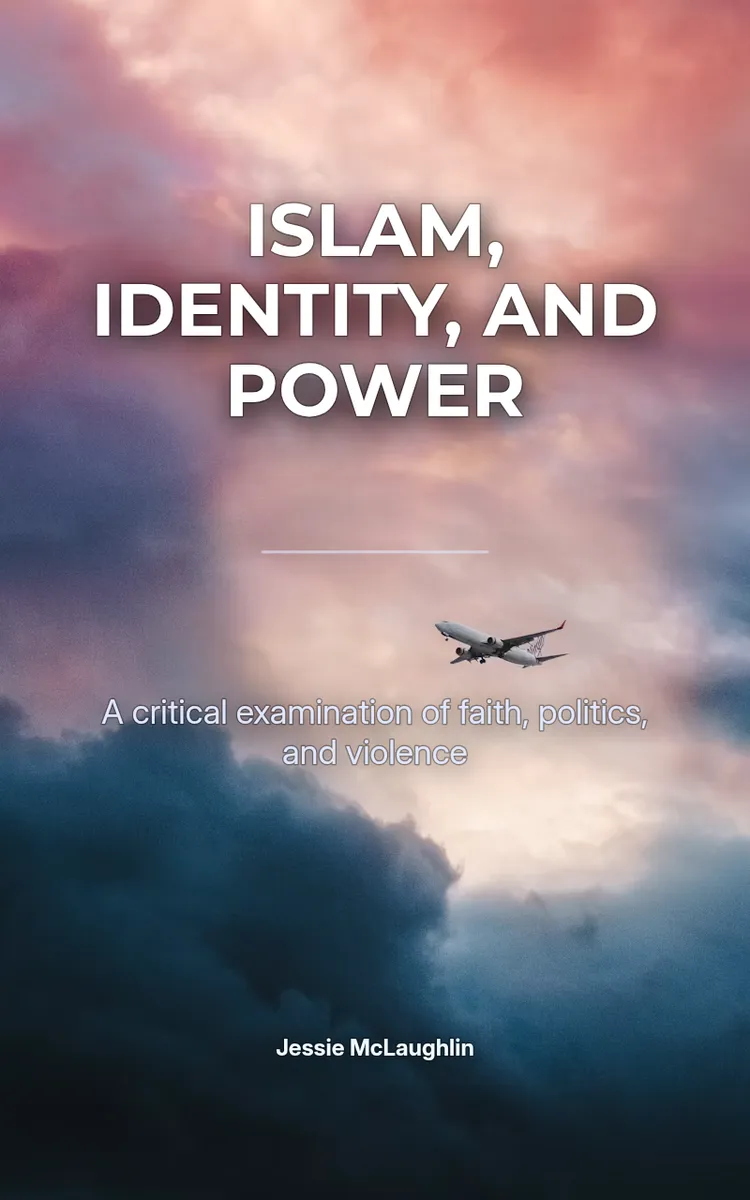
"Islam, Identity, And Power" is a nonfiction book by Jessie McLaughlin with 40 chapters and approximately 67,240 words. Islam as a way of life, Muslim and Islamist identities, and claims linking Islam to violence.
This book was created using Inkfluence AI, an AI-powered book generation platform that helps authors write, design, and publish complete books.
Frequently Asked Questions
What is "Islam, Identity, And Power" about?
Islam as a way of life, Muslim and Islamist identities, and claims linking Islam to violence
How many chapters are in "Islam, Identity, And Power"?
The book contains 40 chapters and approximately 67,240 words. Topics covered include Is Islam More Than a Religion?, Muslim, Islamist, or Something Else?, What the Word Jihad Actually Means, How Islam’s First Community Took Shape, and more.
Who wrote "Islam, Identity, And Power"?
This book was written by Jessie McLaughlin and created using Inkfluence AI, an AI book generation platform that helps authors write, design, and publish books.
Write your own nonfiction book with AI
Describe your idea and Inkfluence writes the whole thing. Free to start.
Start writingCreated with Inkfluence AI


