
Read the first chapter
The whole of chapter one, free. About 9 min. Turn the pages with the arrows, your keyboard, or a swipe.
Chapter 1
Why the Open Road Calls
When the Desk Feels Smaller Than the World
At 8:57 on a Monday morning, a man can be seated, dressed, fed, and technically comfortable - and still feel as though something important has been left outside. The strange part is that the discomfort may have little to do with laziness or dislike of work. It may come from work that asks the body to remain almost perfectly still while the mind performs tasks with no visible edge, weight, distance, or consequence.
For some men, a day spent repairing a roof, guiding a boat, servicing machinery, or crossing a landscape produces a kind of tiredness that feels satisfying. A day spent moving documents between windows can produce a different fatigue: less physical, but not necessarily less real. The distinction is not a simple one between “hard work” and “easy work.” It concerns movement, novelty, risk, usefulness, and the ability to see what one’s effort has changed.
The Motion-Meaning Map offers a way to examine that distinction without reducing men to a single biological script. It follows the meeting point between inherited tendencies and modern surroundings: bodies shaped by motion, cultures that praise particular forms of masculinity, and workplaces that often separate effort from its visible result.
Why can a demanding day in the open feel more restful than an undemanding day in a chair?
A Body Built to Notice Change
Human beings did not evolve in offices. For most of our species’ history, useful work involved walking, carrying, climbing, tracking, making, repairing, and responding to conditions that changed from hour to hour. The exact tasks varied enormously across time and place, but the pattern was consistent: attention was tied to movement, and movement was tied to consequences.
A person gathering food had to read weather, terrain, animal behavior, and the condition of the group. A person making a shelter worked with materials that resisted, broke, or fitted together. A person traveling through unfamiliar country had to judge distance and direction. These activities were not “adventure” in the modern recreational sense. They were ordinary demands of staying alive. Yet they gave effort a clear shape. A decision could alter the next hour. A tool either worked or it did not. A destination was reached, or it was not.
Modern desk work often removes those immediate signals. The body remains in one place while the mind handles abstractions: schedules, files, messages, projections, and digital systems. Such work can be difficult and consequential, but its results may be delayed, distributed, or invisible. A completed repair has a before and after. A completed spreadsheet may simply generate another spreadsheet.
Biology does not dictate a man’s occupation, but it helps explain why certain conditions feel engaging. The brain is highly responsive to novelty and uncertainty because changing surroundings may contain both opportunity and danger. Movement supplies information. Muscles, balance, vision, and hearing continuously report what is happening. A trail changes underfoot; a machine vibrates differently; a customer points to the precise place where a fault occurs. The body is not merely transporting the worker to the task. It is part of the measuring equipment.
That is one reason active work can absorb attention so completely. It joins thought to sensation. A mechanic does not only remember a procedure; he hears an engine’s uneven rhythm and feels resistance through a wrench. A builder does not only calculate dimensions; he handles timber, checks a corner, and watches the structure take form. The work becomes a conversation between intention and material.
Why Novelty Has a Pull
Predictability is useful until it becomes indistinguishable from repetition. The human nervous system saves energy by becoming efficient at familiar tasks, but efficiency can carry a cost: familiar surroundings demand less of conscious attention. A route driven every day becomes a blur. A sequence of office tasks can become similarly automatic, even when it requires intelligence.
Novelty interrupts that automation. It changes the information arriving from the world and forces attention back into the present. This helps explain the appeal of unfamiliar roads, new tools, changing weather, and work sites that never quite repeat themselves. Novelty is not always pleasant. It can produce uncertainty, inconvenience, or fear. But it also restores a sense that one’s decisions matter now rather than later.
Adventure, in this sense, is not limited to dramatic expeditions. A long-distance truck driver dealing with a closed mountain pass, a fishing crew reading a sudden change in wind, and a utility worker tracing a fault after a storm all face different levels of risk, but they share a structure: the environment answers back. The task cannot be completed by following a script alone.
A surprising single-sentence fact captures the difference: many forms of skilled manual work are acts of continuous prediction.
The carpenter predicts how wood will behave when cut. The plumber predicts where pressure is being lost. The farmer predicts how soil, rain, and timing will interact. The result depends on observation as much as on strength. This is why describing active men as merely “restless” misses the point. Their preference may involve a demand for richer feedback - a world that provides enough resistance and variation to keep perception awake.
Culture then gives these preferences names and status. In many societies, men have been encouraged toward occupations involving tools, transport, exploration, construction, and physical protection. Those expectations can open doors, but they can also narrow them. A boy who enjoys taking apart engines may be praised as practical; a boy who enjoys careful administrative work may receive less recognition for the same concentration. The attraction to active work is therefore never purely biological. It is interpreted through stories about what men are supposed to be.
The Work That Leaves a Mark
The strongest pull of active work may not be motion by itself. It may be the combination of motion and visible consequence.
Consider the difference between maintaining a road and monitoring a digital dashboard. Both may require vigilance and technical judgment. The road worker sees damaged surfaces, heavy equipment, changing traffic, and the finished stretch of pavement. The dashboard operator may prevent a serious failure without ever seeing the system’s users or the moment of success. One job is not inherently more valuable. They simply offer different forms of feedback.
Purpose becomes easier to feel when effort is connected to a person, place, or object that can be observed. The electrician restores power to a building. The welder joins two pieces of steel. The guide gets a group safely across difficult terrain. The result may not be glamorous, but it is legible. A man can point to it.
This legibility matters because identity is built partly through repeated evidence. People come to know themselves by seeing what they can affect. A worker who solves physical problems receives a steady stream of proof: the leak stops, the motor starts, the wall stands, the route opens. Desk work can provide the same satisfaction, but often through layers of delay and mediation. The connection between action and outcome is harder to see.
History is full of occupations organized around this direct relationship. The longshoreman, before containerization transformed ports, handled cargo piece by piece in a physically demanding rhythm. The railway mechanic worked beside machines whose scale and noise made their condition impossible to ignore. The forest ranger moved through a landscape where weather, fire, animals, and terrain continually altered the job. These roles differed in skill and danger, yet each placed a worker inside a changing physical system.
Containerization, introduced widely in the mid-twentieth century, offers a useful contrast. It made shipping faster, safer, and more efficient, while also moving much of the work away from the visible drama of individual cargo handling. Progress improved conditions for many workers, but it also changed what work felt like. Efficiency can remove needless hardship while removing some of the sensory evidence that once made a task feel substantial.
The Motion-Meaning Map is useful here because it separates three experiences that are often confused: moving through the world, encountering novelty, and seeing a meaningful result. A desk routine may contain one or two of them. A field job may contain all three. The attraction is not necessarily to exhaustion. It is to a fuller loop between body, attention, and consequence.
The Counterintuitive Cost of Comfort
The surprise is that comfort can make work feel less satisfying, not more. A controlled environment removes heat, cold, danger, and physical strain - but it can also remove the signals that tell the brain where effort has gone.
This does not mean hardship is secretly good or that dangerous work is more authentic. It means that the nervous system does not measure satisfaction by comfort alone. It also responds to engagement, variation, control, and feedback. A man may finish a physically difficult task feeling restored because the difficulty was clear and bounded. Another may finish a comfortable day mentally depleted because the demands were diffuse and never reached a natural stopping point.
The reframing matters. The question is not why some men reject easy work. It is why certain kinds of difficulty feel more coherent than certain kinds of ease. A predictable desk routine can be perfectly respectable and still fail to provide the movement, novelty, or visible consequence that gives another person’s work its charge.
This helps explain why men sometimes leave stable office positions for trades, transport, guiding, emergency services, or small businesses built around practical work. The change may look irrational from the outside. A salary, schedule, and climate-controlled room appear to offer security. Yet the new occupation may supply something the old one could not: a clear exchange between attention and outcome.
A Man, a Road, and a Different Kind of Day
The history of long-distance cycling offers a concrete example of this exchange. When Dervla Murphy set out from Ireland in 1963 to cycle to India, she carried little more than a bicycle, basic supplies, and a pistol for emergencies. Her journey crossed Europe, Afghanistan, Pakistan, and India at a time when long-distance travel required far more improvisation than it does today. The significance of the journey was not simply that she covered thousands of miles. Each day joined physical effort to navigation, weather, mechanical problems, unfamiliar customs, and decisions that could not be postponed until a convenient meeting.
Murphy later wrote about travel with an attention to ordinary details: roads, food, borders, fatigue, hospitality, and the practical intelligence required to continue. Her account shows why adventure can feel meaningful without being theatrical. The landscape was not a backdrop. It was an active participant. A road surface affected speed; a broken part altered the plan; a conversation changed what was possible next.
Her experience also complicates the idea that men are uniquely drawn to movement and challenge. The underlying attractions - novelty, competence, consequence, and contact with the physical world - are human. What differs is how cultures distribute permission to pursue them. Men have often been granted more social approval for wandering, risk, mechanical work, and outdoor skill. The preference may be widespread, but the cultural story surrounding it is gendered.
That distinction is important for understanding men who feel out of place in sedentary work. Their dissatisfaction may reflect temperament, learned identity, economic opportunity, or some combination of all three. A man raised around engines and building sites may recognize himself in practical work because it matches both his body’s preferences and the people who taught him what competence looked like. Another may discover the same fit later, after years of being told that professional success means remaining indoors and available to a screen.
The road, then, is not magic. It is a setting in which several kinds of information arrive together. Distance can be measured, weather felt, tools handled, and progress seen. For some men, that density of feedback makes work feel less like an abstract obligation and more like participation in the world.
Human beings are not divided neatly into people who belong at desks and people who belong outdoors. They are creatures who seek patterns, but also respond to change; who value safety, but remain attentive to challenge; who want comfort, yet often need resistance to know what they are capable of affecting. Perhaps the open road calls because it offers no clean separation between movement and meaning - and because, somewhere beyond the next bend, the world may still have an answer.
End of chapter one. 39 more chapters and about 68,617 words in the full book.
Swipe or use the arrows to turn the page


What's inside: 40 chapters
- 1. Why the Open Road Calls
- 2. The Body Built for Effort
- 3. Risk That Feels Worth Taking
- 4. When Competence Becomes Identity
- 5. The Desk as a Status Trap
- 6. Testosterone Without the Myth
- 7. How Boys Learn to Compete
- 8. The First Job That Felt Real
- 9. Tools That Extend the Self
- 10. Why Visible Results Matter
- 11. The Pull of Unfinished Frontiers
- 12. Solitude Without Isolation
- 13. Brotherhood on the Hard Route
- 14. The Provider Story’s Hidden Cost
- 15. Danger as a Measure of Skill
- 16. Why Repetition Can Feel Deadening
- 17. The Craftsperson’s Quiet Pride
- 18. Adventure as a Reset Button
- 19. The Road Warrior’s Real Motive
- 20. Work That Leaves a Mark
- 21. The Biology of Boredom
- 22. Why Some Men Choose the Trades
- 23. The Entrepreneur’s Escape Hatch
- 24. Military Training and Male Identity
- 25. The Athlete’s Need for a Test
- 26. When Adventure Becomes Avoidance
- 27. The Desk Job That Works
- 28. Men Who Love Quiet Offices
- 29. The Care Work Men Overlook
- 30. What Screens Cannot Replace
- 31. The Cost of Proving Manhood
- 32. Age Changes the Adventure
- 33. Fatherhood Rewrites the Risk
- 34. Culture Draws the Map
- 35. Class Determines Who Gets Away
- 36. The Nature Prescription, Carefully
- 37. Designing a More Alive Workweek
- 38. Choosing Work Without a Script
- 39. A Better Measure of Success
- 40. The Open Road Is a Choice
About this book
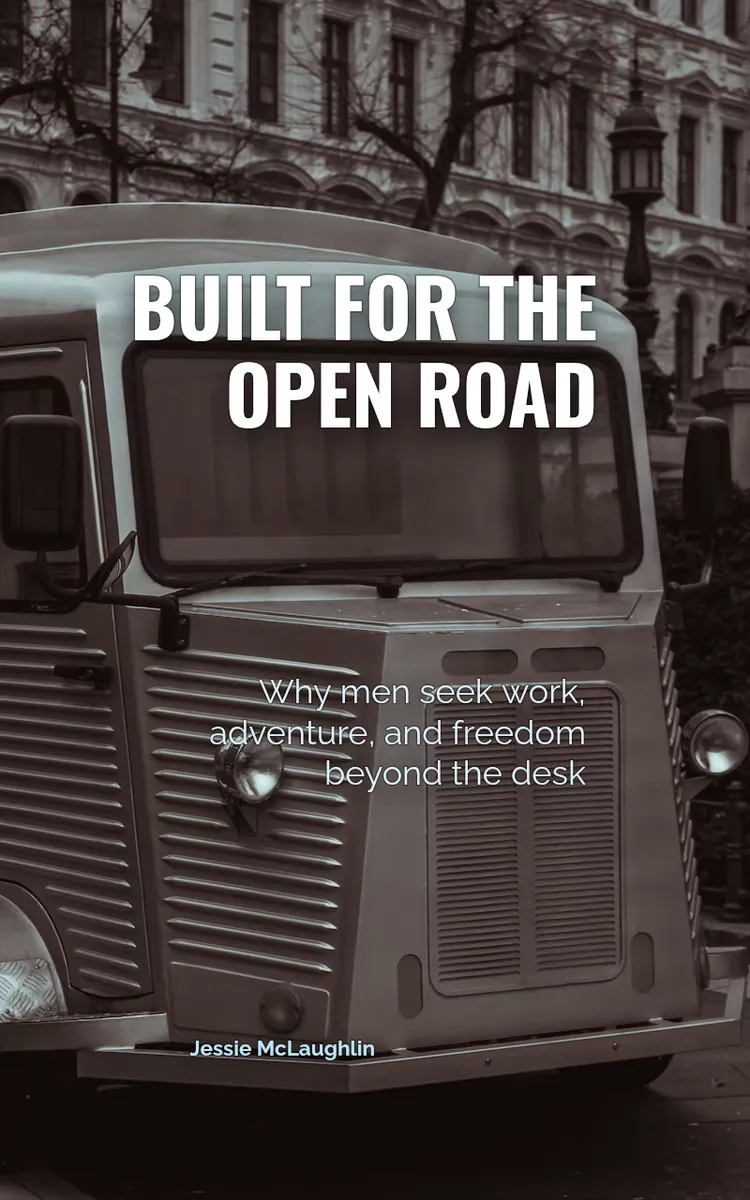
"Built For The Open Road" is a nonfiction book by Jessie McLaughlin with 40 chapters and approximately 68,617 words. Exploring male drives toward active work, adventure, and life beyond desk jobs.
This book was created using Inkfluence AI, an AI-powered book generation platform that helps authors write, design, and publish complete books.
Frequently Asked Questions
What is "Built For The Open Road" about?
Exploring male drives toward active work, adventure, and life beyond desk jobs
How many chapters are in "Built For The Open Road"?
The book contains 40 chapters and approximately 68,617 words. Topics covered include Why the Open Road Calls, The Body Built for Effort, Risk That Feels Worth Taking, When Competence Becomes Identity, and more.
Who wrote "Built For The Open Road"?
This book was written by Jessie McLaughlin and created using Inkfluence AI, an AI book generation platform that helps authors write, design, and publish books.
Write your own nonfiction book with AI
Describe your idea and Inkfluence writes the whole thing. Free to start.
Start writingCreated with Inkfluence AI


