

Read the first chapter
The whole of chapter one, free. About 7 min. Turn the pages with the arrows, your keyboard, or a swipe.
Chapter 1
The Music Box’s Hidden Drawer
The music box played one wrong note.
Edith Vale stopped winding it at once, her fingers resting lightly on the brass key. Outside Vale Antiques, rain ticked against the front windows and blurred the village green into a wash of silver, but inside the crowded shop every clock seemed to pause and listen.
The box sat on a square of brown paper beneath the green-shaded lamp. It was a handsome little thing, rosewood darkened by age, with a painted spray of forget-me-nots on its lid and a brass plaque set into the front. The plaque had lost most of its engraving. Only two letters remained clear.
L. Q.
Edith bent closer. At eighty, she no longer apologised for using a magnifying glass. She lifted it from beside the jeweller’s scales and examined the worn corners, the tiny brass feet, the hairline scratches around the lock.
“Come on,” she murmured. “Tell me what you are.”
The donation had arrived less than an hour earlier in a cardboard box carried by a nervous young man who had given his name as Peter Marsh. He had claimed the music box belonged to his late aunt and that he knew nothing of its history. Edith had believed only the first half of that statement.
Now she wanted a proper identification before she entered it in the shop ledger. The mechanism mattered. A replacement comb, a later lid, a repaired hinge - each detail could alter its value and its story. She had no intention of forcing the lock or prising up the lid like an impatient dealer at a car-boot sale.
The music began again when she turned the key. A thin, melancholy waltz trembled into the shop. One note faltered, then rang sharp.
Edith frowned.
She carried the box to her worktable, past a walnut barometer, a row of silver-backed brushes and the great oak clock that had belonged to her father. Rain tapped harder on the glass roof over the rear passage. She switched on the green lamp and drew the blind across the workroom door, shutting out the view of the shop.
A small screwdriver lay in its velvet-lined tray. Edith selected it, then ran her thumb beneath the box’s lower edge. The base was veneered in the same rosewood as the sides, but the grain did not quite meet at the back corner.
“False,” she said.
She fetched a wooden probe and worked it into the narrow seam. Nothing moved. The box was stubborn, or the compartment was not meant to be found by anyone without patience. Edith tried the corner near the left rear foot, then the brass plate beneath the mechanism. A faint click answered her.
The false base dropped half an inch.
Edith did not breathe for a moment.
Inside the shallow cavity lay a yellowed photograph folded around a small iron key. The key had been wrapped in blue thread, now faded almost grey. Its bow bore three scratched initials.
E.M.Q.
Edith lifted both objects with tweezers. The photograph showed the village green in summer, though the image had faded at the edges. A group of young people stood before the lych-gate of St Matthew’s Church. One girl had turned away from the camera. Beside her stood a dark-haired young man in a cricket jumper.
On the reverse, in brown ink, someone had written a date.
17 August 1968.
Edith knew the date. Everyone in Ashcombe knew it, though people spoke of it in lowered voices and never agreed about what had happened.
Eleanor May Quince had disappeared that evening.
She had been nineteen, the only daughter of the Quince family, and had vanished after leaving the harvest dance at the village hall. Her bicycle had been found beside the old mill road. No body had ever been recovered. The police had searched the river, the churchyard and the abandoned glasshouse at Ashcombe Hall. Lionel Quince, Eleanor’s younger brother, had spent half his life insisting that she had not run away.
Edith looked again at the initials on the key.
E.M.Q.
A floorboard creaked in the shop.
She lowered the photograph.
“Peter?” she called.
No answer came. A clock chimed eleven, its sound too bright for the damp afternoon.
Edith slipped the key into her palm and moved towards the workroom door. Through the narrow gap beneath the blind she saw no one, only the familiar clutter of cabinets and chairs. The front door remained locked. A wet umbrella leaned against the counter, though she did not remember hearing the bell above the door.
She opened the door fully.
“Is someone there?”
The shop gave back the soft tick of its clocks. A draught stirred the lace curtain beside the front window. On the counter, Peter Marsh’s receipt lay where she had left it.
Edith crossed to the umbrella. It was black, old-fashioned and dripping onto the flagstones. A silver ferrule bore a small engraved crown.
She did not touch it.
The bell above the front door rang.
Constable Daniel Reed stepped inside, rain shining on his dark coat. He was younger than Edith’s son would have been, had she ever had one, but he possessed the careful expression of a man who had learned that bad news was best delivered plainly.
“Mrs Vale,” he said.
“Constable.” She glanced at the umbrella. “I hope you haven’t come about that.”
His eyes followed hers, and his face tightened.
“No. I’ve come about Lionel Quince.”
Edith’s hand closed around the iron key.
“What has happened to him?”
Reed removed his cap. Water darkened his hair. “He was found dead in the records room at Ashcombe Hall this morning.”
For a moment, only the rain spoke.
“Dead how?”
“We’re treating it as suspicious. Dr Patel hasn’t completed the examination, but there was an injury to the back of his head. The room had been searched. Papers scattered, drawers pulled out.”
“Was anything taken?”
“That’s what we’re trying to establish.”
Edith looked down at the photograph. The young man in the cricket jumper had Lionel’s eyes, though the Lionel she knew had been a silver-haired historian with a stoop and a habit of correcting people’s dates.
“Why come here?” she asked.
Reed’s gaze moved to the music box on the worktable. “Mr Quince spoke to you yesterday, didn’t he?”
“About an appraisal. He brought me a ledger from Ashcombe Hall.”
“He told Sergeant Bell he intended to visit you today.”
“He did not say so to me.”
“Did he leave anything?”
The question settled between them with uncomfortable weight.
Edith considered lying. She had spent a lifetime protecting objects from careless hands, and she knew how quickly an old clue could become evidence, gossip or bait. But the photograph and key had not been in her possession when Lionel was alive. If they were connected to him, the connection might already have cost him his life.
She placed the photograph on the worktable but kept the key concealed between her fingers.
“I’ve found something,” she said. “Inside the music box.”
Reed stepped nearer. “What sort of something?”
“A compartment. A photograph. A key marked with Eleanor Quince’s initials.”
His expression changed.
“You’re certain?”
“I can read, Constable.”
“May I see the key?”
Edith hesitated. The umbrella stood beside the door. Whoever had left it might still be watching the shop through the rain-streaked window. She had no proof, only instinct, but instinct had saved her from more than one fraudulent Georgian commode.
Before she could answer, the lights went out.
The clocks stopped together.
Reed reached for his torch. Edith heard the scrape of his shoes, then a sharp crash from the rear of the shop.
“Stay here,” he said.
“I’m eighty, not ornamental.”
She took the heavy brass candlestick from the counter and followed him through the dark. The torch beam swept across cabinets, paintings and hanging coats. At the back door, the bolt remained in place. A pane in the side window had been pushed open, letting in a blade of cold rain.
The workroom door stood ajar.
Edith hurried to the table.
The photograph was still there.
The music box was not.
Reed swung the torch towards the shelves. “Where was it?”
“On that table.”
“Could someone have taken it when the lights went out?”
“Someone did.”
The rain blew through the open window, spotting the photograph. Edith snatched it up. On its reverse, beneath the date, a second line had emerged where damp had darkened the paper.
L.Q.
Not Lionel Quince’s full initials. His signature, perhaps. Or a warning.
Reed examined the window latch. “No footprints outside. The ground’s too wet. Whoever came in knew the shop.”
“Or had been here before.”
He looked at her. “Who donated the box?”
“Peter Marsh. Though I doubt that is his real concern.”
“And the key?”
Edith opened her hand.
The iron key lay against her palm, cold and black, its initials unmistakable.
E.M.Q.
Reed reached for it. Edith allowed him to take it, but her eyes remained on the empty square of dust where the music box had rested.
Someone had entered her locked workroom while a constable stood in her shop.
Someone had known exactly what to remove.
And whoever it was now knew that Edith Vale had seen what the box contained.
End of chapter one. 16 more chapters in the full book.
Swipe or use the arrows to turn the page


What's inside: 17 chapters
- 1. The Music Box’s Hidden Drawer
- 2. A Murder on the Green
- 3. The Photograph with Two Faces
- 4. The Locked Estate Archive
- 5. The Appraiser’s Promise
- 6. The Clock That Stopped
- 7. The Key Beneath the Yew
- 8. The Garden Wall’s Secret
- 9. The Heirloom Was Never Lost
- 10. A Name in the Ledger
- 11. The Donor’s False Story
- 12. The Letter That Names a Witness
- 13. The Truth Edith Feared
- 14. The Flooded Mill Path
- 15. The Tune at Wren Hall
- 16. The Letters Returned
- 17. A New Place in the Cabinet
About this book
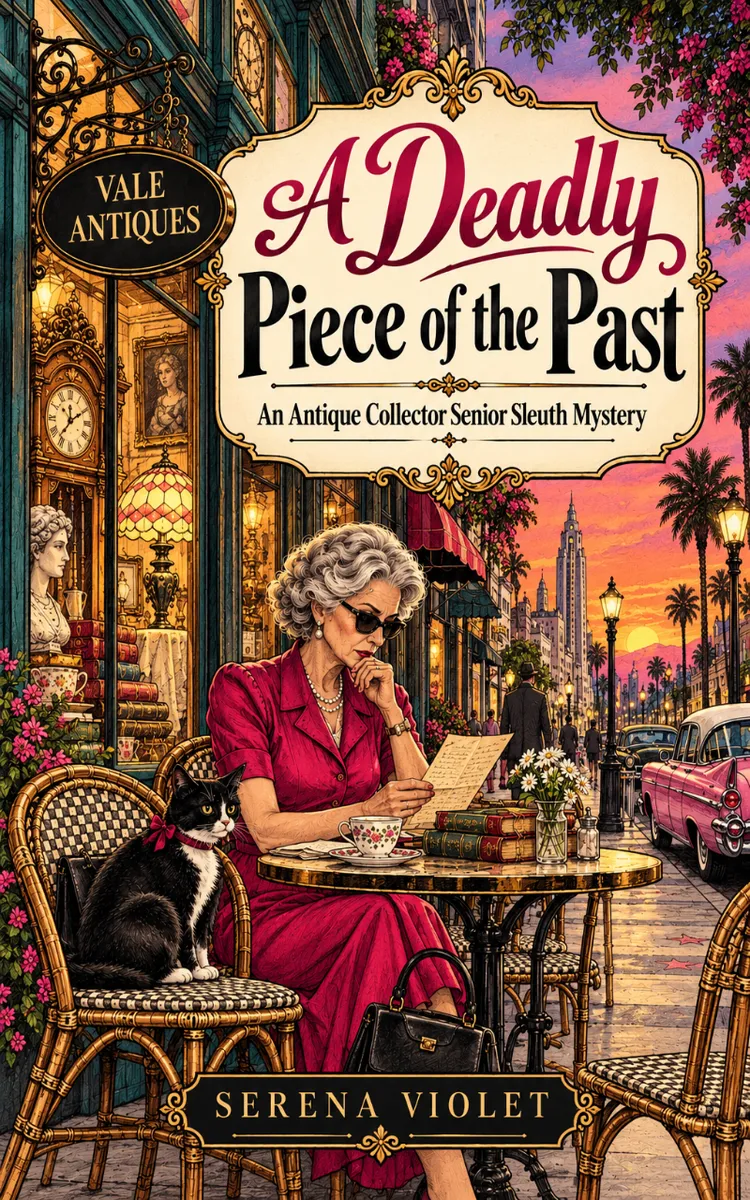
"A Deadly Piece Of The Past" is a fiction book by Serena Violet with 17 chapters and approximately 31,228 words. An elderly antique appraiser uncovers a village secret linked to a new crime.
This book was created using Inkfluence AI, an AI-powered book generation platform that helps authors write, design, and publish complete books. It was made with the AI Novel Writer.
Frequently Asked Questions
What is "A Deadly Piece Of The Past" about?
An elderly antique appraiser uncovers a village secret linked to a new crime
How many chapters are in "A Deadly Piece Of The Past"?
The book contains 17 chapters and approximately 31,228 words. Topics covered include The Music Box’s Hidden Drawer, A Murder on the Green, The Photograph with Two Faces, The Locked Estate Archive, and more.
Who wrote "A Deadly Piece Of The Past"?
This book was written by Serena Violet and created using Inkfluence AI, an AI book generation platform that helps authors write, design, and publish books.
How can I create a similar fiction book?
You can create your own fiction book using Inkfluence AI. Describe your idea, choose your style, and the AI writes the full book for you. It's free to start.
Write your own fiction book with AI
Describe your idea and Inkfluence writes the whole thing. Free to start.
Start writingCreated with Inkfluence AI


