

Read the first chapter
The whole of chapter one, free. About 7 min. Turn the pages with the arrows, your keyboard, or a swipe.
Chapter 1
The Chamomile Cup
The green wall clock in Willowmere’s craft room had stopped at 2:17, but the knitting circle carried on as if time were merely another nuisance to be discussed over tea.
“It is not lavender,” Mabel Hart declared, tugging a loop of cream wool through her needles. “It is the color of a respectable bruise.”
Across the table, June Pritchard peered at the yarn in question. “It’s mauve.”
“Mauve is lavender after a divorce.”
“That explains why you dislike it.”
Mabel gave her a look over the top of her spectacles. The room answered with chuckles, the soft click of needles, and the snip of someone’s crochet hook catching a button. Outside the tall windows, February rain silvered the garden paths. Inside, the craft room glowed with the familiar comfort of old things: oak cabinets, faded floral curtains, and a mustard-colored radio playing a song from 1974 that had survived both disco and three changes of management.
Mabel had come for one purpose: to finish the cuff of her grandson’s sweater before he visited on Saturday and noticed that one sleeve was longer than the other. She had corrected the mistake twice already. The sweater was now developing a character of its own.
At the center of the table, Lillian Price lifted her teacup.
“Chamomile?” June asked.
“Doctor’s orders,” Lillian said. “Though Doctor Singh has never once ordered me to drink it. He merely suggested I avoid caffeine after six.”
“You interpret medical advice with the confidence of a politician,” said Beatrice Cobb, who was crocheting a green afghan large enough to shelter a small family.
Lillian smiled and took a sip.
Mabel glanced toward the tea trolley. The pot sat beside a plate of lemon biscuits, its knitted cozy patterned with cheerful yellow ducks. Nora Bell, the activities coordinator, had brought it in ten minutes earlier and complained that the trolley’s wheel squeaked like a mouse with a grievance. Nothing about the afternoon had seemed unusual. Even the argument over the radio had been routine.
Then Lillian’s cup struck the saucer.
The sharp porcelain click silenced every needle.
Lillian pressed a hand to her throat. “That tea - ”
Mabel was already pushing back her chair. “Lillian?”
Lillian’s face had gone gray beneath her powder. She tried to stand, caught the edge of the table, and sent a row of yarn baskets wobbling.
June grabbed her elbow. Beatrice caught the teapot. Mabel reached across the table and swept the knitting needles away before they could jab anyone.
“Sit down,” Mabel said. “That’s not a request.”
Lillian sank into her chair, breathing in small, frightened pulls. Her fingers trembled against her cardigan.
“It burns,” she whispered. “My mouth. My chest.”
Nora hurried from the doorway. “What happened?”
“She’s having some sort of reaction,” June said.
“To the tea,” Lillian managed. “It was fine a moment ago.”
Mabel took the cup from her hand and set it well out of reach. The tea trembled inside it, pale gold and innocent-looking. That was the trouble with dangerous things, in Mabel’s experience. They rarely announced themselves. Poison did not arrive wearing a black cape. It came in teacups, envelopes, and occasionally the voice of a woman claiming not to have moved your scissors.
“Call emergency services,” Mabel said.
Nora fumbled for her phone. “I’m calling.”
“Tell them she’s having trouble breathing.”
“I can breathe,” Lillian protested.
“Poorly,” Mabel said. “Let’s not split hairs while your lungs are making a formal complaint.”
The room broke apart into motion. June brought a cushion. Beatrice opened the window, letting in a blade of cold air and the distant clatter of a grounds cart. Someone knocked over a bowl of buttons. Tiny plastic flowers scattered across the floor.
Mabel knelt beside Lillian’s chair. Her own knees objected, but she ignored them. Lillian’s skin was clammy beneath Mabel’s fingertips.
“What did you eat?” Mabel asked.
“Half a biscuit.”
“Which half?”
“The left.”
“Lillian.”
“I don’t know.” Lillian shut her eyes. “The tea was harmless. I poured it myself.”
Mabel looked at the cup. “Did you?”
Lillian opened her eyes, offended even through the pain. “I poured tea into my cup.”
“That wasn’t my question.”
For a moment, Lillian seemed ready to argue. Then her gaze flicked toward the trolley. “Nora brought the pot.”
“I set it down,” Nora said, voice thin. “Everyone saw me.”
“We saw you carry it,” June replied. “That is not quite the same thing.”
“Nobody is accusing anybody,” Beatrice said, though she had stopped crocheting.
Mabel heard the lie settle over the table.
The paramedics arrived with brisk shoes and heavy bags. One knelt beside Lillian while the other asked questions. Allergies. Medication. Symptoms. Mabel moved aside, but not far. She watched Lillian’s hands, Nora’s face, and the tea trolley.
The craft room had become a place she no longer recognized. A minute earlier, it had been all soft yarn and old jokes. Now the biscuits sat untouched, the radio sang cheerfully about a Saturday night, and every object seemed to possess a hiding place.
“Was the teapot ever unattended?” the taller paramedic asked.
Nora shook her head. “Not really.”
“Not really?” Mabel repeated.
Nora looked at her. “I put it on the trolley in the kitchenette. Then I fetched the cups.”
“How long?”
“Perhaps a minute.”
“Perhaps?”
“Mabel,” June warned.
Mabel ignored her. “Who was in the kitchenette?”
“Nobody,” Nora said.
“I was,” Beatrice replied.
Every head turned.
Beatrice’s crochet hook hung motionless in her hand. “I went in for more napkins. I did not touch the tea.”
“You were gone long enough to make a cup of coffee,” June said.
“I was looking for the napkins.”
“They were on the shelf beside the biscuits.”
“I know that now.”
A paramedic asked Beatrice to step away from the trolley. She did so, chin lifted, but her face had lost its usual color.
Lillian suddenly coughed. The paramedic leaned close, and Mabel felt the room contract around the sound.
“Is she going to be all right?” June asked.
“We’re treating her and taking her in,” the paramedic said. “The hospital will run tests.”
“Tests for what?” Nora asked.
The paramedic glanced at the cup. “We don’t know yet.”
Mabel did.
Not for certain. She was not a physician, and she had no appetite for drama disguised as expertise. But Lillian had drunk chamomile tea for years. She had once called it “warm dishwater with ambitions” and consumed it nightly anyway. A sudden burning throat, trembling hands, and gray skin did not sound like a disagreement with a biscuit.
The taller paramedic lifted the cup with a gloved hand. “Has anyone else had tea?”
“No,” June said.
“Anyone eat the biscuits?”
“Not yet,” said Beatrice.
“Then don’t.”
The instruction landed heavily.
Lillian was placed on the stretcher. As the paramedics wheeled her toward the door, she caught Mabel’s wrist.
“Don’t let them say I was careless,” she whispered.
Mabel bent close. “You once mailed a birthday card to yourself.”
“It was addressed correctly.”
“It arrived three days late.”
Lillian’s mouth twitched, but fear returned before the smile could form. “The tea was fine when I poured it.”
“I heard you.”
“No one touched my cup.”
Mabel looked toward the table. “Are you certain?”
Lillian’s eyes shifted past her.
That tiny movement troubled Mabel more than the words.
The paramedics took Lillian into the hall. The wheels squeaked over the threshold, a small, persistent sound like the trolley’s complaint. June followed two steps before Nora stopped her.
“Give them room,” Nora said.
“We should go with her.”
“They’ll call us when they know something.”
Mabel remained beside the table. Her fingers itched for her magnifying glass, which was in her handbag beneath a packet of peppermints and a receipt she had been carrying since October. She did not fetch it. Not yet.
The craft room had gone very still.
June stared at the tea. “It could be an allergy.”
“To chamomile?” Beatrice asked.
“People are allergic to astonishing things. I knew a woman who couldn’t tolerate wool.”
“She joined a knitting circle?” Mabel said.
“She was optimistic.”
Nora moved to clear the biscuits. “We should throw everything away.”
“No,” Mabel said.
Nora stopped. “Why not?”
“Because if something made Lillian ill, throwing it away would be the least helpful thing we could do.”
Nora’s hand tightened around the plate. “You think someone poisoned her?”
The word seemed to darken the room.
Mabel looked at Lillian’s cup. “I think we should wait until someone qualified tells us what happened.”
“That is not the same thing,” June murmured.
“No,” Mabel said. “It isn’t.”
She bent to retrieve the scattered buttons. One had rolled beneath the tea trolley. As she reached for it, a glint of blue caught her eye.
Something was snagged beneath Lillian’s saucer.
Mabel leaned closer.
A short blue fiber stretched from the saucer’s underside to the polished wood, fine as a strand of embroidery thread. It was not from Lillian’s cardigan, which was burgundy. Nor from Mabel’s cream wool, June’s lavender, or Beatrice’s green afghan.
She did not touch it.
Behind her, a staff member hurried into the room, followed by another. “Everyone step away from the table,” the first one said. “No one touches the cups, the pot, or anything else.”
Mabel straightened slowly.
The blue fiber quivered beneath the saucer, bright against the dark wood.
She had come to finish a sweater cuff.
Now she could not stop wondering who had carried that thread into the room - and why it had caught beneath Lillian’s cup.
End of chapter one. 14 more chapters in the full book.
Swipe or use the arrows to turn the page


What's inside: 15 chapters
- 1. The Chamomile Cup
- 2. A Circle Under Suspicion
- 3. The Missing Blue Skein
- 4. The Locked Garden Gate
- 5. The Pattern She Kept
- 6. The Anniversary Exhibition
- 7. The House with the Orange Phone
- 8. The Cupboard Inventory
- 9. A Grandmother’s Blind Spot
- 10. The Crochet Bag Switch
- 11. The Empty Needle Case
- 12. The Knot That Lies
- 13. The Shawl in the Bell Tower
- 14. The Pattern Returned
- 15. Tea After the Storm
About this book
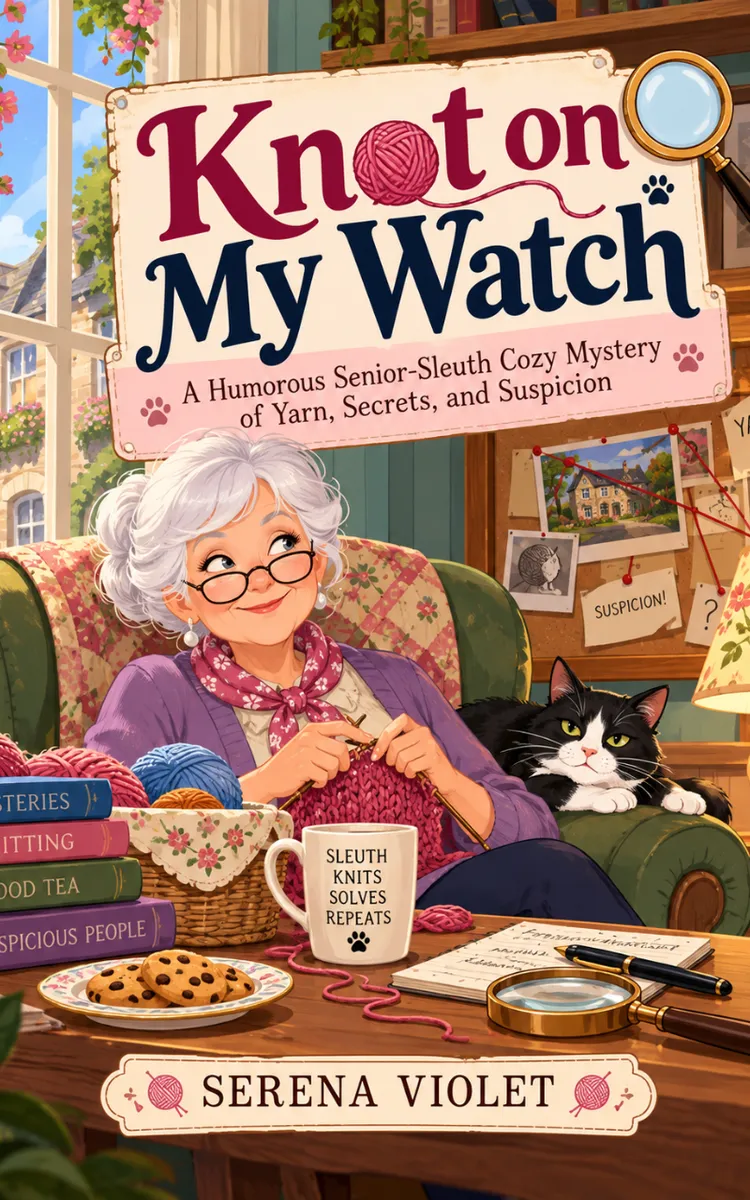
"Knot On My Watch" is a fiction book by Serena Violet with 15 chapters and approximately 27,034 words. A senior crafting circle investigates a poisoning and murder in its retirement community.
This book was created using Inkfluence AI, an AI-powered book generation platform that helps authors write, design, and publish complete books. It was made with the AI Novel Writer.
Frequently Asked Questions
What is "Knot On My Watch" about?
A senior crafting circle investigates a poisoning and murder in its retirement community
How many chapters are in "Knot On My Watch"?
The book contains 15 chapters and approximately 27,034 words. Topics covered include The Chamomile Cup, A Circle Under Suspicion, The Missing Blue Skein, The Locked Garden Gate, and more.
Who wrote "Knot On My Watch"?
This book was written by Serena Violet and created using Inkfluence AI, an AI book generation platform that helps authors write, design, and publish books.
How can I create a similar fiction book?
You can create your own fiction book using Inkfluence AI. Describe your idea, choose your style, and the AI writes the full book for you. It's free to start.
Write your own fiction book with AI
Describe your idea and Inkfluence writes the whole thing. Free to start.
Start writingCreated with Inkfluence AI


