

Read the first chapter
The whole of chapter one, free. About 4 min. Turn the pages with the arrows, your keyboard, or a swipe.
Chapter 1
Weekly Pill Chart Layout Checklist
A missed dose shows up fast when you look at the week on one page. The quickest way to spot gaps is a clear weekly grid that matches your medication schedule, not a messy stack of notes. Nina, a 34-year-old shift nurse coordinator, learned this the hard way: after a busy double shift, her paper reminders didn’t line up with the days, and she had to re-check every evening record before she could feel confident.
Use the Weekly Grid Clarity Model to set up a printout that’s easy to read at a glance. This checklist helps you lay out the chart so daily doses fit cleanly across the week, with room for you to mark each day without crowding or guessing.
What This Helps You Do
This checklist helps you print a weekly pill chart that’s organized enough to track daily doses without confusion. It’s for anyone setting up a new chart or re-printing one when the layout feels cramped - especially when doses happen multiple times per day.
A good layout reduces second-guessing. For example, if your chart uses seven columns for Monday through Sunday and clear rows for each dose time, you can check “did I take the 2nd dose?” in seconds, not minutes.
Before You Start
Before you start filling anything in, get the physical setup and chart structure ready so the grid stays consistent across prints.
• Choose your chart type: once daily, twice daily, or multiple times daily - Pick the week start day that matches your routine (Monday or Sunday) - Confirm your dose times (example: 8:00 AM and 8:00 PM) - Decide how you will mark taken doses (circle, check mark, or ink dot) - Set aside a pen that does not smear on paper
If you’re using the printable weekly chart, verify you can fit the grid on one page. A common mistake is printing at “fit to page” that changes margins, then the boxes no longer line up with your writing. Do a quick test print on plain paper first, then switch to your final paper.
For Nina’s setup, she keeps her chart by the medication container and writes with a medium-tip pen. She also uses the same marking style every day, so the grid stays readable during shift changes.
Checklist Items
Page and Grid Setup
☐ Set the print scale to 100% (no “fit to page” changes). ☐ Confirm the paper size matches the chart (US Letter or A4). ☐ Leave room for headers at the top of the page. ☐ Keep the week grid on one page only. ☐ Use seven day columns, clearly labeled Monday through Sunday. ☐ Make dose-time rows match your exact schedule.
Box Clarity for Daily Doses
☐ Ensure each day has a separate box for each dose time. ☐ Use consistent box shapes for every dose row. ☐ Keep box spacing wide enough for a check mark. ☐ Avoid squeezing more than one dose mark into one box. ☐ Include a blank “Notes” area for missed or changed doses. ☐ Add a “Medication name” line at the top for quick ID.
Tracking Flow Across the Week
☐ Use the same marking method for every dose (check or circle). ☐ Mark taken doses right away to avoid end-of-day confusion. ☐ Leave empty boxes for doses you plan to take later. ☐ Circle or underline any skipped dose immediately. ☐ Write the reason in the Notes area only if needed.
Readability and Consistency
☐ Use bold or darker labels for dose times (example: AM/PM). ☐ Keep text sizes large enough to read from arm’s length. ☐ Use high-contrast ink (black or dark blue works best). ☐ Number dose rows if you take more than two per day. ☐ Check that margins do not cut off day labels or boxes.
Print-Test Checklist
☐ Print one test page and write one full day of marks. ☐ Confirm your pen fits inside the boxes without hitting edges. ☐ Re-print only after the test looks clean and readable.
A grid that’s even slightly off - tight margins, too-small boxes, or dose rows that don’t match your real times - creates a delay when you’re trying to verify your week quickly. That delay is exactly what this checklist removes.
Pro Tips
Use a simple “dose row rule” so your eyes never have to translate the chart. Put each dose time on its own row and keep the order the same across prints (for example, 8:00 AM row first, then 8:00 PM row). When you take three times daily, label the rows as 1, 2, and 3 to prevent mix-ups during busy mornings.
Do one quick measurement before your first real print: mark a check inside a box on the test page and ensure it lands comfortably in the center. If your check touches the box border, adjust the print scale or re-check margins. Nina found that one small print setting change stopped her from smudging at shift change, and it made the weekly review feel calm instead of rushed.
When your grid lines up with how you actually take your doses, the chart stops being a chore. It becomes a fast visual record you can trust at a glance, which sets you up to track week after week with less effort and fewer surprises.
End of chapter one. 4 more chapters in the full book.
Swipe or use the arrows to turn the page

The World In Chaos 6x9 Interior

When Everyone Else Has Moved On 8 5x11 196p REVISED v3

The Blind Spot of Reality EDITED Garamond 6x9
What's inside: 5 chapters
- 1. Weekly Pill Chart Layout Checklist
- 2. Medication Name and Dose Entry Checklist
- 3. Morning, Noon, Evening Marking Checklist
- 4. Missed Dose and Reschedule Checklist
- 5. Refill, Review, and Doctor Update Checklist
About this book
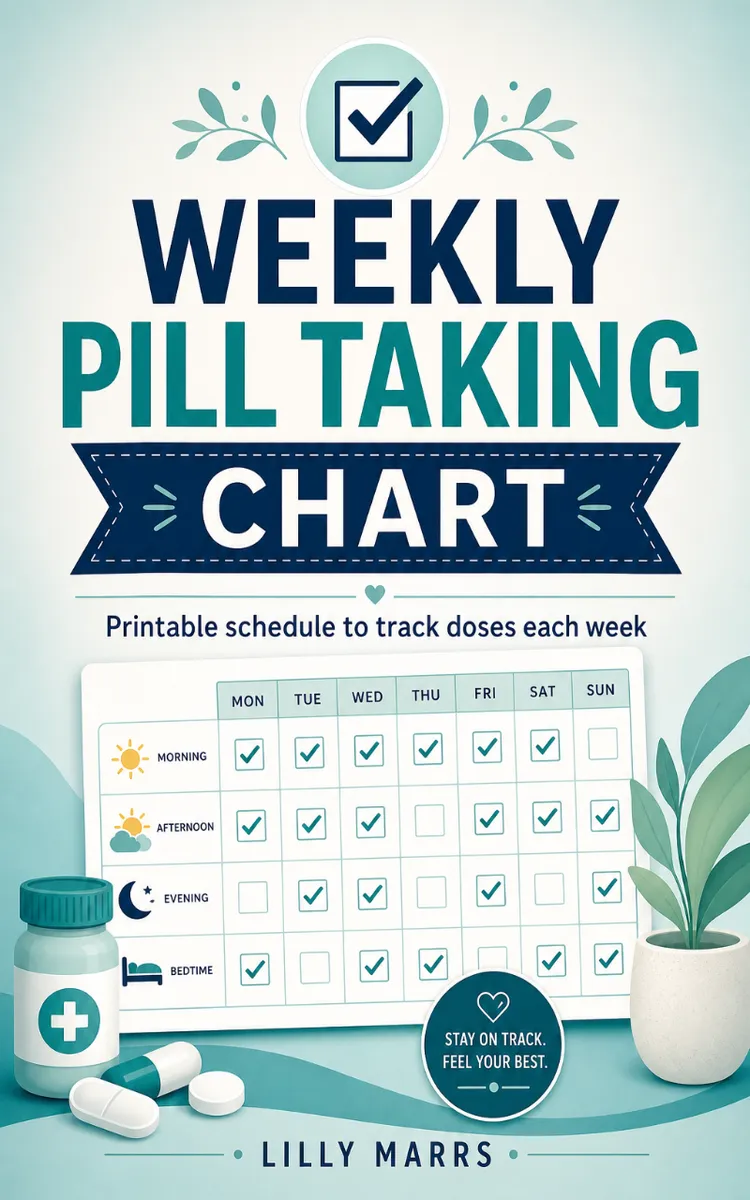
"Weekly Pill Taking Chart" is a checklist pack book by Lilly Marrs with 5 chapters and approximately 4,867 words. Printable weekly chart for tracking pill doses.
This book was created using Inkfluence AI, an AI-powered book generation platform that helps authors write, design, and publish complete books.
Frequently Asked Questions
What is "Weekly Pill Taking Chart" about?
Printable weekly chart for tracking pill doses
How many chapters are in "Weekly Pill Taking Chart"?
The book contains 5 chapters and approximately 4,867 words. Topics covered include Weekly Pill Chart Layout Checklist, Medication Name and Dose Entry Checklist, Morning, Noon, Evening Marking Checklist, Missed Dose and Reschedule Checklist, and more.
Who wrote "Weekly Pill Taking Chart"?
This book was written by Lilly Marrs and created using Inkfluence AI, an AI book generation platform that helps authors write, design, and publish books.
Write your own checklist pack book with AI
Describe your idea and Inkfluence writes the whole thing. Free to start.
Start writingCreated with Inkfluence AI


