
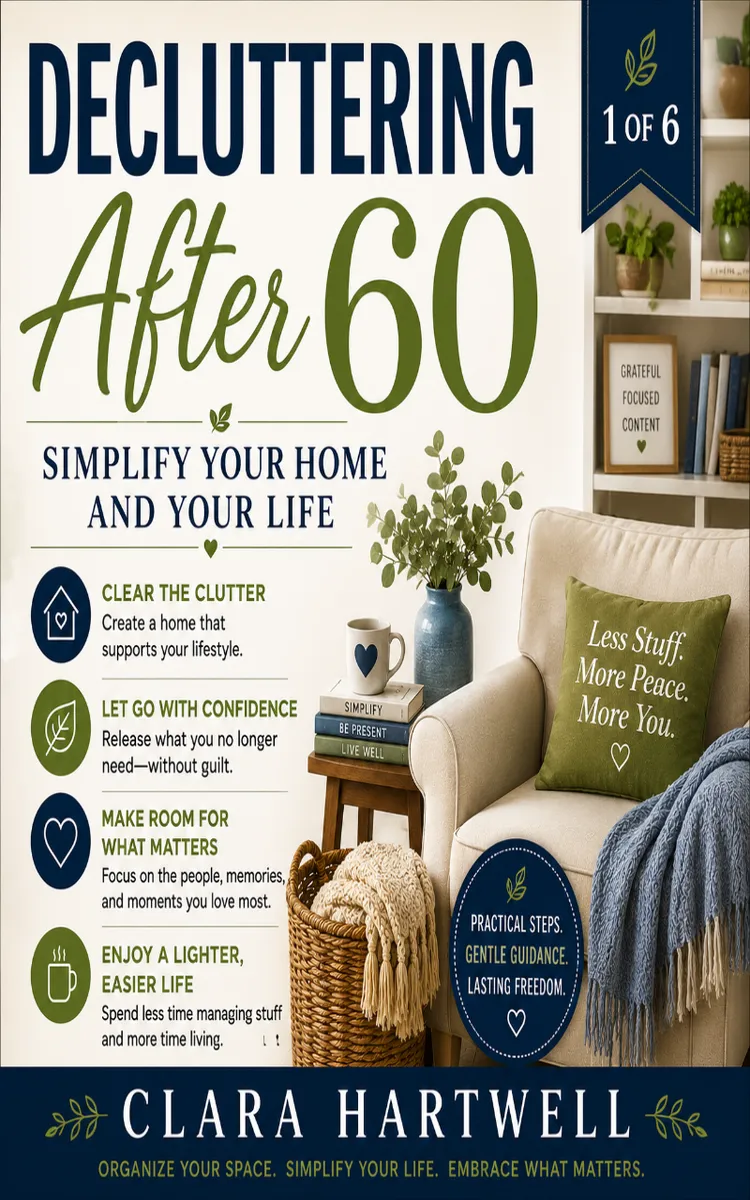
Decluttering After 60: Simplify Your Home and Your Life
Created with Inkfluence AI
Decluttering and organizing for people over 60 years old
Table of Contents
- 1. Reclaiming Identity Through Decluttering
- 2. Breaking the “Someday” Hoarding Cycle
- 3. Letting Go Without Regret Scripts
- 4. Designing Your Clutter-Free Zones
- 5. The 15-Minute Declutter Habit Loop
- 6. Sorting With the One-Touch Decision System
- 7. Choosing Storage That Works for Your Body
- 8. Building Boundaries Without Guilt
- 9. Resilience After Relapse Clutter Returns
- 10. Decluttering for Purpose and Peace
Preview: Reclaiming Identity Through Decluttering
A short excerpt from “Reclaiming Identity Through Decluttering”. The full book contains 10 chapters and 15,784 words.
When the Things Start Speaking for You
Ruth, 67, had retired from nursing and was still learning how quiet a house could feel after losing her husband. One Saturday morning, she opened the hall closet looking for a raincoat. Instead, she found three boxes of nursing uniforms, a chipped vase from their first apartment, and a stack of her husband’s old work shirts.
She stood there with the raincoat in her hand, unable to move. Each item seemed to ask a question: Who are you if you let me go? The uniforms reminded her of long shifts and grateful patients. The vase carried the memory of a young marriage. The shirts made the room feel less empty.
The closet wasn’t only holding objects. It was holding versions of Ruth.
What if your belongings are telling your story - but you’re ready to choose which parts speak for you now?
From “My Things Define Me” to “I Choose What Matters”
Old Belief: If I let go of meaningful things, I’m letting go of the person, work, love, or history connected to them.
New Reality: My memories and identity live in me; I can choose a few objects to honor them without asking every object to carry my life.
This shift matters because possessions often begin as reminders and slowly become evidence. The old uniform says, “You were a nurse.” The wedding dishes say, “You built a home.” The tools, books, photographs, and holiday decorations seem to prove that your life happened.
But you don’t need a crowded room to prove that you worked hard, loved deeply, or raised a family. You already know those things. The challenge is that an object can feel safer than a memory. A box of uniforms is solid. Your years of caring for patients are harder to hold in your hands.
Ruth could keep one nursing badge, one photograph, and perhaps a favorite uniform top. Those pieces might honor her service better than three boxes packed into a closet. The rest wouldn’t erase her nursing years. It would make room for Ruth as she is today - not only Ruth the nurse, Ruth the wife, or Ruth the person who kept everything because it might matter someday.
The Identity Ladder Reset helps you make that move. You begin at the bottom with the object, climb to the memory or role attached to it, and then reach the highest question: What matters to me now? The item may be worth keeping. It may not. Either way, the decision belongs to you.
The Identity Ladder Reset
Objects can quietly take over identity when we stop asking what they mean and start treating their presence as proof. A crowded closet may say, “I was useful.” A cabinet full of inherited dishes may say, “I’m a good daughter.” A drawer stuffed with old appointment cards may say, “I’m responsible.”
The Identity Ladder Reset separates the object from the meaning. When you pick something up, pause before deciding. Ask yourself three questions:
1. What is this object connected to?
Name the role, person, season, or achievement. Ruth’s uniforms were connected to her years as a nurse and the patients she cared for.
2. What feeling am I trying to protect?
Is it pride, love, security, belonging, or fear of forgetting? An honest answer might be, “I’m afraid that if I discard this shirt, my husband’s presence will feel even farther away.”
3. What do I choose to carry forward now?
Choose the value, not automatically the object. Ruth might carry forward compassion, steadiness, and service through one badge and a written memory.
This works because it gives your feelings a place at the table without giving them complete control. You’re not arguing with your memories. You’re making sure your memories don’t require every related object to stay.
Signs Your Belongings Are Running the Story
1. You keep something mainly because it proves you were once important, capable, or needed.
The object may no longer serve you, but releasing it feels like admitting that season is over.
2. You use the word “should” more than “choose.”
“I should keep my mother’s dishes” can hide a difficult question: “Do I actually want these dishes in my life?”
3. You feel guilty when an item doesn’t match your present life.
A retired nurse may no longer need six pairs of work shoes, yet letting them go can feel like disrespecting her working years.
4. You can explain every object’s history but can’t say what you want your home to support today.
The past has become very clear. The present has become crowded out.
Your belongings can honor who you were without deciding who you’re allowed to become.
Questions That Put You Back in the Choosing Seat
1. Which object in your home feels like proof of who you used to be?
It might be a business suit, a set of tools, old teaching materials, or a collection connected to a former hobby. Notice whether you love the object itself or the identity attached to it.
2....
About this book
"Decluttering After 60: Simplify Your Home and Your Life" is a self-help book by Clara Hartwell with 10 chapters and approximately 15,784 words. Decluttering and organizing for people over 60 years old.
This book was created using Inkfluence AI, an AI-powered book generation platform that helps authors write, design, and publish complete books. It was made with the AI Self-Help Book Writer.
Frequently Asked Questions
What is "Decluttering After 60: Simplify Your Home and Your Life" about?
Decluttering and organizing for people over 60 years old
How many chapters are in "Decluttering After 60: Simplify Your Home and Your Life"?
The book contains 10 chapters and approximately 15,784 words. Topics covered include Reclaiming Identity Through Decluttering, Breaking the “Someday” Hoarding Cycle, Letting Go Without Regret Scripts, Designing Your Clutter-Free Zones, and more.
Who wrote "Decluttering After 60: Simplify Your Home and Your Life"?
This book was written by Clara Hartwell and created using Inkfluence AI, an AI book generation platform that helps authors write, design, and publish books.
How can I create a similar self-help book?
You can create your own self-help book using Inkfluence AI. Describe your idea, choose your style, and the AI writes the full book for you. It's free to start.
Write your own self-help book with AI
Describe your idea and Inkfluence writes the whole thing. Free to start.
Start writingCreated with Inkfluence AI


