
Read the first chapter
The whole of chapter one, free. About 8 min. Turn the pages with the arrows, your keyboard, or a swipe.
Chapter 1
The Night Riders’ Secret Signals
A Light in the Window
A knock came after midnight, when most households in the postwar South had only darkness, candlelight, and the sound of insects between them and the road. If the men outside wore masks, carried firearms, and refused to identify themselves, a family had little chance of knowing whether it faced neighbors, soldiers, criminals, or an organized political force.
That uncertainty was not a side effect of Ku Klux Klan violence. It was one of its main instruments. After the Civil War, Klan riders turned concealment, rumor, and carefully timed visits into a system for controlling Black communities and intimidating white people who supported Reconstruction. Their clothing hid their identities; their threats traveled farther than their horses; their night raids made ordinary acts - opening a door, looking down a road, lighting a lamp - feel dangerous.
The Midnight Signal Map begins with a simple question: how did terror move through a community when the attackers wanted to remain unseen?
The Uniform of the Unknown
The Ku Klux Klan formed in Pulaski, Tennessee, in 1866, initially among former Confederate soldiers. Within a few years, related groups and imitators operated across much of the former Confederacy. Their targets included Black voters, teachers, officeholders, ministers, Union veterans, white Republicans, and people who helped formerly enslaved people claim the rights promised by emancipation.
The disguise was practical, but it was also theatrical. Riders often wore masks, robes, or clothing altered to make their bodies appear unfamiliar. Some covered their faces with cloth or painted them. Others used tall hats, sheets, or false beards. The purpose was not simply to avoid arrest. A masked attacker became harder to identify as a neighbor, employer, former soldier, or local official. The disguise turned a known person into an anonymous force.
That transformation mattered in rural places where social life depended on recognition. People knew the shape of a neighbor’s horse, the sound of a familiar voice, and the rhythm of a particular knock. Klan disguises disrupted that knowledge. A person who could be identified in daylight became unknowable at night, and the uncertainty encouraged victims to imagine that the threat was larger than the men actually present.
A costume can conceal a face. It can also manufacture a legend.
The riders’ clothing sometimes carried a supernatural suggestion. White robes and masks encouraged stories about ghosts, spirits, or the dead returning to punish the living. Such images drew on older folklore, but their political purpose was immediate. The Klan was not a supernatural power. It was a human organization using the appearance of the supernatural to make resistance seem useless and detection nearly impossible.
The effect depended on local knowledge. A Klan group did not need to frighten every person in a county directly. A single raid, followed by whispered descriptions of strange riders, could make many families wonder who might be involved and when the riders might return. Fear filled the gaps left by missing information.
Why Night Changed the Balance
Night raids gave the attackers several advantages at once. Darkness concealed numbers, clothing, and direction. It made horses and firearms difficult to distinguish until the riders were close. It also placed the burden of decision on the household inside: remain silent, answer the door, flee through a window, or risk confronting armed men.
For formerly enslaved people, the night had long carried complicated meanings. Enslaved labor had been controlled by bells, patrols, curfews, and passes. After emancipation, darkness could offer privacy and movement beyond white supervision. Klan raids sought to reverse that possibility. They entered homes, beat residents, fired weapons, destroyed property, and delivered warnings designed to control what people did during the day.
The threat often focused on public life. A Black man might be warned not to vote, testify, hold office, organize labor, attend a particular meeting, or support a Republican candidate. A teacher could be told to stop teaching Black children. A white resident might be threatened for renting land to Black families or assisting federal officials. The violence was therefore political even when the immediate scene looked personal.
The Klan’s night work also exploited a basic feature of human perception: darkness reduces reliable information while increasing attention to sudden sounds. A horse stopping outside, a boot on a porch, or a shot fired into the air could produce a powerful response before anyone understood what was happening. Fear is especially effective when it arrives before explanation.
One documented pattern appeared repeatedly in testimony gathered during congressional investigations: riders used threats and beatings not merely to punish a past act but to force future obedience. A victim was expected to carry the warning into the community. The raid became a message with a human delivery system.
In this way, the Klan’s violence resembled a crude communication network. The riders created the signal; the victim, often unwillingly, carried it onward.
The Midnight Signal Map
The Midnight Signal Map traces terror through four connected points: concealment, approach, command, and aftermath. These were not formal stages written in a manual, but they describe the structure visible across many accounts of Klan activity.
Concealment began before the riders reached a house. Masks and altered clothing protected identities. Groups sometimes traveled at night and chose isolated roads, making it harder for witnesses to follow them. The approach used silence, speed, or sudden noise. A quiet arrival could make the first knock seem unreal; a burst of gunfire could overwhelm the household before a demand was made.
The command was usually direct. Stop voting. Leave the county. Abandon a school. Withdraw a complaint. Produce a person. Keep silent. The wording varied, but the purpose was to establish the riders as an authority outside the law. They acted as judge, police force, and executioner while refusing to reveal who they were.
The aftermath extended beyond the damaged house. A victim might report the assault to local authorities and receive no protection, especially where sheriffs, magistrates, or jurors sympathized with the attackers. Even when federal officials intervened, identifying the masked men could be difficult. The lack of names became part of the weapon.
A surprising fact is that the Klan’s secrecy did not require perfect secrecy. Many communities suspected exactly who the riders were. What mattered was the gap between suspicion and proof. A neighbor could be recognized by his horse or voice and still escape conviction if witnesses could not safely testify or if local courts refused to act.
That gap changes how the violence should be understood. The mask was not always meant to make recognition impossible; it was meant to make recognition legally and socially unusable. Terror flourished where everyone knew and no one could safely say.
The federal government eventually responded with the Enforcement Acts, including the Ku Klux Klan Act of 1871. The law authorized federal action against conspiracies that deprived citizens of their rights, and President Ulysses S. Grant used those powers in South Carolina. Federal prosecutions and military intervention weakened the original Klan in some areas, but the broader culture of night riding, racial intimidation, and organized violence did not disappear. It changed form, location, and name.
The Schoolhouse, the Ballot, and the Door
The violence becomes clearest when connected to the institutions the riders sought to control. Reconstruction created new possibilities for Black political participation, education, landholding, and public office. Those possibilities were visible in courthouses, churches, schools, and polling places. Klan raids reached into each of them.
A schoolhouse could become a target because literacy threatened the old order. Black teachers and students were not simply learning letters; they were entering a world in which contracts, ballots, newspapers, legal documents, and written testimony mattered. Burning or threatening a school sent a message about who was permitted to acquire knowledge and who was expected to remain dependent.
The ballot produced another kind of danger for white supremacists. Black men gained voting rights through the Fourteenth and Fifteenth Amendments, while Republican governments across the South included Black officeholders. Night riders attempted to make the formal right to vote meaningless by making the personal cost of using it unbearable.
The home was the point where these larger conflicts became intimate. A raid did not need to destroy a courthouse to alter politics. It could visit a farmer’s cabin, a minister’s house, or a county official’s bedroom and turn a constitutional right into a private calculation about survival.
This is the central paradox of the riders’ method: they used spectacular clothing and frightening stories to enforce ordinary political control. Beneath the robes and masks was a practical aim - to decide who could speak, teach, vote, testify, and remain in a community.
The People Behind the Masks
The congressional investigation known as the Ku Klux Committee gathered testimony in 1871 from residents across the South. Witnesses described beatings, threats, shootings, disguises, and raids carried out by men who often appeared to possess local knowledge. They identified patterns rather than isolated outbreaks: attackers knew where targets lived, what they had done, and which authorities were unlikely to protect them.
The testimony also revealed the importance of Black and white resistance. Some people continued voting despite threats. Others reported attacks to federal investigators, sheltered fugitives from night riders, or gave evidence at considerable personal risk. Black communities warned one another, moved vulnerable families, protected schools, and preserved information about the men suspected of participating. White Unionists and Republicans who opposed the Klan could face the same masked violence.
One of the most revealing features of these accounts is the contrast between the riders’ appearance and their social position. Under the robes were often men embedded in the community: former soldiers, landowners, laborers, local political figures, and people who knew the roads and households. The supernatural image concealed a human network.
That recognition does not make the raids less frightening. It makes them more comprehensible. The Klan did not descend from nowhere. It grew through relationships, shared assumptions, and the willingness of institutions to tolerate or assist violence. The secret signal was not only the knock at midnight. It was also the silence that followed in daylight.
A masked rider could disappear down a road, but the consequences remained in the schoolhouse, the polling place, the courtroom, and the family home. The night ended; the pressure did not. Every unpunished raid taught the community something about whose safety the law valued.
The most unsettling feature of the story may be how little mystery was required. The riders needed masks, but they also needed witnesses to doubt themselves, officials to delay, and neighbors to understand the warning without naming its source. Terror depended on darkness, yet it was sustained by what happened after sunrise.
A community can be controlled not only by what its people see, but by what they are forced to pretend they did not see.
End of chapter one. 39 more chapters and about 67,986 words in the full book.
Swipe or use the arrows to turn the page


What's inside: 40 chapters
- 1. The Night Riders’ Secret Signals
- 2. When the Klan First Appeared
- 3. The Vote They Tried to Steal
- 4. Black Communities Build Their Defense
- 5. The Union League’s Hidden Network
- 6. White Allies Who Took the Risk
- 7. The Schoolhouse Under Guard
- 8. Women Who Carried the Warning
- 9. The Courthouse Became a Battleground
- 10. Testimony Against the Hood
- 11. Federal Law Enters the Fight
- 12. Grant’s War on the Klan
- 13. Inside the Federal Raids
- 14. The South Carolina Trials
- 15. When Habeas Corpus Was Suspended
- 16. The Informants Inside the Klan
- 17. Why Some Klansmen Confessed
- 18. The Press Printed the Names
- 19. Churches as Resistance Headquarters
- 20. Armed Self-Defense’s Hard Choices
- 21. The Battle for Black Land
- 22. Reconstruction Governments Under Siege
- 23. The White League’s Open Violence
- 24. Coushatta’s Deadly Political Purge
- 25. The Colfax Massacre’s Aftermath
- 26. The Supreme Court Closes Doors
- 27. The Klan’s First Collapse
- 28. The Compromise That Abandoned Protection
- 29. How Terror Changed Its Uniform
- 30. The Women’s Ku Klux Klan Myth
- 31. Black Veterans Refused to Yield
- 32. The Refugees Who Crossed County Lines
- 33. The Evidence Hidden in Archives
- 34. Counting the Dead Without Erasing Them
- 35. The Lost Stories of Local Resisters
- 36. When Resistance Could Not Win
- 37. The Second Klan Was Different
- 38. The Civil War That Never Ended
- 39. What Interracial Resistance Made Possible
- 40. Freedom Needs More Than Courage
About this book
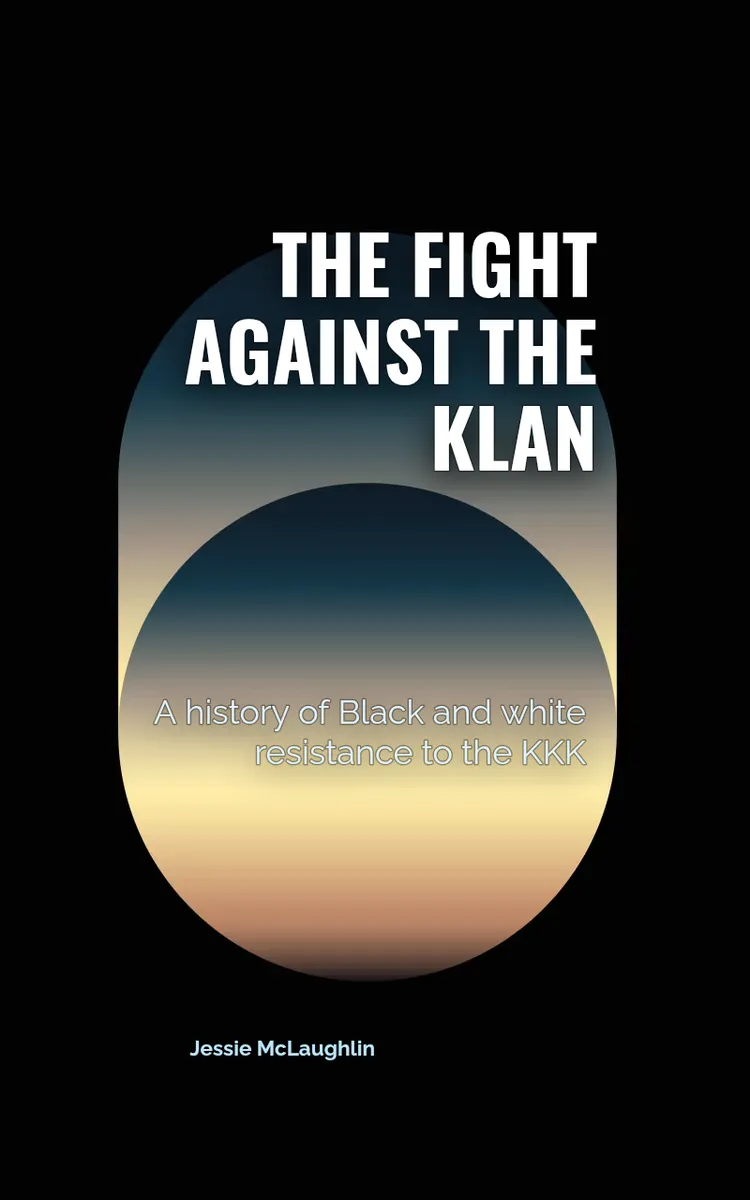
"The Fight Against The Klan" is a curiosity book by Jessie McLaughlin with 40 chapters and approximately 67,986 words. Black and white resistance to the Ku Klux Klan during the Second Civil War.
This book was created using Inkfluence AI, an AI-powered book generation platform that helps authors write, design, and publish complete books.
Frequently Asked Questions
What is "The Fight Against The Klan" about?
Black and white resistance to the Ku Klux Klan during the Second Civil War
How many chapters are in "The Fight Against The Klan"?
The book contains 40 chapters and approximately 67,986 words. Topics covered include The Night Riders’ Secret Signals, When the Klan First Appeared, The Vote They Tried to Steal, Black Communities Build Their Defense, and more.
Who wrote "The Fight Against The Klan"?
This book was written by Jessie McLaughlin and created using Inkfluence AI, an AI book generation platform that helps authors write, design, and publish books.
Write your own curiosity book with AI
Describe your idea and Inkfluence writes the whole thing. Free to start.
Start writingCreated with Inkfluence AI


