
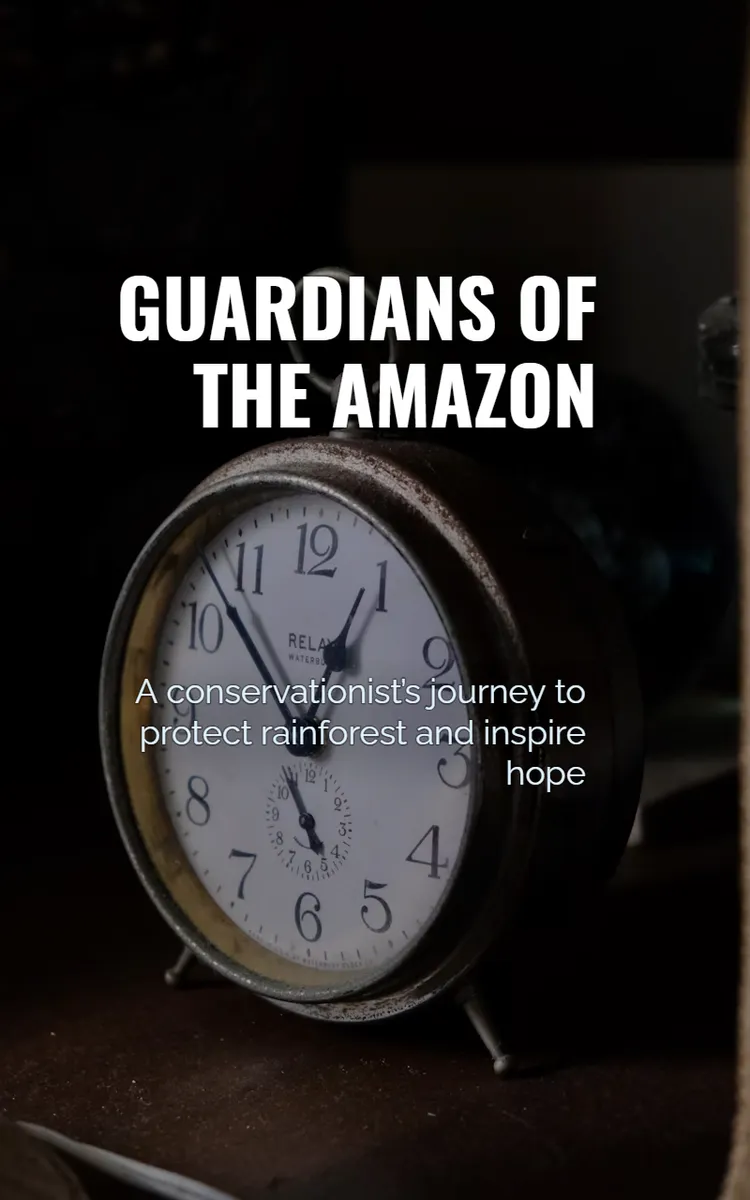
Read the first chapter
The whole of chapter one, free. About 9 min. Turn the pages with the arrows, your keyboard, or a swipe.
Chapter 1
First Journey into the Amazon
The outboard motor coughed just as the tributary narrowed.
Mateo Silva leaned forward, one hand gripping the side of the aluminum boat and the other resting on the fuel tank. Brown water slid past in slow, muscular folds. The forest crowded both banks, its roots disappearing beneath the flood, its upper branches knitted so tightly that daylight reached the river in broken pieces. The motor coughed again, then fell silent.
For a moment, only the water spoke.
Mateo was twenty-eight and still new enough to the Amazon to mistake determination for preparation. He had begun the journey several days earlier, carrying survey papers, a compass, spare batteries, and a conviction that a short visit to a forest outpost might reveal a conservation opportunity worth pursuing. The outpost lay beyond the flooded channels, somewhere upriver, and he had promised himself he would reach it before nightfall.
The promise already felt less like a plan than a burden.
“Try it again,” said João from the stern.
João was a local boatman with a narrow face, patient eyes, and the habit of studying the river before answering any question. He pulled the starter cord. The motor shuddered without catching.
Mateo looked toward the channel ahead. It divided around a low island covered in palms and half-submerged shrubs. Neither branch looked safe. The left channel was narrower, but the current moved quickly through it. The right opened into a broad sheet of brown water where fallen trunks floated beneath the surface.
“We can take the left,” Mateo said.
João glanced at him. “If the propeller catches a root, we walk.”
The statement was calm. That made it heavier.
Mateo had spent years studying forests from maps and reports, learning to describe watersheds, habitat corridors, and protected areas in careful language. On paper, the distance to the outpost had seemed manageable. The river had reduced that distance to something physical: the weight of wet clothing, the sting of insects along his neck, the uncertain depth beneath the boat.
João pulled the cord once more. The motor gave a hollow click.
“Then we walk,” Mateo said.
They tied the boat to a buttress root and climbed into the water.
The current pressed against Mateo’s thighs as soon as he stepped over the side. It was warmer than he expected, carrying the smell of mud, leaves, and something green and sharp from the flooded forest. His boots sank into the soft riverbed. Each step had to be tested before he placed his weight on it.
João moved ahead with a long pole, probing for submerged branches. Mateo followed, keeping the dry bag above his shoulder. Water soaked through his trousers and reached his waist where the channel dipped. Something brushed his calf. He stopped.
“What was that?”
“Root,” João said.
“You saw it?”
“No.”
Mateo watched the brown surface close over the spot where the unseen thing had touched him. He forced himself to move again.
The forest seemed larger from the water. Trees that had looked close from the boat stood far beyond the banks, their trunks rising through layers of vines and shadow. A macaw crossed overhead, its wings flashing blue and yellow between the leaves. Somewhere deeper in the forest, a howler monkey called, the sound low and rough enough to seem like it came from the ground.
Then João stopped so suddenly that Mateo nearly collided with him.
A thick coil lay across a fallen trunk near the bank, patterned in dark olive and black. It was wider than Mateo’s thigh and long enough that its body disappeared into the vegetation on either side. The anaconda remained motionless, its skin wet with river water, its head hidden beneath a curtain of leaves.
Mateo stared.
João raised one hand, warning him not to approach.
The snake was not a monster from a story. It was an animal occupying the same flooded forest they were trying to cross, powerful because it belonged there. Mateo felt fear, but also a strange humility. The river, the trees, and the snake were not obstacles arranged for his journey. They were a living system, and he had entered it with very little understanding.
They backed away and found another route through the shallows.
By midafternoon, the boat was moving again. João had cleaned the fuel line and coaxed the motor back to life, but it ran unevenly, losing power whenever they pushed against the current. Mateo sat near the bow, soaked to the waist, while the forest passed in a shifting wall of green.
He had expected beauty. He had not expected it to feel so demanding.
The flooded channels led them away from the main river and into a maze of narrow passages. At times, branches scraped the boat’s sides. At others, the water opened beneath enormous trees whose roots rose like walls above the surface. The air smelled of wet bark and rotting fruit. Gnats gathered around Mateo’s ears. Sweat ran down his back despite the coolness beneath the canopy.
He checked the compass, then checked it again.
“Does it point correctly here?” he asked.
João gave a short laugh. “The compass points correctly. We are the ones who keep getting lost.”
The motor faltered.
João cut it before it could die completely. The boat drifted toward a bank crowded with reeds.
Mateo looked at the sky, though he could see almost none of it. “How far?”
“If the river permits us, two hours.”
“And if it doesn’t?”
“Longer.”
The answer irritated him, though he knew the irritation was not directed at João. It came from the distance between his intentions and the reality before him. He had come to assess land, speak with conservation workers, and decide whether the area could support a larger protection effort. He had imagined arriving with useful questions. Instead, he was measuring progress by whether the motor continued to run.
They pushed off again.
Near dusk, the forest changed. The dense banks gave way to a cleared strip where the trees stood back from the water. At first Mateo thought the opening had been made by a storm. Then he saw the cuts.
Fresh stumps marked the edge of the forest. Their pale centers were clean and bright against the dark soil. Branches lay scattered across the ground, leaves already wilting in the heat. A narrow track led away from the river, its surface pressed flat by tires.
João slowed the boat.
“Is this near the outpost?” Mateo asked.
“No.”
“How far?”
João studied the track. “Not far enough.”
Mateo felt the words settle inside him. Until then, the rainforest had seemed immense in a way that protected it. Its scale had made human effort look temporary. But the cut trees altered that understanding. The forest was vast, yet the damage was precise. Someone had chosen this place, brought equipment into it, and begun removing what had taken decades or centuries to grow.
He took out his notebook.
João watched him. “You can write it down. It will still be here.”
“I need the location.”
“You need to see it first.”
Mateo stepped onto the muddy bank. The ground gave beneath his boots. He followed the track for several paces, careful not to disturb the tire marks. The smell of fresh sap hung in the air. He touched one stump with two fingers and pulled them back wet and pale.
A bird called from the uncut forest. Another answered farther away.
Behind him, the motor made a strained metallic sound.
Mateo turned. “We should keep going.”
João nodded, but his expression had changed. The journey was no longer only about reaching the outpost. The clearing had placed another responsibility in front of them, one that could not be solved by arriving before dark.
They returned to the boat. The motor carried them through the last channels with long pauses between bursts of power. When it failed again, they used the pole and paddles, working in silence. Mosquitoes settled on Mateo’s wrists. His shoulders ached. The dry bag had taken on water, and several pages of his notes had blurred into gray smears.
He had wanted evidence. The river had given him evidence, but at a cost he had not understood when he began.
The outpost appeared after night had settled over the trees. A small structure stood on raised wooden posts above the flooded ground, with a tin roof that caught what little light remained. A lantern moved near the steps.
Two conservation workers came down to help pull the boat in. One was a woman named Ana, whom Mateo had exchanged letters with before the journey. The other, Paulo, carried a coil of rope over one shoulder.
“You made it,” Ana said.
“Eventually,” Mateo replied.
She looked at the silent motor, then at his soaked clothes. “The river disagreed with your schedule.”
“It had several objections.”
Paulo took the dry bag from him. “Did you see the cut near the western channel?”
Mateo stopped.
“How do you know?” he asked.
“We have seen the marks before.”
Ana’s face was tired, but not surprised. “Come inside. You can tell us what you saw, and we will tell you what we have been hearing.”
The outpost smelled of kerosene, damp wood, and coffee. Mateo sat at a rough table while Ana spread a hand-drawn map beneath the lantern. The boundary of the area was marked in blue pencil. Several tributaries crossed it like veins.
Paulo pointed to the western channel. “The clearing is here?”
Mateo placed his finger on the map. “I think so. The track went inland.”
“Did you see machinery?”
“No. Only tire marks and fresh stumps.”
Ana exchanged a glance with Paulo. “That is enough to know someone is testing the route.”
Mateo wanted to ask how large the operation might become, but the question felt premature. He had not yet seen the whole area. He had not spoken to the families who depended on the forest. He knew that uncontacted Indigenous tribes lived in remote parts of the Amazon, protected by distance and by the rules meant to prevent outside contact. He also knew that roads, even narrow ones, could change that distance quickly.
He looked at the map again. The blue boundary seemed fragile beneath the lantern light.
“I came to assess whether this place could be protected,” he said.
Ana rested both hands on the table. “It is already being protected. The question is whether we can protect it with what we have.”
The words stayed with him.
That night, Mateo slept lightly beneath the roof’s steady creaks. Rain began after midnight, striking the tin in a dense, continuous rush. He thought of the anaconda across the fallen trunk, the macaw above the channel, and the pale wood of the fresh stumps. He thought of how easily he had treated the forest as a destination, something he could enter, measure, and leave.
By morning, he understood that the journey had changed the terms of his work.
He had reached the outpost, as he intended. He had also arrived carrying a warning. The forest’s beauty was no longer an idea he could admire from a distance, and its vulnerability was no longer a line in a report. It had become a place he had crossed with his own body, a place whose waterways had delayed him and whose trees had shown him how quickly pressure could move inward.
Looking back, I now understand that the broken motor and flooded channels were not merely difficulties along the route. They taught me to listen to the people who knew the river better than I did, and to recognize that conservation began with humility. The Amazon did not need another visitor confident in his plans. It needed witnesses willing to remain when the plans failed.
At the edge of the outpost, beyond the raised walkway, the fresh cuts waited near the boundary. Ana and Paulo would lead Mateo there after breakfast. His journey had brought him to the place he wanted to reach, but it had also made clear that reaching it was only the beginning.
End of chapter one. 39 more chapters and about 94,439 words in the full book.
Swipe or use the arrows to turn the page
What's inside: 40 chapters
- 1. First Journey into the Amazon
- 2. Meeting the Field Team
- 3. Who Owns the Logging Road?
- 4. Lost in the Flooded Forest
- 5. Choosing Conservation Over Comfort
- 6. The First Logging Raid
- 7. Following the Timber Trail
- 8. Anaconda in the Blackwater
- 9. The Cost of Being an Outsider
- 10. The River Checkpoint Closes
- 11. The Missing Permit File
- 12. Crossing the Canopy Bridge
- 13. Learning to Share the Lead
- 14. The Outpost Goes Dark
- 15. Who Is Funding the Cutters?
- 16. The Broken Footbridge
- 17. The Temptation of a Shortcut
- 18. The Fire on the Survey Line
- 19. Shelter at the River Bend
- 20. The Boundary Map Revealed
- 21. The Burden of a Bigger Promise
- 22. The First Grant Falls Through
- 23. The Witness Who Wouldn’t Sign
- 24. The Unmarked Tributary
- 25. When Urgency Becomes Overreach
- 26. The Warehouse Records Burn
- 27. Tracing the Financier’s Shells
- 28. Rain Traps the Survey Crew
- 29. The Nonprofit Takes Shape
- 30. The Night the Team Nearly Quit
- 31. The Ledger That Survived
- 32. The Ridge Above the Cut
- 33. Letting Partners Set the Terms
- 34. The Map’s Hidden Source
- 35. The Community Protection Accord
- 36. Building a Lasting Field Team
- 37. Returning to the Anaconda Channel
- 38. A New Generation of Guardians
- 39. The Loggers Return to the Boundary
- 40. Hope Beyond the Protected Tract
About this book
"Guardians Of The Amazon" is a nonfiction book by Anonymous with 40 chapters and approximately 94,439 words. A conservationist’s work protecting Amazon rainforest and its communities.
This book was created using Inkfluence AI, an AI-powered book generation platform that helps authors write, design, and publish complete books.
Frequently Asked Questions
What is "Guardians Of The Amazon" about?
A conservationist’s work protecting Amazon rainforest and its communities
How many chapters are in "Guardians Of The Amazon"?
The book contains 40 chapters and approximately 94,439 words. Topics covered include First Journey into the Amazon, Meeting the Field Team, Who Owns the Logging Road?, Lost in the Flooded Forest, and more.
Who wrote "Guardians Of The Amazon"?
This book was written by Anonymous and created using Inkfluence AI, an AI book generation platform that helps authors write, design, and publish books.
Write your own nonfiction book with AI
Describe your idea and Inkfluence writes the whole thing. Free to start.
Start writingCreated with Inkfluence AI


