
Read the first chapter
The whole of chapter one, free. About 9 min. Turn the pages with the arrows, your keyboard, or a swipe.
Chapter 1
A Pennsylvania Land Grant
The Delaware struck Hugh McLaughlin’s boots before he could bring the boat fully around. Cold water rushed over the gunwale, carrying the smell of mud, wet timber, and the broad river’s brown current. He seized the side rail with one hand and steadied the wrapped papers beneath his coat with the other.
“Keep her straight,” the boatman called.
Hugh leaned into the oar. “I am keeping her.”
The answer came sharper than he intended. His wife and children were behind him among the bundles, blankets, and tools that represented nearly everything they had brought into Pennsylvania. Their silence weighed more heavily than the river. They had traveled far on the strength of a hope: that land awaiting confirmation could become a lawful holding, a place where the family might work, raise children, and begin a life measured not by uncertainty but by use.
The boat scraped against hidden stone. A bundle shifted. His youngest cried out, and Hugh heard his wife quiet the child.
“Not much farther,” the boatman said.
Hugh did not reply. The opposite bank had seemed near when they began the crossing. From midstream, it appeared to withdraw with every stroke. The Delaware widened around them, and the wind pressed through Hugh’s damp coat. He thought of the claim folded beneath the oilskin, of the marks and descriptions that were meant to identify the tract, and of the promise that a lawful record could give a family more than shelter. It could give them standing.
The boat struck the shallows at last. Hugh stepped into the river, water rising above his ankles, and pulled at the bow until it grounded on the Pennsylvania side. Mud clung to his shoes. The children were lifted out one by one, and the bundles followed, heavier now with river damp.
His wife looked toward the wooded rise beyond the landing. “Is that the road?”
“It is the way marked on the survey,” Hugh said.
“Marked by whom?”
Hugh folded the oilskin more tightly around the papers. “By men who know the country.”
She studied the trees, then the rough track disappearing between them. “Do they know it well enough to bring us where we are meant to go?”
He had no answer that would satisfy either of them. The crossing had succeeded, but success had left them on an unfamiliar bank with a road that seemed less like a road than a wound through the forest.
They gathered what they could carry. The path rose sharply from the river, its surface slick with leaves and softened earth. Water dripped from branches overhead. Their boots broke through the crust of old leaves, and the smell of pine and wet soil replaced the river’s broad, open air. Hugh walked ahead with the survey papers under his coat, stopping whenever the track divided.
At the first fork, he took the narrower way.
The boatman, who had followed with one of the heavier bundles, frowned. “The settlement road runs left.”
“The surveyor’s notes point toward the ridge.”
“Notes do not make a road.”
Hugh looked back at the family. His wife had one hand on the shoulder of their eldest child and the other around a bundle of blankets. The children were tired, and the cold had reddened their faces. Turning back would mean another crossing, another payment, and another delay. Moving forward meant trusting a description written by someone who had not brought his family through this forest.
“We go toward the ridge,” Hugh said.
The boatman shrugged. “Then you may find the ridge.”
They continued. The path narrowed until branches caught at their clothing. Once, Hugh stopped beside a tree marked with a pale blaze. He brought out the paper and compared the written description with the land before him. The words named a creek, a rise, and a stand of timber, but the creek had divided into two channels, and the rise could not be distinguished from the hills beyond it.
“This is not the place,” his wife said.
“It may be.”
“You said the same at the fork.”
Hugh lowered the paper. “I said we had to choose.”
“And if the choice is wrong?”
The question remained between them, plain and deserved. Hugh had brought them into Pennsylvania believing that determination could carry a family through uncertainty. Yet the forest did not yield to determination. It required knowledge, patience, and the help of people who had already learned its turns.
“We will ask at the next house,” he said.
“There has been no house since the river.”
“Then we will keep going until there is one.”
The track eventually joined a wider route worn by carts. The ruts held rainwater, and the wheels of some earlier passage had cut deeply into the clay. Near dusk, they reached a small settlement gathered around a sawmill and a rough meetinghouse. Smoke rose from chimneys, and the sound of a hammer carried through the damp air.
A man standing beside a fence watched them approach. Hugh greeted him and explained that they were seeking the surveyed tract named in the claim.
The man glanced at the paper. “Which creek?”
Hugh gave the name.
“There are two creeks called that by different families.”
“Which one lies near the ridge?”
“Both have ridges.”
Hugh felt the day’s uncertainty settle into something harder. “The tract was surveyed for my family.”
“Surveyed is not the same as settled.”
The man’s words were not hostile, but they carried the caution of someone who had watched strangers arrive with papers and leave with disputes. Hugh understood then that the land was not empty simply because it had not yet been improved. Every path had a memory. Every stream had more than one name. Every boundary that appeared clear from a desk could become uncertain beneath trees and weather.
“Is there someone who can guide us?” Hugh asked.
The man pointed toward the mill. “Find the surveyor’s assistant there. If he remembers the work.”
The assistant was a narrow-shouldered man with ink-stained fingers. He examined Hugh’s paper beside the mill, where the machinery groaned and sawdust floated in the air like pale dust. He turned the document toward the fading light.
“This corner was marked from a beech,” he said.
“Is the beech standing?”
“It was standing when I last saw it.”
“When was that?”
The man folded the paper along an old crease. “Before the spring floods.”
Hugh took the deed back carefully. “Can you take us there?”
“I can take you near it.”
“Near it will not establish a holding.”
“No,” the man said. “It will establish how much of the holding you cannot yet find.”
Hugh’s wife looked at him. She had heard enough to understand that the land promised to them was not yet secure. Still, the assistant agreed to guide them at first light, and the family spent the night in a crowded room above the mill. The boards beneath them vibrated with the machinery below. The children slept in their travel clothes. Hugh remained awake for some time, listening to the river wind move through the gaps in the walls.
He had imagined that reaching Pennsylvania would be the great difficulty. The crossing, the road, the cold, and the forest had seemed like obstacles between his family and their beginning. Now he saw that arrival was only the first condition. A family could stand on the ground it hoped to own and still possess no certainty that the ground belonged to it.
At dawn, the assistant led them along a route that climbed from the settlement toward the tract. Frost silvered the grass. The air smelled of smoke and crushed leaves. Hugh carried the survey papers beneath his shirt, where his body heat had softened the oilskin. His wife and the children followed with the lighter bundles, while the assistant moved ahead, searching for old marks.
They crossed a shallow stream and climbed toward a line of beech trees. The assistant stopped beside a stump split by weather.
“Here,” he said.
Hugh examined the stump. A faint cut remained in the wood, nearly swallowed by new growth.
“Is this the corner?”
“It may be.”
Hugh unfolded the paper. The lower edge had torn during the river crossing. Water had entered beneath the oilskin, blurring several lines of ink. The description of the eastern boundary was no longer complete. A distance remained visible, but the reference point that gave the distance meaning had faded into a dark stain.
His wife came nearer. “Can it be read?”
“Part of it.”
The assistant held the sheet against the morning light. “The creek name is damaged.”
“Can you restore it?”
“Not with a knife or a prayer.”
Hugh looked across the tract. The land ran toward a wooded hollow, then lifted again beyond it. Somewhere among those trees, another claimant might believe the same ground had been promised to him. The thought did not make Hugh angry. It made the cost plain. A damaged deed could turn labor into dispute, and a dispute could consume the very years the family had come to preserve.
The assistant pointed toward the hollow. “There is a line marked on the older field sketch. If it follows the creek, your eastern edge may lie there.”
“May?”
“That is the word the paper gives us.”
Hugh pressed his thumb against the torn edge. “Then we will find the county record.”
The assistant looked at him. “That will take time.”
“Time is cheaper than losing the land.”
“Not always.”
“No,” Hugh said. “But it is what we have.”
They walked the tract as far as the remaining marks allowed. Hugh counted paces, noted the slope, and watched where water gathered after the night’s frost. He made no claim beyond what the paper and the ground could support. By midday, the family had reached the place where the first clearing might be made. It was not the broad, settled farm Hugh had pictured during the crossing. It was rough woodland, uneven and damp, with stones near the surface and no clear eastern boundary.
Yet it was a place that could be worked. The soil held dark beneath the leaves. A spring ran cold from the hillside. Timber stood thick enough for a house, a fence, and fuel. Hugh saw what the land required before it could return anything: labor, patience, and a willingness to belong to the community around it rather than remain only a stranger with a document.
His wife stood beside him. “Is this ours?”
Hugh looked at the torn deed, then at the marked stump and the uncertain hollow beyond it.
“It is the tract named for us,” he said.
“That is not what I asked.”
He did not soften the truth. “The boundary must still be proved.”
She turned toward the children, who were gathering chips of bark near the spring. “Then we have crossed the river for a question.”
“For a beginning,” Hugh said.
The words sounded less certain than he wished, but they were steadier than silence. He understood that a lawful holding would not be given to them merely because they had endured the journey. It would have to be confirmed through records, witnesses, and service among the people whose roads they now shared. The family’s place in Pennsylvania would begin not with possession alone, but with responsibility.
By evening, Hugh chose the site for their first shelter on a rise above the spring. The assistant marked it with a stone. Hugh set his hand against the rough bark of a beech and looked toward the river, hidden beyond the trees.
He had arrived as a hopeful traveler carrying a claim. He left the surveyed tract as a landholder in name, though not yet in certainty, bound to a parcel whose edges would require further labor and whose security might depend upon the county’s records. The damaged deed had not erased the promise, but it had changed its nature.
Looking back, Hugh would understand that the first Pennsylvania holding of the McLaughlin family was secured in more than ink. It was secured in the decision to remain when the boundary blurred, to seek lawful proof rather than rely on force, and to accept the obligations that came with a place in the Commonwealth. The family’s service would extend across more than three hundred years, but its first measure was made there, beside a cold spring and an uncertain line, where a difficult arrival became a commitment to stay.
End of chapter one. 39 more chapters and about 97,819 words in the full book.
Swipe or use the arrows to turn the page


What's inside: 40 chapters
- 1. A Pennsylvania Land Grant
- 2. The First County Muster
- 3. Tracing the Boundary Claim
- 4. Winter at the Disputed Spring
- 5. Choosing Service Over Flight
- 6. The Millwright’s Broken Promise
- 7. Who Took the Timber?
- 8. The Road Through the Marsh
- 9. The Cost of Staying
- 10. A Fire at the Storehouse
- 11. The Missing Relief Account
- 12. Across the Susquehanna
- 13. The Heir’s Burden
- 14. A Muster Without Supplies
- 15. The Contract Behind the Muster
- 16. The Mountain Pass in Snow
- 17. The Price of a Name
- 18. The Petition Seized
- 19. A New Road to Market
- 20. The Ledger’s Second Hand
- 21. The Child Who Refused
- 22. The Market Cart Overturned
- 23. Finding the Other Claimants
- 24. The Flooded Ferry Landing
- 25. The Meaning of Loyalty
- 26. The Storehouse Requisition
- 27. The Clerk’s Hidden Copy
- 28. Inside the Contractor’s Yard
- 29. A Public Hearing Called
- 30. The Holding at Risk
- 31. Rebuilding the Grain Record
- 32. The Ridge Road to Court
- 33. The Duty to Continue
- 34. The Warehouse Receipt
- 35. The County Opens Its Books
- 36. A Family’s Chosen Service
- 37. Returning to the Holding
- 38. Teaching the Next Ledger
- 39. The First Restitution Payment
- 40. Three Centuries of Pennsylvania Service
About this book
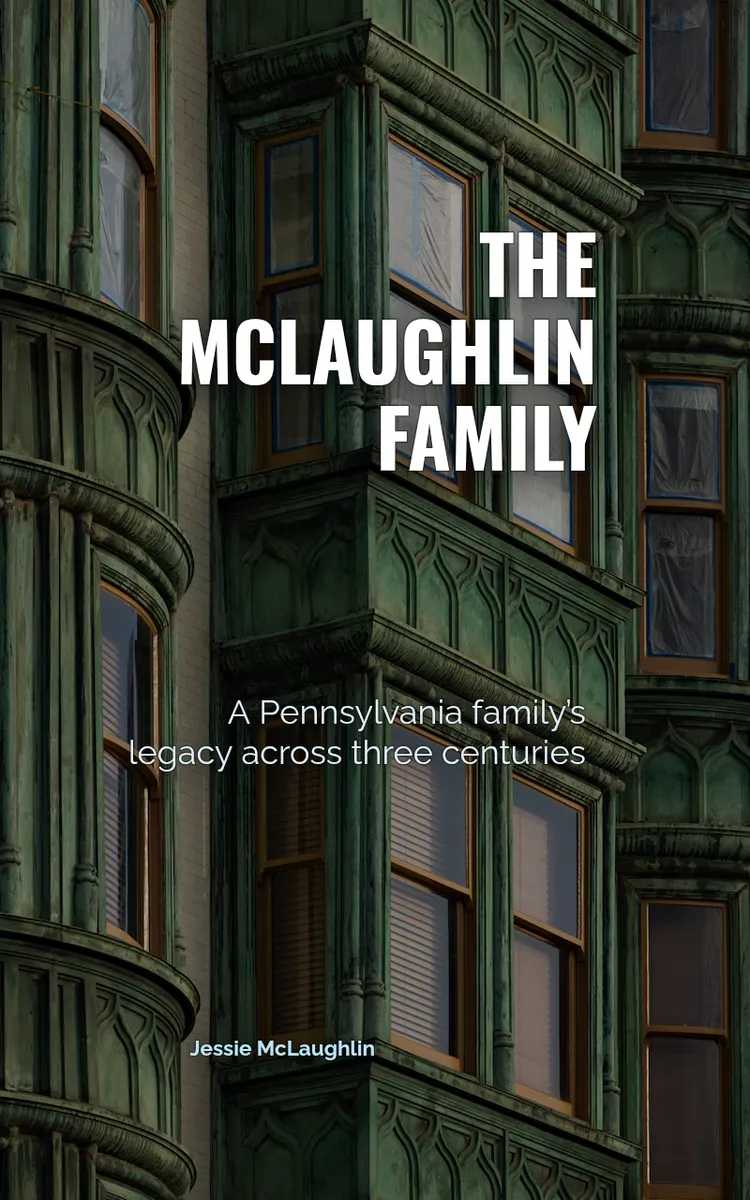
"The Mclaughlin Family" is a nonfiction book by Jessie McLaughlin with 40 chapters and approximately 97,819 words. The McLaughlin family’s history, service, fortunes, conflicts, and connections in Pennsylvania.
This book was created using Inkfluence AI, an AI-powered book generation platform that helps authors write, design, and publish complete books.
Frequently Asked Questions
What is "The Mclaughlin Family" about?
The McLaughlin family’s history, service, fortunes, conflicts, and connections in Pennsylvania
How many chapters are in "The Mclaughlin Family"?
The book contains 40 chapters and approximately 97,819 words. Topics covered include A Pennsylvania Land Grant, The First County Muster, Tracing the Boundary Claim, Winter at the Disputed Spring, and more.
Who wrote "The Mclaughlin Family"?
This book was written by Jessie McLaughlin and created using Inkfluence AI, an AI book generation platform that helps authors write, design, and publish books.
Write your own nonfiction book with AI
Describe your idea and Inkfluence writes the whole thing. Free to start.
Start writingCreated with Inkfluence AI


