
Read the first chapter
The whole of chapter one, free. About 8 min. Turn the pages with the arrows, your keyboard, or a swipe.
Chapter 1
NAP Consistency: The Legal Truth
Learn How Exact Name
What happens when a homeowner searches for your company and finds three different business names, two phone numbers, and an address formatted differently on every site?
Google does not know which version to trust. Neither do Bing, Apple Maps, directory sites, or the systems that generate local answers through tools such as ChatGPT and Google AI Overviews. For a residential contractor, that confusion can cost more than a missed phone call. It can keep your company out of the map results and out of the short list an AI system gives a homeowner searching for a nearby remodeler.
The Legal-Exact NAP Lock prevents that problem. NAP means Name, Address, and Phone number. Your NAP must match word-for-word across every listing, beginning with your Google Business Profile (GBP), formerly called Google My Business. Use your exact legal business name, your exact address format, and your exact phone number everywhere. Match punctuation, abbreviations, spacing, suite numbers, and business suffixes such as “LLC.”
Tanya Rios, owner of a remodeling contractor, might legally operate as “Rios Custom Remodeling, LLC.” That exact name should appear on her GBP, Facebook Business Page, Yelp, Apple Maps, Bing Places, and every other profile. She should not use “Rios Custom Remodeling” on one listing, “Rios Remodeling LLC” on another, and “Rios Custom Home Improvements” on a third unless one of those names represents a properly registered and consistently used business identity.
The same rule applies to the address. If the official format is “1847 West Elm Street, Suite 204,” do not shorten it to “1847 W. Elm St., Ste. 204” on another profile. People may understand both versions, but automated systems compare the text and supporting business signals. Small differences can create uncertainty, especially when several contractors share a city or service area.
Your phone number also needs one standard format. Choose the main number customers should call and use it everywhere. Do not place a tracking number on one directory, a personal mobile number on another, and the office number on GBP. If you use call tracking, handle it carefully and keep the primary business number visible as the consistent reference point.
Ask yourself a simple question before creating any listing: “Would a search engine recognize this as the same business without guessing?” If the answer is no, fix the NAP before adding another profile. The Legal-Exact NAP Lock starts with one identity and protects it everywhere.
Phone Must Match Word-for-word Everywhere
A contractor’s online identity often drifts during ordinary business changes. You move offices, update a phone system, add “LLC” to your branding, or ask a marketing company to create a listing. One person enters “(555) 410-7782,” another enters “555-410-7782,” and a third uses an old number. Over time, the web holds several versions of your company.
Formatting alone does not always create a serious problem, but unexplained differences do. Search systems look at the complete set of business details. When the name, address, and phone repeatedly disagree, the systems receive conflicting evidence about whether the business remains active, whether two listings represent the same company, or whether one listing contains outdated information.
That mechanical problem affects visibility. Google, Bing, and Apple Maps cross-check business information across their own services and outside directories. Increasingly, AI answer engines also gather and compare these signals when they answer searches such as “find a remodeling contractor near me.” If the sources disagree, the system may lower confidence in your business, exclude it from a local recommendation, or select a competitor whose information lines up cleanly.
This does not mean one typo automatically destroys your rankings. It means repeated inconsistency creates friction at every verification point. A homeowner may also lose confidence directly. If your GBP shows one phone number and your Yelp profile shows another, the homeowner may wonder whether the company still operates or whether the listing is legitimate.
Use a short NAP check whenever you claim a profile:
• Is the legal business name identical, including punctuation and “LLC” or another suffix? - Does the address use the same street, suite, city, state, and postal code format? - Does the phone number match the chosen primary number? - Does the profile identify the same business rather than a separate branch or service? - Does the listing show the same website destination?
Do not treat a profile as finished when it merely exists. Open the public version and compare it with your approved information. A listing that displays an old phone number still sends the wrong signal even if your account dashboard contains the new one.
The practical takeaway is direct: make the correct version once, then copy it exactly. Every variation forces search systems and customers to decide whether your business can be trusted.
Starting with Google Business Profile
Start the Legal-Exact NAP Lock at GBP because it serves as the primary reference point for local search. Before you claim another platform, establish the official version of your business there. Use the legal business name, the exact address format, and the primary phone number that you intend to maintain long term.
Tanya should review her GBP as the master public identity for “Rios Custom Remodeling, LLC.” She should confirm that the primary category accurately describes the company, that the service area reflects where the crew actually works, and that the listed hours match the hours when someone can respond to calls or messages. She should also check the business description, photos, and contact details for the same exact identity. The goal here is not to repeat a full profile-building process; it is to lock the information that every other platform must copy.
Once GBP contains the approved NAP, move through the remaining platforms in a deliberate order. Claim the profile when possible, verify ownership, and enter the same NAP without rewriting it from memory. The core sequence should be:
• Facebook Business Page - Instagram - Yelp - Apple Maps through Apple Business Connect - Bing Places - TikTok - LinkedIn Company Page - Nextdoor - Better Business Bureau - Yellow Pages
Nextdoor deserves attention from residential contractors because homeowners often use it to ask neighbors for recommendations. The Better Business Bureau and Yellow Pages also contribute business references, even when they do not produce the same type of lead as a social platform. Each listing adds another place where search systems can confirm - or question - your identity.
Claiming a profile may cost nothing but time, although some platforms offer paid upgrades or lead products. Do not buy an upgrade to solve a consistency problem. First claim the free listing, enter the Legal-Exact NAP, and inspect the public result. Also verify current platform names, features, and free-listing policies before publishing, because directory rules change.
After the core platforms, claim relevant directory listings such as Foursquare, Angi, HomeAdvisor/Angi Leads, Houzz, Thumbtack, Chamber of Commerce listings, and trade-specific directories for roofing, remodeling, HVAC, electrical, or other services. Major data aggregators such as Data Axle and Localeze can distribute business information to many smaller directories. Their role makes accuracy especially important: one incorrect source can spread the wrong phone number or address farther than you can easily track.
Do not open a listing simply to reserve the name and leave it empty. Enter the approved business details, select the closest accurate category, add the service information the platform requests, and complete the contact fields. A profile that shows a business name but no phone, address, website, or useful service information gives search systems little to verify.
Before you move to the next platform, compare the public listing against GBP. That small pause protects the identity you have already established.
To Avoid Ranking and AI Invisibility
The one URL principle strengthens the Legal-Exact NAP Lock. Every profile should point to the same single website URL: social media bios, directory pages, Yelp, Yellow Pages, and every other listing. Do not send one platform to your homepage, another to a Facebook page, and another to a temporary campaign page unless you have a deliberate technical reason and a consistent destination strategy.
For Tanya, that means choosing one primary website address - such as “https://rioscustomremodeling.com/” - and using that same address across her profiles. The exact URL format should remain consistent as well. If the preferred version includes “https” and a specific domain spelling, copy that version everywhere. One destination helps authority and referral traffic consolidate instead of scattering across unrelated pages.
The URL does not replace NAP consistency. It supports it. Search systems can connect a business more confidently when the same name, address, phone, and website appear together across multiple trusted sources. Homeowners also reach the right destination without hunting through outdated social pages or third-party lead forms.
Create a master spreadsheet before you add more listings. Keep one row for the approved business identity and separate rows for every platform. Include these fields:
• Exact legal business name - Exact address format - Exact primary phone number - Primary business category - Single approved website URL - Platform name and profile URL - Login owner or account manager - Date last checked - Notes about verification or corrections
Use this document as the single source of truth whenever you create or update a listing. If a platform asks for the business name, copy it from the sheet. If a staff member or marketing company handles the setup, send the sheet with the assignment and require them to use it. Do not rely on memory, old invoices, or a logo file that omits the legal suffix.
Every six months, run a consistency audit. Use a free listing check such as Moz Local’s free listing check or Whitespark’s citation finder, after verifying that the tool and its free features remain available. Search for the company name, phone number, and address manually as well. Compare every result with the spreadsheet, then correct listings that have drifted.
For a busy contractor, the priority is clear:
• Claim GBP and lock the exact legal NAP. - Complete the core profiles in the listed order. - Apply the same single website URL everywhere. - Record each listing in the master spreadsheet. - Check for NAP drift every six months. - Correct old or conflicting listings before adding more.
Consistency and completeness across every platform - not perfection on one platform - drive local visibility in 2026. A clean Legal-Exact NAP Lock gives Google, other search engines, directories, and AI answer engines one reliable version of your company to recognize. That is how a contractor moves from scattered online references to a business identity customers can find and trust.
End of chapter one. 7 more chapters in the full book.
Swipe or use the arrows to turn the page

Meta Ads For Residential Contractors

Contract Dispute Playbook For Contractors

10 Copy-Paste AI Prompts
What's inside: 8 chapters
- 1. NAP Consistency: The Legal Truth
- 2. Complete Google Business Profile First
- 3. The Wholesome Profile Completeness Rule
- 4. Claim Core Platforms in Priority Order
- 5. One URL Everywhere Principle
- 6. Master Spreadsheet Source of Truth
- 7. Six-Month Consistency Audit Checklist
- 8. Directory Ecosystem: Free Claims and Data Aggregators
About this book
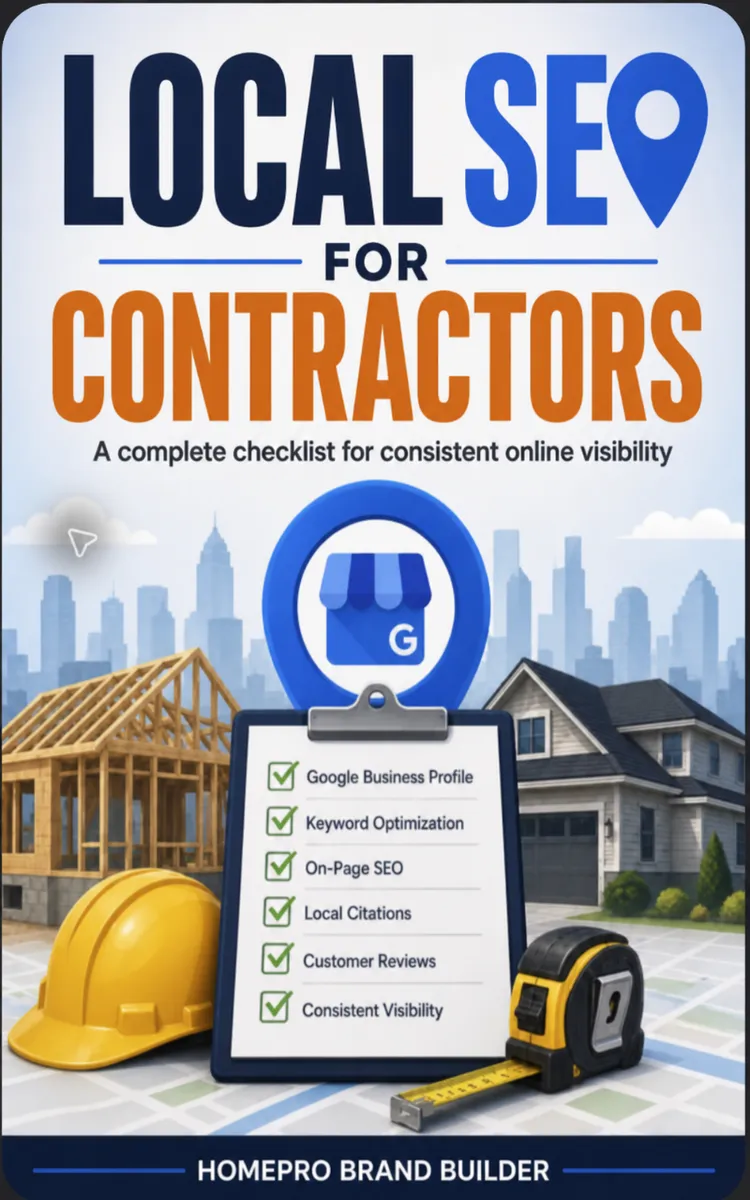
"Local SEO For Contractors" is a how-to guide book by HomePro Brand Builder with 8 chapters and approximately 15,030 words. Building a complete, consistent local online presence for contractors.
This book was created using Inkfluence AI, an AI-powered book generation platform that helps authors write, design, and publish complete books. It was made with the AI Ebook Generator.
Frequently Asked Questions
What is "Local SEO For Contractors" about?
Building a complete, consistent local online presence for contractors
How many chapters are in "Local SEO For Contractors"?
The book contains 8 chapters and approximately 15,030 words. Topics covered include NAP Consistency: The Legal Truth, Complete Google Business Profile First, The Wholesome Profile Completeness Rule, Claim Core Platforms in Priority Order, and more.
Who wrote "Local SEO For Contractors"?
This book was written by HomePro Brand Builder and created using Inkfluence AI, an AI book generation platform that helps authors write, design, and publish books.
How can I create a similar how-to guide book?
You can create your own how-to guide book using Inkfluence AI. Describe your idea, choose your style, and the AI writes the full book for you. It's free to start.
Write your own how-to guide book with AI
Describe your idea and Inkfluence writes the whole thing. Free to start.
Start writingCreated with Inkfluence AI


