
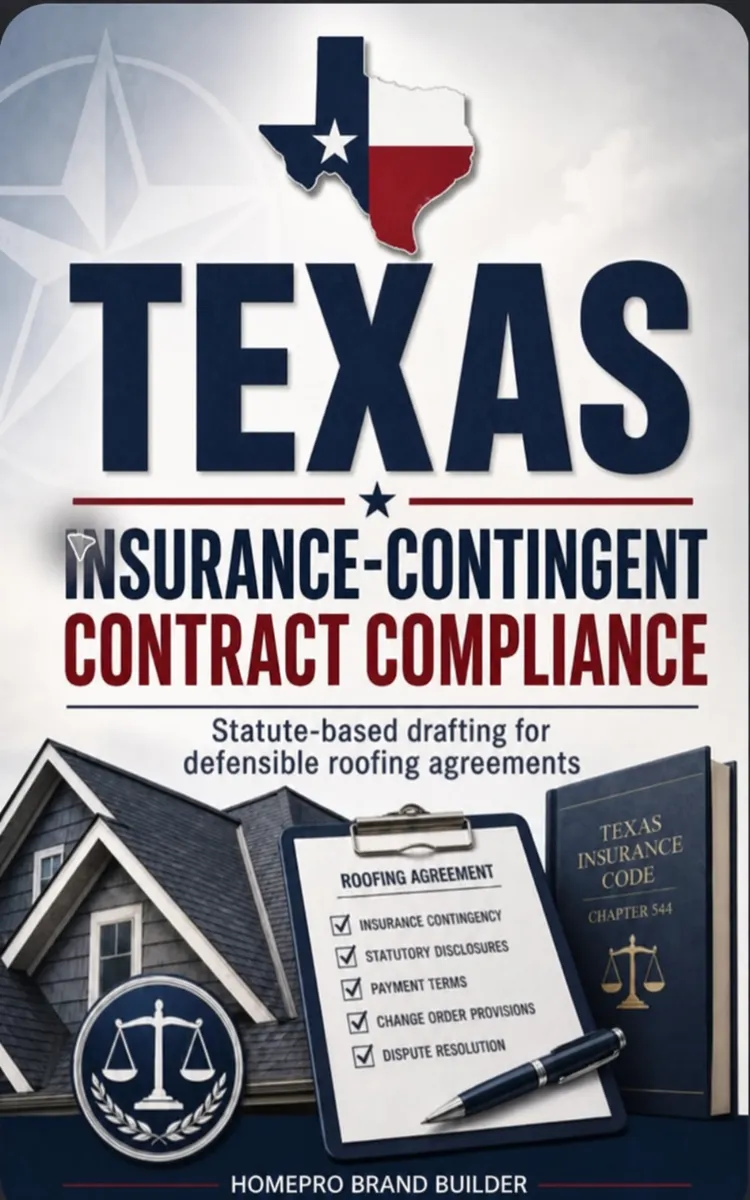
Read the first chapter
The whole of chapter one, free. About 8 min. Turn the pages with the arrows, your keyboard, or a swipe.
Chapter 1
Understanding the Basics of Texas Insurance-Contingent Contract Compliance
Why Insurance-Contingent Language Matters
> “We will handle the insurance company and get the best settlement for your roof.”
That sentence can move a contractor from selling a repair to appearing to adjust a claim. Under Texas Insurance Code Chapter 4102, a roofing contractor cannot act as a public insurance adjuster, advertise that the contractor will adjust an insurance claim, or promise claim results on property where the contractor provides or may provide roofing services. The problem does not depend on the contractor’s job title. The contract, sales pitch, text messages, and conduct can show what the contractor actually promised.
The drafting goal is straightforward: sell and document the repair, not the insurance claim. A compliant agreement states the repair scope and price, leaves the insurance claim to the homeowner and insurer, and clearly says that the contractor will not adjust, negotiate, or represent the homeowner’s claim. After applying the No-Adjusting Script Check, you should be able to identify risky language, replace it with repair-focused language, and preserve a clean record showing that your company never acted as the homeowner’s claim representative.
This distinction matters because Texas courts, including litigation involving Lon Smith Roofing, have treated promises to negotiate with an insurer, obtain the best settlement, or make the contractor’s price depend on the insurer’s approval as possible unlicensed public-adjusting conduct. A violation can expose the contractor to disgorgement of money paid and the homeowner’s attorney’s fees. The safest contract does not merely avoid the words “public adjuster.” It avoids the work and promises associated with adjusting.
The No-Adjusting Script Check
The No-Adjusting Script Check reviews every insurance-related sentence for three questions: Who controls the claim, what does the contractor promise to do, and how does the price work? If the wording gives the contractor control over the claim, promises an insurance result, or ties the contractor’s compensation to the insurer’s decision, revise it before presenting the agreement.
1. Define the contractor’s service. State that the company will inspect, document, repair, or replace the described property for a stated price. This keeps the agreement about construction work rather than claim handling.
2. Reserve the claim to the homeowner. State that the homeowner alone communicates with the insurer, submits the claim, provides requested information, and decides whether to accept or dispute the insurer’s position. This matters because the homeowner, not the contractor, must control the insurance relationship.
3. Reject claim representation. Say that the contractor will not adjust, negotiate, settle, or represent the homeowner in the insurance claim. Do not rely on a vague statement that the contractor is “not an adjuster.” The contract should identify the prohibited activities.
4. Separate price from settlement. Use a stated contract price or a clearly defined repair price. Do not say that the price equals “whatever the insurance company approves,” and do not promise that insurance proceeds will cover the full amount. A contractor may explain the repair scope and provide documents, but the insurer decides coverage and payment.
5. Check the spoken script. Sales representatives must use the same limits in person, by telephone, by text, and in email. A compliant contract cannot cure a sales promise that the company will “fight the carrier” or “get the roof approved.”
Texas Insurance Code Section 4102.158 identifies a conflict when a person adjusts a claim for an insured and also performs the repairs. Section 4102.163 prohibits a roofing contractor from acting as a public adjuster or advertising to adjust claims on property where the contractor provides or may provide roofing services. Section 4102.104 caps an adjuster-style commission at 10 percent of the settlement amount, but that cap does not authorize an unlicensed contractor to adjust claims. A contractor should not treat the cap as a pricing option.
Texas Insurance Code Chapter 707 adds a separate contract requirement for contracts of $1,000 or more tied to an insurance settlement. The agreement must tell the policyholder that the policyholder remains responsible for the deductible and must not waive, rebate, or absorb it. Include this notice in the signed contract, even when the homeowner says the insurer will pay the entire bill. The notice protects the accuracy of the transaction and prevents a sales promise that conflicts with Texas law.
A repair agreement also needs to preserve lien rights. Texas Property Code Chapter 53, including Section 53.255, requires the required lien-rights disclosure in the applicable residential construction setting. Follow the statutory form and delivery rules for the project. Skipping the disclosure can cause a contractor to lose lien rights when the homeowner fails to pay. The insurance disclaimer and lien disclosure serve different purposes: one prevents claim-adjusting confusion, while the other protects payment remedies.
The Texas Business and Commerce Code, Chapter 17, contains the Deceptive Trade Practices Act (DTPA). The DTPA applies to false, misleading, or unconscionable statements in the sales process and contract. “Guaranteed insurance approval,” “free deductible,” “the insurer must replace the whole roof,” and “your warranty covers anything for life” can create problems when the facts or written terms do not support those promises. The No-Adjusting Script Check therefore reviews both legal role and sales accuracy.
Putting the Script Check Into Practice
Rafael Ortiz, a 41-year-old roofing estimator, prepares a $18,400 roof-replacement agreement after hail damage. The homeowner wants Rafael to “deal with the insurance company.” Rafael can document the damage and provide an itemized scope, but he cannot promise to negotiate or obtain a settlement. The following sequence keeps the transaction focused on construction services.
1. Write the repair obligation. Rafael lists the roof system, removal, installation, flashing, ventilation work, cleanup, and the contract price of $18,400. The expected outcome is a definite construction obligation that does not depend on an unknown insurance payment.
2. Add the claim boundary. The agreement states that the homeowner is responsible for filing and managing the claim and that the contractor does not adjust, negotiate, settle, or represent the homeowner before the insurer. The expected outcome is a written record that the homeowner retains claim control.
3. Describe permitted assistance. Rafael may provide photographs, measurements, invoices, and repair information when the homeowner requests those materials. The agreement should explain that providing factual repair documents does not make the contractor the homeowner’s claim representative. The expected outcome is useful cooperation without a promise to influence coverage.
4. Insert the deductible notice. Because the contract exceeds $1,000 and connects the repair to an insurance settlement, Rafael includes the following language:
“The policyholder is responsible for paying the deductible under the insurance policy. The contractor may not waive, rebate, or absorb the policyholder’s deductible.”
Rafael does not reduce the $18,400 price by the deductible or tell the homeowner that the company will “take care of” it. The expected outcome is a price and payment arrangement that does not promise an unlawful deductible benefit.
5. Deliver the lien disclosure. Rafael uses the required residential lien-rights disclosure under Texas Property Code Section 53.255 and follows the applicable timing and delivery requirements. The expected outcome is preservation of the company’s lien rights if the homeowner does not pay.
6. Run the sales materials through the check. Rafael removes “insurance-approved roof,” “we negotiate your claim,” and “best settlement guaranteed” from the proposal, website language, and text template. He replaces them with “roof replacement proposal,” “repair documentation available to the homeowner,” and “coverage decisions remain with the homeowner and insurer.” The expected outcome is consistent language across the transaction.
Quick checklist
• State the repair scope and price. - Say that the homeowner and insurer control the claim. - Prohibit adjusting, negotiating, settling, and claim representation by the contractor. - Do not tie the price to the insurer’s approved amount. - Include the Chapter 707 deductible notice for an applicable contract of $1,000 or more. - Do not waive, rebate, or absorb the deductible. - Deliver the Section 53.255 lien-rights disclosure when required. - Remove insurance-result promises from proposals, advertisements, texts, and scripts. - Keep copies of the signed agreement and delivered disclosures. - Ask whether each sentence describes construction work or tries to control the claim.
The expected result is not merely a better disclaimer. It is a complete transaction record showing that the contractor sold a roof and supplied factual repair information while leaving claim decisions to the homeowner and insurer.
Mistakes and Edge Cases to Catch Before Signing
“We will negotiate the claim for you”
This phrase directly describes claim handling. “We do not charge for adjusting” does not fix it, because the issue concerns the activity, not only the fee.
Do this: State that the homeowner manages the claim and that the contractor may provide factual repair documents at the homeowner’s request.
Not this: Promise to negotiate, argue coverage, obtain the best settlement, or speak for the homeowner with the insurer.
Making the price equal the insurance payment
A clause stating “the final price will be whatever the insurer approves” creates two problems. It makes the contractor’s compensation depend on the claim result and suggests that the contractor expects to influence the insurer’s decision. It also leaves the homeowner without a clear repair price.
Do this: State the repair price and identify any approved change order separately. Explain that insurance approval does not determine whether the homeowner owes the contract price.
Not this: “Homeowner pays only what insurance pays” or “insurance proceeds are full payment.”
Treating the deductible as a sales discount
A contractor may call the arrangement a credit, coupon, rebate, or promotional discount, but a promise to eliminate the homeowner’s deductible can violate Chapter 707. The wording also can support a DTPA claim if the contractor advertises a “free roof” while charging the insurer for work the homeowner agreed to pay for.
Do this: Collect the deductible as part of the homeowner’s responsibility and show it clearly in the payment terms.
Not this: “We waive your deductible,” “we absorb the deductible,” or “your deductible is free.”
Using a disclaimer while acting as the adjuster
A contract disclaimer cannot protect a company that performs the prohibited role in practice. If Rafael attends the insurer’s inspection, presents arguments about coverage, demands a settlement, or tells the homeowner what claim position to accept, the conduct can contradict the contract.
Do this: Limit company communications to factual repair information and direct claim questions to the homeowner or a properly licensed professional who may legally handle them.
Not this: Use “not an adjuster” language as permission to perform adjusting work.
Before using any template, obtain review by a licensed Texas construction attorney. This material provides legal information for internal drafting purposes only and does not replace legal review. Verify the current Texas Insurance Code and Property Code before final use, including Section 4102.104’s commission cap, Chapter 707’s dollar threshold, and the section numbers and requirements for lien disclosures. The Texas Legislature periodically amends these provisions. A contract that clearly sells the repair, preserves the homeowner’s control of the claim, includes the deductible notice, and delivers the required lien disclosure gives the transaction a defensible starting point - and keeps the contractor’s language on the construction side of the line.
End of chapter one. 7 more chapters in the full book.
Swipe or use the arrows to turn the page

Meta Ads For Residential Contractors

Contract Dispute Playbook For Contractors

10 Copy-Paste AI Prompts
What's inside: 8 chapters
- 1. Understanding the Basics of Texas Insurance-Contingent Contract Compliance
- 2. Essential Equipment and Setup for Texas Insurance-Contingent Contract Compliance
- 3. Your First Steps with Texas Insurance-Contingent Contract Compliance
- 4. Building Confidence with Texas Insurance-Contingent Contract Compliance
- 5. DTPA Chapter 17 Promise-Proof Language
- 6. Insurance-Contingent Structure That Stays Neutral
- 7. Commission Caps and Fee Language Safety
- 8. Clause Set Assembly and Final Compliance Review
About this book
"Texas Insurance-Contingent Contract Compliance" is a how-to guide book by HomePro Brand Builder with 8 chapters and approximately 15,130 words. Drafting Texas residential roofing contingency contracts using key statutes.
This book was created using Inkfluence AI, an AI-powered book generation platform that helps authors write, design, and publish complete books. It was made with the AI Ebook Generator.
Frequently Asked Questions
What is "Texas Insurance-Contingent Contract Compliance" about?
Drafting Texas residential roofing contingency contracts using key statutes
How many chapters are in "Texas Insurance-Contingent Contract Compliance"?
The book contains 8 chapters and approximately 15,130 words. Topics covered include Understanding the Basics of Texas Insurance-Contingent Contract Compliance, Essential Equipment and Setup for Texas Insurance-Contingent Contract Compliance, Your First Steps with Texas Insurance-Contingent Contract Compliance, Building Confidence with Texas Insurance-Contingent Contract Compliance, and more.
Who wrote "Texas Insurance-Contingent Contract Compliance"?
This book was written by HomePro Brand Builder and created using Inkfluence AI, an AI book generation platform that helps authors write, design, and publish books.
How can I create a similar how-to guide book?
You can create your own how-to guide book using Inkfluence AI. Describe your idea, choose your style, and the AI writes the full book for you. It's free to start.
Write your own how-to guide book with AI
Describe your idea and Inkfluence writes the whole thing. Free to start.
Start writingCreated with Inkfluence AI


