
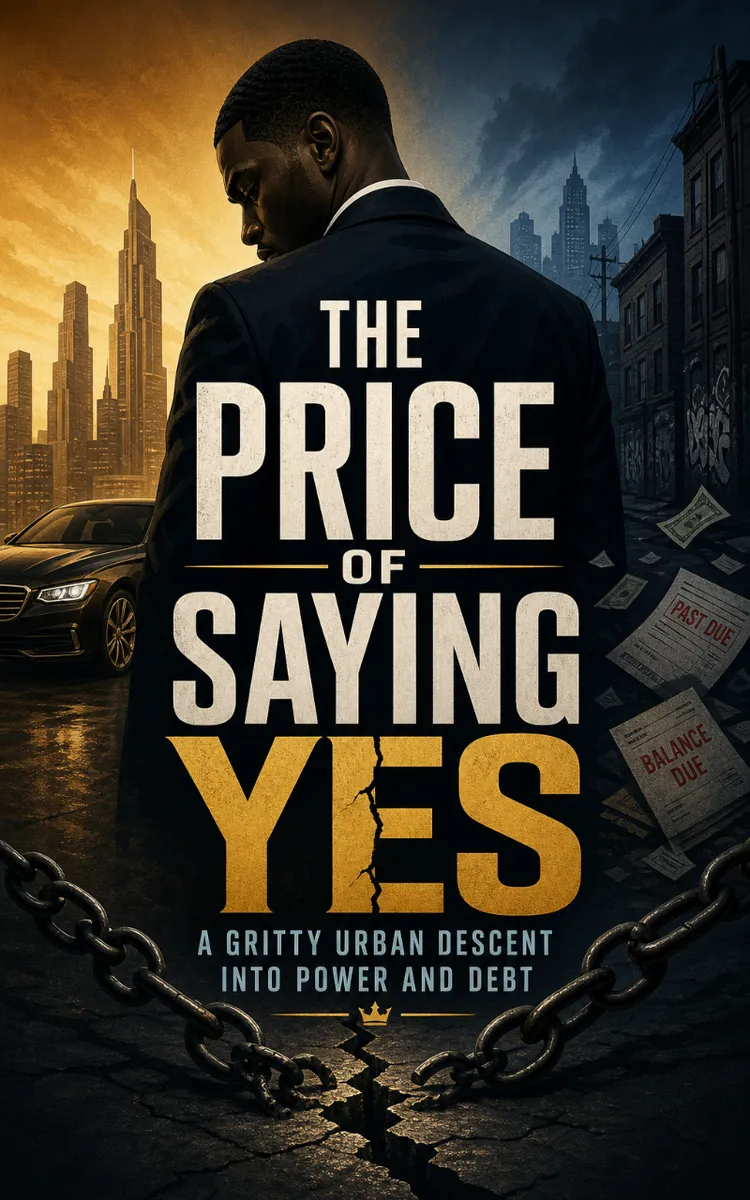
Read the first chapter
The whole of chapter one, free. About 32 min. Turn the pages with the arrows, your keyboard, or a swipe.
Chapter 1
The Receipt in My Palm
I’m walking out of the deal gone wrong, rain working overtime on my face, blood slicking under my collar like a second pulse. The rusted security gate behind me rattles with every breath I take, and the neon sign over the doorway keeps stuttering red - on, off, on - like it’s trying to warn me without words. My mouth tastes like pennies and smoke. I don’t slow down. I don’t look back. I just keep moving until the alley narrows into a throat.
“Marisol,” a voice says from the dark, too calm for the mess I’m in.
I cut my eyes sideways and see the silhouette first - shoulders I know, a shape I didn’t expect to wear here. Then the face slides into the neon spill: Lyle Navarro’s smile in my peripheral like a blade that learned manners. My scar on my ribs - old, pale, and mean - burns like it’s awake. The pain isn’t new. The timing is.
“You said yes,” he calls, stepping out like he owns the rain. “Now you’re mad you got billed.”
I try to keep my hands tight to my body, keep the bleeding quiet, keep the receipt hidden in my coat the way you keep a lie tucked under your tongue. “I didn’t come for conversation.”
“No,” he says, and the smile widens just enough to show he’s counting. “You came for proof.”
A gust of wind hits the doorway, and the neon sign flares. For half a second, the puddles on the sidewalk look like mirrors. In them, I see myself - blood down my neck, teeth clenched, eyes too bright - then I see the thing I missed when I left: a folded receipt clinging to the inside of my palm like it was planted there. White paper soaked at the edges, ink sharp enough to cut.
I don’t remember picking it up.
I don’t remember anybody handing it to me.
I only remember the deal’s last second, the way the air changed when my yes got recorded.
“Drop it,” Lyle says, voice still smooth. “Or drop yourself. Your choice.”
I swallow hard. The paper is warm, like it’s been held. Like it’s been waiting. My fingers open just enough to read the top line before the street can steal it: Project title The Price of Saying Yes. That’s not the kind of title you write on a receipt unless you want it to find the right person. Beneath that, a ledger number in blunt black ink, then a name that makes my stomach go cold.
Jalen Brooks.
My lover’s name sits there like a receipt for a crime.
The rain hammers the rusted gate and turns the sound into static. Footsteps behind me - two sets, steady, coming fast. I feel the trap before it snaps. The neon sign flickers again, and the doorway behind me becomes a frame, a border, a place where exits get decided for you.
“Tell me who took the ledger,” I say, and my voice comes out rough, like gravel dragged across a drum. “Tell me now.”
Lyle tilts his head like I’m the one being rude. “You think it’s missing? I think it’s moving. Same as you.”
I step back into the wet doorway’s edge, using the neon as cover, using the gate as a shield I don’t trust. “You were part of it.”
“I’m part of everything that sells,” he says. “You just didn’t ask what it costs.”
The ink on the receipt shifts when my thumb rubs it - subtle, like the paper wants to confess. The debt amount is written under my scar’s code, a string of numbers that match the mark I got when I stopped running and started surviving. It’s not a coincidence. It’s a ledger ledgering me.
I hear my own breathing, too loud, and under it the scrape of shoes on wet concrete. Someone’s close enough now that I can smell cologne over metal and cheap soap. My coat sticks to my skin where the blood keeps leaking. The doorway feels narrower. The rain feels colder.
“Marisol,” Lyle says again, and this time there’s something under it - respect, maybe, or hunger. “You want the ledger? Then hold the receipt. That’s how it finds you.”
I grip the paper tighter. My scar aches, as if it’s remembering the exact moment money turned into pain. The receipt in my palm is a ledger of favors, lies, and debts, and it’s already charging interest. I don’t have time to be scared. I have time to move.
I lunge for the gate latch, fingers fumbling through soaked fabric. The metal is slick; it bites my skin. Behind me, a door slams somewhere deeper in the building, and the sound is a cue. Lyle’s hand catches my wrist - not hard, not gentle - just enough to steer me like a car into traffic.
“Don’t,” he says, and the word lands like a lock clicking shut.
I twist, and pain flares under my ribs. My breath stutters. I pull the receipt out in the same motion, holding it up like a flare, like a weapon, like a confession. “Look at it. Look at what you did.”
Lyle’s eyes drop to the paper and for a blink his smile loses color. Then it comes back, sharper. “That’s not what I did.”
“Then who?”
He leans closer, and the neon lights the wet edge of his mouth. “You should’ve listened when I said yes is a contract. You didn’t just say yes. You signed for what came after.”
The footsteps close in behind me. One of them speaks, voice young and mean. “We got her.”
I don’t flinch. I can’t afford it. I step sideways into the doorway’s thin neon halo, where visibility turns into a kind of blindness. The rain makes everything reflective and messy, and I use that. I use my coat, my bleeding, my anger - whatever’s left in me that still works.
“You followed me,” I say to Lyle, and my voice tries to stay steady even as my pulse trips. “You knew I’d come out with something.”
“I knew you’d come out with questions,” he says. “I just didn’t know you’d get the receipt in your hand.”
My chest tightens. The cost of the wrong yes hits again, but now it has a face. Now it has my lover’s name attached to it like a hook.
I tear my wrist free with a wet rip of fabric and motion. Lyle doesn’t chase me immediately. He watches, like he’s waiting to see which part of me breaks first. Then he nods once toward the doorway behind the rusted gate.
The trap isn’t just the place. It’s the recognition.
I run anyway, because running is the only language I’ve ever spoken fluently, and because the receipt is proof and poison at the same time. The paper flutters against my palm as I sprint through the rain-slick threshold. The neon sign’s stutter turns into a rhythm my body can’t ignore. I feel eyes on me, not just Lyle’s - other eyes, other debts.
Inside the doorway, the air smells like wet concrete and old cigarette smoke. A hallway stretches out, lit by a busted overhead bulb that buzzes like an insect. Somewhere, a phone vibrates. Somewhere, a ledger gets moved.
I stop just long enough to fold the receipt tighter, to hide the numbers, to keep the debt amount from showing up on anyone’s angle. Then I unfold it again, fast, because I can’t help myself. The ink is still there. The scar code is still there. And Jalen Brooks is still there.
My scar isn’t just a past injury now. It’s collateral.
My head snaps up when I hear a door click behind me. The neon from outside draws a thin line across the floor, and it looks like a runway leading back into the trap. I don’t have the ledger yet. I don’t even know where it went. But I have the receipt, and I have the person it ties to.
The new cost arrives like a punch: I can’t chase the missing ledger without dragging Jalen’s name into the open.
And whoever took it already knows I’m bleeding.
•
Project title The Price of Saying Yes.
I survive by saying yes before it can be taken from me. I’m too proud to beg and too tired to run forever. I keep my secrets folded tight because the city loves tearing them open. Core desire: Get the receipt and figure out who took the ledger before it gets me killed. Fatal flaw: I assume I can control the outcome if I control the information. Recurring motif: the scar on my ribs, which evolves from injury to ledger-coded collateral.
The receipt feels like a living thing in my palm - paper warm, ink cold, my scar burning like it recognizes the numbers. I tell myself it’s just a piece of paper, but my body doesn’t believe me. My lover’s name is there, plain as a threat. I’m bleeding and still thinking like a thief, like if I can read the debt fast enough I can outrun it. But the neon keeps stuttering, and every flicker says the same thing: I’m already late.
He smiles like he’s got time, even when the city chews minutes into dust. He wants me close, but he measures closeness like a risk. Motive: Keep me alive by controlling the truth. Secret: He’s connected to the missing ledger route in a way he’s never told me - his name is on receipts before I even see them.
Lyle Navarro (betrayer/antagonist). Bio: He moves like a man who’s always been invited. He talks soft, but his deals hit hard. Motive: Profit off other people’s desperation. Secret: He arranged the doorway recognition, making sure I’d get the receipt instead of the ledger.
Celeste Ward (mentor-like fixer/antagonist). Bio: She doesn’t chase; she schedules. Her attention feels like money changing hands without touching your skin. Motive: Control the ledger’s endgame through leverage. Secret: She knows my scar code and uses it as a key to locate me.
Rafe Beaumont (friend turned pressure). Bio: He’s the type who helps first and asks later, until the asking turns into terms. He keeps his loyalty close and his threats closer. Motive: Get the ledger out of the wrong hands. Secret: He’s been feeding Lyle information through a third party.
Tessa Harlow (friend/informant). Bio: She’s street-smart, sharp-tongued, and tired of watching people drown in their own yeses. Motive: Pay off a debt by selling the truth. Secret: She already knows who took the ledger, but she’s waiting for the right moment to name them.
Bleeding out of a deal gone wrong, Marisol Vega grabs a receipt that ties her scar and her lover to a missing ledger - then realizes the neon doorway she trusted just sold her recognition.
One-paragraph synopsis (150-200 words): Marisol Vega walks out of a deal gone sideways with blood on her hands and a receipt folded into her palm like a trap with paper skin. The Project title The Price of Saying Yes is printed at the top, but the real damage is beneath it: a ledger number linked to her scar and the name of her lover, Jalen Brooks. In the rain-slick doorway behind a rusted security gate, neon stutters like a warning while Lyle Navarro’s calm voice turns her panic into a spotlight. She chases the receipt’s promise of proof, hunting for who took the ledger before they decide her life is just another line item. Her yeses, her injuries, and the people she thought she could trust all start to behave like a ledger that never stops balancing. To survive, she has to choose between reclaiming herself and making a revenge play that could cost Jalen everything. [SENSITIVITY CHECK]
Beat sheet (one paragraph per chapter, 30-36 paragraphs, each 80-120 words): Chapter 1: Marisol exits a rain-slick doorway after a deal goes wrong, bleeding and trying to stay quiet as a neon sign stutters overhead; she’s recognized and followed by Lyle Navarro. The obstacle is the place itself - the rusted security gate and the doorway trap - turning escape into a maze. She grabs a folded receipt that links her personal injury to a financial ledger and a specific person, Jalen Brooks. The turning point is the realization that the receipt isn’t just evidence; it’s a lure. The emotional beat is raw panic shifting into focus: she wants the ledger, but now she has a debt-linked target. [SENSITIVITY CHECK]
Chapter 2: Marisol slips into a back room off the hallway, using buzzing light and wet concrete smell to mask her breathing. Her objective is to confirm the receipt’s details without getting spotted. The obstacle is surveillance pressure and the fact that the receipt feels “alive,” reacting to her scar code like it’s guiding her. She confronts a contact who pretends not to know her, but her questions land too close to the truth. The midpoint within the chapter is a small reversal: the person who should help reveals they’ve already been paid. The consequence is immediate - someone moves the ledger route, forcing Marisol to chase faster, not safer.
Chapter 3: Marisol returns to the neon-lit doorway from memory, but the gate’s angle is wrong - like the city rearranged itself while she was bleeding. Her objective is to find a trace of the missing ledger before it’s gone for good. The obstacle is that every turn leads her back toward her lover’s name, as if the ledger is being tuned to her. She finds a scrap of ledger paper tucked where her scar matches the cut pattern, then decodes it enough to see her injury isn’t random. The emotional beat is dread tightening into anger. The chapter ends with her realizing the numbers are about her, not them, and the ledger is already inside someone’s plan. [SENSITIVITY CHECK]
Chapter 4: Marisol follows the ledger’s ink trail into a corner store that smells like bleach and old coffee. Her objective is to identify who has the missing ledger’s next move. The obstacle is a man named Lyle Navarro’s shadow - someone else uses his voice patterns to get her to react. She corners a cashier with questions, but the cashier’s fear reads like training. The turning point is a secret phrase hidden in the store’s receipts that matches her receipt’s ledger number. She learns she’s not just being followed - she’s being timed. The emotional beat is cold clarity: betrayal isn’t a possibility; it’s the schedule.
Chapter 5: Marisol meets Celeste Ward in a parking structure where the air is damp and the concrete sweats. Her objective is to get leverage without losing control of her body or her story. The obstacle is Celeste’s terms, sweet as a knife’s edge - help her, and she’ll keep Jalen’s name off the next list. The dialogue is sharp, subtext-heavy, and full of power dynamics, because Celeste speaks like she already owns the outcome. The turning point is Celeste revealing she knows Marisol’s scar code and uses it to prove she’s been tracking her. The consequence is moral cost: Marisol can’t ask for help without offering something back. [SENSITIVITY CHECK]
Chapter 6: Marisol tries to reach Jalen Brooks directly, but he answers like a stranger with rehearsed warmth. Her objective is to pull the truth from him before it becomes a weapon. The obstacle is that he controls the space - his silence is intimacy with teeth. The turning point is Jalen’s admission that someone else is holding the ledger, and he wants her to stop chasing it. The emotional beat is betrayal turning into a sick kind of love. The consequence is irreversible loss in miniature: Marisol’s access to a key contact gets burned because Jalen’s timeline doesn’t match hers.
Chapter 7: Marisol follows a surveillance tail and learns the rules of the neighborhood’s violence without romanticizing it. Her objective is to find where the ledger is stored or moved. The obstacle is that the tail knows her scar - recognition is now a weapon. She forces a confrontation, and the fight leaves her with bruises and a new ache that confirms the ledger is tied to her physically. The turning point is hearing a phrase - something like a contract line - spoken by the person tailing her. The consequence is that she learns she can’t outrun the ledger; she has to outthink the people moving it.
Chapter 8: Marisol tracks the neon sign like a prayer that’s already been answered wrong. Her objective is to find the warehouse connected to the doorway trap. The obstacle is time - every step costs breath and the rain keeps making her footprints look like someone else’s. The turning point is seeing the neon owner’s pattern in a reflection, not directly in sight. She reaches the warehouse exterior, but the interior is already active. The emotional beat is hope flaring hard, then collapsing when she hears her own name spoken by someone inside. The consequence is immediate danger as she realizes the ledger is closer than she thought.
Chapter 9: Marisol tries to get the warehouse key that isn’t mine, and the lock doesn’t care about her intentions. Her objective is to enter without being noticed long enough to find the ledger. The obstacle is security that recognizes her scar like a password. She opens the wrong door and catches a conversation that reveals the ledger is being auctioned. The turning point is an irreversible shift: the ledger isn’t just missing - it’s priced. The emotional beat is rage with a tremor of grief, because auctioning means people are already deciding what her yes is worth. The consequence is that she leaves empty-handed but with names burned into her head.
Chapter 10: Marisol steals a glance at the auction prep room and realizes the list has her name. Her objective is to understand the auction logic before it traps her. The obstacle is that the people running it treat consent as a commodity already “proven.” The turning point is a clerk confirming the ledger will be used as proof of ownership. The emotional beat is horror turning into purpose. The consequence is a new kind of threat: if she tries to fight, she’ll be reframed as evidence against herself. She decides to destroy the evidence, but the cost starts before she even touches the paper.
Chapter 11: Marisol burns her own receipt to keep herself from being owned, and it hurts more than it saves. Her objective is to erase the ledger’s immediate connection to her. The obstacle is that the fire doesn’t stop the system; it only changes what it can track. The turning point is realizing someone anticipated the burn and left a replacement receipt behind, already linked to a new target. [SENSITIVITY CHECK] The emotional beat is grief for the version of herself that believed yes could be private. The consequence is that she’s forced to keep moving without the one thing she thought could protect her.
Chapter 12: Marisol hears Rafe Beaumont’s offer to spare her, and it comes with a trade that sounds like freedom but smells like a different cage. Her objective is to survive long enough to get the ledger before anyone else sells it. The obstacle is that Rafe’s loyalty is conditional, and the condition always takes something from you. The turning point is Rafe revealing he can delay the auction if she gives him access to her next yes. The emotional beat is bargaining with terror. The consequence is that she accepts - because survival has its own violence - and the ledger tighter around her starts tightening around Jalen too. [SENSITIVITY CHECK]
Chapter 13: The neon sign flickers like a warning as Marisol reaches the drop point and finds the owner dead, then realizes the ledger is already moved. Her objective is to locate the ledger’s new location from any trace. The obstacle is grief that won’t slow her down and the fact that death changes how people talk. The turning point is finding the neon owner’s ledger scratch - an echo of her scar code. The emotional beat is rage aimed at a void. The consequence is that she loses a person who could’ve helped, making this chase colder and more personal. The chapter ends with her staring at the last clue and realizing it’s leading her toward betrayal, not rescue.
Chapter 14: Midnight video changes everything: Marisol watches it twice and realizes Jalen wasn’t just hiding - he was delivering her. Her objective is to confirm the truth without breaking. The obstacle is that evidence is messy and people can still lie inside a recording. The turning point is spotting the moment Jalen’s voice matches the doorway recognition. The emotional beat is shock turning into a slow, lethal clarity. The consequence is that the people she loved in her head are now suspects in real life, and the ledger has a route she can’t ignore. She decides to move before they can rewrite the story again.
Chapter 15: Jalen’s apology costs Marisol air; his confession comes with a knife behind it. Her objective is to confront him and learn why he did it. The obstacle is the space between his words and his hands - he’s always controlling the frame. The turning point is Jalen admitting his motive was survival for someone else, but the someone else is connected to the auction. The emotional beat is betrayal turning into a decision. [SENSITIVITY CHECK] The consequence is irreversible loss in the emotional sense: Marisol realizes she can’t go back to being the version of herself that trusted him. She leaves with a new plan and less softness.
Chapter 16: Marisol touches the scar and remembers, returning to the place of her injury. Her objective is to find the lyric scratched into concrete that wasn’t hers. The obstacle is that the city keeps secrets by making you pay for every step. She finds the lyric’s matching rhythm in a nearby wall tag, then follows it. The turning point is recognizing the voice behind the lyric - the same cadence as the receipt’s ink. The emotional beat is pain sharpening into purpose. The consequence is that she learns the ledger’s route is tied to art and money together, and that someone designed her injury to be part of the ledger system.
Chapter 17: Tessa Harlow sells Marisol the truth, but the truth comes with a condition that threatens her survival. Her objective is to get the ledger’s route and who’s holding it. The obstacle is Tessa’s fear - she’s been warned off, and the warning is close enough to smell. The turning point is Tessa naming a person but refusing to say where. The emotional beat is desperation fighting pride. The consequence is a new condition: Marisol must keep someone alive long enough to make the exchange. She agrees because the ledger is moving, and time is the only enemy that doesn’t negotiate.
Chapter 18: Rafe takes Tessa’s last breath [SENSITIVITY CHECK], and Marisol is forced to decide what kind of revenge she can live with. Her objective is to stop the ledger’s next move. The obstacle is Rafe’s control - he can force outcomes with a look. The turning point is Marisol realizing Rafe betrayed Tessa to protect the ledger’s secrecy. The emotional beat is grief turning into a hard, ugly determination. [SENSITIVITY CHECK] The consequence is that the ledger’s next move becomes immediate, and Marisol has to act without Tessa’s route. She chooses revenge anyway, but revenge has a cost she can already feel.
Chapter 19: Marisol steals the keycard from the devil, breaking into the auction prep room. Her objective is to access the system that schedules the auction. The obstacle is the security system recognizing her scar like a password. She gets in by manipulating the timing of a door cycle and using the neon’s reflection as a distraction. The turning point is finding the ledger stored in two pieces, hidden behind different access controls. The emotional beat is triumph with dread underneath. The consequence is that she can’t just steal one half; she has to steal both or the ledger remains usable against her.
Chapter 20: The ledger is in two pieces: one half with debts, one half with names - and the split changes who Marisol can punish. Her objective is to understand how the two halves connect to her scar and Jalen’s name. The obstacle is that each half triggers different safeguards when removed. The turning point is realizing the split changes the ledger’s “proof” mechanism. The emotional beat is cold calculation. The consequence is that Marisol can’t just burn the evidence; she has to weaponize it carefully, or the wrong person gets framed. She decides to use the receipt system against Celeste Ward next.
Chapter 21: Celeste Ward calls Marisol by her real name, revealing she’s been tracking her longer than Jalen ever did, and offers a final bargain. Her objective is to get the last missing piece of the ledger route. The obstacle is Celeste’s ability to force choices without touching her. The turning point is Celeste revealing she orchestrated the doorway trap and the receipt’s placement. The emotional beat is disbelief turning into fury. The consequence is a bargain with moral cost: Marisol must choose between saving Jalen and saving herself the way she used to.
Chapter 22: The burn smell lives in Marisol’s throat as she tries to stop the burn, but can only save a fraction. Her objective is to prevent the ledger from spreading into public “proof.” The obstacle is that the system keeps copying what it thinks is evidence. The turning point is realizing the ledger has already ghost-debts tied to her scar and her yeses. The emotional beat is nausea and determination. The consequence is that she can only save part of the truth, meaning some people will still be hurt. She keeps going anyway, because stopping now would let Celeste win without a fight.
Chapter 23: Marisol finds Jalen’s sister, not Jalen, and the truth hits different when it’s a kid watching you. Her objective is to locate Jalen’s motive source and confirm what he was protecting. The obstacle is that the sister’s fear makes her a moving target for the people chasing Marisol. The turning point is learning the ledger’s motive wasn’t abstract - it was tied to a family debt and a promise Jalen made too late. The emotional beat is grief that turns into restraint. The consequence is irreversible loss: Marisol can’t fix everything in one night. She has to choose what kind of truth will survive.
Chapter 24: Marisol says yes to saving Nia, and it forces her to accept a new kind of debt. Her objective is to keep Nia alive long enough to get actionable information. The obstacle is Nia’s connection to the ledger’s auction list. The turning point is Nia telling Marisol a detail only someone close would know. The emotional beat is tenderness edged with danger, because love is now a liability. The consequence is that saving Nia means Marisol becomes accountable to the ledger logic again. Her scar burns hotter, as if it’s responding to every yes she gives.
Chapter 25: Rafe turns the gun on Marisol [SENSITIVITY CHECK],
He doesn’t say her name when he turns the gun on her. He just smiles like the world is a lock he already has the key to, like the night owes him interest.
Rain needles my cheek. It tastes like pennies and diesel. The doorway behind me is a neon wound - red light bleeding over the rusted gate, over puddles, over the receipt I’d fought for with my teeth and my hands. I try to keep my breathing quiet, but my chest won’t cooperate. Every inhale feels too loud, like a confession.
Rafe’s voice cuts through the hiss of water. “You got the part that matters.”
I look past the barrel. The folded paper is in my fist, slick and crumpled, edges digging into my palm. When I tilt it, the ink catches the neon and suddenly my scar isn’t just skin. It’s a number. A date. A debt that has my body’s fingerprints all over it.
“Let me see,” he says, and the way he says it isn’t a request. His shoes scrape the sidewalk once, slow, deliberate, like he’s measuring distance between who I am and what he plans to take.
I swallow blood. My tongue feels thick, bruised from the deal gone wrong. “You already had your yes.”
He laughs once, short. The sound lands in my ribs and shakes something loose. “You think yes is free?”
I keep my hand closed around the receipt anyway, because if I open it, I’m giving him the ledger back. I’m giving him the story that makes him untouchable.
Then he moves - just a half-step closer - and the gun follows without him even looking down. Cold metal, hot intent. The rain makes everything shine, but his stare stays flat. A man who’s practiced deciding.
“Jalen’s name’s on it,” I say before I can stop myself. The words come out sharp, like I’m spitting nails. “So is my injury. So what ledger are you paying with, Rafe?”
He doesn’t flinch. That’s the worst part. His calm is a wall. “You’re bleeding because you were stupid enough to believe somebody would hand you the receipt without consequences.”
My pulse bangs against my throat. The neon doorway behind me flickers, and the gate’s bars throw striped shadows over my knuckles - like I’m already behind something. I try to angle my body so the gun has less of me to aim at, but I’m still too exposed. Rain runs down my neck and collects in the dip between my collarbones. It’s freezing there, like my skin is trying to shut down.
“Where’s the missing ledger?” I ask. “Who took it?”
Rafe’s eyes drop - just for a second - to my palm. To the way the receipt edges bite into my skin. He steps again and the gun dips, tracking the motion like it’s attached to his thoughts.
“Careful,” he says. “The debt you’re holding might turn on you before you get what you want.”
I can’t tell if he means the receipt, the scar, or me. Maybe all three. Maybe that’s how this works. Maybe desire becomes a ledger because it’s easier to collect when people are afraid of what they already owe.
My voice goes quieter. “I didn’t come here to play.”
“You came here to say yes,” he corrects, and the correction feels personal, like he’s been waiting for me to understand my mistake. “And now you’re going to pay for it.”
He reaches out with his free hand, slow enough for me to see the intention before it lands. I shift back, heel catching on wet concrete. The neon sign hums overhead, buzzing like an insect trapped in the glass. For a second, I think about running - about slipping past him through the doorway and disappearing into the rain-slick streets.
But the gate behind me clanks when the wind hits it, and the sound is enough to pull the night tighter. I hear footsteps on the other side of the security bars - someone else moving, someone else listening.
I realize I’m not alone in this trap. Rafe’s not just turning the gun on me. He’s turning the whole block into a room.
I squeeze the receipt harder, until the paper bends and my palm aches. The pain is clean compared to the rest of this. Pain I can control. Pain I can use.
“Stop,” I say, and it comes out like a rasp. “Don’t touch me.”
His fingers hover, then pause - just long enough to prove he heard me. Consent isn’t just a word in my head; it’s the line I’m trying to keep from snapping. He doesn’t cross it. Not yet.
But the gun doesn’t move away.
I tilt the receipt again, just enough to catch the neon. The numbers glare up at me like they’re lit from inside. My scar’s code. The amount. The part of the ledger that’s missing. And then the name - Jalen’s name - sitting there in ink that looks too steady to be random.
Rafe watches me read it. “That’s the connection,” he says. “That’s why you’re bleeding. That’s why you’re still standing.”
My stomach twists. “So you’ve had it.”
He shakes his head once. “I’ve had pieces. You have pieces. The people you trust have pieces. And everybody thinks their piece is the truth.”
A car passes somewhere down the street, tires hissing through water. The sound fades, leaving the rain to fill the silence. My hands tremble, but my grip holds. I’m still bargaining with time, still trying to buy a way out.
Rafe’s expression shifts - barely. Like he’s getting impatient with my refusal to be simple. “Give me the receipt,” he says. “Or I make sure you don’t get to keep your yes.”
I taste blood again, metallic and sharp. My scar burns hot under my sleeve, like it’s answering him. Like the ledger has a pulse.
I don’t hand it over.
I do something worse.
I flare the receipt outward, just enough to show the ink to the someone behind the gate. A silhouette moves behind the bars, and I catch the outline of a face angled toward me. Whoever it is, they lean in like they can smell the debt.
Rafe’s eyes snap to the gate. The gun stays trained on me, but his attention splits, and that’s all I need. I twist my wrist and tear the receipt - fast, jagged. Paper rips with a sound that feels too loud in the rain. The ink smears, but the debt amount stays legible on the half I keep.
The other half flutters toward the bars, catching on rust, caught like bait.
Rafe curses under his breath, low and ugly. “You - ”
I don’t wait for him to finish. I throw my shoulder into the rusted gate, hard enough to rattle it, and I use the movement to shove my body sideways through the narrow gap where the bars don’t line up right. My skin scrapes metal. The pain is immediate, clean, honest. I don’t care. I move.
The gunshot doesn’t come. Not yet. That’s the problem with men like Rafe - they like the version of control where nothing breaks until they decide it should.
Behind the bars, the other silhouette reaches for the torn half, fingers hesitating over the ink like they’re checking if it’s real.
My opening lasts half a breath. I slip out into the rain and land on the sidewalk, wet concrete grinding my palms. I don’t look back at the gate. I can feel Rafe’s presence behind me like heat off a radiator.
I run for the neon-lit corner where the doorway’s reflection stretches across the puddles like a warning. My lungs burn. My head swims. The receipt half in my fist is heavy with meaning and lighter than it should be - like the missing ledger is still out there, still moving, still deciding who gets blamed.
A message buzzes in my pocket - no ringtone, just a sharp vibration against bruised skin. I stop anyway, because stopping is what you do when you’re trying to stay alive. I pull the phone out with shaking fingers and see a text from an unknown number.
No words at first. Just an image thumbnail.
The ledger. Split. The same shape as the receipt I tore. And in the caption, one line that makes my scar flare so bright it feels like fire under the skin.
It’s tied to my injury. It’s tied to Jalen’s name.
And it’s already been claimed.
I look up through the rain, and the neon doorway behind the gate goes dark for one second - like a blink. When it lights back up, Rafe’s shadow isn’t in the frame anymore.
But the gate is still rattling.
And the torn half of my receipt is still caught on the rust, dangling like proof that somebody else is already holding the next piece of me.
Rain stitched itself into my hair as I ran, the city’s neon bleeding into puddles like bruises. The gate rattled behind me - metal coughing complaint - while the torn half of the receipt fluttered on a rusted tooth, inked numbers dark against pale paper. My palm still throbbed where the edges had bitten. The scar under my sleeve pulsed hot, as if remembering the ledger’s arithmetic.
I didn’t wait to see if Rafe would shoot. Men like him liked performances; they preferred the control of a tableau to the mess of a chase. I kept moving because movement buys time, and time was a currency I hadn’t yet learned to squander.
Two blocks later I ducked into a motel whose neon sign buzzed with the same tired impatience as the city. The clerk glanced at me once and slid a key across the counter with the kind of practiced indifference that comes with seeing trouble all night long. I didn’t bother with small talk. I paid cash - cold, heavy bills pressed into his palm - and he didn’t look at the wet streak where my sleeve had come loose. The room smelled of bleach and old cigarettes, but it was private and the little deadbolt clicked like a promise.
Dorian met me at the door with an economy of words. He took me in the doorway, eyes cataloguing the damp hair, the bruised knuckles, the half-torn paper folded into my fist. I laid the remaining receipt on the motel table like a plea and a weapon at once.
“You pulled shit,” he said. No anger - just the flat note of a man who knew the ledger’s math and counted losses in people. “You got the part that matters and you ran.”
“You think I was leaving it for a tip?” I asked. My voice didn’t shake. It was sharper than I felt. “Rafe nearly lit me up for it.”
Dorian’s mouth thinned. He set a cheap lamp on; it threw the room into harsh geometry. The receipt’s ink glared under the bulb. “You should’ve handed it over,” he said. “You should’ve let them think they still owned you.”
“Is that what you want?” I asked. “Because I’m done being owned.”
He watched me for a long time, like he was reading a page with a new fold in it. “You’re not done with anything until the ledger is dead or you’re dead,” he said finally. “You know the rules.”
I did. The scar under my sleeve had rules written on it in a language I hadn’t chosen. Desire had become a ledger; favors, lies, debts tracing me like a hand. My yeses had weight.
Dorian pushed a cigarette toward me but didn’t light it. “Tell me what you saw,” he said. “And tell me who’s holding the other half.”
I opened my hand. The paper edge was ragged, the numbers still legible. “Someone else has piece two,” I said. “They sent a picture while I ran. It ties my scar to Jalen’s name.”
Dorian’s jaw tightened. “Celeste’s moving the auction forward,” he said. “If she’s got half and someone else has the other, they can weaponize you both.”
“So what, we hand it back?” I asked. “We say yes and let them stitch us into the ledger’s spine?”
“No,” he said. “We find the ledger. We break it.” He tapped the receipt like it was a map. “You keep what you have. You don’t show it. We use it - carefully. You understand?”
I understood that every choice made a ledger entry. I understood that keeping the torn half was a promise to myself I wasn’t sure I could keep. But I also knew that handing it over would be the same as signing away whatever was left of me.
Outside, rain kept writing on the city. Inside, Dorian leaned back like a man who’d seen worse and survived. He reached into his jacket and slid something across the table: a burner, small and unremarkable, the kind meant to destroy paper and stories when necessary.
“Tonight,” he said. “We decide which pieces burn and which get stitched to our terms.”
I stared at the device, at the torn edge of my receipt. The scar under my sleeve felt like a ledger line waiting for an ink stain. Saying yes had brought me here; saving myself would mean saying something else.
I slipped the receipt into my pocket and let the motel’s thin door click shut.
Chapter 21
Rain needles my cheek. It tastes like pennies and diesel. The doorway behind me is a neon wound - red light bleeding over the rusted gate, over puddles, over the receipt I’d fought for with my teeth and my hands. I try to keep my breathing quiet, but my chest won’t cooperate. Every inhale feels too loud, like a confession.
Rafe’s voice cuts through the hiss of water. “You got the part that matters.”
I look past the barrel. The folded paper is in my fist, slick and crumpled, edges digging into my palm. When I tilt it, the ink catches the neon and suddenly my scar isn’t just skin. It’s a number. A date. A debt that has my body’s fingerprints all over it.
“Let me see,” he says, and the way he says it isn’t a request. His shoes scrape the sidewalk once, slow, deliberate, like he’s measuring distance between who I am and what he plans to take.
I swallow blood. My tongue feels thick, bruised from the deal gone wrong. “You already had your yes.”
He laughs once, short. The sound lands in my ribs and shakes something loose. “You think yes is free?”
I keep my hand closed around the receipt anyway, because if I open it, I’m giving him the ledger back. I’m giving him the story that makes him untouchable.
Then he moves - just a half-step closer - and the gun follows without him even looking down. Cold metal, hot intent. The rain makes everything shine, but his stare stays flat. A man who’s practiced deciding.
“Jalen’s name’s on it,” I say before I can stop myself. The words come out sharp, like I’m spitting nails. “So is my injury. So what ledger are you paying with, Rafe?”
He doesn’t flinch. That’s the worst part. His calm is a wall. “You’re bleeding because you were stupid enough to believe somebody would hand you the receipt without consequences.”
End of chapter one. 29 more chapters in the full book.
Swipe or use the arrows to turn the page


What's inside: 30 chapters
- 1. The Receipt in My Palm
- 2. I Say Yes to the Wrong Man
- 3. The Scar That Matches the Numbers
- 4. Lyle Navarro’s Smile in the Dark
- 5. My Lover Wants Me Quiet
- 6. The Bodyguard Who Doesn’t Blink
- 7. Following the Neon Like a Prayer
- 8. The Warehouse Key That Isn’t Mine
- 9. Celeste Ward Offers Me a Deal
- 10. Jalen’s Phone Calls Me a Stranger
- 11. The Auction List Has My Name
- 12. I Burn My Own Receipt
- 13. Rafe Beaumont’s Offer to Spare Me
- 14. The Neon Sign Flickers Like a Warning
- 15. Midnight Video Changes Everything
- 16. Jalen’s Apology Costs Me Air
- 17. I Touch the Scar and Remember
- 18. Tessa Harlow Sells Me the Truth
- 19. Rafe Takes Tessa’s Last Breath [SENSITIVITY CHECK]
- 20. I Steal the Keycard from the Devil
- 21. The Ledger Is in Two Pieces
- 22. Celeste Ward Calls Me by My Real Name
- 23. The Burn Smell Lives in My Throat
- 24. I Find Jalen’s Sister, Not Jalen
- 25. I Say Yes to Saving Nia
- 26. Rafe Turns the Gun on Me [SENSITIVITY CHECK]
- 27. The Receipt Ledger Turns Against Celeste
- 28. Jalen Sees the Video and Breaks
- 29. I Keep My Yes, Even When It Hurts
- 30. The Neon Goes Out, I Stay
About this book
"The Price Of Saying Yes" is a fiction book by Tanisha Bowick with 30 chapters and approximately 107,479 words. First-person gritty urban thriller about sex, power, betrayal, survival.
This book was created using Inkfluence AI, an AI-powered book generation platform that helps authors write, design, and publish complete books. It was made with the AI Novel Writer.
Frequently Asked Questions
What is "The Price Of Saying Yes" about?
First-person gritty urban thriller about sex, power, betrayal, survival
How many chapters are in "The Price Of Saying Yes"?
The book contains 30 chapters and approximately 107,479 words. Topics covered include The Receipt in My Palm, I Say Yes to the Wrong Man, The Scar That Matches the Numbers, Lyle Navarro’s Smile in the Dark, and more.
Who wrote "The Price Of Saying Yes"?
This book was written by Tanisha Bowick and created using Inkfluence AI, an AI book generation platform that helps authors write, design, and publish books.
How can I create a similar fiction book?
You can create your own fiction book using Inkfluence AI. Describe your idea, choose your style, and the AI writes the full book for you. It's free to start.
Write your own fiction book with AI
Describe your idea and Inkfluence writes the whole thing. Free to start.
Start writingCreated with Inkfluence AI


