

Read the first chapter
The whole of chapter one, free. About 5 min. Turn the pages with the arrows, your keyboard, or a swipe.
Chapter 1
The Light That Helps People Arrive
The light is not the house. Anyone who confuses the two ends up selling neither.
THE LIGHT IS NOT THE HOUSE
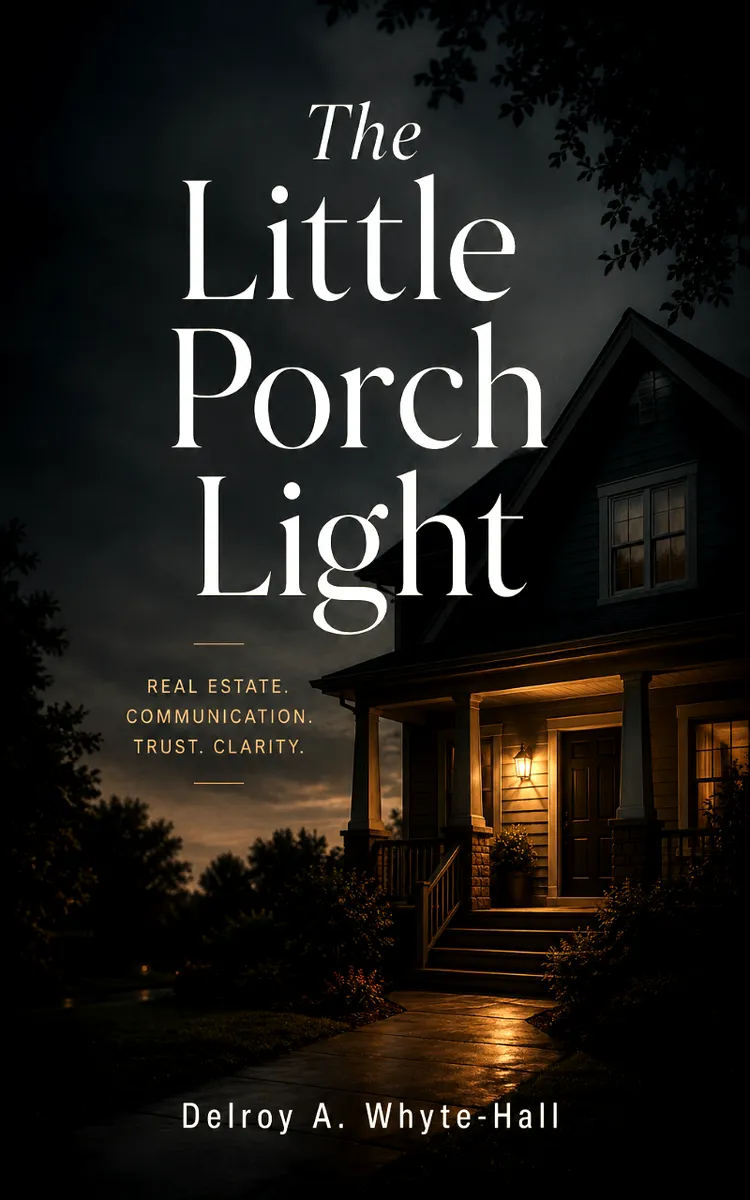
A porch light does not sell the house. It does not explain the square footage, list the upgrades, describe the roof, count the bedrooms, or tell anyone whether the kitchen was redone last year. But when someone is feeling for the front door in the dark, that small light is the thing that matters. It gives them a direction.
That is how good communication works in real estate. It is not the whole service. It does not replace pricing skill, market knowledge, negotiation, preparation, or the way you take care of a client. But without clear communication, most of that work stays hidden. It gets misunderstood. It gets undervalued by the very people who most needed to see it.
The light never becomes the house. It only helps people arrive at the house with less confusion. Writing works the same way. It does not replace the work behind a listing, a deal, an update, or a reputation. It helps the reader reach that work already knowing what they are looking at.
THE FIRST JOB OF REAL ESTATE WRITING
Most people think the job of real estate writing is to promote. The listing should make the home sound impressive. The bio should prove experience. The post should grab attention. The email should sound professional enough to settle the client down. Those things have their place. None of them is the first job.
The first job is to help the reader understand. A buyer shows up with questions. A seller shows up with pressure, expectation, or worry. A client shows up with a half-formed concern they cannot quite put into words yet. The agent may have all the knowledge, experience, and responsibility in the world, and none of it helps enough if the words never give the reader a place to stand.
That is where so many real estate messages fall short. They hand over information and call it direction. They list features and call it understanding. They announce the result and skip what had to be handled to get there. They introduce the agent and never show the reader why that person can be trusted with a serious decision. The words are all on the page. The light is the part that is missing.
THE READER NEEDS ORIENTATION
Most real estate communication is not really writing in the decorative sense. It is orientation. The reader needs to know what they are looking at, why it matters, what happened, what was done, and what they should understand next.
That holds for all of it. A listing description. A buyer update. A seller letter. A market note. A press release. A profile. A short post about a closed deal. Each one has its own purpose, and each one carries the same plain responsibility underneath. It should leave the reader less lost than they were before they started reading.
That sounds simple. It is also the line between a message that gets passed over and one that builds trust. People do not need every fact at once. They need the right facts in the right order, with enough explanation to know why each one belongs there.
CONFUSION DOES NOT ALWAYS SPEAK
People rarely announce their confusion. A buyer does not write back to say the listing failed to help them picture the home. They just scroll past it and keep looking. A seller does not say the update gave them information but no meaning. They just ask the same question again a week later, with a little more tension in their voice.
That silence is expensive. It costs attention, trust, momentum, and sometimes the deal itself. In real estate, uncertainty almost never knocks on the door and introduces itself. It shows up sideways. The buyer does not book the showing. The seller keeps fishing for reassurance. The client stalls. The prospect reads the profile and never reaches out.
From the outside, the message looked fine. The grammar was clean. The tone was professional. The facts were correct. But if the reader was left to guess at the meaning, the communication never finished its job.
INFORMATION IS NOT GUIDANCE
Information hands the reader the pieces. Guidance shows them how the pieces fit. That difference matters, because real estate decisions are almost never made from facts alone. They are made from facts that someone explained clearly enough to become useful.
A listing can say a home has an open kitchen, new flooring, a fenced yard, and a finished basement. Those facts help, but they are not enough on their own. The reader still needs to feel how the home lives, how the rooms connect, why any of it would matter on an ordinary Tuesday. A bio can say the agent has years of experience and a long list of happy clients. Maybe so, but the reader still needs to know how that experience shows up when the deal turns hard. A market update can report inventory, price movement, and days on market, and still leave the reader needing someone to tell them what those numbers mean for their timing, their strategy, their expectations.
Information points at the pieces. Guidance shows the reader the picture.
THE LITTLE PORCH LIGHT
The little porch light is how I think about communication that does not shout, chase, or perform. It just helps people see. It makes the entrance visible. It gives the reader a reason to keep walking. It turns a dark approach into something that feels more like a path.
That is what this book is about. Not tricks. Not slogans. Not clever lines written to impress other people in the industry. It is about the quieter work underneath real estate communication. The sentence that explains what happened. The paragraph that answers a reader's question before they have to ask it twice. The description that lets a buyer picture the home. The profile that lets a client understand the person behind the license.
It is also about the public-facing work that gives meaning to effort that would otherwise go unseen. A closed deal, a hard negotiation, a carefully prepared listing, a steady stream of client updates. All of it can lose its value when the writing around it is too thin to carry the weight.
TRUST OFTEN BEGINS BEFORE THE MEETING
In real estate, trust usually starts before anyone meets in person. It starts in the way something is written, organized, explained, and laid out. The reader notices whether the message feels clear. They notice whether the details are arranged in a way that makes sense. They notice whether the words answer the question they actually had, not just the question the writer felt like answering.
Good communication does not make the reader work too hard. It does not leave them sorting through scattered details, deciding for themselves what matters. It opens the door by making the next step easier to see.
And before the door opens, there should be a light.
End of chapter one. 6 more chapters in the full book.
Swipe or use the arrows to turn the page


What's inside: 7 chapters
- 1. The Light That Helps People Arrive
- 2. When the Reader Gets Lost
- 3. What the Words Must Carry
- 4. The Listing Needs a Path
- 5. The Bio Must Build Trust
- 6. The “Just Sold” Post Must Show the Work
- 7. Clear Words Protect the Relationship
About this book
"The Little Porch Light" is a general book by Delroy A. Whyte-Hall with 7 chapters and approximately 10,316 words. It covers key insights and practical takeaways on the topic.
This book was created using Inkfluence AI, an AI-powered book generation platform that helps authors write, design, and publish complete books.
Frequently Asked Questions
What is "The Little Porch Light" about?
"The Little Porch Light" is a general book by Delroy A. Whyte-Hall covering key insights and practical takeaways on the topic.
How many chapters are in "The Little Porch Light"?
The book contains 7 chapters and approximately 10,316 words. Topics covered include The Light That Helps People Arrive, When the Reader Gets Lost, What the Words Must Carry, The Listing Needs a Path, and more.
Who wrote "The Little Porch Light"?
This book was written by Delroy A. Whyte-Hall and created using Inkfluence AI, an AI book generation platform that helps authors write, design, and publish books.
Write your own book with AI
Describe your idea and Inkfluence writes the whole thing. Free to start.
Start writingCreated with Inkfluence AI


