
Read the first chapter
The whole of chapter one, free. About 9 min. Turn the pages with the arrows, your keyboard, or a swipe.
Chapter 1
The Empty Pumpkin Shed
Rain ticked against the allotment shed roof, one sharp drop after another, while Eliza Hart fumbled the iron key into the lock. Beyond the fence, the village lamps shone in blurred gold puddles, and the church clock began striking eight.
“Come on,” she whispered. “Not tonight.”
The key turned at last, but the door did not move. It had swollen in the damp, its lower edge wedged against the muddy ground. Eliza set down her lantern, tucked her skirts above her boots, and leaned her shoulder into the planks.
The door gave a groan.
“So much for being early,” she muttered.
Tomorrow morning, before the first bell, she meant to roll the prize pumpkin to the fairground herself. It had taken three months of careful watering, sheltering, and coaxing to grow it. The pumpkin was the largest ever raised in Bellwether, a great golden globe with a green stem thick as her wrist. The judges had already awarded it the blue ribbon at the weighing, and Eliza had promised the fair committee it would stand beneath the striped tent until the final judging.
Tonight, she only needed to check the lock, make sure the tarpaulin was tight, and go home before the rain soaked through her coat.
She pushed again.
Mud sucked at her boots. The door shuddered but held.
A gust of wind rattled the bare bean poles behind her. Somewhere down the lane, a loose sheet of tin clanged against a fence.
Eliza lifted the lantern and examined the gap beneath the door. Brown water had crept inside, carrying leaves and grit. She lowered the lantern farther.
Something pale showed beyond the threshold.
Not the pumpkin. A torn sack, perhaps.
She straightened and looked toward the lane. The allotments lay at the far edge of Bellwether, past the last cottages and the old mill road. In daylight, the walk was pleasant enough. At night, with the rain coming sideways and the lane swollen into a ribbon of mud, it felt a long way from every friendly window.
She tried the key again, though she knew the lock was open.
“Mrs. Hart?”
Eliza turned sharply.
A figure stood beyond the gate, wrapped in a dark waterproof cape. For one startled instant, she thought it was Jonah Pike, the fair steward, but the figure lifted a lantern and revealed Mr. Pritchard from the next allotment, his white beard dripping beneath his cap.
“You’ll need a bar,” he called. “That door’s stuck fast.”
“I have no bar.”
“Use the spade.”
“The prize pumpkin is in there.”
“Then you’d better use something stronger than a spade.”
He came squelching up the lane, each step making a wet sucking sound. Eliza watched him glance at the shed, then at her boots. His eyes lingered on the mud.
“Were you expecting trouble?” he asked.
“I was expecting a door.”
“That isn’t what I asked.”
Eliza picked up the lantern. “I’m checking the pumpkin before the fair.”
“Still guarding it like a queen’s crown?”
“It is worth more than most crowns in Bellwether.”
Mr. Pritchard gave a humorless chuckle. “That’s what makes people careless.”
She did not answer. He had been one of the gardeners who complained when the pumpkin won the village prize. His own marrow had come second, and he had said the judges were dazzled by size.
Eliza seized the shed’s iron spade and slid its blade into the gap. Mr. Pritchard wedged his shoulder against the door beside her.
“On three,” he said. “One. Two - ”
The spade slipped. Eliza staggered, catching herself against the wall. The lantern swung from her hand, throwing wild light over the shed and the lane.
“Try again,” she said.
The second time, the swollen wood cracked free with a sharp snap. The door lurched inward.
Cold air rolled out of the shed.
Eliza raised the lantern.
The shelf of seed jars stood undisturbed. The coils of hose hung from their hooks. A stack of empty crates leaned against the back wall. Rain drummed on the roof, and water tapped steadily into a bucket near the corner.
The pumpkin’s place was empty.
For a moment, Eliza could not make sense of what she was seeing. The straw beneath the tarpaulin lay flattened in a wide circle, as though the pumpkin had only just been lifted. One of the blue ribbon’s pins remained caught in the cloth.
“No,” she said.
Mr. Pritchard stepped behind her. “What is it?”
She moved into the shed, lantern held high. Her boot struck the wooden platform where the pumpkin had rested. The boards were damp, but there was no split plank, no sign that it had rolled away by itself.
“No,” she said again, louder this time. “It was here.”
Mr. Pritchard peered beneath the workbench. “Perhaps you put it somewhere else.”
“I did not.”
“You’ve been working yourself thin over that thing.”
“I did not.”
Her voice cracked across the small shed. Mr. Pritchard fell silent.
Eliza reached for the tarpaulin and pulled it aside. A dark smear marked the floorboards. Mud. Fresh mud, still glossy in the lantern light.
She crouched and touched it with one finger.
Cold grit pressed into her skin.
The pumpkin had not vanished. Someone had taken it.
Mr. Pritchard drew a breath. “The lock was on?”
“Yes.”
“Then whoever took it had a key.”
Eliza looked at the lock. The iron was scratched around the keyhole, but the hasp was intact. She lifted it, turned it over, and found a thin crescent of mud along the underside.
“Or they forced the door before it swelled,” she said.
“And you didn’t hear?”
“I was at home.”
“Where?”
Eliza rose slowly. “At home.”
Mr. Pritchard’s face tightened. He did not need to say what he was thinking. The pumpkin had been her responsibility. The shed had been locked in her care. If it was gone, the first questions would not be asked of the rain or the darkness.
They would be asked of her.
A sharp whistle sounded from the lane.
Eliza turned. Three lanterns bobbed beyond the gate, followed by the pale beam of a bicycle lamp. Jonah Pike came first, his fair steward’s sash hidden beneath a wool coat. Behind him were Ada Bell, the committee treasurer, and Councillor Morris, who had promised to inspect the fair tents before bed.
Jonah stopped when he saw the open shed.
“What happened?” he called.
Eliza stepped into the doorway. Rain ran from her hair down the back of her neck.
“The pumpkin is gone.”
Ada Bell gave a small, frightened cry. Councillor Morris swore under his breath.
Jonah came closer. “Gone where?”
“That is what I intend to find out.”
“Intend?” Ada said. “Eliza, the fair opens at nine.”
“I know when the fair opens.”
“And the pumpkin was entered under your name.”
“I know that too.”
Jonah held up a hand. “Let her look first.”
Ada’s gaze moved from Eliza to the muddy floor. “Look at what? There’s nothing here.”
“Exactly,” said Mr. Pritchard.
The word settled among them like another weight of rain.
Eliza stepped outside and raised her lantern toward the lane. The ground between the shed and the gate had become a churned brown strip. At first, she saw only puddles and the deep marks left by her own boots. Then the lantern caught a line of darker impressions beyond the side fence.
She pushed through the dripping nettles.
“Mrs. Hart,” Jonah called. “Where are you going?”
“Downhill.”
The muddy lane sloped away from the allotments toward the old mill. Under the hedge, sheltered from the worst of the rain, lay a trail of broad, broken tracks. Two narrow wheel marks ran beside them.
Eliza knelt.
The prints were not from boots. They were long, uneven gouges in the mud, with a smooth ridge between them. Something round and heavy had been dragged or rolled down the lane. At intervals, a bootprint appeared beside the marks. The heel had pressed deeply into the mud.
Someone had struggled with the pumpkin.
Behind her, the committee crowded through the gate.
Ada stared at the tracks. “That leads to the mill.”
“Yes.”
“Why would anyone take it there?”
Eliza stood. “That is what I mean to discover.”
Councillor Morris caught her arm. “You are not going down there tonight.”
She looked at his hand until he released it.
“The pumpkin is missing,” she said. “The mill road is the only lead we have.”
“The road is flooded.”
“Then I’ll get wet.”
“This is no time for stubbornness.”
“It stopped being a matter of stubbornness when someone broke into the shed.”
Jonah moved between them. His face, usually easy and cheerful, had gone pale. “Eliza, wait.”
She turned on him. “If you want an explanation, help me find one.”
“I want the pumpkin found before half the village hears it’s gone.”
“Half the village will hear it whether we find it or not.”
Ada’s voice sharpened. “They will hear that the gardener entrusted with the prize let it disappear.”
Eliza felt the words land harder than the rain.
For years, she had tended the allotments while other people praised the neat rows and bright flowers from the lane. She had learned to mend broken fences, drive off rabbits, and coax seedlings through late frosts. She had thought the pumpkin was proof that patient work could survive village gossip.
Now Ada was looking at her as though the missing pumpkin were a debt Eliza had chosen not to pay.
“Are you accusing me?” Eliza asked.
“I am asking how a locked shed became empty.”
“Ask the person who took it.”
“Perhaps we are asking the wrong person.”
Jonah’s head snapped toward Ada. “Enough.”
The rain thickened, pattering on the lantern glass. Downhill, the old mill stood black against the low clouds, its broken wheel barely visible through the mist.
Eliza looked at the tracks again. Near the hedge, one of the pumpkin’s pale scrapes curved sharply, as though whoever moved it had stopped and changed direction. A torn thread of blue clung to a thorn.
She reached for it, but the thread slipped loose and vanished into the mud.
“We need to preserve the tracks,” Jonah said.
“Preserve them?” Eliza almost laughed. “The rain is washing them away.”
He glanced toward the mill, then back at the gathered faces. “I’ll come with you.”
“You’ll come to explain to the committee why the prize pumpkin is missing?”
“I’ll come because I’m steward of the fair.”
“And if we find nothing?”
Ada answered before Jonah could. “Then the committee will have to decide whether your entry remains in the competition.”
Eliza stared at her.
The blue ribbon pinned inside the shed seemed suddenly brighter than it had any right to be. It rested on the floor beside the empty straw, its edge damp and darkened.
Her reputation was already being dragged down the hill with the pumpkin.
She picked up the lantern and stepped onto the muddy lane.
“Fine,” she said. “We follow the tracks.”
Jonah caught up with her at the gate. “Eliza - ”
“No promises about keeping this quiet,” she said. “Not yet.”
“I wasn’t going to ask for one.”
“You were thinking it.”
He looked toward the committee, where Ada and Councillor Morris stood beneath their umbrellas. “If the village hears before we know what happened, they’ll make up the story for us.”
“They’ve started already.”
The lane dipped sharply. Eliza took one careful step, then another. Mud slid beneath her boots, and the lantern flame trembled in its glass. Behind her, the others followed, their voices low and uneasy.
At the bend, she stopped.
The tracks continued downhill toward the old mill, fresh enough that rain had not yet softened their edges. Beside them lay a deep, square impression in the mud, as if someone had set down a wooden crate.
Then a voice called from above.
“Mrs. Hart!”
Eliza turned.
Ada stood at the shed gate, one hand gripping her umbrella, the other pointing toward the open doorway.
“Come back,” she called. “The committee wants an explanation now.”
Eliza looked from Ada to the dark road descending toward the mill. The evidence was disappearing beneath the rain, but the questions were gathering behind her.
She tightened her grip on the lantern.
“I’m going to find the pumpkin,” she said.
Ada’s voice carried down the lane. “And if you don’t?”
Eliza faced the old mill.
“Then I’ll find whoever did.”
End of chapter one. 4 more chapters and about 9,662 words in the full book.
Swipe or use the arrows to turn the page
What's inside: 5 chapters
- 1. The Empty Pumpkin Shed
- 2. A Promise Before Dawn
- 3. Tracks Beneath the Mill
- 4. The Ledger’s Missing Name
- 5. The Lanterns Go Dark
About this book
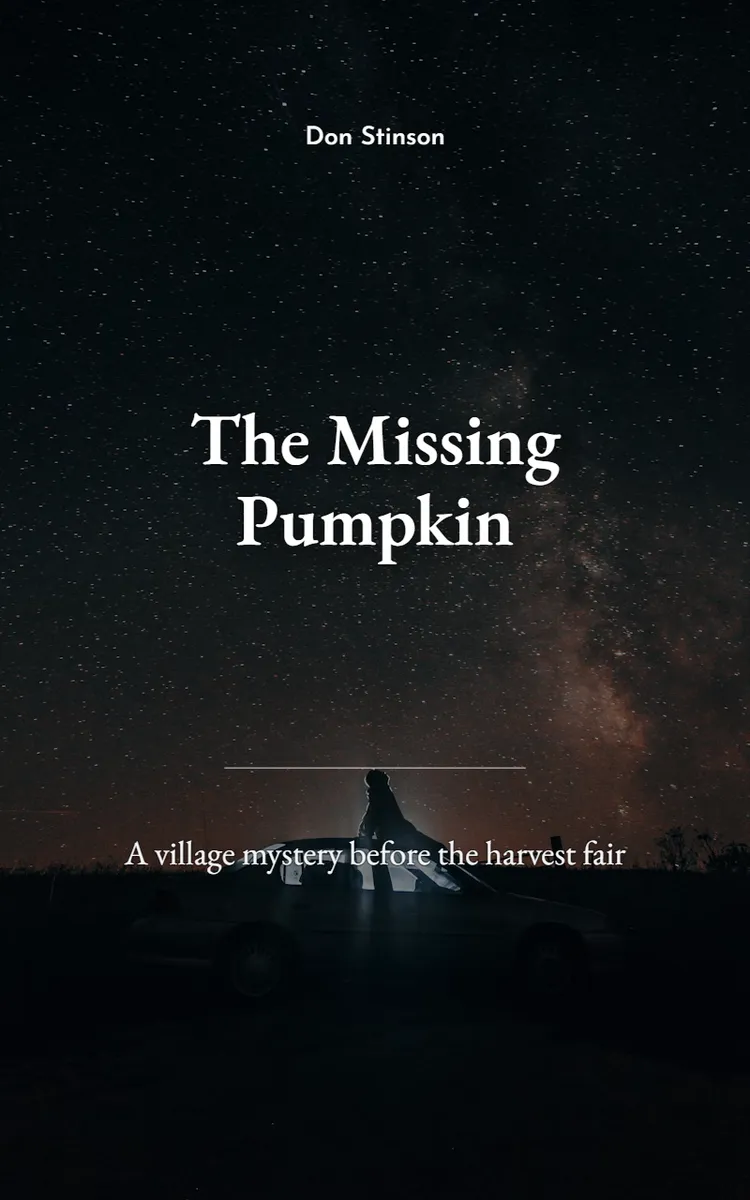
"The Missing Pumpkin" is a fiction book by Don Stinson with 5 chapters and approximately 9,662 words. A village investigates the disappearance of its prize-winning pumpkin before the harvest fair.
This book was created using Inkfluence AI, an AI-powered book generation platform that helps authors write, design, and publish complete books. It was made with the AI Novel Writer.
Frequently Asked Questions
What is "The Missing Pumpkin" about?
A village investigates the disappearance of its prize-winning pumpkin before the harvest fair
How many chapters are in "The Missing Pumpkin"?
The book contains 5 chapters and approximately 9,662 words. Topics covered include The Empty Pumpkin Shed, A Promise Before Dawn, Tracks Beneath the Mill, The Ledger’s Missing Name, and more.
Who wrote "The Missing Pumpkin"?
This book was written by Don Stinson and created using Inkfluence AI, an AI book generation platform that helps authors write, design, and publish books.
How can I create a similar fiction book?
You can create your own fiction book using Inkfluence AI. Describe your idea, choose your style, and the AI writes the full book for you. It's free to start.
Write your own fiction book with AI
Describe your idea and Inkfluence writes the whole thing. Free to start.
Start writingCreated with Inkfluence AI


