

Read the first chapter
The whole of chapter one, free. About 5 min. Turn the pages with the arrows, your keyboard, or a swipe.
Chapter 1
Classic Beginner Sourdough Boule
At a Glance
Prep: 45 min | Cook: 45 min | Total: 12 hr 30 min | Serves: 8 | Difficulty: Easy
Introduction
This classic beginner sourdough boule has a crisp, crackly crust and a chewy center with a mild tang. You will build the dough with an active starter, mix it by hand, and use a simple bulk fermentation rather than relying on complicated timing or advanced shaping.
The key is learning to read the dough. During bulk fermentation, it should become smoother, slightly puffy, and dotted with small bubbles. Baked in a preheated Dutch oven, the boule holds its shape and develops the deep golden crust that makes sourdough so satisfying.
This recipe assumes you already have a sourdough starter. If your starter has been refrigerated, feed it before beginning and use it when it is bubbly, risen, and smells pleasantly sour rather than sharply acidic. Your practical goal is simple: an active starter, a dough that has risen enough, and a fully baked loaf.
Ingredients
• 100 grams active sourdough starter - 350 grams lukewarm water, about 80°F - 500 grams unbleached bread flour - 10 grams fine sea salt - Rice flour or additional bread flour, for dusting - 1 teaspoon olive oil, for the bowl
Instructions
1. Check and prepare the starter. Feed your starter 4-8 hours before mixing, depending on room temperature. It is ready when it has doubled in size, looks airy, and a small spoonful floats briefly in water. This floating test is only a guide; the starter’s rise and bubbles are more useful signs.
2. Mix the dough. In a large bowl, stir together 100 grams active starter and 350 grams lukewarm water until mostly dissolved. Add 500 grams flour and mix with your hand or a sturdy spoon until no dry flour remains. Cover and rest for 30 minutes. This rest lets the flour absorb water and makes the dough easier to handle.
3. Add the salt. Sprinkle 10 grams salt over the dough. Wet your hand, pinch and fold the dough repeatedly until the salt is evenly distributed. The dough may feel sticky at first, but it should begin to feel more elastic after a few minutes of folding.
4. Begin bulk fermentation. Lightly oil the bowl, return the dough to it, and cover. Leave it at about 75-78°F for 4-6 hours. For the first 2 hours, perform a set of stretch-and-folds every 30 minutes: grab one side of the dough, stretch it upward without tearing, and fold it across the center. Turn the bowl and repeat three more times.
Pro Tip: Room temperature controls the schedule. In a cool kitchen, bulk fermentation may take 6-8 hours; in a warm kitchen, it may finish in 3-4 hours. Watch the dough rather than the clock.
5. Judge the end of bulk fermentation. Stop when the dough has increased by about 50-75 percent, looks smoother, and has bubbles along the sides or underneath. It should wobble gently when you move the bowl. Do not wait for it to double completely, or the dough may become weak and difficult to shape.
6. Shape the boule. Lightly flour the counter and turn out the dough. Fold the top third toward the center, then fold in the sides. Roll or fold the dough toward you to create a round. Use lightly floured hands to drag the dough across the counter in short movements, building surface tension. The finished round should feel supported and hold its shape.
7. Proof the shaped dough. Place the boule seam-side up in a floured proofing basket or a bowl lined with a well-floured clean towel. Cover and refrigerate for 8-12 hours. The cold rest improves flavor and makes the dough easier to score. If you prefer to bake the same day, proof at room temperature for 1-2 hours, until the dough looks puffy and slowly springs back when pressed.
8. Preheat the oven and Dutch oven. Place a Dutch oven with its lid inside the oven and heat to 475°F for at least 45 minutes. Carefully turn the cold dough onto parchment paper. Score one deep slash across the top with a bread lame or very sharp knife. A single slash about ½ inch deep gives the loaf room to expand.
9. Bake and cool. Lower the dough into the hot Dutch oven, cover, and bake at 475°F for 20 minutes. Remove the lid, reduce the temperature to 450°F, and bake for another 20-25 minutes, until the crust is deep golden brown. The loaf should sound hollow when tapped, or register about 205-210°F in the center. Cool on a rack for at least 1 hour before slicing.
Chef Notes & Variations
Store the cooled boule at room temperature in a paper bag or wrapped in a clean kitchen towel for up to 2 days. Avoid sealing it in plastic while the crust is crisp, because trapped moisture softens the exterior. For longer storage, slice the completely cooled bread, place the slices in a freezer bag, and freeze for up to 3 months. Rewarm slices in a toaster or a 350°F oven.
Serve thick slices with butter, soup, eggs, or olive oil and salt. For a practical variation, add 1 tablespoon dried rosemary and 75 grams grated Parmesan during the salt step. The cheese may brown quickly, so check the uncovered loaf several minutes early. Ask yourself before baking: has the dough risen enough to look airy, but still strong enough to hold a rounded shape?
Swap It: If you do not have bread flour, use all-purpose flour. The dough may spread slightly more, so handle it gently and use the same visual cues for fermentation.
Quick Version
Mix 100 g active starter, 350 g water, 500 g flour, and 10 g salt; rest, stretch-and-fold during a 4-6-hour bulk rise, shape, and refrigerate 8-12 hours. Score and bake in a preheated Dutch oven at 475°F covered for 20 minutes, then 450°F uncovered for 20-25 minutes; cool 1 hour before slicing.
End of chapter one. 11 more chapters and about 12,828 words in the full book.
Swipe or use the arrows to turn the page


What's inside: 12 chapters
- 1. Classic Beginner Sourdough Boule
- 2. No-Knead Sourdough Sandwich Bread
- 3. Sourdough Cinnamon Swirl Bread
- 4. Sourdough Garlic Knots
- 5. Sourdough Cheddar Jalapeño Loaf
- 6. Sourdough Pizza Dough with Levain
- 7. Sourdough Focaccia with Rosemary
- 8. Sourdough Pretzels with Baking Soda Bath
- 9. Sourdough Pancakes with Discard
- 10. Sourdough Waffles with Crisp Edges
- 11. Sourdough Apple Galette with Crust
- 12. Sourdough Chocolate Chip Cookies with Discard
About this book
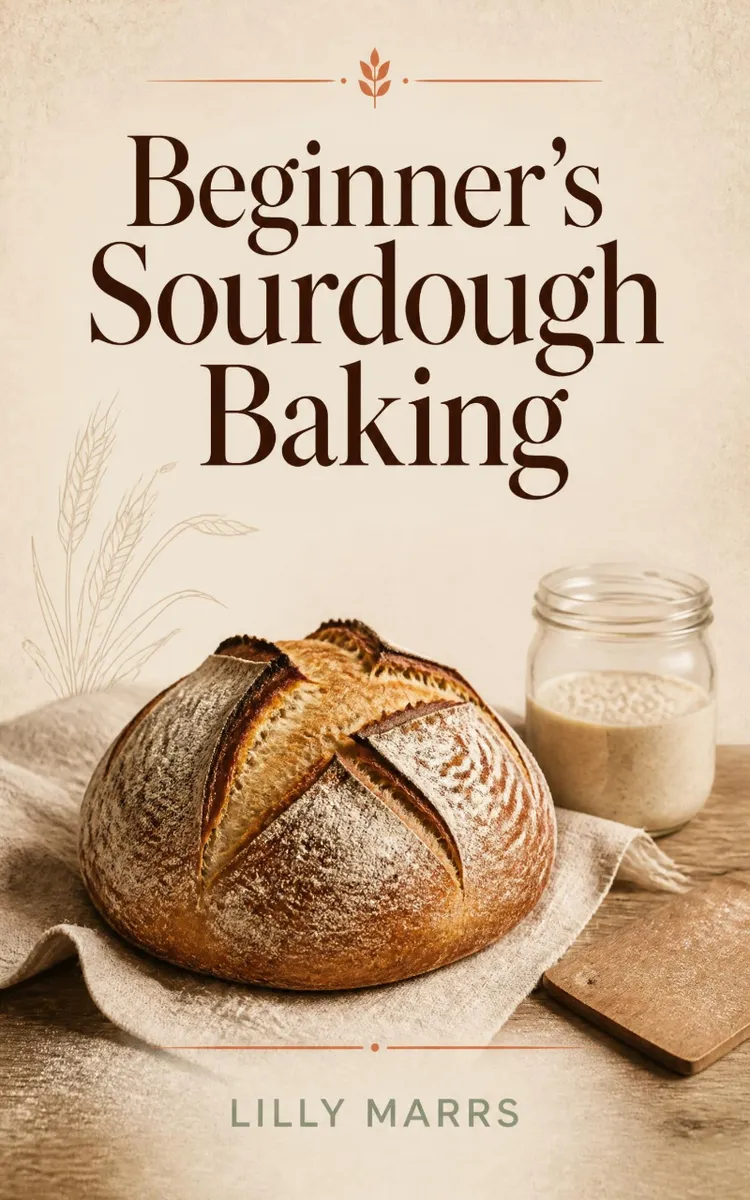
"Beginner's Sourdough Baking" is a cookbook by Lilly Marrs with 12 chapters and approximately 12,828 words. Baking sourdough bread for beginners.
This book was created using Inkfluence AI, an AI-powered book generation platform that helps authors write, design, and publish complete books. It was made with the AI Cookbook Generator.
Frequently Asked Questions
What is "Beginner's Sourdough Baking" about?
Baking sourdough bread for beginners
How many chapters are in "Beginner's Sourdough Baking"?
The book contains 12 chapters and approximately 12,828 words. Topics covered include Classic Beginner Sourdough Boule, No-Knead Sourdough Sandwich Bread, Sourdough Cinnamon Swirl Bread, Sourdough Garlic Knots, and more.
Who wrote "Beginner's Sourdough Baking"?
This book was written by Lilly Marrs and created using Inkfluence AI, an AI book generation platform that helps authors write, design, and publish books.
How can I create a similar cookbook?
You can create your own cookbook using Inkfluence AI. Describe your idea, choose your style, and the AI writes the full book for you. It's free to start.
Write your own cookbook with AI
Describe your idea and Inkfluence writes the whole thing. Free to start.
Start writingCreated with Inkfluence AI


