
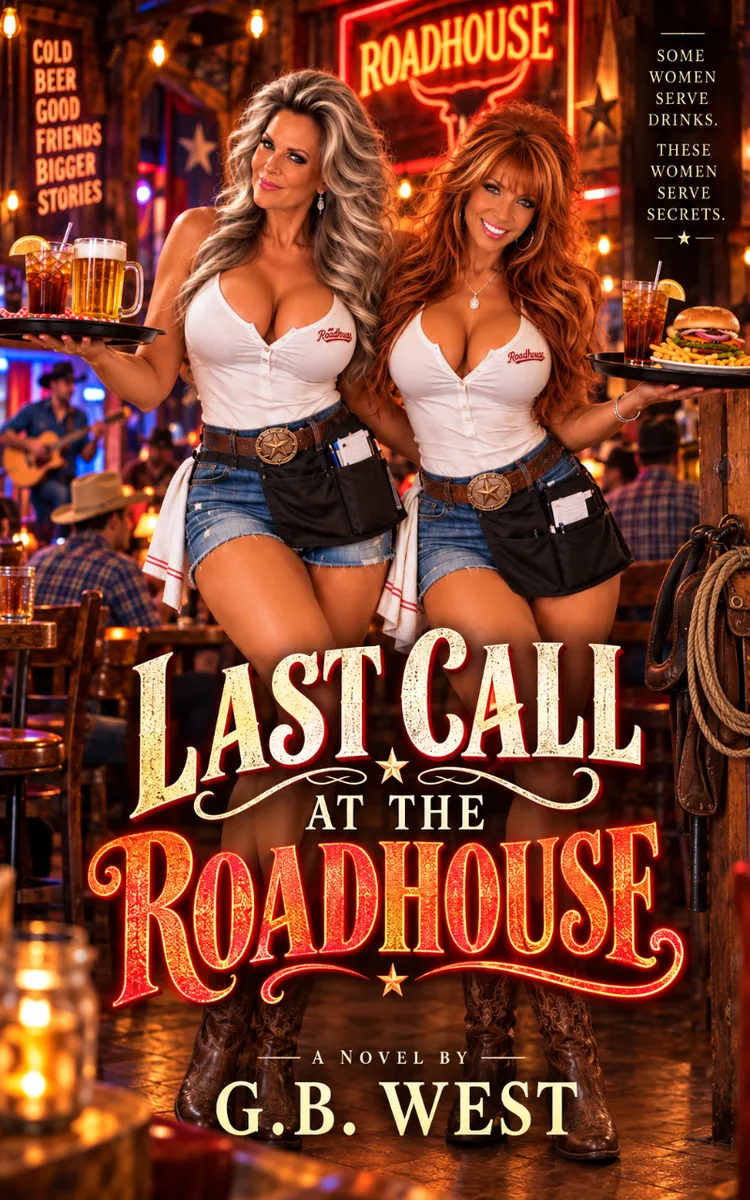
Read the first chapter
The whole of chapter one, free. About 7 min. Turn the pages with the arrows, your keyboard, or a swipe.
Chapter 1
The Photograph in the Envelope
The neon beer sign above Booth Seven flickered every time the ice machine kicked on, turning the Last Chance Roadhouse red, then black, then red again.
“Victoria, table twelve needs coffee,” Ruby Dawson called from behind the counter.
“I heard you the first time.”
“You’re sixty-seven, not deaf.”
“Give me another decade.”
Victoria lifted the stainless-steel pot and threaded through the Friday-night crowd. Boots scraped across the worn concrete floor. A jukebox sang an old country song beneath the racket of plates, laughter, and the kitchen bell. Outside the broad windows, headlights streamed along the highway west of Fort Worth, each car flashing across the walls like a passing thought.
She had one job tonight: keep the shift moving.
That was all she wanted. Four hours without a broken glass, a drunk cowboy, or some well-dressed stranger asking whether she was the Victoria Steele whose husband had died under suspicious circumstances five years ago. Four hours of coffee refills and hot plates, followed by a bourbon with Ruby after closing.
Routine had become a kind of shelter.
At table twelve, a rancher in a pearl-button shirt held out his mug. “Fill her up, darlin’.”
“Black?”
“Unless you’ve got cream that doesn’t taste like regret.”
“Ruby keeps that in a locked cabinet.”
The rancher laughed. Victoria poured. Her white top was already damp between her shoulder blades, and the leather of her boots pinched her left heel. She ignored both. The room was too full to indulge discomfort.
Near the entrance, the bell over the door gave a thin jangle.
Victoria glanced up.
The man who entered looked as if he had taken a wrong turn from a private club. His silver hair was combed neatly back, and his dark suit fit him so well it might have been sewn onto his shoulders. Even from across the room, Victoria could see the fine wool and the gleam of his watch. He paused just inside, surveying the roadhouse as though deciding whether the noise was worth tolerating.
Ruby noticed him too.
For one brief second, the color in her red-haired face sharpened. Then she reached for a menu.
“Table three,” Ruby said. “I’ll take him.”
“You’re the owner,” Victoria said. “You don’t wait tables.”
“I’m making an exception.”
That caught Victoria’s attention. Ruby Dawson had been married three times, and she treated every man who walked through the door as either a future husband or a future story. But she did not make exceptions for strangers in ten-thousand-dollar suits.
Ruby stepped from behind the counter.
The man chose a booth along the wall instead of waiting to be seated. He removed his jacket with careful movements and laid it beside him. When Ruby approached, he looked at her for a long moment.
“Bourbon,” he said.
“We have several.”
“Whatever you pour for yourself.”
Ruby’s smile did not reach her eyes. “You’ve been here before?”
“No.”
“Then you’re in for a surprise.”
She turned toward the bar. Victoria watched her pour two fingers into a heavy glass. Ruby carried it to the booth herself, though the kitchen bell rang twice and table eight waved for ketchup.
The stranger lifted the glass but did not drink.
Victoria told herself to return to work. She collected empty plates, delivered chicken-fried steak, settled a dispute over a missing side of beans. Still, her gaze kept drifting toward the booth.
The man finally drank. Then he set a hundred-dollar bill beneath the glass.
Ruby saw it. So did Victoria.
Ruby’s expression tightened.
When the stranger raised two fingers, Victoria moved before Ruby could stop her. She picked up the bourbon bottle and crossed the room.
“Need another?”
“No.” His voice was smooth, almost gentle. “I need you.”
Victoria stopped beside the booth.
Ruby had turned away, but not far enough. She was listening.
The man reached inside his jacket and brought out a cream-colored envelope. He held it between two fingers.
“For Victoria Steele.”
The room seemed to contract around her.
“Who are you?”
“Someone who knows the photograph will matter to you.”
Victoria did not take the envelope. “What photograph?”
His gaze flicked toward Ruby, then back. “Open it somewhere private.”
“Then you can give it to me somewhere private.”
A faint smile touched his mouth. “You still have your husband’s eyes.”
The glass in Victoria’s hand trembled. She set the bottle on the table before she dropped it.
“My husband is dead.”
“That is the accepted account.”
Ruby appeared beside them. “Victoria, table six is waiting.”
The stranger slid the envelope across the table. “Three days ago.”
Victoria stared at it.
“Who sent you?” she asked.
The man stood. He left the hundred-dollar bill beneath his untouched bourbon and buttoned his jacket.
“Ask Ruby,” he said.
Then he walked out.
The bell jingled behind him. Cold air slipped through the open door, carrying the sharp scent of gasoline and rain-damp pavement.
Victoria snatched up the envelope.
“Not here,” Ruby said.
“Who was he?”
“Not here.”
Ruby caught her wrist. Her fingers were strong, but they were cold.
That frightened Victoria more than the envelope.
A customer called for a refill. Someone at the bar shouted for another basket of fries. The kitchen bell clanged again, impatient and bright. The roadhouse swallowed the moment, forcing it beneath the ordinary noise.
Victoria tucked the envelope against her waist.
“Keep working,” Ruby said.
“You know what’s in this.”
“I know what could happen if you open it in front of half of Tarrant County.”
“Ruby.”
“Table six.”
Victoria looked toward the crowded tables, then at the door through which the stranger had vanished. Her first instinct was to follow him. Her second was to demand an explanation from Ruby. Neither would pay the bills or keep the Friday shift from collapsing.
She picked up the bourbon bottle.
“After closing,” she said.
Ruby’s face had gone pale beneath her freckles. “After closing.”
For the next hour, Victoria carried plates with the envelope pressed against her ribs. She felt its hard, flat shape beneath her uniform, a small weight that seemed to grow heavier each time she passed Ruby.
At last, the crowd thinned. A pair of truckers paid in cash. The rancher from table twelve left a five-dollar tip and a warning about the weather. Ruby locked the front door, flipped the sign to CLOSED, and killed the jukebox.
Silence did not arrive all at once. The refrigerators hummed. Grease popped in the kitchen. Somewhere outside, a truck groaned along the highway.
Victoria stood beneath the flickering beer sign.
“Now,” she said.
Ruby removed her red hair tie and let the thick pile loosen around her shoulders. She looked suddenly older than sixty, tired in a way Victoria had never seen.
“Open it,” Ruby said.
Victoria drew out the envelope. It was unsealed.
Inside was a photograph.
She pulled it free.
The picture had been taken outdoors, beneath a striped awning. A silver-haired man stood in profile beside a black sedan, one hand resting on the roof. His face was turned enough for the light to catch the familiar line of his nose, the narrow mouth, the small notch in his left eyebrow.
Her husband.
Edmund Steele had been dead for five years.
Victoria’s knees weakened. She gripped the edge of the nearest table.
“No,” she whispered.
Ruby did not answer.
Victoria brought the photograph closer. Edmund wore a charcoal coat she remembered buying in New York. He looked thinner than he had before his death, but alive. Entirely, impossibly alive.
On the back, in dark block letters, someone had written:
Ask Ruby what really happened that night.
Victoria turned slowly.
Ruby was standing behind the counter with both hands flat on the wood. The color had drained from her face.
“What does it mean?” Victoria asked.
Ruby’s eyes remained fixed on the photograph.
“You were there,” Victoria said.
“I was there?”
“The night Edmund died. You knew something.”
“Victoria - ”
“You knew something, and you let his children call me a murderer. You let his attorneys freeze every dollar I had. You watched me lose my home, my name, everything.”
“I didn’t let them do anything.”
“Then tell me what happened.”
Ruby looked toward the dark windows. Beyond them, the highway lights slid past, bright and indifferent.
Victoria turned the photograph over again. Along the lower edge, nearly hidden beneath a thumbprint, was a date.
She read it once.
Then again.
Three days earlier.
Her mouth went dry. “This was taken three days ago.”
Ruby’s lips parted, but no sound came.
“Where is he?”
“I don’t know.”
“You know enough to be afraid.”
Ruby flinched.
Victoria stepped around the counter. “What happened that night?”
Ruby backed away until the sink pressed against her hip. “I can’t tell you.”
“You can’t, or you won’t?”
Ruby looked at her then, and the friendship between them seemed to strain like an old rope pulled tight.
“I won’t,” she said.
Victoria stared at the photograph in her hand. The room that had sheltered her for five years no longer felt like shelter. It felt like a locked place, full of doors Ruby had been keeping shut.
Outside, a car slowed beside the roadhouse.
Its headlights washed across the windows and disappeared.
Victoria folded the photograph carefully and slipped it back into the envelope.
“Then I’ll find out without you.”
Ruby closed her eyes.
And for the first time in twenty years, Ruby Dawson had absolutely nothing to say.
End of chapter one. 11 more chapters and about 24,368 words in the full book.
Swipe or use the arrows to turn the page


What's inside: 12 chapters
- 1. The Photograph in the Envelope
- 2. Ruby's Midnight Confession
- 3. The Man in the Suit
- 4. The Locked Steele Estate
- 5. The Necklace She Kept
- 6. The Night Ruby Remembers
- 7. The Fortune's Missing Ledger
- 8. The Witness Who Vanished
- 9. Ruby's Last Safe Place
- 10. The Tunnel Beneath the Estate
- 11. The Living Man's Testimony
- 12. Last Call, New Terms
About this book
"Last Call At The Roadhouse" is a fiction book by G. B. West with 12 chapters and approximately 24,368 words. Two Texas waitresses uncover secrets surrounding a supposedly dead millionaire.
This book was created using Inkfluence AI, an AI-powered book generation platform that helps authors write, design, and publish complete books. It was made with the AI Novel Writer.
Frequently Asked Questions
What is "Last Call At The Roadhouse" about?
Two Texas waitresses uncover secrets surrounding a supposedly dead millionaire
How many chapters are in "Last Call At The Roadhouse"?
The book contains 12 chapters and approximately 24,368 words. Topics covered include The Photograph in the Envelope, Ruby's Midnight Confession, The Man in the Suit, The Locked Steele Estate, and more.
Who wrote "Last Call At The Roadhouse"?
This book was written by G. B. West and created using Inkfluence AI, an AI book generation platform that helps authors write, design, and publish books.
How can I create a similar fiction book?
You can create your own fiction book using Inkfluence AI. Describe your idea, choose your style, and the AI writes the full book for you. It's free to start.
Write your own fiction book with AI
Describe your idea and Inkfluence writes the whole thing. Free to start.
Start writingCreated with Inkfluence AI


