
Read the first chapter
The whole of chapter one, free. About 7 min. Turn the pages with the arrows, your keyboard, or a swipe.
Chapter 1
Card Deck Basics and Handling
Know Your Deck Before You Perform
A card fan slips apart when the cards do not match, a corner bends, and the neat deck becomes a messy pile. That small problem can make an easy trick look difficult. A few minutes of card knowledge and careful handling prevent it.
A standard deck has 52 cards. You will learn the four suits, the card values, and the order that helps you check a deck quickly. You will also practice holding, shuffling, and squaring the cards without squeezing them. These skills give you control, so your hands can focus on the trick instead of fighting the deck.
By the end, you should be able to name any card, prepare a complete deck, hold it comfortably, perform a simple shuffle, and return the cards to a tidy block. Ask yourself this question as you practice: can I handle the deck quietly and smoothly enough that people watch the cards instead of my hands?
The Ready Deck Method
The Ready Deck Method has four parts: know the cards, set the deck, hold it correctly, and keep it square. Each part solves a different problem. Card names help you follow instructions. A proper setup prevents missing or extra cards. A relaxed grip keeps cards from bending. Squaring keeps the deck ready for the next move.
Start with the card names. Each card has a value and a suit. The values are ace, 2 through 10, jack, queen, and king. The ace often counts as 1, although some tricks use it in a special way. The jack, queen, and king are called face cards because they show people.
The four suits use two colors:
• Hearts: red, with a heart symbol. - Diamonds: red, with a diamond symbol. - Clubs: black, with a three-leaf shape. - Spades: black, with a pointed symbol.
A card name combines its value and suit. For example, the red card with five heart symbols is the Five of Hearts. The black face card with a crown-like picture and a club symbol is the King of Clubs. Say the full name instead of only saying “the five,” because each value appears four times.
Use this order to check a deck:
1. Separate the suits. Make four piles: hearts, diamonds, clubs, and spades. This helps you notice a missing suit quickly. 2. Arrange each suit from ace to king. Place ace first, then 2, 3, and so on through 10, jack, queen, and king. This gives you a simple counting pattern. 3. Count each pile. Each suit should contain 13 cards. If one pile has 12, search the table and the card box before you begin. 4. Combine the piles. Place one pile on another until you have all 52 cards. The exact order does not matter for many tricks, but a known order makes checking easier. 5. Turn all cards the same way. Point every card face down with the long edges lined up. This creates a clean starting deck.
Hold the deck in your non-dominant hand, which means the hand you use less for writing or throwing. Rest the deck across your palm. Place your thumb along one long edge and your first three fingers along the opposite long edge. Let your little finger rest near the short edge. Keep your fingers curved, not stiff. Your thumb should guide the cards, not crush them.
To square the deck, tap the short edge lightly against the table, then tap one long edge. Keep the cards flat as you tap. You can also press the edges together with your fingers and thumb. The goal is a neat rectangle with no corners sticking out. A square deck shuffles more easily and gives you a clear starting point when a trick asks you to take the top card.
Practice an overhand shuffle first. Hold the deck in your non-dominant hand. With your other hand, grip the top portion by its short edges. Use your thumb to pull small groups of cards into the receiving hand. Continue until the whole deck moves. This shuffle does not need speed. Small, even groups give you better control than one large drop.
A good practice check looks like this: shuffle ten times, then square the deck. If cards fly onto the table, reduce the number of cards you pull at once. If the deck bends, loosen your grip. The cards should move in packets while staying mostly face down.
A Five-Minute Ready Deck Check
Suppose you plan to show a trick at a family table. You have one deck, five minutes, and a clear space about the size of a notebook. Use the Ready Deck Method from start to finish.
1. Check the deck for one minute. Spread the cards face up across the table. Look for all four suits and check that no card has a torn corner. Count the cards if the deck feels unusually thin. Expected outcome: you find 52 usable cards. 2. Put the deck in order for one minute. Separate the suits, arrange each suit from ace through king, and combine the piles. Place the deck face down. Expected outcome: the cards form one clean block. 3. Practice the grip for 30 seconds. Hold the deck in your non-dominant hand. Lift the top card with your other hand, then replace it. Repeat five times. Expected outcome: you can move the top card without bending its corner. 4. Shuffle for one minute. Perform an overhand shuffle using small packets. Keep the cards face down and close to the table. Expected outcome: the deck changes order while staying in your hands. 5. Square the deck for 30 seconds. Tap the short edge and then the long edge against the table. Press in the loose corners. Expected outcome: the deck looks like a tidy rectangle again. 6. Say three card names aloud. Look at three cards and name each value and suit. For example: “Ace of Spades, Ten of Diamonds, Queen of Hearts.” Expected outcome: you connect the picture and symbols with the correct names. 7. Repeat the shuffle and square once. This final round checks whether you can prepare the deck without rushing. Expected outcome: you finish with a quiet, controlled deck ready for a trick.
Quick checklist
• [ ] The deck has 52 cards. - [ ] Every card belongs to hearts, diamonds, clubs, or spades. - [ ] You can name ace, number cards, jack, queen, and king. - [ ] Your thumb rests on one long edge. - [ ] Your fingers rest on the opposite long edge. - [ ] You use small packets for an overhand shuffle. - [ ] You square the deck before and after handling it. - [ ] You keep the cards close to the table.
Notice what this practice does: it removes little pauses. You do not need to search for a missing card, adjust a bent deck, or wonder which hand should hold the cards. When your deck feels ready, your next move can look natural.
Fixing Common Handling Problems
The deck keeps slipping
A loose grip lets the cards slide, but a tight grip bends them and makes movement harder. Keep the deck low over the table so dropped cards do not scatter.
Do this: Curve your fingers around the edges, press gently with your thumb, and keep your wrist straight.
Not this: Clamp the deck between your fingertips or hold it high above the table.
Test the grip by lifting the deck one inch and lowering it again. If the cards stay together without bending, your pressure works.
The shuffle drops large chunks
Large packets make the overhand shuffle clumsy. They can also expose more cards than you want people to see. Pull smaller groups with your thumb, about three to six cards at a time.
Do this: Keep the receiving hand still and let small packets fall into it.
Not this: Yank the entire top half away in one motion.
If the cards still fall, slow down and practice with only 20 cards. Add more cards after you can move the smaller packet smoothly.
The deck will not square
Cards may stick out because you tap only one edge, or because you push too hard from different directions. Square the deck in two directions, using light taps.
Do this: Tap a short edge first, then a long edge, and press the corners together.
Not this: Slam the deck on the table or bend it to force the cards into place.
Check the corners after squaring. They should line up without white edges sticking out. If one card remains crooked, remove it, straighten it gently, and place it back.
A card name causes confusion
The four suits share the same values, so “the queen” does not identify one card. The color alone does not identify it either because hearts and diamonds are both red, while clubs and spades are both black.
Do this: Say the value and suit together: “Queen of Clubs.”
Not this: Say “the black queen” or “the queen.”
Point to the suit symbol while you say its name. That small check connects the word, color, and shape.
A clean deck and a calm grip give every trick a stronger beginning. Learn the cards, move them in small groups, and square the deck each time. Soon your hands will be ready for the next secret without drawing attention to the preparation.
End of chapter one. 7 more chapters in the full book.
Swipe or use the arrows to turn the page
What's inside: 8 chapters
- 1. Card Deck Basics and Handling
- 2. The Key Card Secret
- 3. The Simple False Cut
- 4. The Self-Working Prediction
- 5. The Rising Card Illusion
- 6. Making a Card Appear
- 7. Building a Three-Trick Routine
- 8. Performing for Friends and Family
About this book
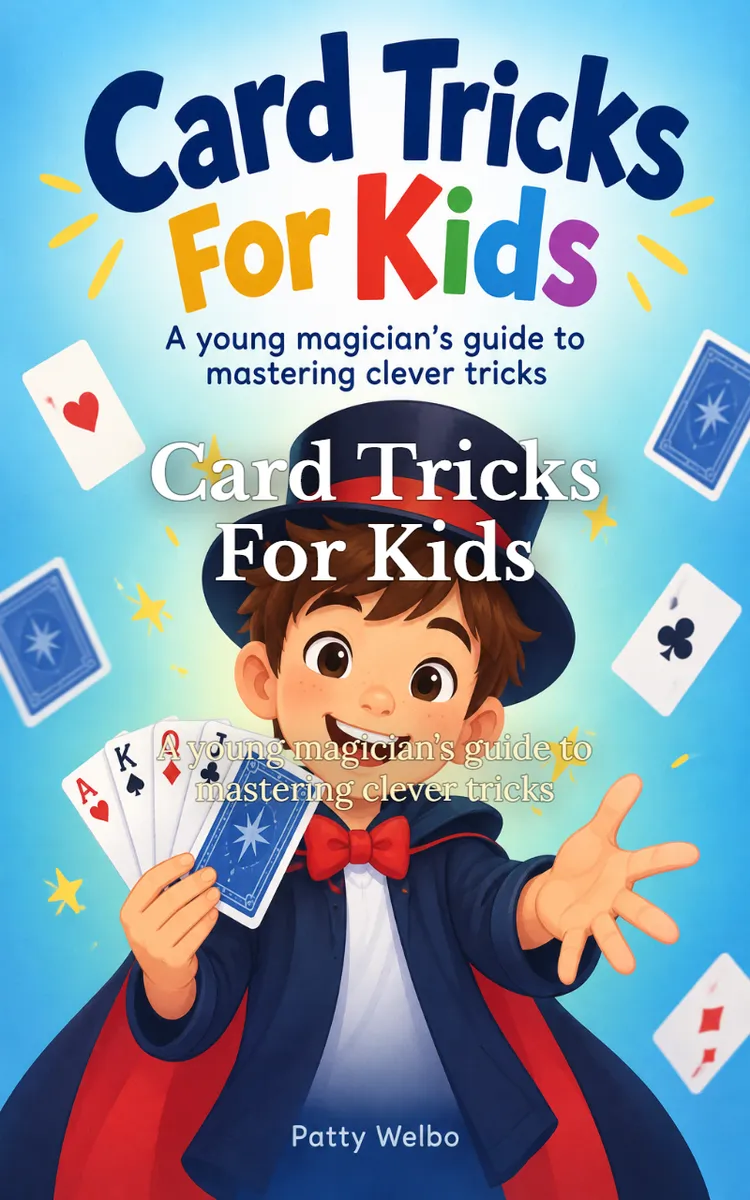
"Card Tricks For Kids" is a how-to guide book by Anonymous with 8 chapters and approximately 13,311 words. Simple card tricks and performance skills for children.
This book was created using Inkfluence AI, an AI-powered book generation platform that helps authors write, design, and publish complete books. It was made with the AI Ebook Generator.
Frequently Asked Questions
What is "Card Tricks For Kids" about?
Simple card tricks and performance skills for children
How many chapters are in "Card Tricks For Kids"?
The book contains 8 chapters and approximately 13,311 words. Topics covered include Card Deck Basics and Handling, The Key Card Secret, The Simple False Cut, The Self-Working Prediction, and more.
Who wrote "Card Tricks For Kids"?
This book was written by Anonymous and created using Inkfluence AI, an AI book generation platform that helps authors write, design, and publish books.
How can I create a similar how-to guide book?
You can create your own how-to guide book using Inkfluence AI. Describe your idea, choose your style, and the AI writes the full book for you. It's free to start.
Write your own how-to guide book with AI
Describe your idea and Inkfluence writes the whole thing. Free to start.
Start writingCreated with Inkfluence AI


