
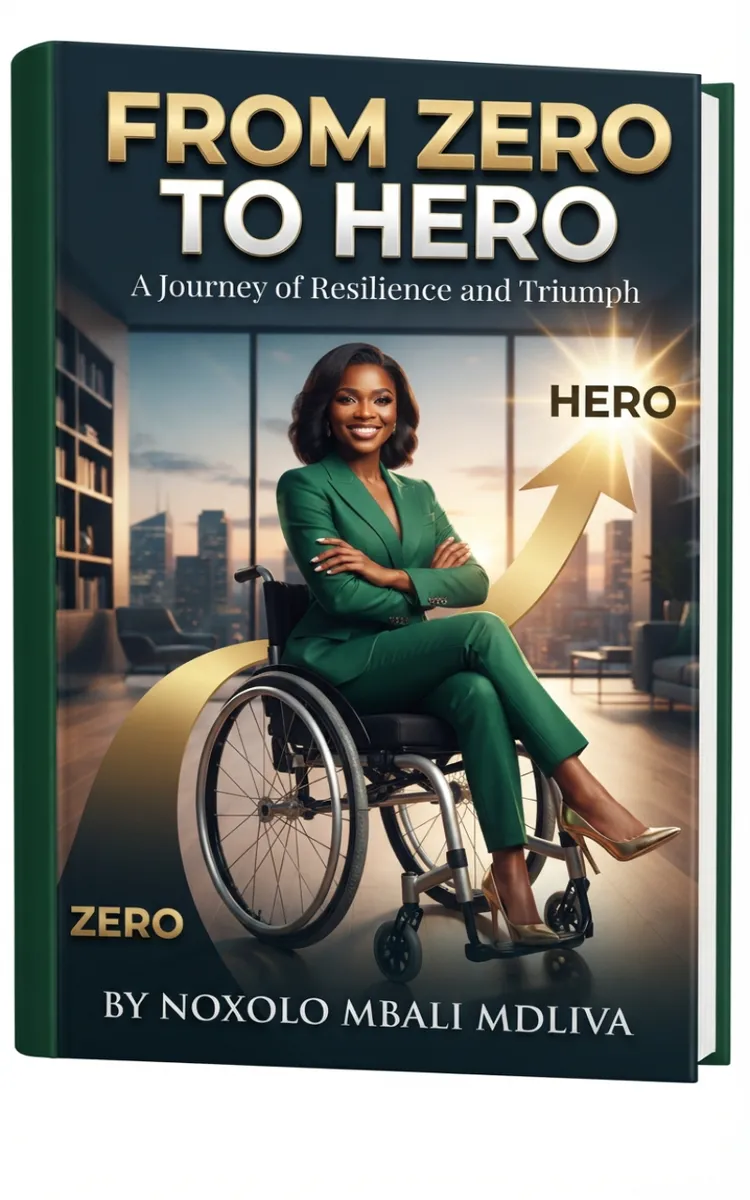
Read the first chapter
The whole of chapter one, free. About 5 min. Turn the pages with the arrows, your keyboard, or a swipe.
Chapter 1
From Hospital to Orphanage
The smell of disinfectant filled the room at Kalafong Hospital on 2 March 2000, the day Noxolo Mbali Mdliva was born. Nurses moved between the beds while rubber wheels squeaked along the polished floor. Outside, Gauteng carried on with its busy sounds, but inside the hospital, Noxolo’s first days were quiet and uncertain.
Noxolo was a vulnerable newborn. Her legs did not work like other children’s legs would, and she needed careful attention and dependable support. Instead, the people who were meant to care for her did not provide the care she needed. Her needs were not properly met, and her caregivers eventually abandoned her.
Although she was too young to understand what had happened, her body knew discomfort, hunger, and tiredness. She needed someone to notice when she needed to be held, fed, or kept warm. The hospital staff saw that she was not receiving the care a baby should have received. Her situation was not a small problem that could be ignored.
A social worker was called to the hospital.
The social worker came to Noxolo’s bedside and looked carefully at the baby who had been left without dependable caregivers. The room was bright, and the white sheets felt cool against Noxolo’s small body. The social worker spoke with the hospital staff and gathered the information needed to protect her.
“This child needs a safe place,” the social worker said.
The words were simple, but they marked an important change. Noxolo could not speak for herself, yet the adults around her had begun to speak on her behalf. Someone had noticed that she needed more than medical attention. She needed safety, care, and a home where her disability would not be treated as a reason to leave her behind.
The hospital remained unfamiliar. There were footsteps in the passage, doors opening and closing, and the steady beeping of medical equipment. Noxolo was surrounded by people, but she did not have the comfort of her caregivers. The social worker’s visit did not erase that loneliness. It did, however, begin the process of moving her away from neglect.
The social workers made arrangements for Noxolo to enter an orphanage. The decision was not made because she was unwanted or unimportant. It was made because she deserved protection and consistent care. The orphanage would become the place where she would grow, learn, and begin to understand the world around her.
When Noxolo was taken from the hospital, she was leaving one unfamiliar place for another. The hospital had its sharp smells, bright lights, and busy corridors. The orphanage had different sounds: children moving through rooms, dishes being placed on tables, doors opening, and voices carrying along the passages. It was not the family home she should have had, but it offered shelter.
At first, the orphanage felt overwhelming. Noxolo had entered it without the people who should have accompanied her. She had no dependable caregiver to explain where she was going or to reassure her when the rooms felt strange. The building became her new address, but it did not immediately feel like home.
Adults at the orphanage cared for her daily needs. They helped her with the routines of life and learned that her legs did not work like other children’s. As she grew, Noxolo used a wheelchair to move around. The chair became an important part of her independence, helping her travel through the orphanage and later through the wider world.
Still, having shelter did not mean that every day was easy. Noxolo had been moved from a hospital into an institution, and she had to begin life without her caregivers. She carried a loneliness that she could not always explain. At mealtimes, the sounds of spoons and plates filled the dining room, but she often felt separate from the other children. Their laughter could be warm when she was included and painful when she was not.
Some children did not understand her wheelchair. They mocked it and used unkind names. At times, they pushed her around. Noxolo had to face the difficult truth that a safe building could still contain unkind behaviour. The orphanage protected her from being left without care, but it could not prevent every hurtful word or action.
She often returned to books.
The pages gave her a quiet place to think. She loved learning, and each new fact seemed to open a door beyond the orphanage walls. When the dining room felt lonely or the children’s teasing became too much, Noxolo focused on the words in front of her. Books did not ask her to walk like anyone else. They did not judge her chair. They allowed her to imagine a future larger than the room around her.
Noxolo also began to dream. She dreamed of doing something important and helping other people. Her dreams were not yet connected to wheelchair basketball, national teams, or visits to schools. Those parts of her life would come later. At that time, her greatest need was to feel safe enough to learn and to believe that her life could become more than the circumstances of her beginning.
Looking back, Noxolo understood that the move from Kalafong Hospital to the orphanage had changed the direction of her life. She had lost the care she should have received from her caregivers, but the social workers’ intervention gave her another chance to grow. The orphanage was not a perfect home, and it could not replace the family support she had needed. Yet it gave her a place to sleep, adults who could attend to her needs, and time to discover her abilities.
Her early experience also taught her something important about disability. The problem was not that Noxolo’s legs worked differently. The greater problem was the lack of support around her. When people failed to care for her or treated her wheelchair as something to ridicule, the world became harder to navigate. When people listened, helped, and included her, she had room to learn and dream.
That understanding would guide her in the years ahead.
Noxolo would later remember the orphanage as a place of difficult beginnings. It was where she experienced loneliness, but it was also where her determination began to show. She learned to return to her books after unkind moments. She learned to keep trying when others underestimated her. She learned that being abandoned did not mean she had no worth.
The social workers had brought her to shelter, but shelter was only the first step. Noxolo still had to find belonging. She still had to discover the people who would see her abilities before her limitations. She still had to learn how to turn her love of learning and her big dreams into action.
For now, she was a child in a new home, protected but alone. Her wheelchair waited beside her, the books remained close at hand, and the orphanage became the beginning of the life she would build for herself.
End of chapter one. 4 more chapters in the full book.
Swipe or use the arrows to turn the page
What's inside: 5 chapters
- 1. From Hospital to Orphanage
- 2. Books, Bullying, and Basketball
- 3. The Championship Winning Shot
- 4. From Training Camp to School Visits
- 5. A Message Beyond the Court
About this book
"Noxolo’s Unstoppable Rise" is a biography book by Noxolo Mdliva with 5 chapters and approximately 8,431 words. Noxolo Mdliva’s life, wheelchair basketball, achievements, and disability advocacy.
This book was created using Inkfluence AI, an AI-powered book generation platform that helps authors write, design, and publish complete books. It was made with the AI Biography Writer.
Frequently Asked Questions
What is "Noxolo’s Unstoppable Rise" about?
Noxolo Mdliva’s life, wheelchair basketball, achievements, and disability advocacy
How many chapters are in "Noxolo’s Unstoppable Rise"?
The book contains 5 chapters and approximately 8,431 words. Topics covered include From Hospital to Orphanage, Books, Bullying, and Basketball, The Championship Winning Shot, From Training Camp to School Visits, and more.
Who wrote "Noxolo’s Unstoppable Rise"?
This book was written by Noxolo Mdliva and created using Inkfluence AI, an AI book generation platform that helps authors write, design, and publish books.
How can I create a similar biography book?
You can create your own biography book using Inkfluence AI. Describe your idea, choose your style, and the AI writes the full book for you. It's free to start.
Write your own biography book with AI
Describe your idea and Inkfluence writes the whole thing. Free to start.
Start writingCreated with Inkfluence AI


