

Read the first chapter
The whole of chapter one, free. About 10 min. Turn the pages with the arrows, your keyboard, or a swipe.
Chapter 1
The Paintbrush in the Drugstore Window
The arthritis had taken the smallest stitches first.
By late October, Mara Bell could still thread a needle if she rested her hand against the table, but the embroidery hoop had become an enemy. It pressed into her knuckles. The needle slipped. Once, she pricked her thumb and watched a bright bead of blood spread across a white rose she’d been working on since spring.
She set the hoop aside and reached for the paintbrush.
It lay in the drugstore window across Maple Street, angled among cough drops, shaving cream, and a cardboard display of winter gloves. The brush was cheap, with a red handle and bristles that leaned to one side. Mara had been staring at it for three days.
This morning, she went in to buy it.
The bell above Bellamy’s Drugstore door gave a tired jingle. Mr. Bellamy looked up from his newspaper.
“Morning, Mara.”
“Morning. I’m buying the crooked brush.”
He glanced toward the window. “The one nobody wants?”
“That’s the one.”
“It’s not crooked. It’s artistic.”
“It’s bent.”
“Same thing, depending on the price.”
Mara smiled, though her fingers ached beneath the wool cuffs of her sweater. She had brought seven dollars in her purse. Enough for the brush, a small tin of paints, and perhaps one canvas board if the prices hadn’t climbed again.
At the counter, she placed the supplies one at a time. The canvas board was thin and pale, like a cracker. The paints came in six little tubes: blue, yellow, red, white, green, and black. The brush looked even more foolish outside the window.
Mr. Bellamy rang everything up.
“That’ll be six twenty-five.”
Mara opened her purse. Her fingers refused to pinch the coins. One rolled beneath the counter.
Mr. Bellamy bent to retrieve it, but Mara stopped him with a sharp shake of her head.
“I’ve got it.”
“I didn’t say you didn’t.”
“You were about to.”
“I was about to save us both a minute.”
She crouched slowly. Her knees complained. Her knuckles felt hot and swollen, and the coin had rolled into the dark space beneath the shelves of cough syrup. She could see it, bright as a tiny moon.
Behind her, the doorbell jingled again.
“Mrs. Bell?” someone asked.
Mara recognized the voice. Tom Avery, who owned the hardware store and believed every problem could be solved with a longer screw.
She reached under the shelf and closed her fingers around the coin.
When she stood, Tom was holding a paper sack against his chest. He looked at the paint.
“Planning to redecorate the pharmacy?”
“Planning to paint.”
Tom’s eyebrows lifted. “Paint what?”
“I don’t know yet.”
“That’s usually how trouble starts.”
Mr. Bellamy slid the receipt across the counter. “She’s got a brush. She can paint the trouble.”
Mara tucked the change into her purse. “I might paint your face.”
Tom grinned. “Make me handsome.”
“I’d need better supplies.”
The joke came easily, but the walk home did not. The bag pulled at her fingers. The cold pressed through her shoes. At the corner, she stopped beside the old stone wall and flexed her hands.
Across the street, the drugstore window caught the afternoon light. The crooked brush had left a faint mark in the dust where it rested against the glass.
Mara looked at it and thought of the embroidery hoop waiting in her parlor.
Not today, she told herself.
Then she carried the supplies home.
Her house stood at the end of Alder Lane, with a porch that leaned toward the road as if listening. Inside, the rooms were warm but dim. Mara set the paints on the kitchen table and filled a jar with water.
The first problem was the table.
It was covered with folded towels, a basket of mending, three unopened letters, and the embroidery hoop. She pushed everything aside. The hoop caught on her sleeve.
For one foolish moment, she nearly put it back.
The half-finished cloth lay beneath the hoop. White roses. Green stems. A blue border that had taken her two weeks. The stitches were fine and even, except for the last corner, where the thread wandered.
Mara touched the cloth.
“I’m not abandoning you,” she said.
The room gave no answer, which was probably for the best.
She carried the hoop to the cabinet and placed it inside. Then she cleared the table completely. The act took nearly twenty minutes. By the end, her back hurt and the paints remained unopened.
She sat down.
Outside, a truck groaned along the street. Somewhere nearby, a dog barked twice and stopped. Mara opened the blue tube.
The paint came out thickly. It smelled sharp and unfamiliar, not unpleasant. She squeezed a little onto a chipped saucer and dipped the crooked brush into it.
The first stroke across the canvas was too dark.
She added white. The second stroke was too pale.
She added more blue. The third stroke looked like a bruise.
Mara held the canvas at arm’s length.
“Well,” she said, “that’s a sky with a difficult childhood.”
A knock sounded at the back door.
She covered the paint with a cloth and went to answer. It was Nell Parker, the widow from two houses down, carrying a basket of apples.
Nell peered past her. “Have you been making a mess?”
“Not yet.”
“Then I’m early.”
Mara let her in. Nell set the basket on the counter and noticed the canvas.
“What’s that?”
“A mistake.”
“It looks like a sky.”
“It’s a mistake shaped like a sky.”
Nell came closer. She wore her gardening coat, though the garden had gone brown weeks ago. A smear of soil darkened one cuff.
“Is that a field?”
“It will be.”
“Will it?”
Mara looked at the canvas. “That depends on whether it improves.”
Nell tilted her head. “Why wouldn’t it?”
“Because I’ve never painted before.”
“You’ve embroidered for forty years.”
“With a needle.”
“And now you have a brush.”
“That’s not the same.”
“No,” Nell said. “It’s bigger.”
Mara laughed, then winced as the movement tugged at her hands.
Nell saw it. Her expression softened, but she didn’t offer help. Mara appreciated that.
“I can’t hold the hoop anymore,” Mara said. “Not for long. My fingers lock around it. The little stitches hurt worse than the big ones.”
“Then paint big.”
Mara looked down at the crooked brush. “That sounds like advice.”
“It’s an observation.”
“Most advice starts that way.”
Nell picked up an apple and polished it on her sleeve. “What did you used to embroider?”
“Things I saw. The hill behind the church. The creek when it flooded. Your old apple tree.”
“You embroidered my tree?”
“Before you cut off half its branches.”
“It was sick.”
“It was beautiful.”
Nell bit into the apple. The crunch filled the kitchen.
Mara looked again at the canvas. Beneath the bruised sky, she had made a pale green line. It was uneven, but it suggested a field. Or perhaps a tablecloth seen from too far away.
“I want it to look like the road to Mill Creek,” she said.
“Then paint the road.”
“I don’t know how.”
“Neither did the road.”
Mara gave her a look.
Nell shrugged. “It became one because people kept going over it.”
The words settled between them. Outside, a gust rattled the bare branches against the window. Mara picked up the brush again.
Nell stayed.
Mara painted a road that bent around a hill. She painted the hill in ocher and brown, then covered half of it with green because the first colors looked like old gravy. She painted a row of trees. The trees leaned in different directions, and one looked suspiciously like a bottle.
“Don’t judge it,” Mara said.
“I’m not.”
“You’re squinting.”
“I squint when I’m interested.”
“You squint when you’re annoyed.”
“That too.”
By dusk, the canvas held a crooked road, a yellow field, and a sky that had finally become blue. Mara’s wrist throbbed. Her fingers were stiff, and the muscles along her forearm trembled when she tried to lift the water jar.
Nell reached for it.
Mara pulled back. “I can.”
“I know.”
That stopped her.
Nell didn’t say it gently. She said it plainly, as if the fact required no decoration.
Mara handed over the jar.
The next morning, she carried the painting to Bellamy’s Drugstore.
She had wrapped it in a towel, then changed her mind and removed the towel. If it was going in the window, people ought to see it. If it wasn’t, she wanted it back before anyone could offer an opinion.
Mr. Bellamy was arranging boxes of winter cough syrup beneath the glass.
“No,” he said.
Mara stopped. “I haven’t asked yet.”
“You’re holding a painting.”
“I noticed.”
“And I’m saying no before you ask.”
“Then you’re saving us both a minute.”
He sighed. “Mara.”
“It’s one painting.”
“It’s a drugstore window.”
“It already has a brush in it.”
“The brush is merchandise.”
“So is the painting.”
He glanced at the canvas. “Are you selling it?”
“No.”
“Then what do you want?”
Mara looked through the glass at the street. The town had changed in small, irritating ways. The bakery had closed. The bank had become a furniture showroom. People still stopped to talk outside the post office, but they talked faster now, as if conversation were something to finish before the next bad notice arrived.
“I want it where people can see it,” she said.
Mr. Bellamy folded his arms. “Why?”
Mara almost answered with a joke. She could say the painting needed fresh air. She could say it had been difficult company and deserved to meet strangers.
Instead, she said, “Because I made it.”
Mr. Bellamy studied her.
Then he moved a box of adhesive bandages from the corner of the window.
“One day,” he said.
“Three.”
“One.”
“Two.”
“Two,” he agreed. “But if somebody complains, I’m blaming you.”
“Blame the road. It started all this.”
He opened the side panel. Mara placed the painting behind the glass, between the winter gloves and a display of peppermint lozenges. The yellow field caught the light. The crooked road led nowhere anyone could identify, but it looked as though it might continue beyond the frame.
By noon, people had noticed.
Tom Avery stood outside with his hands in his coat pockets. Mrs. Bellamy came out twice to adjust the angle. A boy on a bicycle stopped so abruptly that his back tire skidded.
Nell arrived carrying two folding chairs.
“What are those for?” Mara asked.
Nell set them on the pavement beneath the window.
“People are looking.”
“They can look standing up.”
“They’re tired.”
“Of what?”
Nell opened one chair. “Everything.”
The first person to sit was Tom. He leaned back, studying the painting as if it were a faulty hinge.
“My wife used to draw,” he said.
Mara glanced at him. “Used to?”
“Before the children. Then the hardware store. Then her knees.” He rubbed his thumb along the chair’s metal arm. “She still keeps the pencils.”
Nell opened the second chair. “Go get them.”
Tom looked startled. “What?”
“The pencils.”
“I’m working.”
“You’re sitting.”
“I’m inspecting the painting.”
“Inspection’s finished.”
Tom looked at Mara. She expected him to laugh, but he didn’t. He stared through the glass at the road.
“My wife liked drawing birds,” he said.
“Then bring her some paper,” Mara said.
He nodded once and walked toward the hardware store.
Mara watched him go. Her hands hurt. The paint on the canvas had dried unevenly, and the tree-bottle leaned over the field like it had a secret.
Behind her, someone pulled out another chair.
Then another.
By sunset, the drugstore window held Mara’s painting, and the sidewalk held six neighbors. Nell had found a folding table somewhere. Mr. Bellamy contributed a tin of biscuits, though he claimed they were stale enough to be free.
No one called it a club. No one made a plan.
Tom returned with a packet of pencils. Mrs. Avery came with a sheet of paper and a nervous smile. The boy from the bicycle drew a house with three chimneys. Nell sketched the apple tree she’d once defended and later cut.
Mara sat at the edge of the group, her crooked brush resting across her palm.
“What will you paint next?” Mrs. Avery asked.
Mara looked through the glass at the road she had made.
She thought of the embroidery hoop in the cabinet. She thought of the pain that had closed one door and the strange, bright mess opening beneath her hands.
“The hill after the first snow,” she said.
Tom sharpened a pencil. “That sounds difficult.”
“It probably is.”
Nell passed Mara a clean canvas board.
“Good,” she said. “Difficult things are worth looking at.”
End of chapter one. 6 more chapters and about 14,868 words in the full book.
Swipe or use the arrows to turn the page


What's inside: 7 chapters
- 1. The Paintbrush in the Drugstore Window
- 2. The Garden Between Two Fences
- 3. One Step Through the White
- 4. A Voice That Would Not Rise
- 5. The Books That Crossed the Hall
- 6. A Skill Still Needed
- 7. The Story We Choose to Carry
About this book
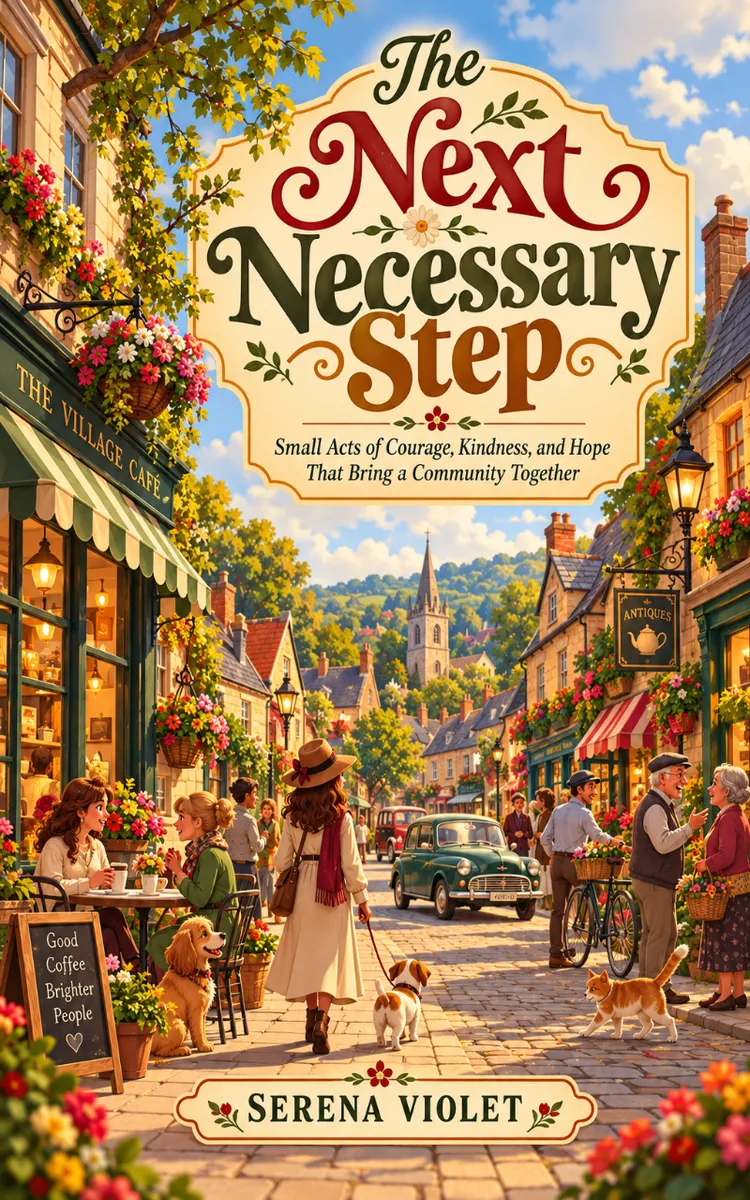
"The Next Necessary Step" is a fiction book by Glory Mindset with 7 chapters and approximately 14,868 words. In a close-knit community facing change and hardship, a handful of neighbors discover how courage, patience, and kindness can turn private struggles into shared hope..
This book was created using Inkfluence AI, an AI-powered book generation platform that helps authors write, design, and publish complete books. It was made with the AI Novel Writer.
Frequently Asked Questions
What is "The Next Necessary Step" about?
In a close-knit community facing change and hardship, a handful of neighbors discover how courage, patience, and kindness can turn private struggles into shared hope.
How many chapters are in "The Next Necessary Step"?
The book contains 7 chapters and approximately 14,868 words. Topics covered include The Paintbrush in the Drugstore Window, The Garden Between Two Fences, One Step Through the White, A Voice That Would Not Rise, and more.
Who wrote "The Next Necessary Step"?
This book was written by Glory Mindset and created using Inkfluence AI, an AI book generation platform that helps authors write, design, and publish books.
How can I create a similar fiction book?
You can create your own fiction book using Inkfluence AI. Describe your idea, choose your style, and the AI writes the full book for you. It's free to start.
Write your own fiction book with AI
Describe your idea and Inkfluence writes the whole thing. Free to start.
Start writingCreated with Inkfluence AI


