
Read the first chapter
The whole of chapter one, free. About 8 min. Turn the pages with the arrows, your keyboard, or a swipe.
Chapter 1
Who Gets Blamed for Neighborhood Change?
The Question Hidden Inside the Accusation
What would have to be true for the claim that Democrats, Muslims, and undocumented immigrants “destroyed” Black neighborhoods to be more than a slogan? The question sounds simple, but it immediately breaks the accusation into separate possibilities: government policy may have weakened local economies; migration may have changed labor markets and commercial life; religious differences may have affected community relationships; or larger forces may have been assigned to convenient political villains.
That distinction matters because neighborhood change is rarely caused by one group acting alone. A city block can be shaped by mortgage rules written decades earlier, a factory closing, a landlord’s decision, a new wave of arrivals, a school boundary, and a national party’s campaign message - all at once. Treating these forces as interchangeable makes the story emotionally powerful but historically difficult to test.
The Claim-to-Evidence Map offers a more exact way to examine the accusation. Each charge must be separated into a claim, a time period, a place, a proposed mechanism, and evidence that could support or weaken it. The method does not decide in advance that Democrats, Muslims, immigrants, or Black residents are innocent or guilty. It asks a less comfortable question: what, precisely, happened, and compared with what?
When a neighborhood changes, who benefits from turning a complicated history into a single culprit?
The Policy Claim: Parties, Promises, and Consequences
The Democratic Party has held power in many cities where Black residents faced disinvestment, segregation, unemployment, and declining public services. That coincidence is real. It is not, by itself, proof that Democratic leadership caused every resulting hardship.
During the twentieth century, many Black families moved into northern and western cities during the Great Migration, seeking industrial work and escape from the racial order of the South. Their arrival transformed cities such as Chicago, Detroit, Cleveland, Philadelphia, and Los Angeles. Yet the neighborhoods they entered were often constrained by restrictive housing practices, redlining, exclusion from unions, and unequal access to credit. Public policy did not merely respond to these conditions; it helped create them.
The federal government’s housing policies are a useful reminder that the political history is larger than city-party labels. Mortgage systems and maps used by public agencies treated many Black neighborhoods as risky investments, while highways and urban renewal projects frequently cut through established communities. In Detroit, the construction of freeways displaced residents and divided neighborhoods. In Chicago, the demolition and replacement of public housing altered entire sections of the city. These decisions involved federal, state, and local authorities, developers, banks, and courts - not one party operating in isolation.
A policy claim becomes testable when it names the mechanism. Did a city reduce police services? Did a state change welfare rules? Did zoning restrict new housing? Did a school district lose funding? Did a redevelopment plan remove affordable homes without replacing them? Each question points toward records, budgets, maps, court cases, and timelines.
The party label alone is too blunt. Republicans governed some states and cities during periods of Black decline; Democrats governed others during periods of Black institution-building, expanded public employment, or improved civil-rights enforcement. The same party could support one policy that helped a neighborhood and another that harmed it. Political responsibility is often real, but it is usually distributed.
Migration and the Arithmetic of Blame
The arrival of immigrants can be visible in ways that older structural forces are not. A new language appears on storefronts. Different foods fill a market. Rental units become more crowded. Employers recruit workers from abroad. Longtime residents may experience these changes as immediate competition, even when the deeper economic shift began years earlier.
The phrase “illegal immigrant” also compresses several different realities. Some people lack lawful status; others have temporary protection, pending asylum claims, permanent residency, or citizenship. Their effects on a neighborhood can differ according to work, housing, age, family networks, and length of residence. A single label cannot explain all of them.
Labor markets provide one possible mechanism. New arrivals may accept low wages because their legal position leaves them vulnerable, or because employers deliberately seek workers with limited bargaining power. That can put pressure on workers already competing for jobs. But employers, not migrants alone, decide whom to hire and what to pay. Labor law, union strength, enforcement, and the supply of affordable housing shape the result.
Housing creates another mechanism. If a neighborhood has too few homes, a growing population can intensify competition for apartments. Landlords may subdivide units, raise rents, or favor tenants with particular family or employment arrangements. Yet population growth can also support grocery stores, restaurants, repair businesses, and childcare networks. The same migration that creates pressure in one part of a city may help sustain commercial life in another.
A revealing comparison comes from places where immigrant and Black residents live side by side. Relationships are not fixed. In some neighborhoods, competition over housing and retail space produces distrust. In others, residents share churches, schools, workplaces, and tenant organizations. The outcome depends on local institutions and economic conditions, not on ethnicity alone.
The surprising fact is that visible newcomers are often blamed for decline that began before they arrived. Deindustrialization, suburban flight, predatory lending, and cuts to public services can precede a new migration wave by decades. This matters because it changes the direction of investigation. Instead of asking only what immigrants brought into a neighborhood, we must ask what conditions were already waiting for them.
Religion, Identity, and the Muslim Question
Muslim communities are frequently treated as a single political or cultural force, although they include Black Americans, immigrants from Africa and the Middle East, South Asians, converts, refugees, professionals, small-business owners, and families whose histories differ sharply. In the United States, Islam has long been part of Black American life through institutions such as the Nation of Islam, founded in Detroit in 1930, and through later Sunni, Shia, and community-based congregations.
That history complicates the idea that “Muslims” are outsiders to Black neighborhoods. Some Muslim institutions were built by Black residents themselves. Others were established by immigrants who arrived later. Mosques may provide food assistance, youth programs, language classes, burial services, and business networks. They can also become sites of tension when groups differ over leadership, gender roles, political priorities, or control of property.
Religion can influence neighborhood life, but it is not a substitute for evidence. If the claim is that a mosque displaced a Black institution, the relevant questions concern ownership, zoning, financing, and the date of the change. If the claim is that Muslim shopkeepers harmed Black businesses, the investigation must examine rents, credit access, supply chains, customer demand, and labor practices. If the claim concerns political influence, campaign donations, voting patterns, and public statements offer stronger evidence than rumors about religious identity.
A single storefront can reveal the limits of broad categories. In parts of Minneapolis, Somali entrepreneurs built restaurants, markets, transportation services, and professional offices in neighborhoods already shaped by Black residents and earlier immigrant groups. Some relationships became cooperative; others were strained by differences over policing, business practices, and public space. Neither harmony nor conflict can be explained by religion alone.
The important distinction is between a community’s identity and an institution’s conduct. A faith does not determine every landlord’s decision, every employer’s wage, or every political alliance. When criticism moves from a specific action to an entire religious population, it stops being an explanation and becomes a generalization.
The Counterintuitive Map of Neighborhood Decline
The most counterintuitive finding is that neighborhood decline often has less to do with who moved in than with who stopped investing. A closed factory, a withdrawn bank branch, a vacant lot, or a demolished school may matter more than the arrival of a new population.
That reframing changes the evidence we seek. Instead of beginning with census categories or campaign speeches, we examine property records, lending patterns, employment histories, transit routes, tax delinquencies, and public budgets. Migration and religion may still matter, but they enter a larger map of forces that includes capital, land, law, and time.
A Block in Detroit and the Problem of One Villain
Detroit makes the difficulty visible. Black residents built thriving neighborhoods during the Great Migration, creating churches, newspapers, professional associations, entertainment districts, and businesses. Black Bottom and Paradise Valley were not empty spaces waiting for development; they were dense communities with their own institutions. Urban renewal and freeway construction later demolished or divided much of that landscape. Industrial decline then removed jobs that had anchored household incomes.
By the time new immigrant groups and suburban commuters became prominent parts of Detroit’s commercial story, many Black residents had already experienced decades of housing discrimination, factory closures, population loss, and municipal crisis. Some newcomers opened stores in areas where major chains had left. Some businesses created jobs and services; some disputes emerged over wages, rents, or customer relations. Those facts can coexist without proving that immigrants caused the original collapse.
The city’s history also shows why party blame requires precision. Democratic officials made consequential choices, but so did federal agencies, lenders, corporations, courts, and voters. A freeway does not ask the race or religion of the people it displaces. A bank’s refusal to lend can shape a neighborhood long before a new family arrives. The human story is therefore not a contest between innocent residents and a single invading force. It is a record of decisions made at different levels, with unequal power and uneven consequences.
What the Map Leaves Unsettled
Blame is attractive because it gives a complicated landscape a recognizable face. Evidence is slower: it separates policy from coincidence, migration from employer behavior, religion from institutional conduct, and political rhetoric from measurable outcomes.
Black neighborhoods have been shaped by both outside pressure and internal debate, by exploitation and enterprise, by loss and reinvention. The deeper mystery is not why people search for a culprit, but why a society so often prefers one culprit to a chain of causes that reaches across generations. Somewhere in that chain, the boundary between arrival and abandonment becomes difficult to see.
End of chapter one. 14 more chapters and about 24,274 words in the full book.
Swipe or use the arrows to turn the page


What's inside: 15 chapters
- 1. Who Gets Blamed for Neighborhood Change?
- 2. The Democratic Coalition’s Uneasy Bargain
- 3. What Voting Patterns Can-and Can’t-Prove
- 4. The Policy Choices Behind Urban Disinvestment
- 5. How Immigration Changes Local Labor Markets
- 6. The Difference Between Migration and Displacement
- 7. Black Immigrants Are Not One Story
- 8. Muslim Neighbors Beyond the Headlines
- 9. Black Muslims and American Belonging
- 10. When Public Services Face Real Strain
- 11. Crime Claims Under the Data Test
- 12. How Media Turns Tension Into Blame
- 13. The Policies That Cross Party Lines
- 14. What Stronger Neighborhoods Actually Need
- 15. Beyond Scapegoats, Toward Shared Power
About this book
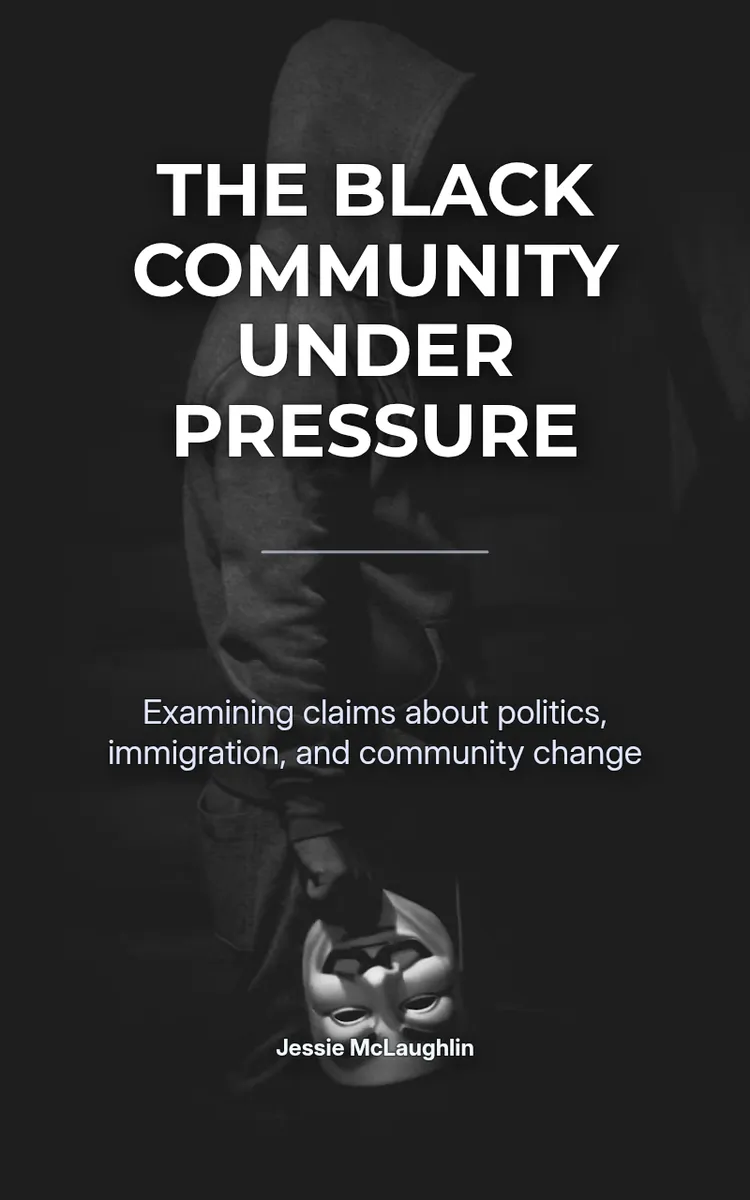
"The Black Community Under Pressure" is a nonfiction book by Jessie McLaughlin with 15 chapters and approximately 24,274 words. Claims about political parties, Muslim communities, immigration, and Black community change.
This book was created using Inkfluence AI, an AI-powered book generation platform that helps authors write, design, and publish complete books.
Frequently Asked Questions
What is "The Black Community Under Pressure" about?
Claims about political parties, Muslim communities, immigration, and Black community change
How many chapters are in "The Black Community Under Pressure"?
The book contains 15 chapters and approximately 24,274 words. Topics covered include Who Gets Blamed for Neighborhood Change?, The Democratic Coalition’s Uneasy Bargain, What Voting Patterns Can-and Can’t-Prove, The Policy Choices Behind Urban Disinvestment, and more.
Who wrote "The Black Community Under Pressure"?
This book was written by Jessie McLaughlin and created using Inkfluence AI, an AI book generation platform that helps authors write, design, and publish books.
Write your own nonfiction book with AI
Describe your idea and Inkfluence writes the whole thing. Free to start.
Start writingCreated with Inkfluence AI


