
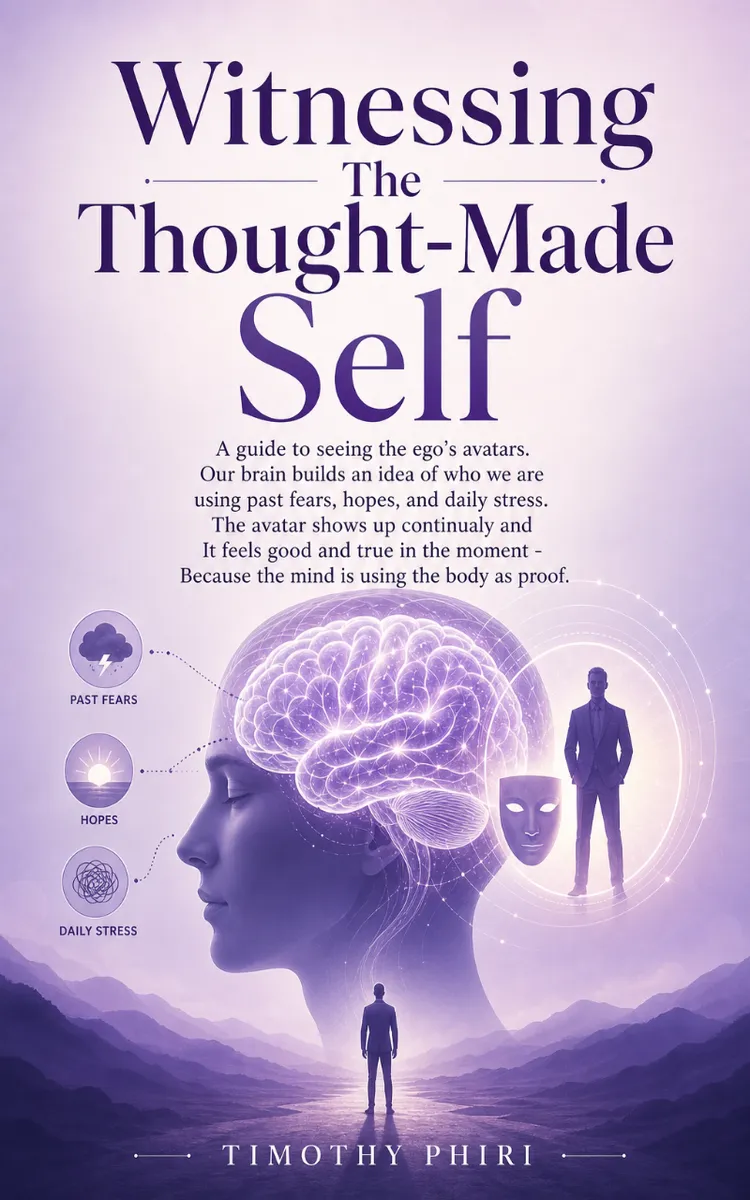
Read the first chapter
The whole of chapter one, free. About 7 min. Turn the pages with the arrows, your keyboard, or a swipe.
Chapter 1
Meet the Thought-Made Avatar
A Moment of Truth: When Your Mind Builds a “You” in Real Time
Nadia, 34, yoga teacher, is mid-flow - breath steady, students quiet - when her phone buzzes. She doesn’t even look at it yet, but the body already knows: shoulders tighten, jaw clicks, and a quick heat of “I should’ve answered earlier” moves through her like a spark. For a second, she can almost feel the next moment forming: the kind of person who’s late, careless, not fully on top of things.
She looks up at the class anyway. Her voice stays calm. Her hands keep guiding. And yet, underneath the calm, a whole character pops into place - an avatar made of thought. Not a metaphor. Not “just a feeling.” A specific, believable self-image: the kind of teacher who’s falling behind. Then the phone buzzes again. Nadia catches herself in that tiny pause where attention can either follow the story… or witness the story assembling an identity.
That’s the central tension: the thought-made avatar feels like “me” - until you catch it being made.
What Changes Everything: The Thought-Made Avatar You Can Notice
Here are a few real-life snapshots you might recognize, using labels you can actually point to:
• “The Late One” avatar: You see a missed call and instantly become the person who “always drops the ball.” Even if you’re not late today, the thought builds a self-image that predicts you will be. - “The Not-Enough Teacher” avatar: A student asks a question you don’t fully answer, and suddenly you’re the kind of teacher who’s exposed. Your mind rewrites the moment into a verdict. - “The Irritable Partner” avatar: Someone’s tone feels off, and your mind responds by assembling a whole identity: I’m the one who gets angry. Then you notice you’re acting from that avatar, not from the actual conversation.
What all these have in common - A thought doesn’t just describe what happened; it creates a person who “is” happening. - The avatar shows up fast, with a clear emotional charge. - It feels true in the moment - because the mind is using the body as proof.
The underlying principle is simple, and honestly kind of wild: everyday thinking doesn’t only produce thoughts. It produces portraits. Your mind takes a few raw ingredients - sensation, memory, interpretation - and stitches them into a “me” that can move through the day. The avatar is convincing because it’s experienced from the inside. You’re not just thinking “I’m late.” You’re living as the Late One.
And here’s the shift that changes everything: you start treating these avatars as events happening in awareness, not as the identity you have to defend. Nadia doesn’t need to “stop being anxious.” She needs to notice the assembly process - how a story becomes a character, and how that character quietly drives her next word, breath, and choice.
That notice is the doorway. Not because noticing fixes your life overnight, but because it breaks the spell that says: If the avatar is here, I must obey it.
The Deeper Truth: Why Thoughts Assemble an Illusory Self-Image
Underneath the stories, there’s a deeper mechanism: the mind is trying to keep you oriented, safe, and continuous. It grabs patterns because patterns feel solid. When something triggers you - an email, a face, a tone - the mind doesn’t want uncertainty. It wants a narrative that tells you who you are in this moment and what you should do next.
So it does what it’s always done: it reaches into memory, finds a “similar me,” and uses that as a shortcut. This is why the avatar can appear with confidence. It’s not random. It’s your mind’s attempt to make the moment predictable. But the cost is that the avatar becomes too real. The story starts acting like a self, and the self starts acting like a prison.
That’s where the illusion lives. The avatar is not you in the way awareness is you. Awareness is the space where everything appears - thoughts, sensations, images, urges. The avatar is what the mind makes to fill that space with meaning. When you believe the avatar fully, you hand the steering wheel to a character made of language and emotion. When you witness it, the avatar loses its authority. You still feel the charge, but it stops being an identity sentence and becomes an experience.
Signs you need this chapter 1. You catch yourself saying things like “I am this kind of person” right after a trigger - before you even check the facts of the moment. 2. Your body reacts first (tight throat, fast heart, clenched jaw), and the mind follows with a storyline that explains the reaction as identity. 3. You feel a strong urge to “prove” your worth right when you’re most activated. 4. You notice you’re repeating the same self-portrait in different situations, as if your mind can’t update the image.
Bold truth-summary: The thought-made avatar is not your true self - it’s your mind’s portrait, appearing in awareness and asking to be witnessed.
Try this as you read: when you feel that “I am…” certainty rise up, pause and ask, “Is this a description of what’s happening, or a character the mind is building?” Just that question already shifts you from belief to observation.
Journal Prompts: Connect the Avatar to Your Own Life (Without Lying)
Journaling here isn’t about writing your way into a new personality. It’s about seeing the assembly line - how thought turns into avatar, and how avatar turns into behavior. Keep it honest. Keep it specific. If you’re tempted to make yourself look better, slow down. The avatar usually gets revealed when you stop polishing it.
1. Name the last “I am” moment you believed. What exactly did the thought say (or what did it imply)? What did your body do right after it? Example of honesty: “I thought I’m failing,” not “I felt stressed.”
2. Trace the trigger → thought → avatar → action chain from a recent day. What happened right before the avatar appeared? What did you do next that matched the avatar’s identity? Keep it simple: one chain, one moment, no grand story.
3. Where did you feel the avatar as “real”? Was it in your chest, throat, stomach, face, or voice? What did you start believing about yourself because of that sensation? Sometimes the sensation is the evidence your mind uses to seal the illusion.
4. What would you do if you didn’t have to be the avatar? When you strip away the identity story, what’s the truest action available in that moment? Don’t force a “perfect” answer - just identify the most honest next step.
5. What does your avatar protect you from feeling? If that avatar disappeared for a day, what vulnerability might show up? What would be harder to face? This prompt often reveals the hidden job the avatar is doing.
If you do these with sincerity, you’ll start seeing a pattern: the avatar arrives like an emergency message. And your awareness - quiet, steady - can learn to read it without obeying it.
Your 7-Day Challenge: The “Avatar Catch” Practice
This week you’re not trying to get peaceful. You’re training recognition - spotting the avatar while it’s still assembling. Think of it like catching a sketch mid-drawing before it turns into a finished portrait.
Challenge Name: Avatar Catch (7 Days, 10 minutes)
Difficulty level: Medium (because it’s easy to miss when you’re busy)
Daily instructions - Pick one moment each day when you’re likely to get activated (a reply you’re waiting on, a meeting, teaching, cleaning the house, a workout check-in). - When activation hits, do this exact sequence: - Stop for one breath (no fixing yet). - Name the avatar in 3-6 words (e.g., “The Late One,” “The Exposed Teacher”). - Notice the belief behind it: what did you start “knowing” about yourself? - Witness: say internally, “This is an avatar being made.” - Write 4 sentences in your journal: - What triggered me? - What avatar appeared? - What did it tell me I am? - What did I do next that matched it? - Do one “tiny reset” action after journaling - something real and observable (adjust posture, soften jaw, take a slower breath, re-read your last message before sending).
Celebrate when… - You name an avatar at least once per day (even if your day is messy). - You catch yourself doing the “I am…” belief before you fully act it out. - You complete your 4-sentence journal reflection daily, without skipping the “what did it tell me I am?” part. - You perform one tiny reset action after noticing the avatar.
If you miss a day, don’t punish yourself. Just restart the next day with one clean catch. The goal is continuity of noticing, not perfection of calm.
Bold sentence: The more you catch the avatar while it’s being made, the less it gets to run your life like it owns you.
• You saw how thoughts assemble identity portraits in real time (Nadia’s crossroads moment). - You learned to recognize common avatar labels and the shared mechanism behind them. - You explored why the mind builds avatars to reduce uncertainty - and how that creates the illusion of “me.” - You practiced connecting avatar moments to your actual triggers through honest journaling. - You’re building a daily habit to spot avatars early and choose differently.
Next, we’ll go one step deeper into what awareness is doing beneath the avatar - because once you start witnessing the sketch, you can begin to feel the steadier presence that was never up for debate.
End of chapter one. 21 more chapters in the full book.
Swipe or use the arrows to turn the page


What's inside: 22 chapters
- 1. Meet the Thought-Made Avatar
- 2. Spot the Concealed Ego Story
- 3. Separate Awareness From Content
- 4. Name the Thought to Loosen It
- 5. Undo the ‘I Am This’ Habit
- 6. Rehearse the Witness Posture
- 7. Interrupt Automatic Self-Images
- 8. Transform Critic Into Curiosity
- 9. Let Feelings Move Without Becoming
- 10. Use the Three-Frame Reality Check
- 11. Build Confidence From Observing Patterns
- 12. Choose Values Over Avatar Approval
- 13. Speak Without Performing the Self
- 14. Set Boundaries Without Self-Destruction
- 15. Stop Rumination With the Rewind Practice
- 16. Turn Shame Into Repair
- 17. Handle Triggers With the Pause-Name-Act
- 18. Practice Nonattachment to Outcomes
- 19. Integrate the Avatar Into Compassion
- 20. Live as Witness, Not Sketch
- 21. Bonus Toolkit for Witnessing Practice
- 22. Summarize the core insights in focused prose and reinforce what matters most
About this book
"Witnessing The Thought-Made Self" is a self-help book by Timothy Phiri with 22 chapters and approximately 34,465 words. Mindfulness and self-inquiry about thoughts creating an illusory self.
This book was created using Inkfluence AI, an AI-powered book generation platform that helps authors write, design, and publish complete books. It was made with the AI Self-Help Book Writer.
Frequently Asked Questions
What is "Witnessing The Thought-Made Self" about?
Mindfulness and self-inquiry about thoughts creating an illusory self
How many chapters are in "Witnessing The Thought-Made Self"?
The book contains 22 chapters and approximately 34,465 words. Topics covered include Meet the Thought-Made Avatar, Spot the Concealed Ego Story, Separate Awareness From Content, Name the Thought to Loosen It, and more.
Who wrote "Witnessing The Thought-Made Self"?
This book was written by Timothy Phiri and created using Inkfluence AI, an AI book generation platform that helps authors write, design, and publish books.
How can I create a similar self-help book?
You can create your own self-help book using Inkfluence AI. Describe your idea, choose your style, and the AI writes the full book for you. It's free to start.
Write your own self-help book with AI
Describe your idea and Inkfluence writes the whole thing. Free to start.
Start writingCreated with Inkfluence AI


