

Read the first chapter
The whole of chapter one, free. About 8 min. Turn the pages with the arrows, your keyboard, or a swipe.
Chapter 1
Rebuilding Your Parent Identity
The Moment You Notice You’ve Gone Missing
At 6:42 on a Tuesday morning, Mara stood in the kitchen holding a cold mug of coffee and one tiny sock. Her toddler was calling from the bedroom, the baby monitor was crackling, and her phone showed three unanswered messages from work. She had spent the last hour packing snacks, wiping yogurt from a sleeve, and searching for the missing shoe.
Then she noticed the sock in her hand.
She used to be a person who made things. She played guitar badly but enthusiastically. She met friends without checking nap schedules. She had opinions about books, music, and where to eat. Lately, when someone asked what she liked, her mind went blank. Not because she had stopped caring. Because caregiving had filled every available space.
Mara had a choice that morning - not between being a good parent and a selfish one, but between disappearing completely and making a small place for herself inside this new life.
The question isn’t whether parenthood changed you; it’s whether caregiving gets to be the only thing that defines you.
Three Ways Identity Gets Crowded Out
The Calendar Eraser - Priya
Before her son was born, Priya ran a small bakery. She loved the early quiet, the smell of cardamom, and the satisfaction of solving a frosting disaster before opening time. After maternity leave, she kept saying, “I’ll figure out what I want later.” Later became a year of toddler breakfasts and daycare illnesses. She didn’t need to reopen the bakery right away. She did need to admit that the part of her who loved making things was still there.
The Automatic Yes - Devon
Devon became the parent who remembered everything: the pediatrician appointment, the spare clothes, the birthday gift, the daycare form. When his partner asked if he could also take over weekend meal planning, he agreed before thinking. He was proud of being dependable, but quietly resentful. His identity had narrowed into “the person who handles it,” and every request seemed to confirm that role.
The Mirror Stranger - Lin
Lin looked at old photos while her baby napped. In one, she was laughing with friends at a crowded restaurant. She almost didn’t recognize herself. The photo didn’t make her want her old life back exactly. It showed her something more useful: she had always been social, curious, and a little spontaneous. Those qualities hadn’t vanished. They needed new forms - perhaps a short walk with a friend, a voice message, or dinner at home with music playing.
What all these have in common:
• Caregiving became a role, then quietly became an entire identity. - Each person confused “not possible right now” with “not part of me anymore.” - The missing piece wasn’t a dramatic escape. It was a visible connection to qualities that still mattered. - Small choices helped them recognize themselves without pretending parenthood hadn’t changed them.
A young child’s needs are immediate, repetitive, and loud. Your needs are often quieter. That makes them easy to postpone, not less real. When the baby cries or the toddler needs help with the toilet, the caregiving task wins the moment. The danger comes when every moment starts making the same decision.
This is where the Identity Anchors Map helps. An identity anchor is a quality, interest, relationship, value, or role that reminds you who you are beyond the next task. It isn’t a fantasy version of your former self. It’s a living thread you can carry into your current life.
You might anchor to creativity by taking photos on your walk instead of scrolling. You might anchor to friendship with a ten-minute voice note. You might anchor to competence by finishing one small work task without apologizing for needing childcare. The point isn’t to recreate your pre-parent life. It’s to stop treating that life as evidence that you’re gone.
Why Your Brain Needs More Than “Me Time”
Burnout makes identity especially slippery. When you’re tired, your brain looks for the fastest way to reduce demands. It may decide that your own interests are optional because they require planning, energy, or a little disappointment. Feeding the baby is urgent. Texting a friend can wait. A shower feels practical. Reading three pages of a novel can feel absurdly ambitious.
There’s also a hidden story many parents carry: a good parent should be fully available. If you enjoy something that doesn’t involve your child, guilt may rush in to fill the gap. You may hear an inner voice saying, “You have time for a hobby, but not enough patience at bedtime?” That voice sounds responsible, but it often turns ordinary human needs into moral failures.
Separating yourself from caregiving doesn’t mean caring less. It gives your child a parent who is a person, not an endlessly available service. Your identity also has to change. A parent of a six-month-old may need different anchors than a parent of a two-year-old. Flexibility is not inconsistency. It’s how an identity survives real life.
You may need the Identity Anchors Map if:
1. You introduce yourself mainly through your child’s age, schedule, or needs. 2. You feel guilty whenever you do something that has no obvious benefit for your family. 3. You keep saying, “That’s just not me anymore,” about interests you haven’t tested in months. 4. You feel resentful when people ask for more because you’ve become the default person for everything.
You can be deeply devoted to your child without handing over every room in your inner life.
Drawing Your Identity Anchors Map
Set aside ten minutes. Use paper, a notes app, or the back of an unopened piece of mail - parenting is not a stationery competition. Write “Me, beyond caregiving” in the middle. Around it, add five possible anchors: a quality, an interest, a relationship, a value, and a role you want to keep developing.
1. What part of you existed before your child needed you so constantly? Name something specific, not a broad label. “Creative” might become “I like making ordinary things beautiful,” while “social” might become “I feel more like myself after honest conversation.”
2. Which caregiving task has swallowed a role you still miss? Maybe you used to be a teammate, a problem-solver, a funny friend, or a professional with clear responsibilities. What would one tiny version of that role look like this month?
3. What do you want your child to learn about being a person from watching you? Honest reflection may sound like, “I want my child to see that rest matters,” or, “I want them to see me keep a promise to myself without making a speech about it.”
4. Where are you saying “I can’t” when the truer sentence is “I can’t do it in the old way”? You may not be able to attend a weekly class at 7 p.m. You might be able to watch a twenty-minute lesson during naptime twice a week.
5. Which anchor feels nourishing rather than impressive? Choose the thing that gives you a sense of recognition, not another achievement to perform. Listening to one favorite album while folding laundry may count if it reconnects you with yourself.
Don’t judge the answers by how practical they seem. The first job is recognition. You can solve the logistics after you know what you’re trying to protect.
The Seven-Day Identity Anchors Challenge
Challenge name: One Anchor, Seven Days
Choose one anchor from your map. Keep it small enough to survive a rough night. The goal is not to build a perfect routine. It’s to gather seven pieces of evidence that you still belong to yourself.
• Day 1 - Name it: Write your anchor in one sentence: “I’m a person who values music,” or “I’m a friend who stays connected.” Put it somewhere you’ll see it. - Day 2 - Spot it: Notice one moment when that quality already appears in your day. A silly song at bath time may be evidence of playfulness. - Day 3 - Give it ten minutes: Do a direct version of the anchor. Sketch, stretch, call someone, read, cook, or work on a skill for ten minutes. - Day 4 - Tell one person: Say, “I’m trying to make room for this part of me again.” Choose someone who won’t turn it into a productivity project. - Day 5 - Change the shape: Adapt the anchor to your current life. If you miss exercise, try a stroller walk with a podcast. If you miss writing, record a voice memo. - Day 6 - Protect a boundary: Decline, delay, or share one task that would have automatically landed on you. Use simple words: “I can’t take that on today.” - Day 7 - Review the evidence: Write what felt like you, what felt forced, and what you’d repeat next week. Keep the anchor; adjust the size.
Difficulty level: Gentle, with occasional emotional resistance.
Celebrate when:
• You can name one part of yourself that caregiving hasn’t erased. - You complete at least one anchor action, even if it lasts ten minutes. - You notice guilt without allowing it to make the decision. - You ask for support or set one boundary that protects your identity.
The challenge may look modest from the outside. That’s the point. A parent identity is rebuilt through repeated contact with the parts of you that still matter, not through one grand declaration.
Carrying Yourself Forward
Your child can be central to your life without becoming the whole definition of who you are.
• You explored how caregiving can crowd out older roles, interests, and qualities. - You learned to use the Identity Anchors Map to name what still belongs to you. - You looked at the guilt and exhaustion that make your needs seem optional. - You practiced reconnecting with one anchor through a seven-day challenge.
You don’t have to return to who you were before parenthood. You’re allowed to become someone new while keeping the pieces that make you recognizable to yourself. The next step is turning that recognition into habits that can live alongside bottles, tantrums, laundry, and the unpredictable shape of family life.
End of chapter one. 12 more chapters and about 18,979 words in the full book.
Swipe or use the arrows to turn the page
What's inside: 13 chapters
- 1. Rebuilding Your Parent Identity
- 2. Letting Go of Perfect Parenting
- 3. Reading Your Burnout Signals
- 4. Protecting Sleep in Small Steps
- 5. Choosing Habits That Survive Chaos
- 6. Resetting Routines After Disruption
- 7. Sharing the Invisible Work
- 8. Asking for Help Without Apology
- 9. Setting Boundaries With Confidence
- 10. Calming Overwhelm in the Moment
- 11. Reclaiming Connection With Your Partner
- 12. Adapting Habits as Children Grow
- 13. Building a Sustainable Family Rhythm
About this book
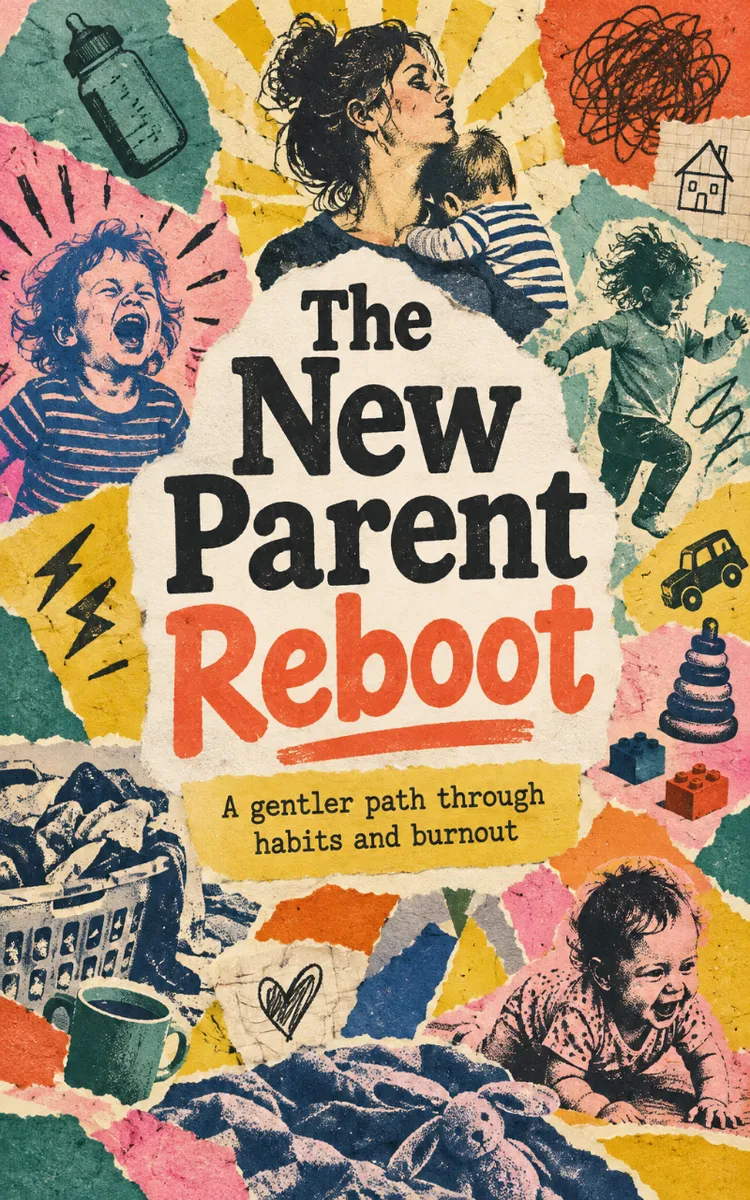
"The New Parent Reboot" is a self-help book by Anonymous with 13 chapters and approximately 18,979 words. Rebuilding sustainable habits while managing burnout from infancy through toddlerhood.
This book was created using Inkfluence AI, an AI-powered book generation platform that helps authors write, design, and publish complete books. It was made with the AI Self-Help Book Writer.
Frequently Asked Questions
What is "The New Parent Reboot" about?
Rebuilding sustainable habits while managing burnout from infancy through toddlerhood
How many chapters are in "The New Parent Reboot"?
The book contains 13 chapters and approximately 18,979 words. Topics covered include Rebuilding Your Parent Identity, Letting Go of Perfect Parenting, Reading Your Burnout Signals, Protecting Sleep in Small Steps, and more.
Who wrote "The New Parent Reboot"?
This book was written by Anonymous and created using Inkfluence AI, an AI book generation platform that helps authors write, design, and publish books.
How can I create a similar self-help book?
You can create your own self-help book using Inkfluence AI. Describe your idea, choose your style, and the AI writes the full book for you. It's free to start.
Write your own self-help book with AI
Describe your idea and Inkfluence writes the whole thing. Free to start.
Start writingCreated with Inkfluence AI


