
Read the first chapter
The whole of chapter one, free. About 8 min. Turn the pages with the arrows, your keyboard, or a swipe.
Chapter 1
The Execution Hidden in Plain Sight
The Sentence That Was Meant to Be Seen
A crowd gathered in Red Square on January 17, 1920, not to watch an execution but to witness its reversal: Soviet authorities publicly abolished the death penalty. The gesture lasted only months. By 1921, executions were again part of the machinery of Bolshevik rule, sometimes announced in newspapers, sometimes carried out in basements whose doors opened onto streets full of ordinary life.
That contradiction - violence displayed as law in one moment and hidden as administration in the next - runs through the history of communist regimes. Public executions warned the living. Concealed killings protected the state from questions about the dead. Both served the same political purpose: to make the government’s power felt beyond the person who was sentenced.
The Visible Violence Lens helps distinguish these two forms without separating them. A firing squad in a town square and a prisoner who vanished into an internal-security building looked different, yet each communicated a message about who could decide whether another human being continued to exist.
When violence disappears from view, does it become less political - or more difficult to resist?
The Square, the Scaffold, and the State
Public execution is an old instrument of government, but communist regimes gave it a particular role. The condemned person was rarely presented as an ordinary criminal. He - or, less often in the surviving records, she - was described as an enemy of the revolution, a saboteur, a traitor, or an obstacle to history itself. The sentence therefore claimed to do more than punish an individual. It announced that the state had identified a threat to the entire social order.
During the Russian Civil War, the Bolsheviks used executions alongside arrests, hostage-taking, and forced requisitions. The Red Terror, formally announced in 1918 after an assassination attempt against Vladimir Lenin and the killing of Bolshevik official Moisei Uritsky, turned political violence into an openly defended policy. Local newspapers published warnings. Posters declared that suspected enemies would be treated without mercy. In some places, executions were staged near railway stations or administrative buildings, where the audience included workers, soldiers, and passersby.
The setting mattered. A killing in a prison could be denied, delayed, or reclassified. A killing in public became a lesson with witnesses. The body, the uniforms, the officials, and the silence afterward formed a kind of political theater. The state did not need every spectator to approve. It needed them to understand that authority had crossed from issuing orders to deciding life and death.
Yet public violence was never simply a display of strength. It could also reveal anxiety. A government secure in its authority has less need to prove that it can destroy its enemies. The repeated staging of punishment often signaled that leaders feared disobedience spreading faster than loyalty could be produced.
The same pattern appeared beyond the Soviet Union. In China, public executions during Maoist campaigns and later criminal crackdowns placed punishment before large crowds, sometimes in stadiums or on makeshift platforms. In North Korea, public executions have been reported as a means of deterring acts classified as political or economic offenses, though the secrecy surrounding the country makes individual cases difficult to verify. In Cambodia, the Khmer Rouge relied less on formal public executions than on terror embedded in forced labor, detention, and disappearance. The absence of a public spectacle did not mean the absence of a message. Fear traveled through rumor, empty houses, and the sudden removal of neighbors.
One sentence could carry the weight of an entire legal system: the state alone decides who is dangerous enough to die.
The Bureaucracy Behind the Vanishing
Concealed killing required more than secrecy. It required paperwork, transportation, guards, medical examinations, lists of names, and a chain of authority designed to make responsibility difficult to locate. The hidden execution was not the opposite of bureaucracy. It was bureaucracy’s most chilling achievement.
In the Soviet Union, the NKVD - the security agency that preceded the KGB - organized mass operations through quotas, arrest lists, troikas, and execution protocols. During the Great Terror of 1937-38, special three-person bodies known as troikas could issue death sentences without a normal trial. Many victims were executed away from public view, at sites such as Butovo, south of Moscow, where thousands were shot and buried in concealed graves. Families might receive a false explanation, a vague notice of imprisonment, or no reliable information at all.
The hidden location served several purposes at once. It reduced the chance of public resistance. It kept the dead from becoming rallying points. It also allowed officials to present terror as routine administration. A file could replace a courtroom; a coded entry could replace a grave.
The physical science of concealment was unremarkable but important. Bodies had to be transported, buried, or burned. Paper records had to be stored and later altered, destroyed, or sealed. Sites had to remain accessible to officials but invisible to the wider population. The state’s power depended not only on weapons but on control over information: who knew, who could ask, and whose answer counted as truth.
At Katyn, the Soviet secret police executed thousands of Polish military officers, police officials, and intellectuals in 1940. The victims were buried in mass graves in what was then Soviet-occupied territory. When the graves were discovered by German forces in 1943, the Soviet government blamed the Germans. For decades, the official lie outlived the people who had carried out the killings. Only in 1990 did the Soviet government formally acknowledge Soviet responsibility.
Katyn demonstrates why concealment can be more durable than spectacle. A public execution creates witnesses. A hidden execution creates disputes over evidence, dates, perpetrators, and even whether the event occurred. The political struggle continues after the bullets have been fired.
The Counterintuitive Power of Secrecy
The surprising fact is that concealed killing can control more people than public execution. A visible execution frightens those who see it; a disappearance unsettles everyone who cannot determine what happened.
That uncertainty changes the nature of fear. Families do not know whether a missing person is dead, imprisoned, hiding, or about to return. Neighbors learn that ordinary questions may be dangerous. Officials gain room to deny responsibility while allowing rumor to perform the work of warning. Secrecy, in this sense, is not a failure of propaganda. It is a form of propaganda without a poster.
The distinction matters because political violence is often measured by bodies found, names published, or trials recorded. Communist regimes frequently made the absence of evidence part of the system. A person removed from a factory, village, university, or army unit became an unanswered question. The question itself disciplined those left behind.
This is where the Visible Violence Lens becomes useful. “Visible” does not mean only what happens in front of a crowd. It includes the signs that violence leaves behind: a sealed apartment, a missing name from a roster, a sudden change in a family’s status, a grave discovered years later. Concealed killing depended on traces that were faint enough to deny but strong enough to be noticed.
A Village Between Two Kinds of Terror
The experience of Koreans in the Soviet Far East shows how public and concealed violence could reinforce one another. In 1937, Soviet authorities deported hundreds of thousands of ethnic Koreans from the Far East to Central Asia, accusing them collectively of possible espionage for Japan. The operation was carried out through arrests, sealed trains, forced transport, and the removal of entire communities. It was not an execution campaign in the narrow sense, but it belonged to the same political world: the state treated a population as a threat and used coercion to make that judgment visible.
Some individuals were arrested and executed through security procedures that families could not observe or challenge. Others survived the deportation but carried the knowledge that the government could empty a village without a public trial. The train itself became a moving instrument of state power. People did not need to see a firing squad to understand what refusal might bring.
A different kind of human record emerged in Soviet Ukraine during the Holodomor, the famine of 1932-33. The famine’s causes, the state’s grain policies, the restrictions on movement, and the suppression of information remain subjects of historical debate in terminology and interpretation, but the coercive setting is clear: food seizures and travel controls trapped millions of people while authorities denied the scale of suffering. The dead were often buried in mass graves, and records were manipulated or withheld. Here, death did not arrive as a sentence read aloud. It came through policies that made survival increasingly impossible, followed by official silence.
The connection to execution is not that famine and shooting were identical. They were not. The connection is that both could be used to demonstrate the state’s power over the conditions of life. A government did not need to announce every death as punishment for death to function politically. When people saw that the authorities could take food, movement, property, or a family member - and could deny the consequences afterward - the boundary between punishment and policy became dangerously thin.
The Dead Who Returned as Evidence
At Butovo, the ground eventually became an archive. After the collapse of the Soviet Union, investigations and memorial work helped identify the site as a major execution ground. Names that had once been reduced to secret files became part of a public record. Visitors could stand in a quiet landscape outside Moscow and confront the physical distance between the ordinary appearance of a place and the violence it contained.
The site’s importance lies partly in its scale, but scale alone cannot explain its force. Each name represented a person whose final moments had been controlled by officials who expected the killing to remain invisible. The later recovery of names reversed that intention. The state had tried to make the victims disappear twice - first from life, then from memory. Documentation interrupted the second disappearance.
The same struggle over evidence shaped the history of Katyn. For decades, families and governments encountered the Soviet version of events not as a simple mistake but as an organized campaign of denial. Documents, forensic findings, witness accounts, and political changes gradually made the lie harder to sustain. Truth did not restore the dead, but it altered the meaning of their deaths. They were no longer merely casualties of war or unnamed prisoners. They became evidence of a state decision.
That is the deepest connection between public executions and concealed killings. Both seek an audience. The public execution speaks immediately, through spectacle. The hidden execution speaks indirectly, through fear, absence, and the management of records. Neither ends when the victim dies. The intended audience includes those who remain, those who inherit the documents, and those who one day ask why a name vanished from the world.
A state can bury a body, but it cannot fully control the future observers who uncover the burial. Somewhere between a sealed file and an open grave, private grief becomes public history - and the old instrument of power begins to point back at its maker.
End of chapter one. 39 more chapters and about 66,651 words in the full book.
Swipe or use the arrows to turn the page


What's inside: 40 chapters
- 1. The Execution Hidden in Plain Sight
- 2. When Quotas Became Death Sentences
- 3. The Secret Police at Your Door
- 4. A Confession Written Under Pressure
- 5. The Gulag’s Economy of Survival
- 6. Deportation by Train and Decree
- 7. The Famine the State Denied
- 8. Children Raised by the State
- 9. The Price of Leaving Home
- 10. Neighbors Turned Informants
- 11. The Black Market Kept People Alive
- 12. Work Without Choice
- 13. The Party’s Privileged Pantry
- 14. Censorship Before the Page
- 15. Teaching Children the Party Line
- 16. Religion Under Official Suspicion
- 17. The Doctor Who Wouldn’t Obey
- 18. Women’s Rights, State by State
- 19. The Prison Inside the Border
- 20. When Medicine Became a Shortage
- 21. The Minority Labeled a Threat
- 22. The Uprising That Changed Nothing
- 23. The Cost of Saying No
- 24. Purges That Devoured the Revolution
- 25. The Executioner’s Paper Trail
- 26. Mass Graves Beneath Ordinary Ground
- 27. The Numbers That Hide the Dead
- 28. A Leader’s Cult of Innocence
- 29. The Secret Deals Behind Scarcity
- 30. Prisoners Used as Diplomatic Currency
- 31. The Environmental Damage Nobody Counted
- 32. The Family Left Waiting
- 33. Survival Through Small Acts
- 34. The Archive Opens, Then Closes
- 35. After the Statue Comes Down
- 36. Trials Without a Full Accounting
- 37. The Victims Who Disappear Twice
- 38. Why the Promise Still Persists
- 39. Recognizing Repression Before It Hardens
- 40. The Human Cost Is the History
About this book
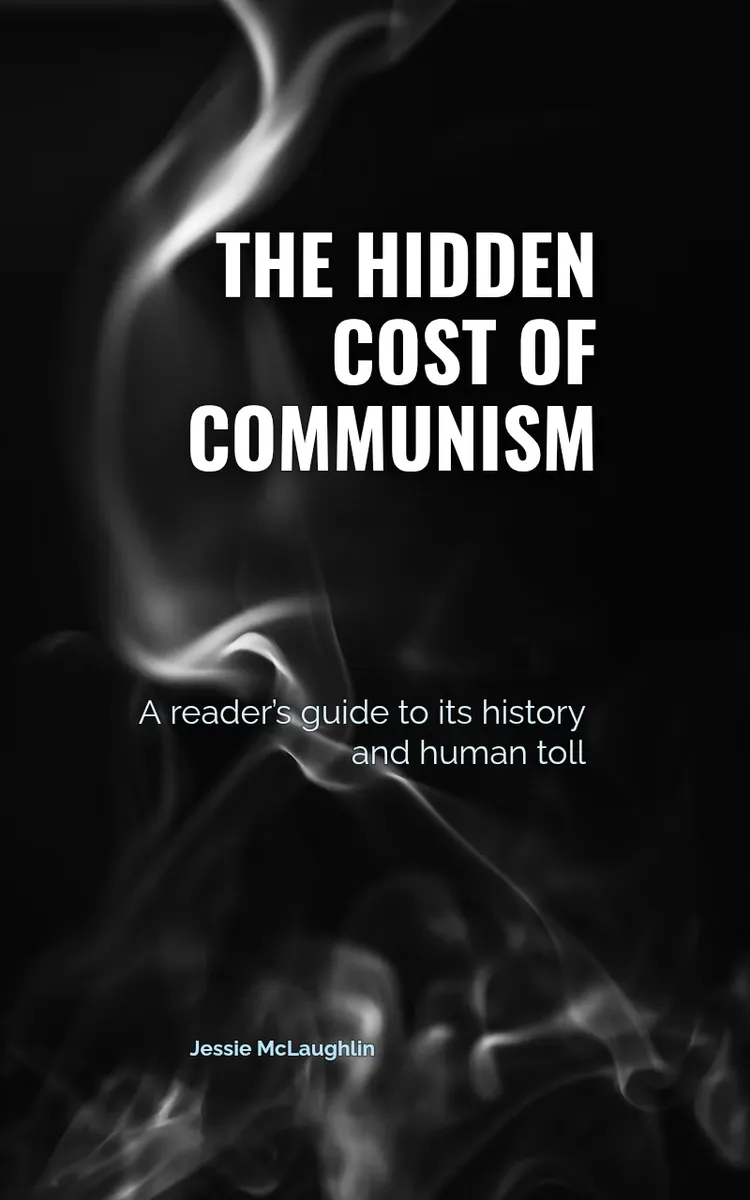
"The Hidden Cost Of Communism" is a curiosity book by Jessie McLaughlin with 40 chapters and approximately 66,651 words. Communist regimes, concealed histories, executions, and population suffering.
This book was created using Inkfluence AI, an AI-powered book generation platform that helps authors write, design, and publish complete books.
Frequently Asked Questions
What is "The Hidden Cost Of Communism" about?
Communist regimes, concealed histories, executions, and population suffering
How many chapters are in "The Hidden Cost Of Communism"?
The book contains 40 chapters and approximately 66,651 words. Topics covered include The Execution Hidden in Plain Sight, When Quotas Became Death Sentences, The Secret Police at Your Door, A Confession Written Under Pressure, and more.
Who wrote "The Hidden Cost Of Communism"?
This book was written by Jessie McLaughlin and created using Inkfluence AI, an AI book generation platform that helps authors write, design, and publish books.
Write your own curiosity book with AI
Describe your idea and Inkfluence writes the whole thing. Free to start.
Start writingCreated with Inkfluence AI


