
Read the first chapter
The whole of chapter one, free. About 9 min. Turn the pages with the arrows, your keyboard, or a swipe.
Chapter 1
The Square Turns Hostile
A brass clock over Gare du Nord struck eleven, and a pigeon struck the station glass, an event that barely registered with Martin.
His fingers whitened around the suitcase handle, and the leather creaked under his grip. Inside were spare shirts, a linen jacket, and a battered notebook. He thought of timetables like footnotes and followed the map's blue line without hesitation. After four years of postponed leave, he had finally come. He intended to travel from Paris to Brussels, then Prague and Vienna, ending in Rome. Years of lecturing had kept him confined to a walnut desk and seminar rooms. Now cities awaited him beyond the station doors.
His hotel sat across the historic center, roughly a forty-minute walk. Martin wanted to arrive before noon, leave his bags in the room, and wander off in the Paris streets. He pictured a cafe by the Seine: coffee steaming, the notebook open, the morning unfolding without surprises.
Outside, a low roar rolled along the boulevard.
Martin paused beneath the station’s stone arch. The traffic had been diverted. Vans stood nose to tail beside the curb, and a line of metal barriers divided the pavement. Farther down the street, people were moving in a dense, restless stream. Some carried red-white-and-blue flags. Others held cardboard signs above their heads.
A woman hurried past him, pulling a child by the wrist.
“Which way is the center?” Martin asked.
She glanced toward the crowd. “Not that way.”
The answer was delivered with such certainty that he looked again at his phone. The route led south into a square printed in faint gray on the map.
Then chanting rose from the boulevard, a flat, relentless refrain that slammed against the facades.
Martin slipped his phone into his coat and began walking. He chose the square from his guidebook, the kind of place with nineteenth-century façades and cafés, where he pictured coffee and his notebook.
The first police barrier appeared at the end of the block. Two officers stood behind it in helmets and dark protective vests. Beyond them, the street was packed shoulder to shoulder.
“Excuse me,” Martin said. “I need to get through to the old center.”
The taller officer shook his head. “Closed.”
“Is there another route?”
“Go around.”
“Which way is around?”
The officer pointed without looking. “East. Then south.”
Martin thanked him, though the officer had already turned away. He wheeled his suitcase down a narrow side street, its wheels caught in the seams between the paving stones. The buildings leaned over him, pale and tall, their shutters closed. A café owner was dragging chairs inside while customers watched from behind the glass.
At the next corner, another barrier blocked the road.
Martin stopped. He checked the map. The blue line blinked out, replaced by a pale notice: route unavailable.
A man in a yellow vest came toward him carrying a bundle of rolled posters. Martin stepped aside.
“Hotel de l’Arche?” he asked. “Near the river?”
The man stared at the suitcase, then at Martin’s face. “You should not be here.”
“I’m beginning to understand that.”
The man gave a humorless smile, a gallic shrug and continued past him.
Martin turned back toward the square. The sound swelled as drums began to beat beyond the buildings. Glass broke. A murmur passed through the crowd, followed by a wave of movement that sent pedestrians spilling into the lane.
He should have gone back to the station, he realized, since the hotel lay ahead. But the station was behind two barricades, and his hotel was somewhere in the distance. He had come this far to walk Paris’s streets; he would not spend the morning stalled on a sidewalk.
Bodies closed around him and a shove forced him into the square.
It opened suddenly between the buildings, broad and gray beneath a sky the color of old paper. The center bristled with demonstrators, painted banners trembling above the press of the crowd. Loudspeakers crackled from the steps of a municipal building. Along the edges, police formed a hard blue line behind interlocking barriers.
Martin felt as if a historical photograph had come to life: the same narrow exits, the same architecture pressing people inward, the same sense that a public space could become a trap in minutes.
His second thought was about how ill-prepared he was for this crowd.
Someone struck his shoulder. His suitcase tipped, and the handle snapped back against his palm.
“Sorry,” a young man said, though he did not slow down.
Martin pulled the suitcase upright and tried to reach the far side. Every exit was sealed. At one end, police had blocked off a lane with interlocking barriers. At the other, a knot of demonstrators surged around a van. The route he'd taken was now packed with people flowing the other way.
A woman beside him raised a sign above her head. “No more silence,” it read.
“Is there a way out?” Martin asked.
She looked at him as if the question were absurd. “Wait.”
“I’d rather not.”
A sharp crack, baton on shield, sounded from the north side of the square. The crowd recoiled. Martin saw a canister bounced across the paving stones, spinning a thin white trail. People began shouting. The woman lowered her sign and covered her mouth with her sleeve.
Martin’s eyes burned. He pulled his handkerchief from his pocket and pressed it over his nose. The suitcase slipped from sight behind a wall of bodies.
“Keep moving!” someone yelled.
He flowed with the crowd, carried forward by the pressing bodies and the shouted commands. His shoulder struck a barrier. Metal rattled. A man fell near his feet, and Martin caught the man’s coat before the crowd could step on him.
“Up,” Martin said. “Come on.”
The man tore free. “Leave me!”
Another surge drove Martin sideways. His suitcase disappeared completely. He reached for the handle and grasped only air.
“Martin?”
The voice came from behind him, clear despite the shouting.
He turned. A woman with dark hair cut to her jaw stood between two fleeing demonstrators. Her charcoal coat was flecked with ash, a press badge flashed at her throat, and a camera hung against her chest. Her eyes flicked over him, the coat, the university lanyard, the empty hand where the suitcase should have been.
“You’re English?” she asked.
“American.”
“Worse timing.”
“What?”
She seized his sleeve, eyes steady. “Come with me.”
“I’ve lost my luggage.”
“Stay, and you’ll lose more than a suitcase.”
He hesitated, lungs tight, then let her yank him toward the western edge. They ducked behind a newspaper kiosk as another canister burst near the steps. The air smelled metallic; his eyes stung and his throat burned. Martin coughed into his handkerchief.
“Who are you?” he asked.
“Elena Varga. Journalist.”
“For whom?”
“Right now? Myself.”
She craned around the kiosk; a line of shields was barreling forward, officers' helmets glinting. Behind them, demonstrators hurled bottles that shattered against the pavement.
Elena pointed to a narrow passage beside a shuttered bookshop. “When I say go, run.”
“That passage leads where?”
“Out.”
“Are you certain?”
“No. I am not.”
Before he could object, she pushed him forward.
They crossed the open strip between the kiosk and the lane. Martin felt the heat of the canister against his face and heard the slap of shoes behind him. Elena reached the passage first, shoved through a half-open gate, and held it while he stumbled after her.
The gate slammed, sealing them away from the square.
For several seconds, there was only the muffled violence beyond the wall and Martin’s coughing. The lane smelled of wet stone, yeast, and old rubbish. Elena bent with her hands on her knees, breathing hard.
Martin leaned against the brickwork. “You said out.”
“It is out.”
“It is a passage.”
“Paris has many passages.”
“My suitcase is still in there.”
“Clothes can always be replaced.”
“My passport was in the suitcase.”
Elena's eyes narrowed.
“Are you certain?”
Martin reached into his coat and shook his head.
“I always keep it there.”
“Always?”
Martin reached into his coat and touched the wallet in his breast pocket. His credit cards were there. His university identification was there. The hotel reservation, folded into the same pocket, was there.
But the blue passport was nowhere to be found.
He checked every pocket, tickets, coins, the brass key, until the certainty settled in: the passport was gone.
Elena watched him without speaking.
“I had it at the station,” Martin said. “I showed it at the exchange desk.”
“Did you take it out afterward?”
“I put it in the suitcase.”
“Then it is in the square.”
Martin looked toward the gate. A tremor passed through the metal as something struck it from the other side.
“I need to go back.”
Elena caught his arm. “No.”
“My passport is there. I cannot leave without it.”
“And the police are clearing the square.”
“I cannot remain in France without it.”
“If you go back now you'll be crushed or hauled off," she said.
Martin protested, “I have a hotel reservation. I have money. I can explain.”
“To whom? The tear gas?”
Martin pulled free, anger briefly overcoming fear. “You don’t understand. I have spent years arranging this trip.”
Elena’s expression shifted, not quite softening. “I understand more than you think. I've been filming all morning. I need a record before someone erases it.”
She raised the camera and thumbed the display, showing blurred bodies and a blue wall of shields. In the distance, a crimson flag was folding under a plume of smoke.
“Your name is Martin?”
“Yes.”
“Martin what?”
“Hale.”
“Professor Hale?”
He looked at the lanyard around his neck. “History.”
“Then you know what happens when a crowd is trapped.”
The sentence landed like a lesson made real: a fact he'd taught for years, now burning in his chest.
From the square came a fresh wave of shouting. A siren wavered overhead, rising and falling like a distant alarm.
Elena opened the gate a fraction and looked through. “There’s another lane behind the bookshop. It leads toward the river. The consulate is not far from there.”
“The consulate?”
“You need to report the lost passport.”
Martin stared at the narrow darkness ahead. He had wanted to reach his hotel, unpack, and begin his journey in safety. Instead, he was standing in a service lane with a stranger, his itinerary folded in a suitcase somewhere inside a hostile square.
He glanced back at the gate, then let Elena haul him forward.
“Come on,” She said.
Martin followed her.
They moved through the adjoining lanes, past locked courtyards and bins overturned by the wind. Elena walked quickly, checking each intersection before crossing. Martin kept one hand pressed against his empty coat pocket. His shoes slipped on damp cobbles. Behind them, the demonstration rolled through the square like a storm contained by stone.
At the mouth of the final lane, sunlight struck his eyes. The river flashed beyond the rooftops, bright and indifferent.
Elena stopped beneath an awning and turned to him. “We find a police station first. Then the consulate.”
Martin nodded, though his attention had fallen to the pavement beside his shoe.
A small torn strip of blue fabric lay in the gutter; Martin's chest tightened when he recognized the weave of a passport lining.
He bent down and picked it up. It wasn't his, only a scrap torn from a passport's inner lining.
Elena saw his face change. “What is it?”
Martin opened his hand.
The cloth trembled between them while, somewhere behind the buildings, the square erupted again.
End of chapter one. 11 more chapters and about 24,729 words in the full book.
Swipe or use the arrows to turn the page

What's inside: 12 chapters
- 1. The Square Turns Hostile
- 2. A Lecture He Cannot Give
- 3. A Station Under Siege
- 4. The Photograph That Lied
- 5. The Night the Barricades Fell
- 6. The Historian’s Silence
- 7. The Record Goes Public
- 8. The Next Record
- 9. A Different Kind of Journey
- 10. Via dei Fossi awaits
- 11. The Prefecture Door
- 12. The Last Record
About this book
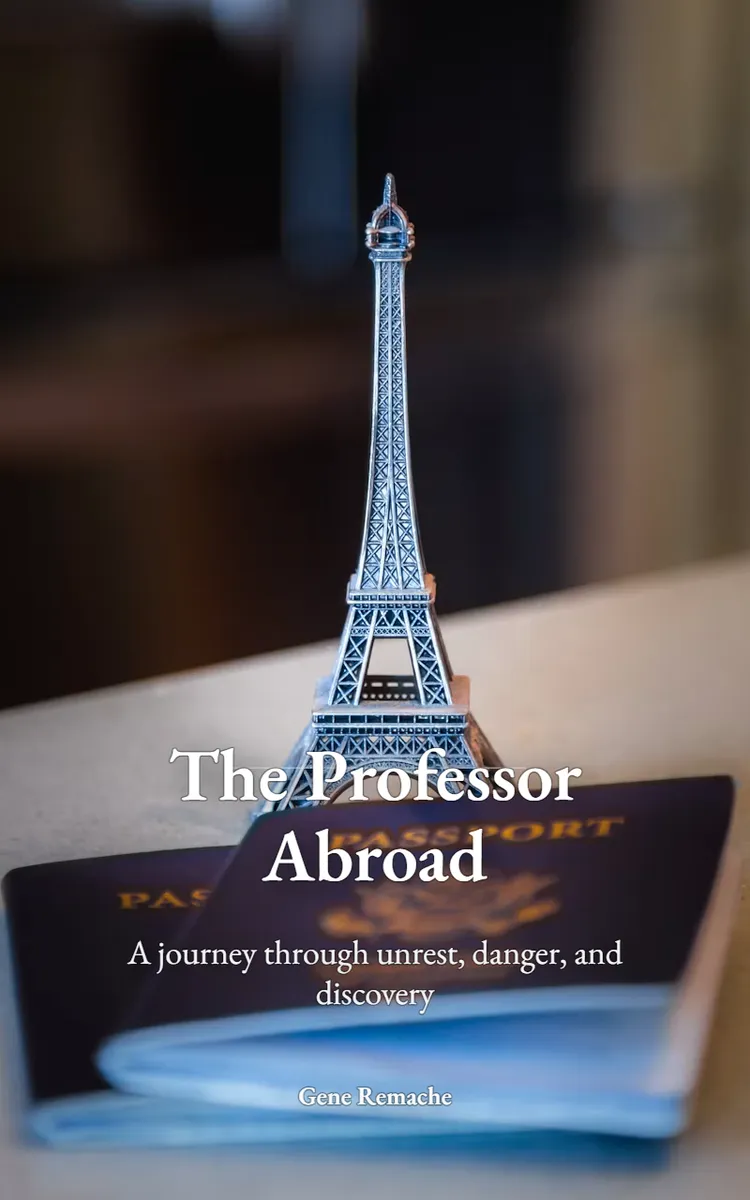
"The Professor Abroad" is a fiction book by Gene Remache with 12 chapters and approximately 24,729 words. A history professor's European journey disrupted by demonstrations and violent riots.
This book was created using Inkfluence AI, an AI-powered book generation platform that helps authors write, design, and publish complete books. It was made with the AI Novel Writer.
Frequently Asked Questions
What is "The Professor Abroad" about?
A history professor's European journey disrupted by demonstrations and violent riots
How many chapters are in "The Professor Abroad"?
The book contains 12 chapters and approximately 24,729 words. Topics covered include The Square Turns Hostile, A Lecture He Cannot Give, A Station Under Siege, The Photograph That Lied, and more.
Who wrote "The Professor Abroad"?
This book was written by Gene Remache and created using Inkfluence AI, an AI book generation platform that helps authors write, design, and publish books.
How can I create a similar fiction book?
You can create your own fiction book using Inkfluence AI. Describe your idea, choose your style, and the AI writes the full book for you. It's free to start.
Write your own fiction book with AI
Describe your idea and Inkfluence writes the whole thing. Free to start.
Start writingCreated with Inkfluence AI


