

Read the first chapter
The whole of chapter one, free. About 7 min. Turn the pages with the arrows, your keyboard, or a swipe.
Chapter 1
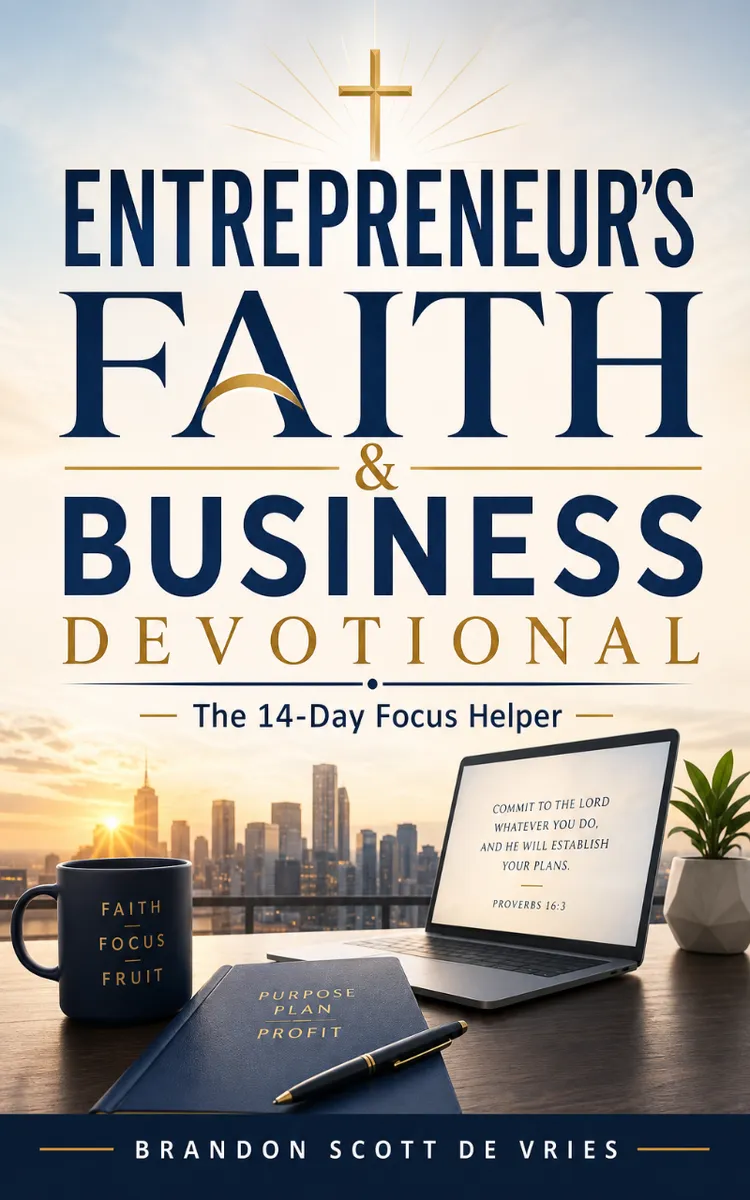
Entrepreneur’s Faith & Business Devotional: The 14-Day Focus Helper
Entrepreneur’s Faith & Business Devotional:
The 14-Day Focus Helper
This devotional offers a grace-centered framework specifically designed for Christian entrepreneurs, leaders, and high achievers experiencing spiritual exhaustion.
A Note to the Exhausted Achiever
If prayer feels like an additional obligation, this does not indicate failure before God. Rather, it reflects fatigue. When the soul is weary, even beneficial practices can become overwhelming.
This 14-day guide is intended for believers who shoulder significant responsibilities, care for others, and experience genuine pressure. Its aim is not to impose additional discipline on those already facing burnout. Instead, it encourages a return to spiritual practices that foster vitality and challenges the notion that God is only pleased by constant activity.
This guide does not require increased effort; rather, it invites a renewed focus on grace.
How to Use This Devotional (Simple, No Pressure)
Each day includes:
• Anchor Scripture: a stable place to stand
• A brief devotional: practical and calming, never burdensome
• Kingdom Bible Study Tools: concise strategies that reduce obstacles and restore spiritual rhythm
• Prayer prompt: guidance for moments when words are lacking
• Business alignment step: a gentle approach to aligning leadership, revenue goals, and decisions with God’s wisdom
• Boundary or rest practice: emphasizing that rest is a spiritual necessity rather than a selfish act
The recommended duration is 10 to 15 minutes per day. On especially busy days, even a few quiet moments are sufficient. You may combine days as needed or return whenever possible. If a day is missed, avoid guilt and simply resume where you left off.ff.
The Core Distinction You Will Practice for 14 Days
Religious Pressure says:
“God is measuring me. I must prove I am serious.”
Holy Discipline says:
“God is with me. I get to return to Him, and He gives me strength.”
This book serves as a guide for transitioning from pressure to presence. Over the next 14 days, you may progress from spiritual exhaustion to renewed connection, deeper rest, and a revitalized sense of purpose in both faith and professional life.
PHASE 1: This phase emphasizes recognizing the burden of carrying responsibilities beyond what grace requires and breaking the cycle of attempting to prove faith through continuous effort.
Set the context: Recognizing the weight is essential at this moment. You have carried the load and labeled it devotion. That mislabeling is where fatigue begins. When spiritual practices become another
quota to meet, they stop being a conduit for God’s strength and become a demand on your limited energy. This section helps you stop confusing motion with mission so you can free up
emotional and spiritual bandwidth for what truly renews you. What this solves: it helps you spot behaviors that feel holy but actually drain you - overextending your time, saying yes because of
fear, or squeezing prayer into leftovers of your day. After this part, you’ll know how to identify three common pressure patterns, and you’ll have concrete steps to release or reframe each one so
you can bring work and faith into healthier alignment. You’ll finish this section able to name the specific habit that wears you down, take one measurable action to change it this week, and notice a simple, immediate shift: one less thing that seems to define your worth. Remember, small changes provide steady relief. Teach the core technique: Recognize, Release, Replace. The core
technique here is a three-move routine: Recognize the pressure, Release what isn’t grace, and Replace the habit with a life-giving practice. Use this routine whenever devotion starts to feel like
a second shift. Below are the distinct steps with concrete examples. Recognize the Pressure:e Notice the tone of your inner voice when you approach spiritual tasks. Does it sound like a
manager ticking boxes or like a friend wanting to reconnect? Example: if you open your Bible and immediately check how long you must read rather than what you need to read, that’s pressure.
Write down the phrase you hear in your head; that phrase identifies the rule you’re following. Release What Isn’t Grace: Remove or shrink practices that operate from fear of not measuring up.
Example: if you force two hours of Bible study daily because “that’s holy,” try cutting to 15 focused minutes for three days and note how you feel. Releasing here means actively choosing rest
over obligation; set a timer, and follow it. The why: removing tasks frees attention for practices that actually feed you. Replace with a Life-Giving Practice:e Swap the emptied slot with a short,
nourishing habit that connects heart and work. Example: replace one rigid devotion hour with a five-minute morning centering where you name one thing you need God’s help with in business,
then invite guidance. The why: small practices create sustainable rhythms; they rebuild trust that God meets you where you are. These steps keep you practical. You’ll use a notebook, a phone
timer, and one chosen replacement practice. Over the course of r a week, the Recognize-Release-Replace routine reduces the “I must prove” voice and increases genuine presence. Putting it
into practice: A realistic 7-day plan with numbers and outcomes. Start Monday. Block 10 minutes each morning for seven days. You’ll use a simple log with the following columns: Day, Pressure
Phrase, Release Action, Replacement Practice, Outcome. Follow these numbered steps and expect measurable shifts. Day 1 - Record the Pressure Phrase Action: Spend 3 minutes noticing
how you think about devotion. Write the exact phrase in your log (e.g., “I must pray for an hour or I’m lazy”).Expected outcome: Clear identification of the rule driving your behavior. Day 2 -
Implement a Release Action: Set a 15-minute timer and do the shortest spiritual practice you can that still feels meaningful (read one Psalm or pray 3 sentences). Stop when the timer
rings. Expected outcome: You’ll feel less trapped by length and more open to quality over quantity. Day 3 - Replace with a Work-Linked Practice Action: Spend 5 minutes naming one business
challenge (e.g., a marketing email deadline). Pray or reflect specifically for guidance on that one item. Expected outcome: You’ll begin to see faith as directly useful in your work, not separate
from it. Day 4 - Add a Boundary Action: Schedule a 30-minute no-check phone window after work. Use that time for a quiet walk or a scripture reading of 5-7 verses. Expected outcome: Your
mind stops carrying work into devotion and vice versa; stress drops a notch. Day 5 - Evaluate and Adjust Action: Review your log. If a release action felt too small, try 25 minutes; if it felt too big,
try 10 minutes. Make one precise adjustment and note it. Expected outcome: You’ll learn which size practice restores you rather than draining you. Day 6 - Connect with Someone Action: Share
one pressure phrase and one release step with a trusted peer or mentor (via text or 5-minute call).Expected outcome: Externalizing the rule breaks its power and provides accountability. Day 7 -
Measure Change and Choose Next Steps Action: Score your spiritual energy on a 1-10 scale at start and end of the week. Commit to keeping the most helpful replacement practice for two more
weeks. Expected outcome: You’ll likely see a 1-3 point improvement and have a clear practice to continue. Quick checklist: Write your Pressure Phrase today. Use a timer for release
actions. Replace one long devotion with a 5-minute work-linked prayer. Schedule one 30-minute no-phone window. Share progress with one person. Score and commit at week’s end. You’ll notice
the difference not because you did more, but because you did less of the wrong activities and consistently practiced a small, beneficial action. That is grace in action. Common mistakes and edge cases:
Mistake: Replacing a long practice with vague busyness. If you cut a long devotion and fill the time with random tasks (scrolling, to-do lists), you’ll end the day more restless. Do this: Schedule a
specific five-minute replacement practice (read Psalm 23 aloud, pray a one-sentence request for clarity on a business decision). Use a timer and note one phrase that felt real. Not this: Fill the
gap with social media or unfocused “quiet time” without a clear activity. Mistake: Mistaking guilt relief for spiritual growth.h If you pause a demanding practice just to avoid guilt, you might
substitute one anxious habit for another. Do this: After a release action, journal one observable change (calmer breathing, clearer focus during a meeting, fewer resentful thoughts). Track it
two days in a row. Not this: Stop and then assume “I’m healed” without checking whether your inner voice still operates from proving. Mistake: Going solo when you need small accountability
If you try to reboot your rhythm alone and you’re used to proving yourself, you’ll slip back into old rules. Do this: Tell one trusted peer your Pressure Phrase and the one change you’ll make
this week. Ask them to check in by text on Day 4. Not this: Keep it private and hope the pattern shifts without outside help. These fixes keep the work doable and the benefits real. You’ll
Reclaim spiritual practices that nourish rather than drain. Keep the routine simple, measure small wins, and remember that grace requires honest and steady returns, not grand performances.
You’ve already taken the first step by noticing; now let the next steps be gentle and concrete.
End of chapter one. 19 more chapters in the full book.
Swipe or use the arrows to turn the page

What's inside: 20 chapters
- 1. Entrepreneur’s Faith & Business Devotional: The 14-Day Focus Helper
- 2. Anchor Scripture:
- 3. Anchor Scripture:
- 4. Anchor Scripture:
- 5. Anchor Scripture:
- 6. Anchor Scripture:
- 7. Anchor Scripture:
- 8. Anchor Scripture:
- 9. Anchor Scripture:
- 10. Anchor Scripture:
- 11. Anchor Scripture:
- 12. Anchor Scripture:
- 13. The One Psalm Reset:
- 14. Anchor Scripture:
- 15. The Boundary Script
- 16. Anchor Scripture
- 17. The Quiet Listen Minute
- 18. Anchor Scripture
- 19. The Grace Rhythm Rule
- 20. You now have a simple map
About this book
"Entrepreneur’s Faith & Business Devotional" is a general book by Brandon Scott De Vries with 20 chapters and approximately 37,436 words. It covers key insights and practical takeaways on the topic.
This book was created using Inkfluence AI, an AI-powered book generation platform that helps authors write, design, and publish complete books.
Frequently Asked Questions
What is "Entrepreneur’s Faith & Business Devotional" about?
"Entrepreneur’s Faith & Business Devotional" is a general book by Brandon Scott De Vries covering key insights and practical takeaways on the topic.
How many chapters are in "Entrepreneur’s Faith & Business Devotional"?
The book contains 20 chapters and approximately 37,436 words. Topics covered include Entrepreneur’s Faith & Business Devotional: The 14-Day Focus Helper, Anchor Scripture:, Anchor Scripture:, Anchor Scripture:, and more.
Who wrote "Entrepreneur’s Faith & Business Devotional"?
This book was written by Brandon Scott De Vries and created using Inkfluence AI, an AI book generation platform that helps authors write, design, and publish books.
Write your own book with AI
Describe your idea and Inkfluence writes the whole thing. Free to start.
Start writingCreated with Inkfluence AI


