
Read the first chapter
The whole of chapter one, free. About 10 min. Turn the pages with the arrows, your keyboard, or a swipe.
Chapter 1
Jing, Qi & Shen for Hair
Have you ever noticed how your hair can look “fine” on the outside while your whole body feels depleted - like you’re running on fumes? In TCM terms, that’s often the difference between having enough Jing (Essence) to build and pigment hair well, enough Qi (Vital Energy) to keep circulation and scalp support moving, and enough Shen (Spirit) to keep your stress system from constantly draining you. And if greying is already showing up, the goal isn’t a magic switch - it’s creating the kind of internal “fuel” that makes healthy aging easier on your hair.
This chapter gives you a plain-language foundation for the Three-Lens Vitality Map: Jing, Qi, and Shen - so you can understand why your greys may be accelerating (or slowing) and what to support with daily choices. You’ll leave with a practical way to notice what’s most likely “low” in your life right now - sleep, stress load, or nutrition/hydration - and then plug it into the routines you’ll use throughout this book.
Who this is for: adults who already care about hair health and want an evidence-aware, TCM-informed approach that’s realistic, measurable, and kind to your schedule. Key benefits you can expect: clearer understanding of the TCM levers behind greying, better self-tracking, calmer stress-to-hair support, and a simple starting protocol you can begin today.
Jing, Qi & Shen: the plain-language “why” behind healthy aging and pigmentation
In TCM, hair isn’t just “protein plus vitamins.” Hair is considered a visible expression of what your body stores, moves, and regulates. The Three-Lens Vitality Map helps you separate three different roles that often get mixed together in everyday advice.
Jing (Essence) is your stored “foundation fuel” - the deep resource connected with healthy aging and the body’s ability to replenish. When Jing is strong, the body has more capacity to support growth, repair, and pigment maintenance over time. When it’s depleted, aging tends to show up earlier or more intensely, including in hair color.
Qi (Vital Energy) is the life force that powers movement: circulation, digestion, and the body’s ability to get nutrients where they need to go. For hair, Qi support matters because the scalp and hair follicles need steady delivery and regulation. If Qi feels stuck or underpowered - often from chronic stress, inconsistent eating, or under-recovery - hair can look dull, thin, or change color faster.
Shen (Spirit) is how your nervous system expresses itself - how steady, safe, and regulated you feel. In modern terms, you can think of Shen as your stress physiology and sleep quality working together. When Shen is chronically strained, your body often stays in a “high alert” mode; that can disrupt normal repair cycles and make long-term changes more likely.
Ask yourself: if your hair could “tell the truth” about your week, would it point more to (1) exhaustion and low recovery, (2) poor circulation/digestion rhythms, or (3) constant stress load? That’s the entry point for this chapter’s practical protocols.
Several common factors can push Jing, Qi, and Shen out of balance - some are lifestyle, some are aging-related, and some are individual: 1. Sleep debt and late nights (hits Shen first, then affects Qi and long-term Jing support). 2. Chronic stress (keeps the system activated; often shows up in scalp tension and appetite changes). 3. Nutrient gaps - especially inconsistent protein, low iron status, B-vitamin irregularity, or low overall intake (affects Qi and the “raw materials” needed for hair). 4. Dehydration and low fiber (can worsen digestion and delivery - again influencing Qi). 5. Overheating/scalp irritation from frequent harsh coloring, aggressive heat, or constant product buildup (can increase local stress on hair and scalp). 6. Genetics and normal aging (TCM acknowledges this as “built-in tendency,” and it’s why the focus here stays on support, not guarantees).
A quick note on evidence-awareness: greying is influenced by biology and genetics, and science doesn’t yet promise a universal reversal. What TCM offers - and what we’ll practice here - is support for overall vitality, scalp function, and the internal conditions that influence healthy aging. If you want to measure “better,” you’ll track your energy, sleep, stress, and scalp comfort alongside any visible hair changes.
Practical takeaway / reflection prompt: Choose one lens to start with this week. If your life feels more “wired and tired,” your entry point may be Shen. If your days are unpredictable and your meals are inconsistent, Qi may be your main lever. If you’re feeling like your recovery is slower than it used to be, lean into Jing support.
A daily protocol you can start today (with milestones, timing, and safety boundaries)
Nadia is 46, an ER nurse and a new mom. Her greys weren’t just a “beauty” thing - they were happening while her sleep was fractured and her stress load was constant. What helped wasn’t a complicated routine; it was building a consistent 10-minute ritual that matched her real constraints. She didn’t overhaul her life overnight - she created a small, repeatable pattern that supported Jing (recovery), Qi (circulation and digestion rhythm), and Shen (nervous system downshift).
Here’s a simple, hair-specific protocol built around that Three-Lens Vitality Map. You’ll do it morning or evening depending on your day.
Morning (6-10 minutes): Qi + Shen “set the tone” 1. Warm up the scalp (60 seconds): Place your fingertips on your scalp and do gentle, slow circles. Keep it comfortable - think “wake up,” not “massage until sore.” 2. Breathwork for Shen (2 minutes): Inhale through the nose for 4, exhale for 6. Repeat for 8 cycles. If you feel lightheaded, shorten the exhale to 5. 3. Acupressure for circulation support (3-4 minutes): Use the points GB20, GV20, and LI4 (details below in the safety section). 4. Hydration cue (30 seconds): Drink 8-12 oz (250-350 ml) of water right after your breathwork. If you already hydrate well, keep it consistent rather than increasing.
Evening (7-12 minutes): Jing + Qi “recover and replenish” 1. Downshift breath (2 minutes): Same 4-in/6-out pattern, but slower. 2. Lower-body Qi support (3-5 minutes): Acupressure ST36 and KI3 (details below). 3. Optional scalp comfort (1 minute): Gentle combing with a wide-tooth comb or soft brushing from root to tip - no tugging. 4. Quick nutrition check (30 seconds): Ask, “Did I get enough protein today?” If not, plan a protein-forward snack for tomorrow (you’ll learn more in later chapters).
Acupressure instructions (the 7 points) Use a calm, steady pressure - not stabbing, not grinding. Aim for a sensation that feels like comfortable pressure with mild warmth or tenderness, not sharp pain.
• GB20 (Fengchi): Locate the hollow area at the base of the skull, roughly where the neck muscles meet the skull. - Technique: Use thumbs to press gently into the hollows, then hold. - Frequency: 1-2 minutes total, then release. - GV20 (Baihui): Locate the point on the midline of the head, about at the top of the head (crown). - Technique: Light-to-moderate vertical press with fingertips. - Frequency: 30-60 seconds, hold steadily. - ST36 (Zusanli): Locate about 4 finger-widths below the kneecap, on the outside of the shin bone. - Technique: Firm, comfortable press with thumbs or knuckles. - Frequency: 1 minute per side. - KI3 (Taixi): Locate the hollow between the inner ankle bone and the Achilles tendon, slightly above the ankle crease. - Technique: Moderate press, often feels tender but should not be sharp. - Frequency: 45-60 seconds per side. - LV3 (Taichong): Locate the top of the foot, in the web between the big toe and second toe, then measure about a thumb-width up along the joint line. - Technique: Press gently and hold. - Frequency: 45-60 seconds per side. - SP6 (Sanyinjiao): Locate about 3 finger-widths above the inner ankle bone along the inner leg line. - Technique: Moderate press; hold steadily. - Frequency: 45-60 seconds per side. - LI4 (Hegu): Locate the web between the thumb and index finger, slightly toward the index finger. - Technique: Firm press into the web space. - Frequency: 30-45 seconds per hand.
Safety precautions (please read this part like you mean it) - Avoid acupressure on broken skin, active rashes, or areas that are severely bruised. - Use gentle to moderate pressure. If you get sharp pain, numbness, or tingling that lingers, back off and skip that point for the day. - If you’re pregnant, have a history of fainting with pain, take blood-thinning medication, or have a condition where your clinician has advised caution with bodywork, check with a licensed professional before doing LI4, SP6, or strong pressure on lower points. - Keep your breath steady during pressure. If you notice dizziness, stop and return to gentle scalp touch and slower breathing.
Progression milestones (so you don’t guess) You’ll follow this for 4 weeks. Don’t “add everything” - build consistency first.
• Week 1 (Days 1-7): Do the morning protocol 5 days and the evening protocol 4 days. Track sleep quality (1-5), stress level (1-5), and scalp comfort (1-5). - Week 2: Add one extra acupressure point once per session - choose either LV3 (for stress-related tension) in the morning OR SP6 (for overall calming and support) in the evening. - Week 3: Increase total time slightly: mornings to 8-11 minutes, evenings to 9-13 minutes, while keeping pressure comfortable. - Week 4: Make it “yours.” If your energy is low, keep the evening session longer. If your nervous system runs hot, keep the breathwork longer.
When to seek professional help If you notice sudden patchy hair loss, significant scalp pain, persistent itching with scaling, or rapid changes that worry you, it’s wise to consult a licensed clinician. Wellness routines can support, but they shouldn’t replace evaluation when symptoms are unusual.
Comparison table: what to emphasize based on your Three-Lens Map | If your week feels like… | Lean more into… | Your timing focus | |---|---|---| | “I’m exhausted, recovery is slow” | Jing support + evening routine | Evening protocol (Jing/Qi) | | “I’m tense and wired, sleep is light” | Shen downshift | Morning + evening breathwork | | “My digestion/appetite is inconsistent” | Qi movement + hydration cue | Morning hydration + ST36/KI3 |
Practical takeaway / reflection prompt: After 7 days, ask yourself: did your sleep feel more stable, did scalp comfort improve, and did your stress feel easier to come down? Choose one improvement and keep it.
Common mistakes that quietly block your results
Even with a great plan, a few common missteps can keep Jing, Qi, and Shen from getting the support they need. Here are the ones I see most often - especially in busy adults trying to fit hair health into real life.
Mistake 1: Going too hard on acupressure Why it happens: Many people assume “stronger pressure = faster results,” especially when they’re frustrated by greys. But hair support in TCM is about steady circulation and nervous system regulation, not bruising the tissue. What to do instead: Use a pressure level that feels like “comfortable, persistent.” If you feel sharp pain, stop. Keep each point in the range of 30-120 seconds as given, and prioritize consistency over intensity.
Mistake 2: Skipping breathwork because “I’m doing enough already” Why it happens: When life is full - shift work, new-parent chaos, heavy schedules - breathwork can feel like an optional extra. In the Three-Lens Vitality Map, breathwork is your Shen lever. Without it, your body may stay in a stressed mode that makes Qi support harder to sustain. What to do instead: Make breathwork non-negotiable: 2 minutes in the morning and 2 minutes in the evening for Week 1. Even on the busiest day, do the 4-in/6-out pattern for 8 cycles.
Mistake 3: Treating greying as a “hair-only” problem Why it happens: It’s tempting to focus only on scalp oils, dyes, and supplements - especially when you can see the hair change. But TCM understands hair as downstream of what’s happening with Jing storage, Qi movement, and Shen regulation. What to do instead: Pair one hair-related action with one body-related action. Example: after scalp circles, do hydration (8-12 oz) and the GB20/GV20 sequence. Or after dinner, do ST36/KI3 instead of scrolling endlessly - your routine becomes consistent support, not random effort.
Practical takeaway / reflection prompt: Choose one mistake above and correct it for the next 3 days. Notice what changes in your energy and scalp comfort - not just your hair.
If you remember only one thing from this chapter, make it this: greying is often the visible timeline of deeper processes. When you support Jing with recovery, Qi with steady movement and nourishment rhythms, and Shen with real downshifts, you’re giving your body the conditions it needs to age in a way that feels more supportive - one small, repeatable ritual at a time.
End of chapter one. 7 more chapters and about 14,932 words in the full book.
Swipe or use the arrows to turn the page


What's inside: 8 chapters
- 1. Jing, Qi & Shen for Hair
- 2. 10-Minute Hair Vitality Routine
- 3. Scalp Massage for Microcirculation
- 4. Self-Acupressure: GB20 & GV20
- 5. ST36 & KI3 for Energy Support
- 6. LV3, SP6 & LI4 for Stress Balance
- 7. Sleep Hygiene for Shen Restoration
- 8. 30-Day Challenge Review & 90-Day Plan
About this book
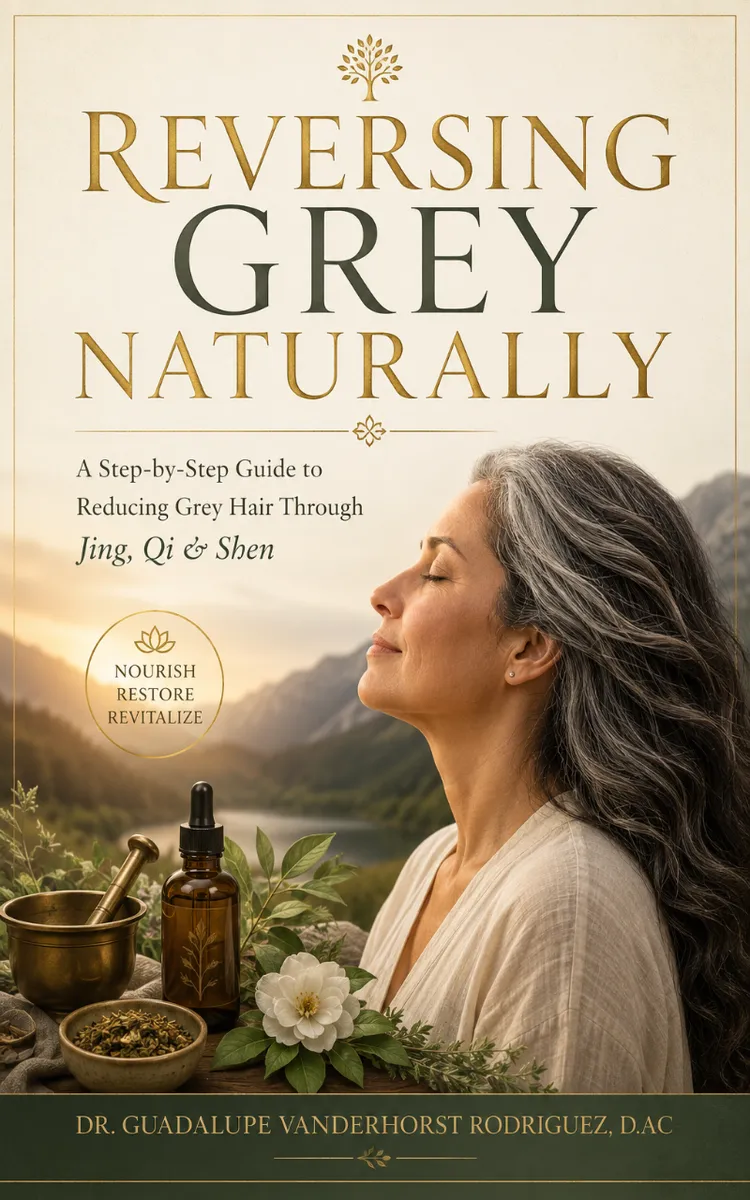
"Reversing Grey Naturally" is a health & wellness book by Dr. Guadalupe Vanderhorst Rodriguez, D.Ac with 8 chapters and approximately 14,932 words. Traditional Chinese Medicine support for reducing grey hair.
This book was created using Inkfluence AI, an AI-powered book generation platform that helps authors write, design, and publish complete books. It was made with the AI Health Book Generator.
Frequently Asked Questions
What is "Reversing Grey Naturally" about?
Traditional Chinese Medicine support for reducing grey hair
How many chapters are in "Reversing Grey Naturally"?
The book contains 8 chapters and approximately 14,932 words. Topics covered include Jing, Qi & Shen for Hair, 10-Minute Hair Vitality Routine, Scalp Massage for Microcirculation, Self-Acupressure: GB20 & GV20, and more.
Who wrote "Reversing Grey Naturally"?
This book was written by Dr. Guadalupe Vanderhorst Rodriguez, D.Ac and created using Inkfluence AI, an AI book generation platform that helps authors write, design, and publish books.
How can I create a similar health & wellness book?
You can create your own health & wellness book using Inkfluence AI. Describe your idea, choose your style, and the AI writes the full book for you. It's free to start.
Write your own health & wellness book with AI
Describe your idea and Inkfluence writes the whole thing. Free to start.
Start writingCreated with Inkfluence AI


