
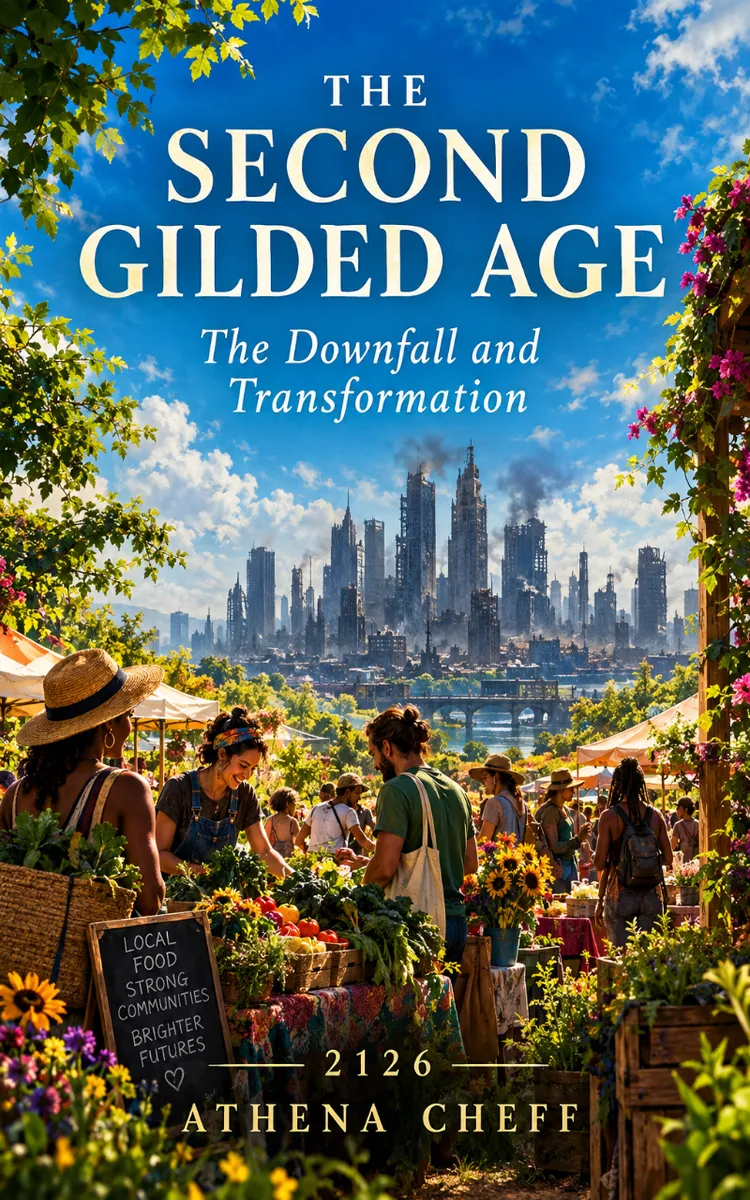
Read the first chapter
The whole of chapter one, free. About 28 min. Turn the pages with the arrows, your keyboard, or a swipe.
Chapter 1
The Second Gilded Age
Table of Contents
Part I The World They Had Built
Part II The Breaking Point & Transformation
Part III The Warning
THE SECOND GILDED AGE
The Downfall and Transformation
Copyright © 2026 Athena Cheff
All rights reserved.
This is a work of fiction inspired by historical events, public records, political movements, and real-world circumstances. Some events, organizations, characters, dialogue, and relationships have been altered, combined, imagined, or invented for the purposes of the story. The fictional characters and events should not be understood as factual accounts of real individuals or organizations.
No part of this book may be reproduced, distributed, or transmitted in any form or by any means without prior written permission from the author, except for brief quotations used in reviews, criticism, or other uses permitted by law.
First edition, 2026
Published independently by Athena Cheff
Prologue
This is the story of the Second Gilded Age. This is the story of how the people narrowly escaped a fascist authoritarian takeover. Most of the events are true. Some of the events are fictional. Some of the events have just not happened yet. Liberties have been taken. This is how the people of the Second Gilded Age transformed their society from an individualistic, consumer-driven, survivalist society into a community-focused, matriarchal, solarpunk society.
Introduction
They were ordinary human beings who had accumulated extraordinary amounts of money and power, and they increasingly behaved as though that made them extraordinary.
Yet, they had no extraordinary business acumen, no special education or knowledge. They were ordinary people who had simply gotten lucky. No amount of money could buy them class, morals, or values. They truly lacked empathy and self-awareness.
They believed their money made them invincible. They used the Earth like their playground, polluting the environment while traveling around in their private jets and luxury yachts. One study had estimated that their yachts polluted in one year what an average person contributed in 860 years. Yet, that was less than half of what their investments contributed.
They supported any candidate that would cut their regulations so they could build massive data centers and who would cut their taxes. Not because they didn’t have the money to pay their taxes, but because they knew that paying them might help the people and make them less desperate.
They didn’t care about the Earth. They were busy contemplating apocalyptic scenarios of how society would collapse. Each one had their beliefs about how it would end and were planning and implementing their escape plans.
The first, and only, trillionaire ( who was known as the world’s most miserable man!) had stated repeatedly that AI was “the biggest existential threat” to human civilization. His escape plan was to build a self-sustaining civilization on Mars. It was now a hundred years later and still not achievable. Another billionaire had bought a longtime friend a VP position because of his fanatical religious beliefs about the End Times. He had built bunkers and bought properties in multiple countries with another billionaire to try to escape from whatever happened.
That was the year 2026. She imagined that they had no idea that it was billionaires who would no longer exist in just a few short years.
Part I
Maia had always been fascinated with billionaires.
There were historians who spent their lives studying wars. Others specialized in plagues, famines, dictators, collapsing empires, and the various creative ways humans had found to kill one another.
She had studied the wealthy tycoons from the First Gilded Age who had been visionaries, but grew their wealth by building monopolies. Unlike the billionaires from the Second Gilded Age, they knew their immense wealth would draw public backlash. So they built libraries, museums, universities, public pools, and hospitals.
In contrast, the billionaires from the Second Gilded Age believed themselves to be heroes while paying poverty wages. They were completely unaware of why a growing number of people thought they were villains. They felt as though they had already given so much by creating jobs that they shouldn’t be taxed and called it unfair.
It is hard to fathom now- but there was a time when the elite billionaire class hoarded most of the wealth and worldly possessions for themselves. The government allowed monopolies and corruption to go unchecked. It was a time when there was more wealth than ever before.
Yet, instead of producing an enlightened society, it produced superyachts and homelessness. It was a time when the people working full-time had to choose between rent, food, or medicine.
It was a rather unfortunate time to be poor.
The billionaire elite owned the corporations. They owned the media. They owned the politicians.
Laws were written in corporations’ favor instead of the people. Instead of the workers.
Back before the markets and people turned against the companies that once conquered industries, there was a host of characters- and characters they were.
Maia’s thought is interrupted by a message from the OFFICE OF NATIONAL CONTINUITY. She is to report immediately.
The Office of National Continuity occupied an old government building that had been preserved almost entirely. Someone, a century earlier, had decided that tearing down the old building was not progress.
Maia liked it.
The elevators were slow. The corridors smelled faintly of paper.
The woman at the security desk checked Maia’s identification.
“Oh. Yes, go right in.”
She pointed down the corridor to the Director’s office.
Maia wasn’t particularly nervous. Although she had no idea what the urgent matter could be. Historians were accustomed to disasters. They simply preferred theirs to have already happened.
The Director was waiting beside a wall-sized display.
There were no photographs on it.
No charts.
No names.
Just four dates.
1890
1933
2026
2126
Maia stopped.
For several seconds, neither of them spoke.
"Sit down."
Maia sat.
"What's happened?"
"We're concerned about a political movement."
"That's vague."
"We need you to determine whether it is historically significant."
"Everything is historically significant eventually."
"Maia."
She looked at the Director.
"All right."
A file appeared on the table.
She opened it.
Photographs.
Transcripts.
Speeches.
Social media posts.
News reports.
Organizational documents.
Names she recognized.
Others she didn't.
She read for several minutes.
Then she looked up.
"Why me?"
"Because you've spent ten years studying the Second Gilded Age."
"I've spent ten years studying billionaires."
"Same thing, according to your department."
Maia looked back at the file.
"What exactly am I supposed to find?"
The Director paused.
"Whether we're seeing the beginning of a pattern."
Maia looked at the four dates again.
And this time she understood.
Outside her window, the city was beginning its evening cycle. The electric trolleys moved silently through the lower district. Gardens covered what had once been parking structures. Children were playing in a communal courtyard three floors below.
The world looked peaceful.
The First Gilded Age had not looked like a disaster while people were living through it.
That was one of history's more irritating habits.
It had looked like progress.
Factories expanded.
Railroads crossed the country.
Fortunes became enormous.
New technologies appeared.
Cities grew.
The country became richer.
There was, naturally, a great deal of poverty.
There were workers with few protections, enormous disparities in wealth, political corruption, financial crises, and industrialists with extraordinary influence.
But progress was progress.
At least that was what people with money tended to call it.
The Library of Congress would later describe the period as one of extraordinary industrial and economic growth alongside large income disparities and few protections for many workers.
The Progressive Era that followed brought antitrust measures, labor reforms, consumer protections, and other efforts to address the concentration of power and wealth.
The people living through it did not have the benefit of knowing they were living through the First Gilded Age.
They didn’t wake up and say:
"Good morning. I appear to be living through a historically significant period of concentrated wealth and political corruption."
They simply went to work.
They paid rent.
They thought about their next meal.
They complained about politicians.
They read the newspaper.
They hoped things would get better.
And the people at the top continued to insist that everything was working exactly as it should.
Maia turned another page.
Then another.
She had seen this before.
Not just the wealth.
The psychology.
That was what interested her.
The wealthy industrialists of the First Gilded Age had not generally regarded themselves as villains.
They were builders.
Captains.
Visionaries.
The men who owned enormous fortunes tended to believe their fortunes demonstrated something about them.
Intelligence.
Discipline.
Superior judgment.
Worth.
Money became evidence of merit.
And merit became an argument for having more money.
It was a wonderfully convenient philosophy.
Maia wrote one sentence in her notes.
Power begins to defend itself by calling itself deserved.
Then she moved forward in time.
Germany was different.
But not entirely.
The circumstances were different.
The institutions were different.
The people were different.
History is never kind enough to repeat itself exactly.
It prefers costumes.
Germany's economic and political crises after World War I created conditions in which extremist movements could gain support. The Nazis used propaganda, political violence, fear, and promises of national restoration. Hitler did not seize power in one dramatic instant. He was appointed chancellor on January 30, 1933, after years of political maneuvering and growing Nazi power. Conservative elites who believed they could use him for their own purposes helped make his appointment possible.
That part had always fascinated Maia.
People liked to imagine dictators appearing from nowhere.
It made history easier.
A monster arrives.
Everyone recognizes the monster.
Everyone fights the monster.
The end.
It was a comforting story.
It was also usually wrong.
Authoritarianism was rarely announced with a trumpet.
It came with promises.
Order.
Security.
Restoration.
Strength.
A return to greatness.
Someone was always to blame.
Someone was always supposedly taking something away.
Someone was always threatening the nation.
And there were always people who believed they could control the movement once it became useful.
That was the dangerous part.
Not simply the demagogue.
The people who thought the demagogue was useful.
Maia stared at the screen.
Then she moved to 2026.
The Second Gilded Age was easier to recognize from a distance.
The wealth was larger.
The technology was advanced.
The billionaires had rockets.
They had social media platforms.
They had enormous corporations.
Local businesses had folded under predatory pricing, media was being consolidated into soulless conglomerates, and civic trust was being eroded as institutions bent under corporate pressures. Their philanthropic gestures were performative, tax-advantaged donations that bought naming rights and headlines, not systemic change.
They insulated themselves behind security teams, gated estates, and private islands, while public infrastructure crumbled around them. They had their plans for surviving the collapse of civilization in private underground facilities.
Humanity had finally achieved the ability to build a bunker underneath the planet while failing to agree that everyone should have somewhere to live above it.
The billionaires had not merely accumulated wealth.
They had accumulated influence.
They shaped markets.
Bought companies.
Funded political causes.
Employed armies of lawyers and accountants.
Owned media organizations and platforms.
Influenced public debate.
The richest people in the country had more ability to shape the conditions of ordinary life than most ordinary people had to shape the conditions of their own lives.
And then there was President Trump.
Maia opened another file.
The name appeared everywhere.
Trump had not created every condition of the Second Gilded Age.
That would have been historically convenient.
He had entered a country that already had economic inequality, political polarization, declining trust in institutions, and a long history of racial and cultural conflict.
But he had understood something important.
Fear could be organized.
Anger could be organized.
Grievance could be organized.
And people who felt powerless could be persuaded that someone else was responsible for their powerlessness.
That was one of the things Maia kept returning to.
The authoritarian did not have to invent every grievance.
He only had to give the grievance a target. He had begun his campaign by scapegoating immigrants. Maia had seen a quote from his presidential campaign announcement, “When Mexico sends its people, they’re not sending their best… They’re sending people that have lots of problems, and they’re bringing those problems with us. They’re bringing drugs. They’re bringing crime. They’re rapists.”
Even though the facts didn’t support this claim. The history books described him as having a strained relationship with facts. So did his followers. As his political career went on, he even began sounding like Hitler, claiming immigrants were “poisoning the blood of our country.”
By 2026, the United States was again arguing over the boundaries of executive power, the press, immigration, political institutions and the meaning of democracy itself. Contemporary analysts were documenting concerns about democratic backsliding and Trump’s administration's weakening of longstanding democratic institutions and norms.
But Maia wasn't interested in the argument over whether one particular person was the whole problem.
She had studied history too long for that.
Trump was a person.
So was Hitler.
So were the industrialists of the First Gilded Age.
So were the billionaires of the Second.
People mattered.
But structures mattered too.
And structures had a nasty habit of surviving the people who built them.
She put the four dates on the screen.
1890
1933
2026
2126
Then she added another word beneath them.
POWER.
She stared at it.
That was too simple.
WEALTH.
Too simple.
FEAR.
Closer.
She tried again.
CONCENTRATION.
She stopped.
Not quite.
She added:
ISOLATION.
Then:
DIVISION.
Then:
SCAPEGOATING.
Then:
AUTHORITY.
She stepped back.
There it was.
Not a straight line.
A progression.
Wealth became concentrated.
Power followed.
People became insecure.
Institutions lost legitimacy.
Someone was blamed.
People divided themselves into camps.
A leader promised to restore order.
The public argued about the leader.
Meanwhile, the institutions changed.
Slowly.
Then quickly.
Then all at once.
Maia felt a chill.
She looked at the final date.
The Director's words returned to her.
We're concerned about a political movement.
Maia opened the contemporary file again.
The rhetoric was familiar.
Not identical.
That would have been too easy.
But familiar.
Traditional families.
Personal responsibility.
Restoring authority.
Taking the country back.
Suspicion of collective institutions.
Hostility toward communities that had organized themselves outside traditional hierarchies.
Fear of people who were different.
Anger toward people who were supposedly receiving something they had not earned.
Promises that one strong movement could restore what had been lost.
Maia sat back.
Then she laughed.
It wasn't because anything was funny.
It was the sort of laugh a person makes when history has just told the same joke for the third time.
"You have got to be kidding me."
There was one thing Maia could not understand.
People in 2126 knew all of this.
They knew about the First Gilded Age.
They knew about Hitler.
They knew about the Second Gilded Age.
They knew about the rise and fall of Trump.
They had spent a century teaching it in schools.
They had museums.
Archives.
Memorials.
Entire academic disciplines.
There were historical simulations.
Documentaries.
Public lectures.
Children learned the warning signs.
And yet the pattern was beginning to appear again.
Why?
Maia had spent years assuming the answer was ignorance.
It was not.
In 2026, they were watching.
They were arguing.
They were posting.
They were warning each other.
Half of the people in the country could see what was happening.
They could name it.
They could point to historical examples.
And still, the movement grew.
That bothered her more than anything.
Because recognition was supposed to be the part that saved you.
Wasn't it?
If half of the people could see the cliff, surely everyone would stop walking toward it.
Maia looked again at the file.
The answer came to her slowly.
Perhaps they needed to be able to move together.
That was different.
A million people could recognize the same danger and remain a million individuals.
They could be angry separately.
Afraid separately.
Informed separately.
They could even agree with one another completely and still accomplish very little.
The people trying to take power understood organization. Hate was a powerful motivator.
They built networks.
They recruited.
They raised money.
They created loyalty.
They repeated messages until people knew them by heart.
They did not wait for everyone to agree.
They organized the people who already did.
Maia looked at the old photographs from 2026.
The billionaires were still smiling.
They had believed wealth was power because wealth gave them power.
They had believed their success proved the system was functioning.
They had mistaken their position inside the machine for proof that the machine worked.
That was the great trick of the Second Gilded Age.
The people who benefited most from the system were the least likely to notice what it looked like from underneath.
And underneath it, people were tired. The bills kept rising. Their paychecks didn’t.
They were paying an increasing amount for housing.
Paying an increasing amount for health insurance that didn’t cover what it was supposed to if they needed it. Many couldn’t afford health insurance at all.
Paying an increasing amount for food. At the same time, Trump was cutting food benefits and health insurance programs for the poor.
Paying an increasing amount for transportation.
Paying taxes.
Paying for everything individually.
They had been taught to solve collective problems privately.
If you could not afford healthcare, find better insurance.
If you could not afford housing, work harder.
If you were lonely, buy something.
If your community was unsafe, buy security.
If your wages were too low, get another job.
If politics ignored you, donate.
If your neighbor needed help, tell them to call a service.
Everything had been turned into an individual problem.
Perhaps that was why people had become so easy to divide.
They had forgotten they had the same problems.
Maia wrote another sentence.
They knew something was wrong.
Then beneath it:
They did not yet know what to do together.
She stared at the words.
Maia knew that, also at this time, ICE was roaming the streets. Surveillance cameras were going up on every block. They didn’t know what was coming as Trump kept them in distress, guessing at what borderline unconstitutional thing he would try next. The Iran war was causing diesel shortages. The war Trump had started to get Israel back to biblical times.
Outside, the city lights came on. Somewhere below, Lena was probably finishing work. Her kids were probably home by now.
Maia picked up her phone.
She almost called her.
Then stopped.
There was something else in the file.
Names.
Lena's name was on the list.
Maia read the page again.
The movement had begun identifying community networks as a threat.
Lena’s job in the community was to work with several of them.
Food.
Housing.
Childcare.
Transportation.
Mutual aid.
The very systems that had emerged from the transformation of the Second Gilded Age were now being described as dangerous.
Collectivist.
Anti-family.
Anti-tradition.
Unaccountable.
Maia felt the room become very quiet.
For the first time since receiving the assignment, she was afraid.
Not for history.
For Lena.
She looked at the four dates.
The pattern was not repeating because people had forgotten history.
It was repeating because history had never taught them the most important lesson.
Seeing the danger was only the beginning.
Maia closed the file.
Then she opened the oldest file in that archive.
The one that explained what happened next.
The document was dated 2026.
She began to read.
And this time, she wasn't looking for the moment when everything fell apart.
She was looking for the moment when people finally realized they could no longer survive alone.
That was where the Second Gilded Age really began to end.
PART II
Maia's notes on the food crisis began with a grocery receipt.
It was not an especially interesting receipt.
Milk. Eggs. Bread. Apples. Chicken. Chips.
The sort of things people had been buying for generations.
Yet, the total was ridiculous.
She wondered how anyone could afford food.
Maia stared at it for a while.
Then she turned the page.
There were hundreds more.
In 2026, food prices rose sharply. Transportation costs were climbing. Crops were failing in some places. Weather was becoming less predictable. There were shortages of particular foods, empty shelves, delayed deliveries, and families who suddenly discovered that having a job did not necessarily mean having enough food.
The people had always believed that the market would provide.
For a while, it did.
Then it didn't.
The food shortages became common due to supply disruptions.
That was when food co-ops began spreading. People began by organizing daily farmers markets that were supplied by local farmers, which helped with the diesel shortage. The farmers couldn’t keep up the daily schedule.
So each local community pooled together money to open co-op grocery stores.
At first, they were not particularly impressive.
One occupied an empty storefront between a laundromat and a hardware store. Another started in the back of a church. One operated out of a warehouse with terrible lighting and a parking lot full of potholes.
Nobody called them revolutionary.
They called them grocery stores.
The difference was who owned them and who supplied them.
The people buying the food owned shares of the store.
The money stayed closer to home.
At first, people joined because they were tired of empty shelves and paying more for less.
Then something strange had happened.
Farmers met customers.
Customers started talking.
Community grew.
Someone knew a woman who grew tomatoes three counties away. Someone else knew a man with chickens. A retired mechanic offered to repair the refrigeration system. A teacher organized the children's corner while parents shopped.
The grocery store became something more than a place to buy food.
It became a place where people could find out who was growing it.
Maia stopped reading.
She saw a photograph.
Twenty-three people standing outside the store.
They were holding a hand-painted sign:
WE FEED EACH OTHER.
Maia smiled.
She had expected something more dramatic.
A protest.
A revolution.
Perhaps a politician standing on a stage promising to save everyone.
Instead, there were twenty-three people standing outside a grocery store.
That was how much of the transformation had begun.
People did not overthrow the old system all at once.
They began out of necessity.
The cooperatives spread.
Some were small. Some became large. Some failed. Others merged. Many became permanent institutions.
And once people had a place to buy food from their neighbors, another question became difficult to avoid.
Why couldn't they grow some of it themselves?
The first answer was obvious.
Because the city or their HOA wouldn't let them.
Maia found the photographs amusing.
Lawns were everywhere.
Thousands upon thousands of carefully maintained rectangles of grass.
People were accustomed to spending their weekends cutting them, watering them, fertilizing them, or paying someone else to cut them when they were too busy.
In most communities, growing vegetables in the front yard was considered a problem. Raising your own livestock forbidden. Even if you owned the land.
This made less sense once people were hungry.
So the lawns began to disappear.
Tomatoes appeared.
Then beans.
Then peppers.
Fruit trees replaced ornamental shrubs.
Chickens appeared in backyards.
People began trading eggs for vegetables, vegetables for bread, bread for repairs.
This was the beginning of the end of individual survival.
People discovered they had neighbors.
THIS is where the revolution began.
THE GREAT YARD REVOLT.
Some municipalities and HOAs tried to stop them.
People fought back.
Not violently.
Legally.
Politically.
Collectively.
Thousands of people began challenging ordinances that prohibited food production on residential property.
And eventually the political question became:
Why is a homeowner allowed to have a perfectly manicured lawn that produces nothing, but not allowed to grow food?
Then it became a question of freedom. Were the American people really free with all the personal and property restrictions?
The lawn began to look absurd.
And expensive.
And wasteful.
Then eventually, historically strange.
Once people started growing food together, something else happened.
They started doing other things together.
Tool libraries.
Community kitchens.
Repair shops.
Gardens.
Childcare exchanges.
Elder care.
Community festivals.
Neighborhood workshops.
Mutual-aid networks.
She realized that the important transformation that was happening wasn't just economic.
It was psychological.
People stopped being strangers.
Before, the people couldn't organize effectively since they didn't know one another.
The food crisis accidentally created the social infrastructure for everything that followed.
Over time, people realized they needed less and that they were less willing to give their money to big corporations that didn’t pay well.
The HEIRS had inherited their family’s fortune and supermarkets. Most of them didn’t work in the business, but kept the majority stake. Their supermarkets started making less money at a time when businesses were expected to make more profit every year. The executives responded by lowering prices to compete. They tried to sell more local products and produce. That didn’t work so well, as farmers wanted to sell directly to consumers. They raised their employee pay to gain support from the community. It worked to some extent, but their monopoly-like hold was reduced because people had another option.
Then, CostLessCo began supplying more and more of the items that people normally ordered online. CostLessCo was the only large chain store that paid its workers a living wage and treated its employees well at the time. This started to cut into the profits of another billionaire, the sly MERCHANT KING. As time went on, this hurt his business as well, and his power declined.
Then came another problem.
People were meeting their neighbors and finding that they could barely afford to survive.
Housing had been one of the great measures of wealth in the Second Gilded Age.
A house was not just a place to live.
It was an investment.
A retirement plan.
A source of debt.
A status symbol.
For some, it was all four.
For others, it was something they could never afford. Housing prices had soared during this time.
The strange part, Maia noted, was that there were houses everywhere.
There were empty houses.
There were second houses.
There were houses used for vacations.
Houses owned by corporations and private equity.
There were houses purchased as investments and left empty while people slept in cars.
The problem wasn’t a lack of buildings.
It was ownership.
That became harder to ignore when the food cooperatives began bringing people together. Americans had been taught that success meant acquiring an individual home, individual appliances, individual childcare, individual transportation, individual everything. They started realizing independence didn’t require isolation. They started realizing that their individual problems might be solved through community.
Neighbors who had once barely known one another now knew who grew their tomatoes, who fixed the refrigerators, and who had extra eggs.
Some of them discovered that they were struggling to pay three separate mortgages for three separate houses while living within walking distance of one another.
The first experiments were small.
Three families bought one large house together.
An older couple moved into a spare bedroom rather than moving into assisted living.
Some families began co-living.
Four families purchased one large property.
A group converted an abandoned building into housing.
People created housing cooperatives.
Some communities created housing cooperatives in which residents owned shares rather than individual pieces of property.
Others created community land trusts, separating the land from the individual house so that housing could remain affordable instead of becoming another investment vehicle. The land itself was removed from speculative ownership while residents retained rights to their homes.
Eventually the cultural question changed.
The old question was:
"How much house can I afford?"
The new question becomes:
"How much house do we actually need?"
That is a huge cultural shift.
A workshop doesn't have to belong to one household.
A garden doesn't have to belong to one family.
A kitchen doesn't always have to be private.
It was not always peaceful.
Americans had spent generations being told that a house was the ultimate symbol of independence.
Sharing one sounded suspiciously like failure. Yet they realized that they could fail on their own or thrive together.
Maia found an interview with a woman who had lived in a five-bedroom house with five other adults and three children.
The interviewer asked whether she missed having her own house.
The woman laughed.
She said she had three things she had never had before.
Time.
Company.
And someone else to take the trash out.
Maia added the interview to her notes.
The old system had treated privacy as freedom.
The new communities began discovering that sometimes privacy was simply expensive isolation.
They did not all live together.
They did not have to.
Some shared houses.
Some shared courtyards.
Some shared kitchens, gardens, workshops and childcare.
Some simply lived in neighborhoods where people knew one another well enough to knock on the door.
The important change was not the architecture.
It was the changing mindset that they did not have to handle every problem alone.
And now the women notice something.
They have been doing an enormous amount of unpaid work all along.
Childcare.
Elder care.
Caring for disabled family members.
Cooking.
Cleaning.
Organizing.
Emotional labor.
Community maintenance.
The economy had treated much of it as if it barely existed.
That becomes one of the intellectual foundations of the new society.
Instead of asking:
"How do we get women into the workforce?"
they start asking:
"Why did we ever build a society that treated caregiving as something women were supposed to perform for free?"
The society began valuing:
care over conquest
interdependence over isolation
stewardship over extraction
cooperation over domination
relationship over hierarchy
life over accumulation
community over individual status
Parents had more time, especially women. That gave people more ability to participate in community decision-making, education, politics, and typical paid work.
Women increasingly held political and economic power because the old structures that had excluded them were being dismantled.
For most of the Second Gilded Age, childcare had been treated as an individual problem.
If a family could afford it, they hired someone.
If they could not, someone stayed home.
Usually a woman.
Sometimes a grandparent.
Sometimes a teenager.
Sometimes nobody had enough help, and everyone simply became exhausted.
Maia found hundreds of arguments about childcare.
People argued about prices.
They argued about parental responsibility.
They argued about whether mothers should work.
They argued about whether fathers should help more.
Almost nobody asked the more inconvenient question.
Why was raising the next generation considered a private expense?
Children grew up to become teachers, nurses, engineers, farmers, mechanics, scientists, artists, parents and neighbors.
Everyone depended on the next generation.
Yet the responsibility for producing that generation had largely been pushed onto individual families.
The new communities began doing what they had done with food.
They shared the responsibility.
A room above a grocery cooperative became a childcare center.
Then another opened inside a housing cooperative.
In-home daycares also grew in number.
Older people volunteered.
Parents traded hours.
Childcare workers and caregivers were paid properly.
Neighborhoods built playgrounds where parking lots had once been.
Schools opened their kitchens and community rooms after hours.
A parent could leave a child with someone they actually knew.
That detail appeared repeatedly in Maia's research.
Someone they actually knew.
It seemed insignificant until she compared it with the old records.
The Second Gilded Age had been full of strangers providing essential services to strangers because everyone was too busy working to know their neighbors.
The new system reversed that.
Care became visible. And once it became visible, it became difficult to pretend it had no value. People began counting childcare as infrastructure.
So they counted elder care.
Then disability care.
Then cooking.
Then cleaning.
Then the thousands of small acts that kept communities functioning.
The old economy had measured productivity by what could be sold.
The new communities began measuring something else.
Who was cared for?
Who had enough time?
Who was safe?
Who was fed?
Who was lonely?
Who needed help?
Maia paused there.
She had found the pattern again. Food had taught them that they depended on one another. Housing had taught them that they did not need to own everything individually. Childcare taught them something harder. A society could not survive by treating care as someone's private problem.
She looked at the photograph attached to the final report.
A group of children were running through a community garden.
Behind them were several adults.
None appeared to be watching a particular child.
They were watching all of them.
Maia smiled.
That, she thought, was probably the point.
People became less economically desperate and less isolated. Once people weren't one missed paycheck away from losing their home, starving, or having no one to care for their children, they had room to look around.
And then they started noticing everything else that didn't make sense.
By then, the cooperative grocery stores were no longer unusual.
Neither were the housing cooperatives. Childcare had changed too.
People still had jobs. They still earned money. They still bought things.
But they were no longer quite as frightened of losing everything.
That changed the questions they were willing to ask.
For most of the Second Gilded Age, a person could not afford to question the system that paid them.
A bad job was still better than no job.
An expensive apartment that left no money left over was better than homelessness.
A large medical bill was better than no medical care.
A car was necessary because there was no reliable way to get to work without one.
Insurance was necessary because one disaster could destroy a family.
Debt was necessary because nobody had enough cash.
And so people kept working.
They worked because they had to.
The remarkable thing about the new communities was not that people stopped working.
It was that, for the first time, more people could afford to say no.
No to the job that paid too little.
No to the landlord who raised the rent again.
No to the credit card with the ridiculous interest rate.
No to the company that expected twelve-hour days because everyone knew they needed the health insurance.
Then people started asking:
"Why are we all allowing corporate banks to handle our money?"
Credit unions expanded.
Community lending circles became more sophisticated.
Cooperative financial institutions became common.
Eventually communities created debt collectives.
Instead of one person being crushed by medical debt, student debt, or predatory loans, people pooled resources and negotiated collectively.
The underlying principle changed from individual creditworthiness to collective financial security.
Money began behaving less like a weapon and more like infrastructure.
That was when Maia found the credit union records.
The first ones were almost boring.
Teachers.
Factory workers.
Farmers.
Municipal employees.
Neighbors putting money into a shared institution rather than sending every dollar to a bank owned somewhere else.
Then came the lending circles.
People pooled money to help one another buy homes, start businesses, pay medical bills, or get through temporary unemployment.
Some communities began negotiating debts together.
Others bought distressed debt and canceled it.
The idea sounded radical until Maia read the financial records.
Then it sounded obvious.
People had spent decades borrowing individually to survive problems they were experiencing collectively.
So they began borrowing collectively.
The banks noticed.
So did the politicians.
And so did the corporations.
But by then the people had discovered something more important.
They had options.
Then came the oil crisis. There had been warnings.
Everyone knew transportation depended on it.
Everyone knew food depended on transportation.
Everyone knew that the suburbs had been designed around the assumption that every adult would own a car.
Knowing something and changing because of it were two different things.
For decades, people had complained about public transportation.
Nobody wanted to spend the money.
Then oil became so expensive and unreliable that they no longer had a choice.
At first, they complained.
Then they carpooled.
Then the buses got crowded.
Then cities began restoring routes they had once cut.
Old rail lines were reopened.
New ones were built.
Electric buses appeared.
Bus systems expanded.
Rail expanded.
Trams.
Regional rail.
Bike infrastructure.
Neighborhood delivery systems.
Neighborhoods were redesigned around walking, bicycles, and public transportation.
The automobile did not disappear.
It simply stopped being the only way to live.
Suddenly, the train wasn't ideological.
It was practical.
Eventually, people realized they had spent enormous amounts of money building cities around corporate-owned businesses.
That started looking ridiculous.
More people started private businesses in their homes. In their communities.
Maia found an old newspaper column complaining that public transportation was becoming "socialized."
She laughed.
End of chapter one.
Swipe or use the arrows to turn the page
What's inside: 1 chapter
- 1. The Second Gilded Age
About this book
"The Second Gilded Age" is a fiction book by Athena Cheff with 1 chapters and approximately 10,143 words. A Fantastical Short Story Of Our Time.
This book was created using Inkfluence AI, an AI-powered book generation platform that helps authors write, design, and publish complete books. It was made with the AI Novel Writer.
Frequently Asked Questions
What is "The Second Gilded Age" about?
A Fantastical Short Story Of Our Time
How many chapters are in "The Second Gilded Age"?
The book contains 1 chapters and approximately 10,143 words. Topics covered include The Second Gilded Age.
Who wrote "The Second Gilded Age"?
This book was written by Athena Cheff and created using Inkfluence AI, an AI book generation platform that helps authors write, design, and publish books.
How can I create a similar fiction book?
You can create your own fiction book using Inkfluence AI. Describe your idea, choose your style, and the AI writes the full book for you. It's free to start.
Write your own fiction book with AI
Describe your idea and Inkfluence writes the whole thing. Free to start.
Start writingCreated with Inkfluence AI


