
Read the first chapter
The whole of chapter one, free. About 9 min. Turn the pages with the arrows, your keyboard, or a swipe.
Chapter 1
The Secret You Tell Without Speaking
The Sentence That Places You
You mention that the train was late, your child has football practice on Thursdays, and the new café near your office is finally open. None of these remarks sounds private. Together, they can sketch a timetable, a neighborhood, a family routine, and the hours when your home is likely to be empty.
Privacy rarely disappears in one dramatic confession. More often, it leaks through ordinary conversation, in pieces too small to notice while they are leaving your mouth. A question about traffic can disclose where you live. A complaint about a colleague can identify your workplace. A passing reference to a partner, a prescription, a holiday, or a landlord can connect facts that were never meant to be connected.
The Unintended Disclosure Map follows those connections. It asks what a remark reveals about location, habits, relationships, and vulnerability - not because every listener is collecting information, but because information becomes revealing when separate fragments meet.
How much of your life can be reconstructed from the things you consider too ordinary to hide?
The Geography Inside a Casual Remark
People have always located themselves through speech. Before smartphones, a person’s accent, vocabulary, and stories could suggest a birthplace, a trade, or a social circle. A mention of the market, the bus route, or the church on the hill placed a speaker within a recognizable landscape. Conversation carried geography long before digital maps made location a data point.
What has changed is the precision and persistence of the clues. “I’m stuck outside the station” may once have vanished into the air. Spoken near a phone, it can be recorded, transcribed, searched, or overheard by someone who knows which station matters. “I’m heading back to the flat after work” adds a direction, a schedule, and perhaps a clue about where the speaker lives. “The children are at the other parent’s this weekend” adds a recurring arrangement.
The sentence itself is not necessarily sensitive. Its meaning depends on what surrounds it. A neighbor who hears that the dog is being walked late may learn only that the dog needs exercise. A burglar who has already noticed an empty driveway may hear a confirmation of routine. A colleague who knows the speaker’s office hours may understand that “I’ll be home by six” is not a casual estimate but a predictable pattern.
This is the first feature of the Unintended Disclosure Map: information gains force through connection. Location is rarely announced as an address. It is assembled from landmarks, routes, travel times, school names, shops, weather, and complaints about parking. The mouth does not need to say, “I live at this exact place.” It can draw the route there.
A brief exchange at a gym illustrates the process. Someone says they cannot stay for the evening class because they have to collect a child from a school near the river. A few days later, they mention that the school closes early on Fridays. Later still, they complain that the bus from the school takes twenty minutes. Each detail feels harmless because each arrives as part of a different conversation. Together, they describe a regular movement through a particular area at a particular time.
The remarkable part is not that people reveal information. It is that they often reveal patterns without intending to. An address is static. A pattern shows when a person is present, absent, reachable, busy, alone, or accompanied.
When Routine Becomes a Public Record
Human beings are good at noticing repetition. We recognize a familiar face in a crowd, learn when a shopkeeper takes lunch, and remember which neighbor leaves for work before sunrise. Speech strengthens this natural ability by giving routines names and explanations.
A person who says, “I always stop here on my way home,” has turned a private habit into a public one. The phrase “always” matters. It transforms a single visit into a schedule. “Every Wednesday I work late” does the same. So does “I take my medication after dinner,” “my sister calls on Sunday mornings,” or “the children are with their father every other week.”
The scientific background is simple but important: memory does not store every detail equally. Repeated events are easier to recognize and predict. Once a listener hears a routine more than once, the routine becomes part of their model of the speaker. The information may not be written down, yet it can still guide expectation.
Digital systems intensify this effect, but the original mechanism is human. A spoken routine can be repeated by another person, entered into a calendar, attached to a message, or combined with an online post. The remark travels beyond its original setting. A colleague tells a friend that someone is away every August. A child repeats a parent’s work schedule at school. A voice assistant records a shopping request that includes a date and destination. Privacy can cross boundaries without anyone deciding that a boundary has been crossed.
History offers older versions of the same problem. In small villages, personal knowledge was distributed through repeated encounters: who had visitors, whose fields were being sold, which household had a new baby, who had left for the city. Gossip was not merely entertainment. It was an informal information network. Modern life has not eliminated that network; it has given it faster channels and a longer memory.
One sentence can be a timetable disguised as small talk.
The danger is not always malicious listening. A friend may ask when someone is leaving for holiday because they are being friendly. A coworker may ask whether a partner is still away because the subject came up before. A receptionist may repeat a detail while arranging an appointment. The vulnerability lies in the fact that ordinary social behavior rewards disclosure. Conversation moves more smoothly when people offer context, and context is often where the private information sits.
Relationships Hidden in Grammar
Relationships enter speech through small grammatical choices. “We decided” identifies a partnership without naming it. “My mother is staying with us” reveals a household arrangement. “The kids are with their dad” suggests separation, custody, or a family structure that may not be visible from the outside. “My manager wants me to…” identifies a chain of authority. Even pronouns can carry social information.
Names make the map sharper. A person who mentions a partner’s first name, a child’s school, or a colleague’s unusual job title may believe they are simply making a story easier to follow. But names connect conversations. The listener can attach a person to a workplace, a neighborhood, a household, or a conflict.
Relationship information can also expose vulnerability. Saying that an elderly parent lives alone may reveal who depends on whom. Mentioning a recent breakup can identify an emotional pressure point. Referring to a controlling landlord, a difficult supervisor, or a former partner can disclose circumstances that another person might exploit, repeat, or misunderstand.
In the early twentieth century, telephone etiquette manuals treated the shared line as a social hazard. Families using party lines could hear neighbors’ calls, and the possibility of being overheard shaped what people said. The technology was different, but the underlying problem was familiar: a private relationship became visible because the medium was shared.
Today, the shared space may be a workplace chat, a waiting room, a school pickup line, or a speakerphone in a café. The words travel through environments designed for convenience rather than confidentiality. A conversation about a medical appointment may be audible at a reception desk. A discussion of a separation may take place beside children. A voice message may be played aloud by mistake.
The Unintended Disclosure Map treats relationships as bridges. Once one person is identified, other facts can cross through them. A partner’s job can reveal a workplace. A child’s activity can reveal a location. A relative’s illness can reveal a medical history. A complaint about one person can expose the speaker’s dependence on that person.
What sounds like a story about someone else is often also a story about the speaker.
The Counterintuitive Leak
The most revealing remarks are often not the intimate ones. They are the boring ones.
A dramatic confession announces its importance and may make listeners cautious. A comment about a bus, a delivery, or a late shift passes beneath that guard. Its very dullness gives it credibility, and repeated dull details can expose more than a single secret.
This changes the usual picture of privacy. The threat is not only that someone will ask a direct question or obtain a hidden document. It is that everyday speech produces a usable outline of a life. The outline may show where a person goes, who matters to them, what they fear, and when they are exposed, even though no sentence contains the whole picture.
The surprise matters because people often judge privacy by the apparent sensitivity of each fact. They ask whether a detail is embarrassing, dangerous, or confidential on its own. But privacy also concerns combinations. A harmless location clue joined to a routine, a routine joined to a relationship, and a relationship joined to a vulnerability can create a much more consequential portrait.
This is why a person may feel that they have “said nothing” while another listener has learned a great deal. Disclosure is not always an event. Sometimes it is an accumulation.
The Village That Knew Too Much
The English village of Bampton, in Oxfordshire, offers a useful real-world picture of how personal knowledge can circulate through ordinary social life. Its Morris dancing tradition, documented over generations, depended on repeated public gatherings, familiar families, and shared local spaces. People knew who belonged to which household, who worked where, and which events shaped the community calendar. The knowledge was not stored in a central file. It lived in faces, conversations, and memory.
That kind of community can feel protective because familiarity provides support. It also makes privacy difficult. A change in routine is noticeable. A new visitor is discussed. A person who stops attending a regular gathering may prompt questions. The same social closeness that helps someone in trouble can make it hard to keep a relationship, illness, financial difficulty, or absence from becoming known.
Modern neighborhoods are less uniformly intimate, but fragments of the old village remain. The school gate, the barbershop, the local café, and the group chat each hold partial maps of people’s lives. Someone may know the children’s schedule but not the work schedule; a colleague may know the work schedule but not the home address; a neighbor may know the holiday dates but not the reason for the trip. Speech links these separate pockets of knowledge.
The result is not necessarily a conspiracy or a failure of manners. It is a social system built from ordinary attention. People listen for relevance, remember what affects them, and repeat what seems useful or interesting. A casual remark becomes part of a shared environment, where its meaning may change as it meets other remarks.
Human privacy has always depended partly on the limits of memory, distance, and attention. Those limits are thinning. The spoken word still disappears from the air, but its consequences may remain in the minds, messages, calendars, and records of everyone who heard it.
A life is not revealed only by its secrets. It is revealed by its repetitions: the places named without thought, the people mentioned in passing, the hours described as normal. Somewhere between conversation and recollection, ordinary speech becomes a map - and the map may show more than its maker ever intended.
End of chapter one. 39 more chapters and about 64,734 words in the full book.
Swipe or use the arrows to turn the page


What's inside: 40 chapters
- 1. The Secret You Tell Without Speaking
- 2. Why Silence Feels So Awkward
- 3. The Oversharing Reflex
- 4. When Small Talk Becomes a Search
- 5. Privacy Is More Than Secrecy
- 6. The Audience in Your Head
- 7. Confession as Social Currency
- 8. The Workplace Has Ears
- 9. Family Questions Without Answers
- 10. The Friend Who Shares Your Story
- 11. Children’s Lives on Display
- 12. The Medical Story That Travels
- 13. Money Talk Changes the Room
- 14. The Location You Mentioned
- 15. Gossip’s Invisible Data Trail
- 16. The Screenshot Never Forgets
- 17. Voice Assistants in the Room
- 18. The Podcast Confessional
- 19. Dating’s Fast-Track Intimacy
- 20. When Honesty Becomes a Demand
- 21. The Algorithm Learns Your Voice
- 22. Public Places, Private Conversations
- 23. The Question You Can Decline
- 24. A Pause Before the Answer
- 25. Boundaries That Sound Kind
- 26. Repairing an Accidental Reveal
- 27. When Someone Else Overshares
- 28. The Right to Change Your Mind
- 29. Privacy Across Generations
- 30. Culture’s Different Quiet Rules
- 31. The Unequal Cost of Disclosure
- 32. Privacy Under Surveillance
- 33. The Myth of Total Transparency
- 34. What Privacy Makes Possible
- 35. Designing a Personal Disclosure Budget
- 36. Choosing Who Gets the Full Story
- 37. Making Room for Unshared Things
- 38. Teaching Children to Keep Boundaries
- 39. Building a Culture of Permission
- 40. The Boundary You Carry Within
About this book
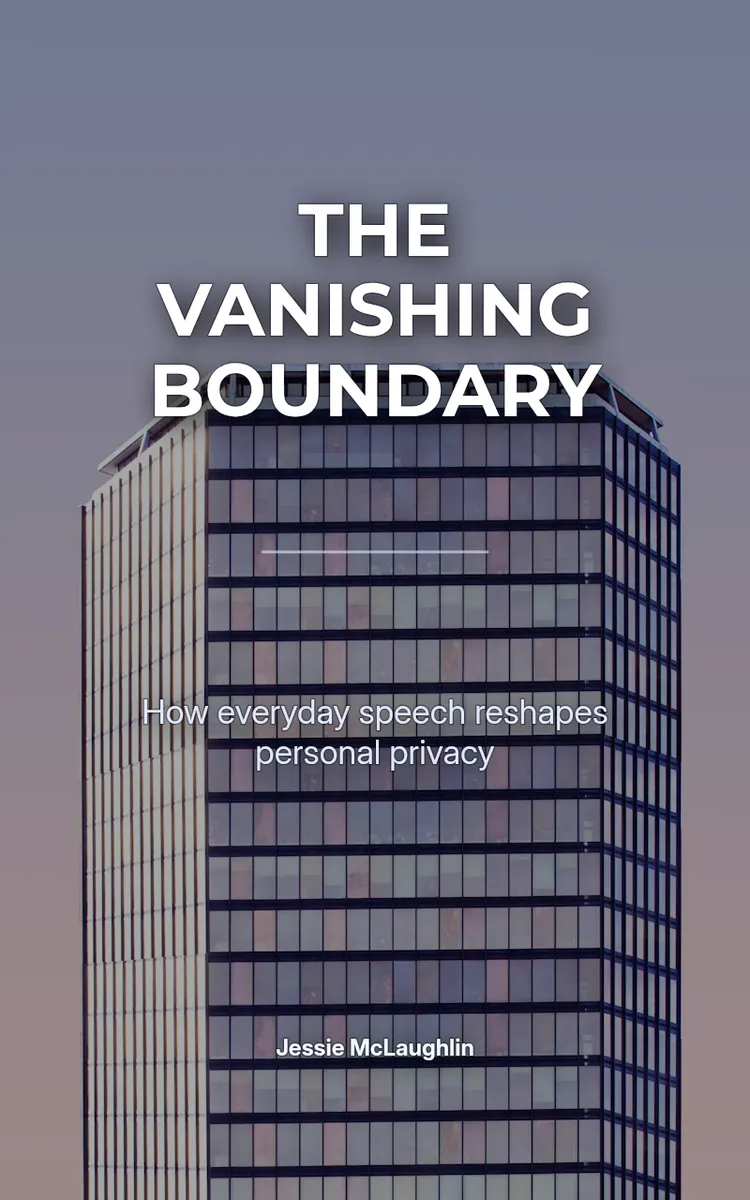
"The Vanishing Boundary" is a nonfiction book by Jessie McLaughlin with 40 chapters and approximately 64,734 words. The meaning of privacy and how everyday speech erodes it.
This book was created using Inkfluence AI, an AI-powered book generation platform that helps authors write, design, and publish complete books.
Frequently Asked Questions
What is "The Vanishing Boundary" about?
The meaning of privacy and how everyday speech erodes it
How many chapters are in "The Vanishing Boundary"?
The book contains 40 chapters and approximately 64,734 words. Topics covered include The Secret You Tell Without Speaking, Why Silence Feels So Awkward, The Oversharing Reflex, When Small Talk Becomes a Search, and more.
Who wrote "The Vanishing Boundary"?
This book was written by Jessie McLaughlin and created using Inkfluence AI, an AI book generation platform that helps authors write, design, and publish books.
Write your own nonfiction book with AI
Describe your idea and Inkfluence writes the whole thing. Free to start.
Start writingCreated with Inkfluence AI


