
Read the first chapter
The whole of chapter one, free. About 8 min. Turn the pages with the arrows, your keyboard, or a swipe.
Chapter 1
Spot the First Help Signals
A parent misses one appointment, leaves a grocery bag in the car overnight, or asks the same question twice during a phone call. Each event may have a simple explanation. A bad night’s sleep, a new pair of glasses, a confusing online system, or an unusually busy week can create a temporary problem. The difficulty begins when you must decide whether you are seeing an isolated glitch or the first sign of a wider change.
You do not need to diagnose your parent to make that decision. You need a reliable way to notice changes, check them against daily life, and look for a pattern. The Signal-to-Pattern Ladder gives you that structure. It turns scattered concerns into observations you can review calmly and discuss clearly.
Separate One Signal from a Pattern
A signal is one noticeable change: a missed bill, an unsteady step, an empty refrigerator, a forgotten conversation, or an unusually strong reaction to a routine problem. A signal deserves attention, but it does not prove that your parent has a lasting decline.
A pattern appears when similar changes repeat, spread to more than one area, or interfere with ordinary tasks. For example, one missed payment may reflect an overlooked envelope. Missed payments over several weeks, unopened mail, and confusion about account balances point to a broader concern with managing household tasks.
The first rung of the Signal-to-Pattern Ladder is therefore notice without labeling. Write down what happened using observable facts. “Dad seemed confused” tells you what you felt. “Dad asked three times when the appointment was after receiving the reminder” gives you something you can examine.
Use a short record for each concern:
• Date and approximate time - What happened - What your parent said or did - What happened before the event - Whether anyone helped - Whether the task was completed later
Keep your wording neutral. Instead of writing “Mom is becoming careless,” write “Mom left the stove burner on after heating soup.” Neutral notes protect your judgment from fear and frustration. They also give a clinician, another family member, or your parent a clearer starting point if you later need help.
Example - Composite persona: Leon, 48. Leon noticed that his mother had forgotten a weekly lunch with a friend. He almost treated it as proof that she could no longer manage her schedule. Instead, he recorded the date, asked whether anything unusual had happened, and learned that the friend had changed the meeting place without calling. Leon kept watching rather than drawing a conclusion from one event.
Ask yourself: What exactly did I see or hear, and what part of my interpretation remains unproven? Your practical takeaway is simple: record the event before you explain it.
Use the 30-Day Observation Window
A 30-day observation window helps you collect enough information to see direction without turning every day into an inspection. The goal is not to test your parent. The goal is to compare ordinary functioning over time.
Choose a small number of areas that matter to your parent’s normal routine. Include tasks such as preparing a familiar meal, keeping track of appointments, handling a usual errand, moving safely around the home, maintaining personal care, or responding to calls and messages. Do not create a large surveillance project. Pick three to five areas that have raised concern.
At the start, write a baseline: what your parent usually does independently, what already requires help, and what has recently changed. A baseline prevents you from mistaking a long-standing limitation for a new decline. If your parent has always used grocery delivery, that choice does not automatically signal a new problem. If your parent suddenly cannot place the usual order, that change deserves attention.
During the 30 days, record events as they occur. Do not wait until the end and rely on memory. A note can take less than a minute. Mark whether the task was completed independently, completed with a reminder, completed with hands-on help, postponed, or not completed. Also note conditions that may have affected performance, such as illness, poor sleep, pain, a new environment, or a disrupted routine.
Review your notes once a week. Look for three kinds of movement:
• Repetition: The same problem occurs more than once. - Spread: A concern appears in different parts of daily life. - Impact: The problem causes a missed obligation, unsafe situation, conflict, or loss of independence.
You do not need a perfect record. You need enough consistent observation to answer a practical question: Is this event becoming more frequent, more widespread, or more disruptive?
Tool - 30-Day Signal Log
| Date | Area | Observable event | Help needed | Possible short-term factor | Outcome | |---|---|---|---|---|---| | | | | | | |
Possible short-term factors include a recent illness, travel, a broken appliance, a change in routine, or difficulty hearing the conversation. Record them without assuming they explain everything.
Composite persona: Priya, 39. Priya lives several hours from her father and cannot observe him every day. She asks him the same practical questions during scheduled calls and asks a neighbor to report only specific observations, such as whether he collected delivered groceries. Over 30 days, she sees that one missed delivery came from a store change, but two later orders remain uncollected. The repeated issue gives her a stronger basis for action than the first missed order did.
The takeaway: use the 30-day window to compare ordinary functioning, not to search for evidence that confirms your fear.
Check Temporary Causes Before Calling It Decline
A sudden change deserves a different response from a slow, repeated change. When your parent seems noticeably different over hours or a few days, contact an appropriate health professional promptly for guidance, especially if the change includes severe confusion, fainting, new weakness, trouble speaking, chest pain, serious breathing difficulty, a fall with injury, or an immediate safety concern. If you believe there is an emergency, use local emergency services.
For less urgent changes, ask what changed around the event. Temporary contributors can include poor sleep, dehydration, pain, an infection, constipation, hearing difficulty, vision problems, stress, heat, a new device, or a disrupted routine. You do not need to identify the cause yourself. You need to notice the timing and pass accurate information to the right professional.
Do not use a temporary explanation to dismiss a repeated problem. “She was tired” may explain one missed task. It does not settle the question when the same task fails repeatedly after rest and routine return. Treat a possible temporary cause as a question to check, not as a conclusion.
Use this short comparison:
| Question | What to look for | |---|---| | Did the change start suddenly? | Hours or a few days versus gradual change | | Did something change first? | Illness, sleep, pain, routine, equipment, environment | | Did the problem resolve? | Full return, partial return, or continued difficulty | | Has it happened before? | First event or repeated event | | Does it affect another area? | One task or several familiar tasks |
Composite persona: Mateo, 55. Mateo’s aunt called him because his mother sounded unusually muddled during a morning conversation. He learned that she had slept poorly because the heating system had failed overnight. After the home warmed and she rested, she returned to her usual conversation. Mateo recorded the event and continued observing. When similar confusion appeared later without the same circumstance, he shared the dates and details with her health professional rather than dismissing the concern.
The practical rule is: sudden or severe changes call for prompt attention; mild, isolated changes call for observation; repeated changes call for a planned conversation and professional input.
Move from Pattern to a Clear Next Step
At the end of 30 days, sort your notes into one of three decisions.
If the event happened once and your parent returned to normal functioning, keep the record and continue ordinary awareness. You do not need to create a new care system for every mistake.
If the same issue repeated but stayed limited to one task, look for a specific adjustment. A large wall calendar, a simpler reminder method, better lighting, a replacement appliance, or help with one errand may address the problem. Ask your parent what would make the task easier. A support should match the actual obstacle rather than assume incapacity.
If the issue repeated, spread across areas, or created safety concerns, arrange a focused conversation with your parent and an appropriate professional. Bring your factual notes. Describe the change, when it began, how often it occurred, and what help your parent needed. Avoid presenting a diagnosis or demanding a particular treatment.
Use language such as: “I noticed three missed appointments in the last month, although you usually kept them. Can we work out what made them harder to manage?” This approach keeps the conversation specific and gives your parent room to explain. It also separates the need for support from a judgment about character or competence.
Common mistakes weaken this process. Family members often wait for a crisis before recording anything, collect every possible detail until the record becomes unusable, or argue about whether an event “counts.” Some relatives watch silently and then present a long list of complaints, which can make a parent feel ambushed. Others treat help as an all-or-nothing decision: either the parent manages everything alone or the adult child takes over.
The Signal-to-Pattern Ladder offers a better sequence: notice the signal, record the facts, observe for 30 days, check temporary factors, identify repetition or spread, and choose the smallest appropriate next step. That sequence does not remove uncertainty. It gives uncertainty a place to go.
When you can distinguish a one-time problem from a developing pattern, you can respond earlier without overreacting. You can also bring clearer information into the larger work of organizing care, because good decisions begin with accurate observations rather than guesses.
End of chapter one. 4 more chapters in the full book.
Swipe or use the arrows to turn the page
What's inside: 5 chapters
- 1. Spot the First Help Signals
- 2. Run the Parent Support Assessment
- 3. Build the Parent Information Folder
- 4. Track Medications and Appointment Notes
- 5. Set Up the Family Responsibility Matrix
About this book
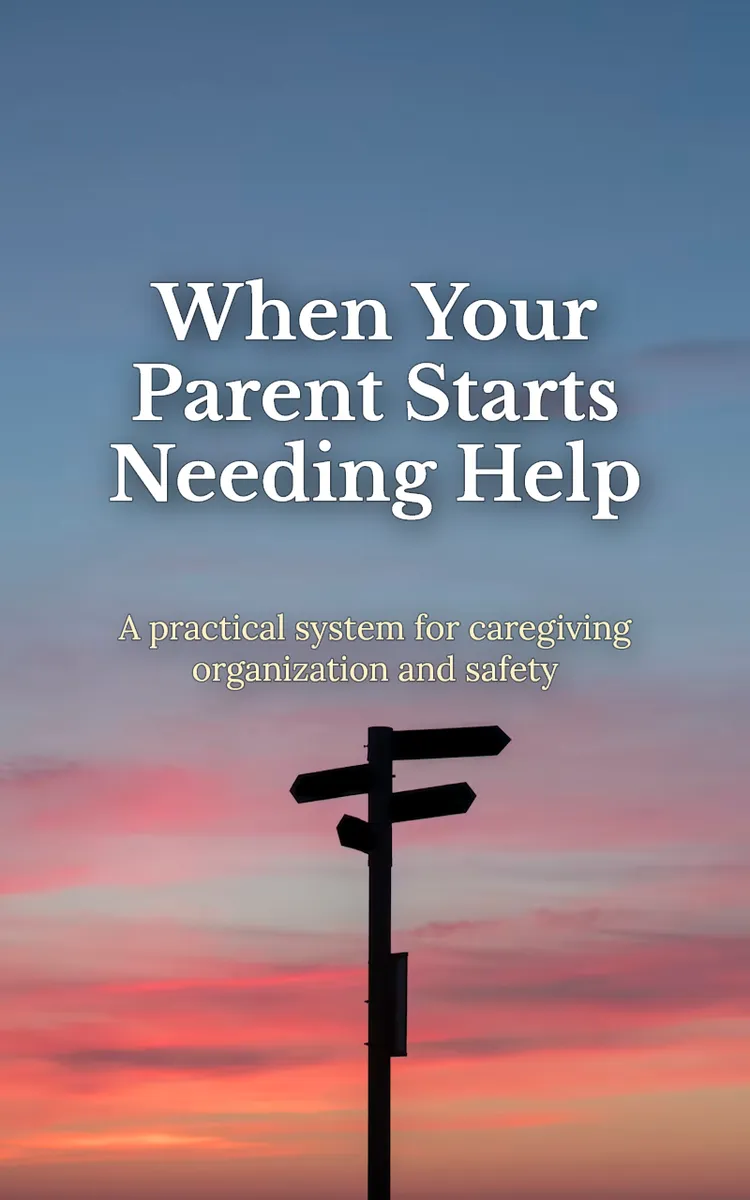
"When Your Parent Starts Needing Help" is a how-to guide book by Anonymous with 5 chapters and approximately 8,983 words. Practical system for organizing aging-parent caregiving tasks and information.
This book was created using Inkfluence AI, an AI-powered book generation platform that helps authors write, design, and publish complete books. It was made with the AI Ebook Generator.
Frequently Asked Questions
What is "When Your Parent Starts Needing Help" about?
Practical system for organizing aging-parent caregiving tasks and information
How many chapters are in "When Your Parent Starts Needing Help"?
The book contains 5 chapters and approximately 8,983 words. Topics covered include Spot the First Help Signals, Run the Parent Support Assessment, Build the Parent Information Folder, Track Medications and Appointment Notes, and more.
Who wrote "When Your Parent Starts Needing Help"?
This book was written by Anonymous and created using Inkfluence AI, an AI book generation platform that helps authors write, design, and publish books.
How can I create a similar how-to guide book?
You can create your own how-to guide book using Inkfluence AI. Describe your idea, choose your style, and the AI writes the full book for you. It's free to start.
Write your own how-to guide book with AI
Describe your idea and Inkfluence writes the whole thing. Free to start.
Start writingCreated with Inkfluence AI


