
Read the first chapter
The whole of chapter one, free. About 7 min. Turn the pages with the arrows, your keyboard, or a swipe.
Chapter 1
The Identity Behind Your Corrections
When Your Child’s Struggle Feels Like a Personal Challenge
What do you tell yourself after the fourth reminder to start homework turns into a sharp voice, a slammed pencil, and a child who says, “You’re always mad at me”? Maybe you’re trying to protect your evening, keep schoolwork from piling up, and teach responsibility. But in that moment, it can feel as if your child’s delay, interruption, or refusal is pulling you into a role you never wanted: the enforcer.
You may begin the afternoon hoping to be patient. Then your child forgets the assignment, wanders away, argues about the first question, and needs another reminder. By bedtime, you’re measuring success by whether they finally complied - not by whether they recovered from frustration, tried a new approach, or used one of their strengths.
The hardest parenting moments ask not only, “What should my child do?” but also, “Who am I becoming while I respond?”
From Controlling Behavior to Guiding Strengths
Old Belief: My job is to control the behaviors that keep causing trouble.
New Reality: My job is to understand how my child works, protect their dignity, and build supports that help their strengths show up.
The old belief makes sense when you’re tired. You see unfinished work, forgotten shoes, interruptions, or a child who seems to avoid anything difficult. You want the problem stopped. You repeat the direction, add a consequence, explain it again, and raise your voice when nothing changes. For a moment, the focus becomes obedience because obedience feels like proof that you’re still in charge.
The Identity-First Compass points somewhere more useful. Before asking how to stop the behavior, you ask what kind of support would help your child take the next step without being shamed. That doesn’t mean ignoring limits or allowing everyone else to carry the work. It means treating the behavior as information about how your child is managing the demand.
Take homework. The controlling approach might sound like, “Stop fooling around and finish all of it right now.” The guiding approach could be, “Let’s choose the first two questions. I’ll sit nearby while you get started.” The second response still moves toward responsibility, but it lowers the size of the first step and adds support where starting is hard. It also tells your child, “You’re not the problem. We’re solving the problem together.”
That shift matters because your child’s dignity affects what they can bring to the task. When every mistake becomes evidence against them, they may spend their energy defending themselves, avoiding the work, or recovering from embarrassment. When you notice effort, recovery, and creative problem-solving, you teach them that their identity is larger than the moments that cause trouble. You’ve still got boundaries; you’re simply using them to build skills instead of winning a battle.
Notice Which Identity Is Taking the Lead
Your parenting identity isn’t a label carved in stone. It’s the role you slip into under pressure. Sometimes you’re the guide, helping your child understand a hard task and find a workable entry point. Other times, especially after a long day or repeated reminders, the enforcer takes over. The Identity-First Compass helps you notice that shift before your response becomes automatic.
The enforcer identity often focuses on visible compliance. It asks, “Did my child do exactly what I said, immediately?” The guiding identity asks, “What support will help my child move toward the responsibility while keeping their dignity intact?” That question changes your next sentence, your timing, and what you choose to praise.
Here are signs the enforcer pattern may be running your life:
1. You describe your child mostly through what they forget, interrupt, avoid, or fail to finish. Their curiosity, humor, persistence, or unusual ways of solving problems barely enters the story.
2. You give repeated reminders, then hear your voice become sharper. You may start with “Please put your shoes on,” repeat it five times, and end with a threat because the earlier requests didn’t produce quick compliance.
3. You feel more relieved by obedience than encouraged by effort. If your child finally completes the worksheet after a struggle, the main thought is, “At last,” rather than, “They came back and finished two questions.”
4. You treat recovery as less important than the original mistake. Your child may lose control, calm down, and try again, but the earlier behavior still defines the whole evening.
The Identity-First Compass turns correction into guidance.
When you feel pulled toward control, pause and ask: “What would protect my child’s dignity and help their strengths show up in the next small step?” You don’t need a perfect answer. The question itself creates room between the problem and your response.
For example, if your child interrupts during a family conversation, the goal isn’t to pretend interruption is fine. A guide might say, “I want to hear you. Touch my arm so I know you’re waiting, and I’ll come back to you when this sentence is finished.” That response protects the conversation while offering a physical reminder your child can actually use. It guides a skill rather than turning the child into “the rude one.”
If you’re parenting alone, this identity shift can be especially important because there may be no other adult to take over when your patience runs out. You might be carrying work, meals, school messages, and bedtime by yourself. The compass doesn’t ask you to become endlessly calm. It gives you a way to return to your purpose after a hard moment: understand, protect dignity, and build support. That’s a realistic next step, and you’ve got this.
Questions That Reveal Your Parenting Compass
1. When your child struggles, what do you usually notice first: the behavior that disrupts the moment or the strength that could help them through it? An honest answer might be, “I notice the unfinished work first because I’m worried about tomorrow.” That concern is real; now try adding one strength, such as persistence, humor, curiosity, or the ability to solve problems creatively.
2. Which behavior most quickly turns you into the enforcer - homework, getting dressed, leaving the house, or interruptions? Name one specific moment rather than saying, “Everything.” If homework is the trigger, notice the exact point where you shift from helping to demanding. That point is where the Identity-First Compass can guide your next response.
3. What does your child hear about who they are when you correct them repeatedly? You may realize they hear, “I’m always in trouble,” even when you mean, “This task still needs attention.” You can keep the limit and change the message: “The assignment matters, and I’ll help you find a way to begin.”
4. What would count as progress if immediate compliance weren’t the only measure? Perhaps your child starts two questions, returns after a break, asks for clarification, or accepts help without arguing. Naming these forms of progress helps you see skill-building that the old identity might overlook.
5. What support could you add before giving another reminder? It might be sitting nearby, reducing the task to the first two questions, using a written direction, or offering a brief choice. Support isn’t a reward for failure; it’s a bridge to the skill your child is still learning.
The Seven-Day Identity-First Compass Challenge
For the next 7 days, pause before one correction each day and choose guidance over control.
• Pick one predictable trouble spot, such as homework, morning dressing, or waiting during conversation. - Before speaking, take one breath and ask: “What would protect my child’s dignity and help their strengths show up in the next small step?” - Give one concrete support. For homework, try: “Let’s choose the first two questions. I’ll sit nearby while you start.” - Notice one form of effort, recovery, or problem-solving, and say it out loud: “You came back after getting frustrated,” or “You found another way to solve that.” - At the end of the day, write one sentence: “When I acted as a guide, my child…” Don’t judge the result; record what you noticed.
Expected difficulty: Medium
You’ll know it’s working when:
• You catch yourself before repeating the same reminder in a sharper voice. - Your correction includes a support, not only a demand. - You notice something about your child beyond what they forgot or avoided. - Your child takes one small step, even if the whole task isn’t finished. - You recover more quickly when the moment still goes badly.
Some days, your child may not cooperate. The challenge isn’t to produce perfect behavior in seven days. It’s to practice choosing your identity before the pressure chooses it for you. If you lose your patience, you can return with a simple repair: “I got too sharp. The homework still matters, and I’m going to help us find the first step.” That repair is part of guiding strengths, too.
Your child’s hardest behavior may need your support, but it doesn’t have to decide who you are as a parent.
• You learned to replace the controlling belief with the Identity-First Compass. - You saw how protecting dignity can support responsibility rather than weaken it. - You identified signs that the enforcer identity is taking over. - You practiced measuring progress through effort, recovery, and problem-solving - not only immediate compliance. - You chose a seven-day challenge to guide one small step each day.
The next time a demand turns into a battle, you won’t have to solve your child’s entire future in that moment. You can pause, find the next small step, and offer support that helps their strengths become visible. From there, clear directions and predictable routines can do more of the heavy lifting - without making either of you the enemy.
End of chapter one. 14 more chapters in the full book.
Swipe or use the arrows to turn the page


What's inside: 15 chapters
- 1. The Identity Behind Your Corrections
- 2. From Behavior to Communication
- 3. The Belief-to-Behavior Bridge Self-Reset
- 4. Predictable Routines That Don’t Fight
- 5. The Transition Ladder Protocol
- 6. Rate the Routine, Not Your Parenting
- 7. One-Task, One-Check Directions
- 8. Clear Directions Don’t Need More Volume
- 9. Skill-Linked Rewards That Build Independence
- 10. When Rewards Become Negotiations
- 11. The Seven-Day Skill Bridge
- 12. De-escalation Scripts for Meltdowns
- 13. The One-Minute Bridge Experiment
- 14. Coach Executive Skills, Not Attitude
- 15. Bounce Back With Meaning and Next Steps
About this book
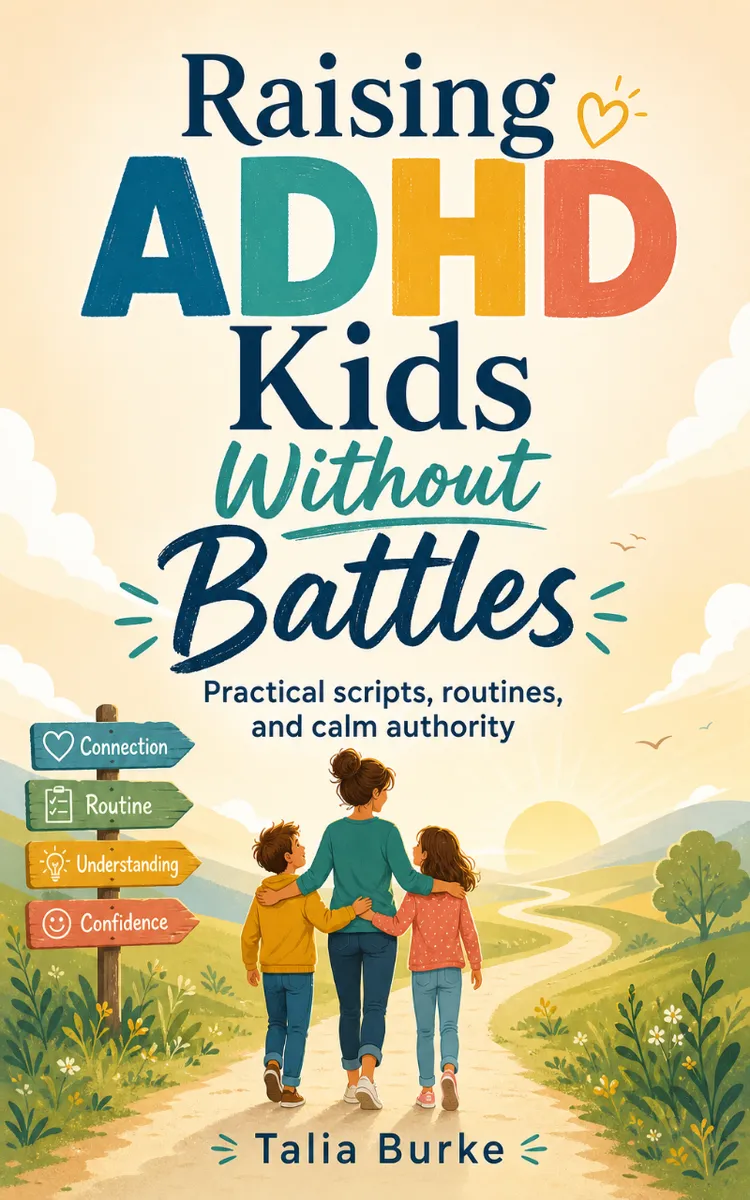
"Raising ADHD Kids Without Battles" is a self-help book by Talia Burke with 15 chapters and approximately 25,582 words. A compassionate guide for parents to replace blame and power struggles with identity-based support, clear directions, predictable routines, and skill-building systems for everyday ADHD challenges..
This book was created using Inkfluence AI, an AI-powered book generation platform that helps authors write, design, and publish complete books. It was made with the AI Self-Help Book Writer.
Frequently Asked Questions
What is "Raising ADHD Kids Without Battles" about?
A compassionate guide for parents to replace blame and power struggles with identity-based support, clear directions, predictable routines, and skill-building systems for everyday ADHD challenges.
How many chapters are in "Raising ADHD Kids Without Battles"?
The book contains 15 chapters and approximately 25,582 words. Topics covered include The Identity Behind Your Corrections, From Behavior to Communication, The Belief-to-Behavior Bridge Self-Reset, Predictable Routines That Don’t Fight, and more.
Who wrote "Raising ADHD Kids Without Battles"?
This book was written by Talia Burke and created using Inkfluence AI, an AI book generation platform that helps authors write, design, and publish books.
How can I create a similar self-help book?
You can create your own self-help book using Inkfluence AI. Describe your idea, choose your style, and the AI writes the full book for you. It's free to start.
Write your own self-help book with AI
Describe your idea and Inkfluence writes the whole thing. Free to start.
Start writingCreated with Inkfluence AI


