
Read the first chapter
The whole of chapter one, free. About 6 min. Turn the pages with the arrows, your keyboard, or a swipe.
Chapter 1
Understanding Your Brain’s Focus
When Your Brain Says “Not Now”
Why can you sit down with a clear plan, open your laptop, and suddenly feel an urgent need to check messages, make coffee, or reorganize a drawer you haven’t noticed in months? Then, later, you call yourself lazy because the important task is still untouched.
Often, the problem isn’t a lack of character. Your attention is being pulled by stress, poor sleep, and a motivation system that prefers quick relief over delayed rewards. If your body feels under pressure, focusing on a difficult task can feel less appealing than reaching for your phone. That reaction is understandable - even when it creates another frustrating day.
Your focus is not a moral test; it is a message from your biology.
From Self-Blame to the Focus Foundations Map
Old Belief: If I really cared about my goals, I’d stay focused and stop procrastinating.
New Reality: Focus depends on a moving relationship between attention, stress, sleep, and motivation. I can improve it by working with those foundations instead of attacking myself.
This shift matters because self-blame adds more stress to an already strained system. You avoid a task, feel guilty, worry about falling behind, and then find concentration even harder. The original problem was unfinished work. Now you’re also carrying shame, tension, and mental noise.
The Focus Foundations Map gives you four connected points to check: attention, stress, sleep, and motivation. They aren’t separate switches. They influence one another. Poor sleep can weaken attention. Weak attention can make work take longer. Longer work can increase stress. Stress can make quick distractions feel unusually attractive.
Consider a difficult email you’ve postponed. After a short night, you read it three times without deciding what to write. Your stress rises, so you check your phone for relief. The break feels good for a moment, but the email remains. By evening, motivation has dropped because the task now carries even more emotional weight. The answer isn’t to shout at yourself. It’s to notice which foundation needs support first.
You might sleep earlier, take five quiet minutes to settle your body, or reduce the email to one small action: write the opening sentence. That isn’t lowering your standards. It’s making the task reachable for the brain you actually have today.
How the Four Foundations Work Together
Attention is your ability to select what matters and keep returning to it. It isn’t unlimited, and it isn’t perfectly steady. Each notification, unresolved worry, and open browser tab asks for a small piece of it. When too many demands compete, your mind may keep switching even when you’re determined to stay put.
Stress changes what feels important. A stressed brain tends to scan for problems and immediate relief. That can be useful when something truly needs urgent action. It’s less helpful when you’re trying to plan a budget, study a new skill, or write a proposal. The task requires patience, while stress keeps whispering, “Find safety now.”
Sleep supports the mental control needed to pause, choose, and continue. After poor sleep, an ordinary task can feel strangely personal. A blank page may seem threatening. A small mistake may feel like proof that you’re failing. This doesn’t mean sleep solves every problem, but it changes the amount of effort required to manage one.
Motivation also works differently from a constant inner fire. It often grows after action begins, especially when a task becomes clearer and progress becomes visible. Waiting to feel motivated can leave you stuck. A smaller starting point can give your brain evidence that the task is possible.
The Focus Foundations Map shows that better focus often begins with better conditions, not harsher self-talk.
Signs this pattern is running your life:
1. You begin the day with a plan, but your attention disappears into messages, news, or small chores before the first important task. 2. You treat tiredness as a personal failure instead of asking what your sleep and recovery have been like. 3. You keep postponing one task because it feels vague, uncomfortable, or too large to start. 4. You use your phone to calm stress, then feel more stressed because the task is still waiting.
Notice the order of events. You may not be “choosing distraction” in a simple way. You may be responding to discomfort with the fastest available reward. Understanding that pattern gives you something practical to change.
Questions That Reveal Your Real Starting Point
1. When does your focus usually break: before you begin, during the first few minutes, or after sustained effort? If it breaks before starting, the task may be unclear or emotionally heavy. If it breaks after twenty minutes, your environment, energy, or stress level may need attention.
2. What did you sleep like on the days when concentration felt unusually difficult? Look for details rather than judgment. Perhaps you stayed up scrolling, woke several times, or kept thinking about tomorrow’s problems.
3. What feeling appears just before you reach for a distraction? It might be boredom, uncertainty, fear of doing poor work, or simple tiredness. Naming the feeling can interrupt the automatic move toward relief.
4. Which important task have you made larger in your mind than it is on paper? “Deal with the accounts” may become more manageable as “open the account folder and list the three unpaid items.” Specificity gives attention somewhere to land.
5. What kind of reward could make a useful task feel more immediate? You might mark each completed section, listen to music during routine work, or stop after a clearly defined twenty-minute block. The point is to help motivation notice progress now, not someday.
Answer these without trying to sound disciplined. An honest answer such as “I avoid planning because I’m afraid the numbers will be worse than I expect” is more useful than “I just need to try harder.”
The Seven-Day Focus Foundations Reset
Challenge: Map Before You Push
For the next seven days, spend five minutes at the start of your main work period checking the four foundations. Use a note on paper or a simple phone document.
• Rate your sleep from 1 to 5, based on how rested you feel. - Name your current stress in one sentence. - Choose one task and define its first visible action. - Set a 20-minute focus block with notifications turned off. - When the block ends, record what helped or disrupted your attention. - Give yourself a small, immediate reward after completing the block, such as tea, a short walk, or five minutes of guilt-free messages. - At the end of the day, write one sentence about which foundation needed the most support.
Expected difficulty: Medium
You’ll know it’s working when:
• You start important tasks with less negotiation in your head. - You catch stress before it turns into automatic scrolling. - Your first action becomes smaller and more specific. - You can see patterns between sleep, stress, and attention. - You measure progress by returning to the task, not by never getting distracted.
Don’t aim for perfect focus during these seven days. The useful skill is noticing and returning. If you miss a day, restart at the next work period. The map only helps when it reflects real life, including late nights, busy mornings, and uneven energy.
Your Biology Is a Partner in Progress
Focus improves when you stop treating your brain as an enemy and start supporting the conditions it needs.
• Attention becomes easier to guide when distractions and competing demands are reduced. - Stress can pull you toward immediate relief, so calming your body may come before demanding deep work. - Sleep affects how much effort concentration and emotional control require. - Motivation often follows a clear first step and visible progress rather than appearing before action. - The Focus Foundations Map helps you decide whether to adjust the task, the environment, your recovery, or your starting point.
You don’t need to wait until your life is perfectly organized to make progress. Begin by asking a better question: “Which foundation needs support right now?” That question turns frustration into information. As you learn to read your attention, stress, sleep, and motivation, you create the steadier ground needed for meaningful goals - and for the deeper work of deciding what those goals should be.
End of chapter one. 4 more chapters and about 7,408 words in the full book.
Swipe or use the arrows to turn the page
What's inside: 5 chapters
- 1. Understanding Your Brain’s Focus
- 2. Breaking the Procrastination Loop
- 3. Designing Habits That Stick
- 4. Eating for Steadier Energy
- 5. Finding Purpose Through Small Experiments
About this book
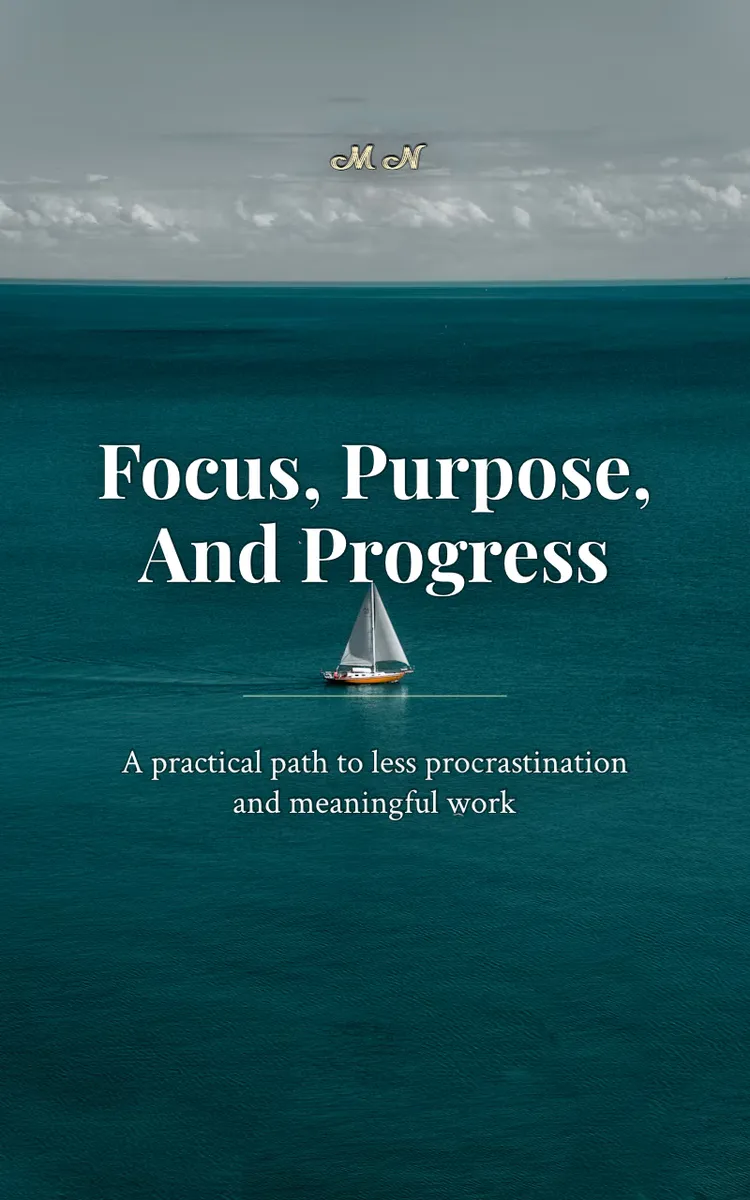
"Focus, Purpose, And Progress" is a self-help book by M N with 5 chapters and approximately 7,408 words. Mental well-being, productivity, procrastination, and purpose through biological and psychological approaches.
This book was created using Inkfluence AI, an AI-powered book generation platform that helps authors write, design, and publish complete books. It was made with the AI Self-Help Book Writer.
Frequently Asked Questions
What is "Focus, Purpose, And Progress" about?
Mental well-being, productivity, procrastination, and purpose through biological and psychological approaches
How many chapters are in "Focus, Purpose, And Progress"?
The book contains 5 chapters and approximately 7,408 words. Topics covered include Understanding Your Brain’s Focus, Breaking the Procrastination Loop, Designing Habits That Stick, Eating for Steadier Energy, and more.
Who wrote "Focus, Purpose, And Progress"?
This book was written by M N and created using Inkfluence AI, an AI book generation platform that helps authors write, design, and publish books.
How can I create a similar self-help book?
You can create your own self-help book using Inkfluence AI. Describe your idea, choose your style, and the AI writes the full book for you. It's free to start.
Write your own self-help book with AI
Describe your idea and Inkfluence writes the whole thing. Free to start.
Start writingCreated with Inkfluence AI


