
Read the first chapter
The whole of chapter one, free. About 7 min. Turn the pages with the arrows, your keyboard, or a swipe.
Chapter 1
Seeing Children as Whole People
When a Child’s “Defiance” Is Actually a Voice
A child sits at the kitchen table, pencil pressed hard enough to leave a mark in the paper. You ask about homework. They shrug. You ask again, sharper this time. Their shoulders rise. “Because I said so” slips out before you’ve even noticed the conversation has become a contest.
Later, you replay the moment. You remember the unfinished work, the eye roll, the refusal to explain. You don’t remember the small details: the child had been interrupted three times, had lost a game at lunch, and had spent the afternoon being told where to sit, when to speak, and what to do. By evening, the only power left was saying no.
Many adults fall into the same habit. We correct before we understand. We treat questions as challenges, hesitation as laziness, and strong feelings as proof that a child is being controlled by someone else. We reach for quick labels - rude, distracted, dramatic, difficult - because labels make messy behavior feel tidy.
Then we wonder why a child stops telling us what they think. We praise obedience and call it character. We fill every silence with instructions. We mistake a quiet child for a safe child. Do you recognise yourself in this pattern?
The Question That Changes the Adult’s Position
What if my job isn’t to fill this child, but to protect the person already forming inside them?
That question changes the whole relationship. A child isn’t an empty container waiting for your opinions, fears, rules, and ambitions. They’re developing, yes - but developing doesn’t mean powerless. They notice patterns. They test ideas. They carry preferences, memories, loyalties, humor, and a growing sense of right and wrong.
The Whole-Person Lens asks you to look beyond the behavior in front of you. Instead of seeing only the unfinished worksheet, you ask what effort, confusion, pressure, or belief sits underneath it. Instead of asking, “How do I make this child comply?” you ask, “What is this child trying to communicate, protect, understand, or control?”
Consider a child who refuses to join an after-school activity. Through a narrow lens, the child is ungrateful or unmotivated. The adult pushes harder: “You’ll thank me later.” Through the Whole-Person Lens, the adult pauses. The child explains that the group chat is full of jokes about mistakes, and they’re afraid of being laughed at. The problem hasn’t vanished. But now the child is part of solving it.
Before, the adult made the decision and the child learned to hide discomfort. After, the adult still sets boundaries but includes the child’s knowledge. They discuss whether to try one session, identify a safe person, and agree on what the child can do if the teasing starts. The child hasn’t been handed total control. They’ve been treated as a person whose experience matters.
That distinction is where mental autonomy begins. Not in letting children decide everything. Not in pretending adults have nothing to teach. It begins when guidance stops erasing the child’s mind.
How Empty-Vessel Thinking Trains Dependence
1. When you treat a child’s opinion as an obstacle to your authority, you interrupt, override, or dismiss it. 2. You feel efficient for a moment, but the child feels unseen, powerless, or foolish. 3. So you make more decisions for them, because they stop bringing you their real thoughts. 4. Which leads to dependence, secrecy, and greater vulnerability to whoever speaks with confidence outside your home.
The alternative chain looks different:
1. When you treat a child’s opinion as information, you listen before deciding. 2. You feel slower and sometimes uncomfortable, because listening may expose a mistake or a fear you’d rather avoid. 3. So you ask one more question and separate the child’s feelings from the final decision. 4. Which leads to practice: the child learns to explain, question, weigh evidence, and act with support rather than waiting for someone else to think for them.
This doesn’t mean every child’s conclusion is correct. A child may believe a viral video, a friend, or an adult online without checking it. Respecting agency means helping them examine the claim - not humiliating them for having heard it.
Try saying, “Tell me what makes that seem true,” before saying, “That’s nonsense.” The first sentence opens the mind. The second often closes it. You can still correct misinformation. You can still say no. But the child remains a thinking person during the correction.
A protected mind is not an obedient mind; it is a practiced mind.
Rate Your Whole-Person Lens
1. From 1 to 10, how often do you ask a child what they think before giving your answer? A low score may reveal that speed and control have become your default. A high score suggests you’re making room for the child’s reasoning, though it’s worth checking whether you truly listen when their answer surprises you.
2. Yes or no: When a child disagrees with you, can you stay curious for one full minute without correcting them? “No” doesn’t make you a bad adult. It shows where disagreement feels threatening. “Yes” shows growing tolerance for the discomfort that honest thinking creates.
3. From 1 to 10, how often do you describe a child by a fixed label - lazy, dramatic, difficult, gifted - instead of describing a specific action? A high score may mean the label is replacing observation. A lower score suggests you’re leaving room for change, context, and strengths that don’t appear in one moment.
4. Yes or no: Can the child name one decision they’re allowed to influence at home? “No” may reveal that the child has responsibilities without meaningful agency. “Yes” means they’re getting practice using judgment, not just receiving orders.
Use your answers as a map, not a verdict. Scores of 1 to 3 point to a habit that needs immediate attention. Scores of 4 to 7 show a mixed pattern: you may respect the child’s voice in calm moments but take it away under pressure. Scores of 8 to 10 suggest a strong foundation, but don’t confuse listening with surrender. The question is whether the child is becoming more capable of thinking, explaining, and choosing responsibly.
The Three-Day Whole-Person Challenge
Action title: Give the Child’s Mind a Seat at the Table
1. Day one: Replace one command with a question. Choose a routine moment, such as homework, screen use, clothing, or bedtime. Before giving the instruction, ask, “What’s your plan?” Give the child thirty seconds to answer. Difficulty: Easy. You’re not handing over the rule. You’re collecting the child’s reasoning before setting the boundary.
2. Day two: Name the strength beneath the behavior. When the child pushes back, describe what you observe without a label. Try, “You noticed that rule feels unfair,” or, “You’re determined to finish this your way.” Then add the limit: “The rule still applies, and we can discuss how to handle it.” Difficulty: Medium. This can feel awkward because it refuses the familiar shortcut of calling the child rude or stubborn.
3. Day three: Share one small decision. Let the child influence a real choice with clear limits. They might choose the order of two chores, help create a family screen agreement, select between two study locations, or decide how to repair a conflict. Ask them to explain their choice and review the result afterward. Difficulty: Hard. Shared decision-making exposes whether you actually trust the child’s developing judgment.
You’ll know it’s working when:
• The child offers an explanation before shutting down. - You hear more questions instead of automatic agreement or secrecy. - You can hold a boundary without mocking, interrupting, or erasing the child’s perspective.
The point isn’t to produce a miniature adult. It’s to give a real child repeated practice being heard, thinking clearly, and taking responsibility. Those abilities don’t appear because we demand them later. They grow through small moments now.
Protect the Person, Not Just the Performance
Children are not empty vessels waiting for our programming; they are whole people whose judgment is still being built.
The Whole-Person Lens asks you to remember four things:
• A child’s behavior carries information, even when the behavior needs a boundary. - Listening to a child’s reasoning does not mean agreeing with every conclusion. - Agency grows when children influence age-appropriate decisions and explain their choices. - Respect protects the relationship that makes guidance possible.
When you see a child as a whole person, outside influences become easier to challenge together. You’re less likely to demand blind obedience and more likely to ask what a message is trying to make the child feel, buy, believe, or repeat. You’re building something stronger than compliance: a child who can notice pressure without immediately bowing to it.
The next question is unavoidable: once you recognise the mind already forming inside a child, how do you identify the voices trying to form it for you?
End of chapter one. 39 more chapters and about 60,124 words in the full book.
Swipe or use the arrows to turn the page


What's inside: 40 chapters
- 1. Seeing Children as Whole People
- 2. Separating Identity from Labels
- 3. Understanding How Influence Works
- 4. Spotting Hidden Persuasion
- 5. Building Trust Without Blind Obedience
- 6. Making Room for Curiosity
- 7. Teaching Children to Check Claims
- 8. Telling Facts from Opinions
- 9. Recognizing Emotional Pressure
- 10. Strengthening Self-Trust
- 11. Practicing Independent Decisions
- 12. Setting Boundaries with Confidence
- 13. Handling Peer Pressure Safely
- 14. Choosing Friends Who Respect You
- 15. Talking Through Disagreement
- 16. Building Media Awareness
- 17. Questioning Online Recommendations
- 18. Protecting Privacy in Digital Spaces
- 19. Responding to Online Manipulation
- 20. Creating Healthy Screen Rhythms
- 21. Understanding Advertising Tactics
- 22. Resisting Comparison Culture
- 23. Growing a Flexible Mindset
- 24. Managing Big Feelings
- 25. Building Resilience After Setbacks
- 26. Recognizing Unfair Treatment
- 27. Exploring Beliefs with Respect
- 28. Finding Reliable Information
- 29. Changing Your Mind with Courage
- 30. Building a Supportive Adult Network
- 31. Partnering with Schools Thoughtfully
- 32. Setting Family Media Agreements
- 33. Modeling Critical Thinking at Home
- 34. Replacing Control with Coaching
- 35. Repairing Trust After Conflict
- 36. Supporting Autonomy by Age
- 37. Turning Values into Daily Habits
- 38. Finding Purpose Beyond Approval
- 39. Turning Concern into Constructive Action
- 40. Raising Independent, Connected Thinkers
About this book
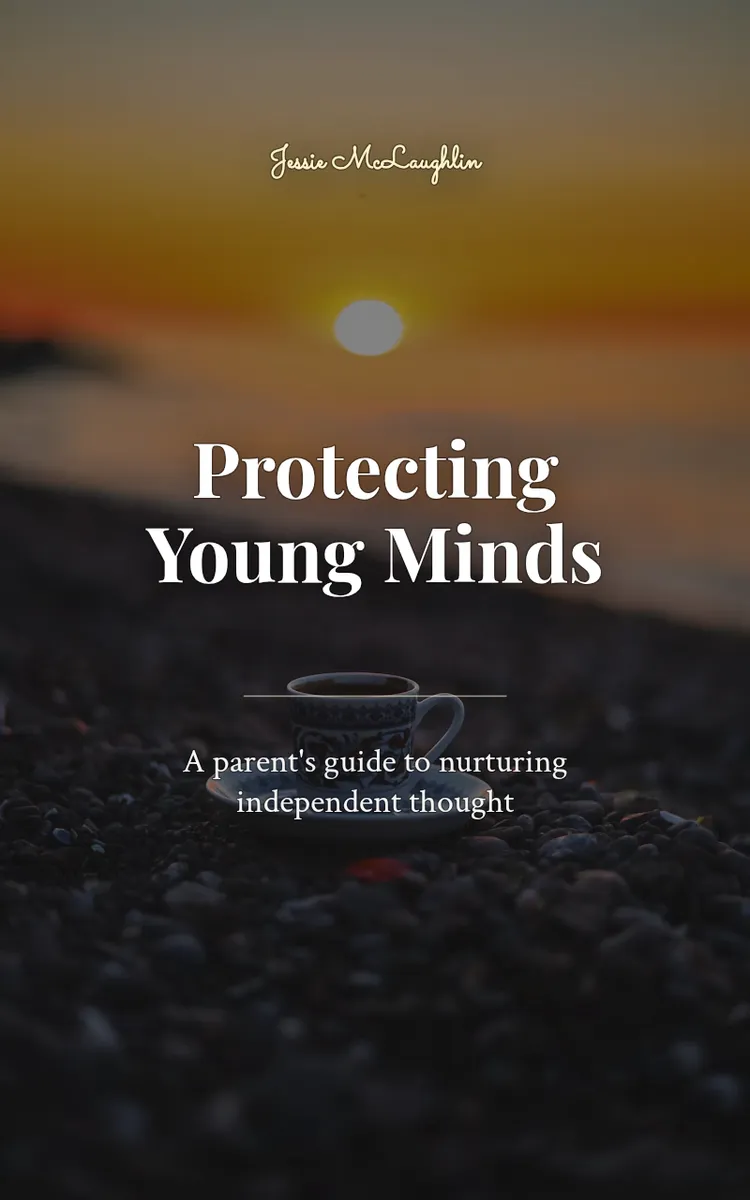
"Protecting Young Minds" is a nonfiction book by Jessie McLaughlin with 40 chapters and approximately 60,124 words. Children's mental autonomy, outside influences, and ways to support critical thinking.
This book was created using Inkfluence AI, an AI-powered book generation platform that helps authors write, design, and publish complete books.
Frequently Asked Questions
What is "Protecting Young Minds" about?
Children's mental autonomy, outside influences, and ways to support critical thinking
How many chapters are in "Protecting Young Minds"?
The book contains 40 chapters and approximately 60,124 words. Topics covered include Seeing Children as Whole People, Separating Identity from Labels, Understanding How Influence Works, Spotting Hidden Persuasion, and more.
Who wrote "Protecting Young Minds"?
This book was written by Jessie McLaughlin and created using Inkfluence AI, an AI book generation platform that helps authors write, design, and publish books.
Write your own nonfiction book with AI
Describe your idea and Inkfluence writes the whole thing. Free to start.
Start writingCreated with Inkfluence AI


