
Read the first chapter
The whole of chapter one, free. About 9 min. Turn the pages with the arrows, your keyboard, or a swipe.
Chapter 1
A Pennsylvania Boyhood
The market road had always carried Robert McLaughin home by the same familiar signs: the bend where the creek showed between the trees, the split rail fence leaning toward the fields, and the smell of wood smoke rising from farmhouses before the McLaughin place came into view. That day, none of those signs brought comfort.
Robert had been old enough to work hard but still young enough to believe that the road would remain what it had always been. He had spent his days in the ordinary rhythm of a Pennsylvania farm - lifting, mending, hauling, and following the seasons as closely as any man could. His hands knew the roughness of a fence rail and the weight of a sack of grain. His ears knew the sounds of the countryside: wagon wheels, barking dogs, axes striking wood.
Now the road carried other sounds.
From somewhere beyond the rise came the uneven clatter of wheels and the murmur of many voices. Robert stopped beside the ditch, one hand resting against the worn strap of the bundle he carried. The afternoon air smelled of dust and crushed grass. A warm wind moved through the roadside weeds, but the road ahead seemed close and crowded.
He could not see his farm from where he stood. The rise blocked it, as it had blocked it every other time he had made the journey. Yet the distance felt different. Home was no longer simply waiting at the end of the road. It had become a place he had to reach.
Robert had gone into the market settlement expecting to finish the usual errands and return before dark. Instead, the streets had filled with men who did not move like farmers returning from their work. Some carried muskets. Others wore coats that marked them as belonging to no single household Robert recognized. Groups stood near the meetinghouse and the public house, speaking in low voices that rose and fell whenever a stranger passed.
The trouble had not arrived in one clear moment. It had traveled by rumor, printed notices, and hurried riders. It had come in arguments over taxes and authority, in warnings repeated at doorways, and in questions that no longer allowed a quiet answer. Robert had heard men speak of liberty, loyalty, resistance, and the need to choose a side. Until then, those words had seemed to belong to distant towns and important men.
On the market road, they belonged to him.
He moved on when the first wagon passed. Its wheels struck the hard ground with a hollow thump, and the horse tossed its head against the bit. Robert stepped aside, close enough to feel the dust settle on his face. Behind the wagon came several men on foot. Their boots were muddy, and one carried a musket across his chest.
“Which way?” a man asked.
Robert looked toward the fork ahead. The left branch led toward the creek and the longer route home. The right passed through the settlement, where the road had been narrowed by wagons drawn across it.
“Left,” Robert said. “The right road is blocked.”
The man studied him briefly. “Blocked by whom?”
Robert felt the question settle between them. He could have answered that he did not know. That would have been true, or nearly true. He had seen men gathered there, but he had not asked their purpose. He had learned that questions could make a person noticeable.
“Men from the settlement,” he said at last.
The man’s expression hardened, though Robert could not tell whether the answer pleased him. He turned to the others and repeated it. The group moved toward the left branch, and Robert waited until they had gone before continuing.
The longer road was narrow and uneven. Branches crowded its edges, and the creek ran beside it in a dark, hurried line. Robert had used it in wet weather when the main road became too deep for a wagon, but he had never traveled it with so many unknown men moving in the same direction. Their presence changed the road. It was no longer a quiet way around an inconvenience. It had become an uncertain passage, one that could lead him toward safety or toward men who might demand more than directions.
At the creek crossing, he found the first real obstruction. Two wagons stood wheel to wheel where the road narrowed between the bank and a low stone wall. A group of men had gathered around them. Their voices were sharp, and the horses stamped impatiently. One man held a paper in his hand and read from it while another kept watch with a musket resting against his shoulder.
Robert stopped before he reached them.
A boy could have turned back. A farmer’s son could have waited by the trees until the wagons moved. But the light was fading, and the road home still stretched beyond the crossing. He thought of the farm as it would be at that hour: the work finished or nearly finished, the animals quieting, the last chores being done before darkness. He thought of how long it would take to reach the house if he delayed.
He stepped forward.
“Let me pass,” he said.
The man with the paper looked over. “Where are you bound?”
“Home.”
“That is not a place.”
“It is for me.”
The answer came more firmly than Robert intended. The man glanced at the bundle in his hand, then at Robert’s plain clothes.
“Whose farm?”
Robert hesitated. Naming the farm would make it known to a stranger. Refusing might make him appear secretive. The road had changed the meaning of ordinary facts. Even a name could become evidence of where a person belonged.
“McLaughlin,” he said.
The man with the musket shifted his grip. “Are you with them?”
“With whom?”
The question drew a few looks from the others. Robert felt the familiar wish to become invisible, the same wish that had kept him from asking questions in the settlement. But invisibility had become impossible. The men wanted an answer, and his silence would be treated as one.
“I am with my family,” he said.
For a moment, only the creek could be heard below the bank. Water moved over stones with a steady, indifferent sound. Then the man holding the paper folded it and tucked it beneath his coat.
“Go around,” he said. “Keep to the edge.”
Robert did as he was told. He climbed down beside the creek, boots sliding in the wet earth, and led himself past the wagons. The smell of horse sweat and damp leather followed him. One of the horses jerked its harness as he passed, and the wooden frame creaked against the stone wall.
He reached the far side without being stopped. The relief was brief. Behind him, the men resumed their argument, louder than before. Their voices carried along the water, broken by the sharp crack of a command. Robert did not turn to look.
The road rose through a stand of trees. The air beneath them was cooler, and the last light had begun to thin between the branches. Robert walked faster. His bundle struck against his hip with each step. He had wanted only to get home safely, but safety now required attention to every group of men, every wagon placed across a road, and every question asked by someone who believed the countryside had become his responsibility to guard.
At the top of the rise, he saw smoke in the distance. For one hopeful instant, he thought it came from his family’s chimney. Then he noticed another column farther east, rising darkly above the trees. A second followed, thinner but unmistakable.
Robert stopped.
Nothing in the sight itself told him what had happened. Smoke could mean a cooking fire, a burned field, or something worse. Yet he knew that the old habit of assuming the ordinary had ended. He had spent years measuring danger by weather, illness, poor harvests, and the accidents that could come from farm work. Those dangers had belonged to the land. The danger now came from people, and people could carry their intentions from one place to another.
He continued toward home.
The final stretch of road was more familiar. He recognized the split rail fence and the old maple bent over the ditch. He heard a dog bark from a neighboring farm and then fall silent. The smell of smoke grew stronger, but it was wood smoke, clean and bitter, rising from a chimney he knew.
Robert reached the farm as darkness gathered over the fields. The house stood where it had always stood, its windows catching a dim glow from within. He paused at the gate, listening.
There were no voices outside. No wagon blocked the yard. The barn door was closed, and the animals shifted softly inside. For a moment, the sight of these things restored the shape of the world he had known that morning.
Then he saw the marks in the road.
Boot prints crossed the soft earth near the gate. They were deeper than the prints made by farm shoes and pointed in several directions. Beyond them, near the edge of the field, a small fire had burned down to gray ash. Someone had stopped there recently, close enough to watch the road and the approach to the farm.
Robert entered the yard and set down his bundle. The house door opened, and the warmth of the kitchen reached him, carrying the smell of supper and wood smoke. He did not speak at once. He looked back toward the road.
Far beyond the fence, a lantern moved between the trees.
Another appeared near the rise.
The patrols had not been in the settlement alone. They had extended along the roads that connected the farms, placing watchmen where travelers had once passed without notice. Robert understood then that reaching home had not returned him to the old life. It had only shown him how near the new one had come.
He turned toward the house, but his attention remained fixed on the road. The farm was safe for that night, perhaps. Yet the way home would no longer belong only to those who lived along it. It was being watched, and Robert had learned that a person could be drawn into the conflict simply by trying to cross the ground between one ordinary duty and the next.
Looking back, he understood that his first change did not come through a speech or a battle. It came on a road he had known since childhood, when unfamiliar men stopped him and demanded to know where he belonged. He had wanted to answer that he belonged only to his family and his farm. The events of that day showed him that such an answer might not be accepted.
The road had taught him a harder kind of awareness. He would have to watch, listen, and decide when silence protected his family and when it merely left others to decide for him. The quiet Pennsylvania life he had known was still visible - the fields, the house, the animals, the work waiting for morning - but it was no longer sheltered from the country’s unrest.
Robert stepped inside. Behind him, the lanterns continued to move along the road.
End of chapter one. 39 more chapters and about 98,158 words in the full book.
Swipe or use the arrows to turn the page


What's inside: 40 chapters
- 1. A Pennsylvania Boyhood
- 2. The County Muster
- 3. The Missing Muster Roll
- 4. Across the Susquehanna
- 5. Choosing the Cause
- 6. The Broken Supply Wagon
- 7. Who Took the Flour?
- 8. The Mountain Road
- 9. The Price of Silence
- 10. The Alarm at Dawn
- 11. The Quartermaster’s Ledger
- 12. Winter Quarters at Carlisle
- 13. Duty Beyond the Farm
- 14. The Pay Chest Disappears
- 15. Tracing the Pay Chest
- 16. The Frozen Camp
- 17. A Soldier’s Conscience
- 18. The March Order
- 19. The Allegheny Passage
- 20. The Order Behind the Losses
- 21. The Burden of Proof
- 22. The Company Splits
- 23. The Clerk Who Remembers
- 24. The Flooded Valley
- 25. The Cost of Returning
- 26. The Company’s Last Rations
- 27. A Witness in the Mill
- 28. The Abandoned Depot
- 29. The Officer’s Departure
- 30. The Empty Hearing Room
- 31. Finding the Original Copy
- 32. The Pass Through the Hills
- 33. The Choice to Persist
- 34. The Courier’s Missing Route
- 35. The Public Muster
- 36. Restoring His Name
- 37. Back to the Family Farm
- 38. A Different Kind of Service
- 39. The Final Supply Return
- 40. The Record Robert Leaves
About this book
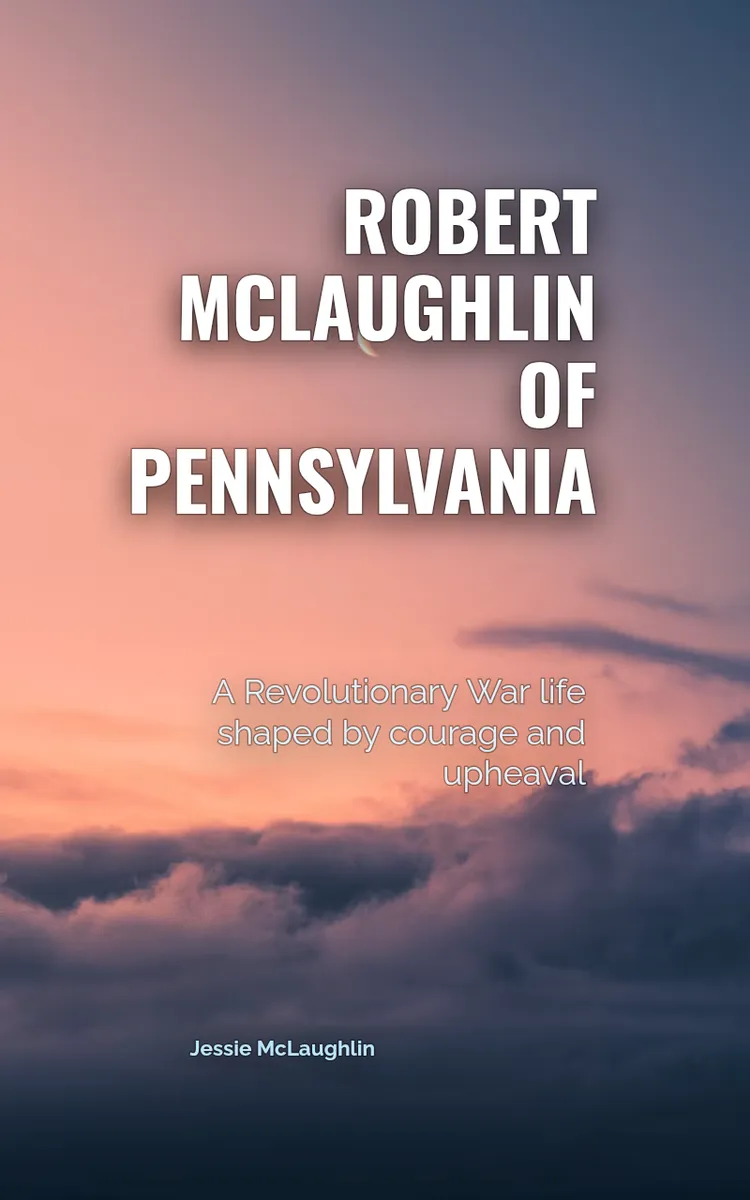
"Robert Mclaughlin Of Pennsylvania" is a nonfiction book by Jessie McLaughlin with 40 chapters and approximately 98,158 words. Robert McLaughlin’s life and experiences in Pennsylvania during the Revolutionary War.
This book was created using Inkfluence AI, an AI-powered book generation platform that helps authors write, design, and publish complete books.
Frequently Asked Questions
What is "Robert Mclaughlin Of Pennsylvania" about?
Robert McLaughlin’s life and experiences in Pennsylvania during the Revolutionary War
How many chapters are in "Robert Mclaughlin Of Pennsylvania"?
The book contains 40 chapters and approximately 98,158 words. Topics covered include A Pennsylvania Boyhood, The County Muster, The Missing Muster Roll, Across the Susquehanna, and more.
Who wrote "Robert Mclaughlin Of Pennsylvania"?
This book was written by Jessie McLaughlin and created using Inkfluence AI, an AI book generation platform that helps authors write, design, and publish books.
Write your own nonfiction book with AI
Describe your idea and Inkfluence writes the whole thing. Free to start.
Start writingCreated with Inkfluence AI


