
Read the first chapter
The whole of chapter one, free. About 7 min. Turn the pages with the arrows, your keyboard, or a swipe.
Chapter 1
Understanding Brand-Funded Micro-Dramas
Why Micro-Dramas Matter to Brands and Creators
A local skincare company once reviewed a proposed sponsorship that featured its product in a single polished video. The video looked good, but the brand had one concern: viewers might notice the bottle without remembering why it mattered. A serialized micro-drama offered a stronger answer. Instead of placing the product in one scene, the creator could build a five-part story in which a character prepared for a difficult event, dealt with a setback, and used the product as part of a believable routine. The brand gained repeated, useful exposure. The audience gained a reason to return. The creator gained more than one deliverable to sell.
That exchange solves a common problem for independent filmmakers. A strong short film can earn attention without creating a clear reason for a brand to pay. A product placement can earn money without giving viewers a reason to care. Serialized short-form storytelling connects those two needs. Each episode gives the audience a small payoff and a reason to watch the next one, while the full series gives the sponsor several natural moments to appear.
You will learn to match a story format to a brand’s goal, your production limits, and the audience you want to build. You will also leave with a working method for turning a story idea into a sponsor-friendly package without flattening the story into an advertisement. The reader this book serves is a creator who can write, shoot, edit, or produce short videos but needs a clearer path from concept to paid partnership. You may work with a small crew, a phone or mirrorless camera, borrowed locations, and a budget that requires careful choices. The promise is practical: you will be able to explain why your series creates value and show a brand exactly where that value appears.
The Story-to-Sponsor Map
The central framework is the Story-to-Sponsor Map. It connects four points: the audience problem, the story engine, the brand role, and the creator’s production plan. If one point fails, the partnership weakens. A brand cannot rescue a story that gives viewers no reason to continue. A great story cannot support a sponsor if the product feels pasted into the frame. A clever integration can still fail if the creator cannot deliver the episodes on schedule.
Use the map in this order:
1. Audience problem: Define the tension that makes viewers care. “A young worker wants to look confident at an important interview” gives you a usable problem. “People want better lives” does not. A specific problem creates scenes, choices, and emotional stakes.
2. Story engine: Choose the repeating question that pulls viewers into the next episode. For a five-part series, the question might change from “Will the character attend the interview?” to “What will the character risk to keep the opportunity?” Each episode should answer one small question while opening another.
3. Brand role: Give the product a job inside the story. A meal-delivery service can create a time-saving solution during a demanding week. A clothing brand can support a character’s preparation for a new role. The product should help the character act, decide, recover, or connect. If removing the product changes nothing, the integration needs work.
4. Production plan: Set the episode count, running time, locations, cast, and delivery schedule before you pitch. A three-episode series with one apartment, two actors, and a six-day edit may fit your resources better than an eight-episode story with five locations. A sponsor trusts a plan that shows you understand the work.
The map also helps you choose a format. A continuing serial follows one plot across episodes and suits brands that want viewers to return for a resolution. A linked anthology uses a shared theme, setting, or product while each episode tells a complete story; it suits brands that want flexible clips for different audiences. A branching choice series asks viewers to choose between two paths, then releases different outcomes; it creates participation but requires more writing and editing. A behind-the-scenes story layer pairs the drama with short production or character clips, giving the sponsor additional content without forcing the main episodes to carry every message.
Select the format by scoring three practical needs from one to five: audience return, brand visibility, and production control. If your concept scores high on audience return but low on production control, reduce the number of locations or use a linked anthology. If the brand needs clear product demonstrations, build short companion clips rather than interrupting the drama. This simple scoring method prevents you from selling a format you cannot finish.
The framework works because it separates attention from exposure. The story earns attention. The brand role makes exposure useful. The production plan makes the promise believable. Your pitch should show all three, not just a logline and a mood board.
A Five-Episode Map in Practice
Consider a creator developing a series for a neighborhood meal-prep company. The creator has one apartment location, two performers, a phone camera, and three weekends available. The brand wants local awareness and usable vertical videos for its social channels. The creator applies the Story-to-Sponsor Map like this:
1. Choose the audience problem. The series targets people who work late and keep postponing meals. The dramatic question becomes: can the lead character prepare for a major personal decision while managing an exhausting schedule? This gives the audience a recognizable pressure rather than a product lecture.
2. Build five episode questions. Episode 1 asks whether the character will accept an unexpected invitation. Episode 2 asks whether missed meals will affect the decision. Episode 3 introduces a conflict with a roommate. Episode 4 forces the character to choose between convenience and an important conversation. Episode 5 resolves the decision. Each episode runs 45 to 60 seconds and ends with a clear turn.
3. Assign the brand a useful role. The meal-prep service appears when the character needs a reliable meal during a rushed evening. The script shows the package arriving, the character heating it, and the character returning to the conversation. The product does not solve the emotional conflict; it removes one practical obstacle. That boundary keeps the scene credible.
4. Plan the deliverables. The package includes five vertical episodes, five 10-second cutdowns, one 20-second product-focused clip, and six still frames. The creator schedules one shooting day for the apartment scenes and a half-day for inserts and pickup shots. The plan gives the brand material for its own channels without adding a second full production.
5. Set success checks. The creator tracks episode completion rate, comments that mention the story, saves, shares, and clicks from the brand’s profile link. The creator does not promise a specific sales result. Instead, the creator promises a clear delivery schedule and a report showing how viewers responded to each episode. The expected outcome is a finished story package that earns repeat viewing and gives the sponsor several usable assets.
Before pitching, the creator prepares a one-page map: audience problem at the top, five episode questions in the center, brand role beside the relevant scenes, and production details at the bottom. That page lets a sponsor understand the idea in less than five minutes. It also exposes weak points before the creator spends money.
Quick checklist
• Define one specific audience problem. - Write one question for every episode. - Give the product a useful role, not a forced appearance. - Choose a format that fits your locations, cast, and schedule. - List every promised asset and delivery date. - Identify the audience signals you will report. - Prepare a one-page Story-to-Sponsor Map before contacting brands.
Mistakes That Weaken the Map
Mistake: Treating the sponsor as a logo
A logo in the opening frame may satisfy a placement request, but it rarely creates story value. Viewers remember actions and consequences more easily than isolated branding. Fix the problem by writing the product into a decision, routine, or obstacle.
Do this: Show how the product helps the character take a meaningful action.
Not this: Pause the story so the character can praise the product in a speech.
Mistake: Choosing too many episodes too soon
A creator may promise ten episodes because a longer series sounds more valuable. With one location and a small crew, that promise can produce repeated scenes, rushed edits, and late delivery. Start with the smallest season that proves the story engine. A three- to five-episode run often gives you enough material to test return viewing while protecting quality.
Do this: Match episode count to your actual shooting days, edit hours, and cast availability.
Not this: Announce a large season before you can explain how each episode changes the situation.
Mistake: Confusing product visibility with brand value
A product can appear in every episode and still fail to support the brand. If the audience cannot connect the product with a useful feeling or action, the exposure remains shallow. Fix the integration by naming the brand’s intended association: convenience, confidence, care, energy, discovery, or another specific idea. Then build scenes that earn that association.
Do this: Ask, “What does the audience understand about this brand after watching the scene?”
Not this: Count appearances and assume more screen time automatically means more value.
Your immediate action is to choose one brand category, one audience problem, and one five-episode question chain. Put them on a single page using the Story-to-Sponsor Map. If the brand role does not change a character’s action, rewrite it before you pitch. That discipline gives you a foundation for building a series that audiences want to follow and brands can confidently fund.
End of chapter one. 7 more chapters and about 15,870 words in the full book.
Swipe or use the arrows to turn the page

What's inside: 8 chapters
- 1. Understanding Brand-Funded Micro-Dramas
- 2. Designing a Sponsor-Ready Series
- 3. Finding Brands That Fit Your Story
- 4. Pitching a Micro-Drama Partnership
- 5. Pricing Episodes and Sponsorship Packages
- 6. Integrating Products Into the Plot
- 7. Producing Episodes on a Lean Budget
- 8. Measuring Results and Renewing Sponsors
About this book
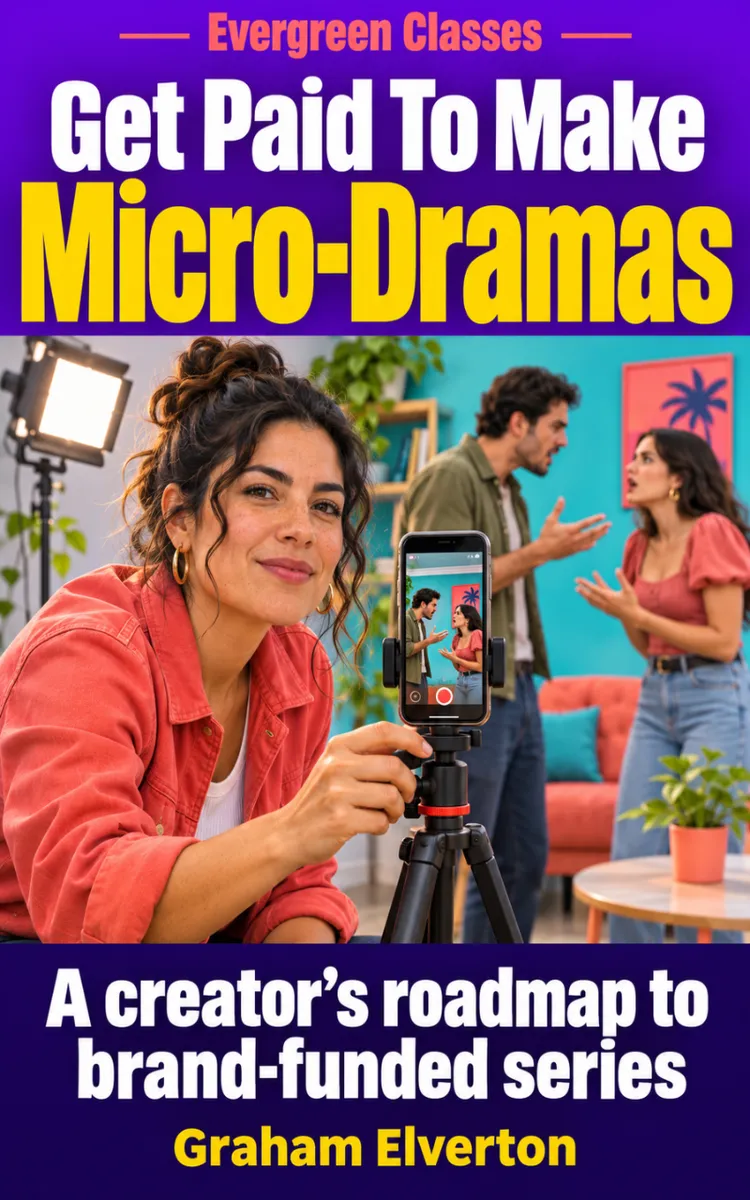
"Get Paid To Make Micro-Dramas" is a business book by Graham Elverton with 8 chapters and approximately 15,870 words. A skincare bottle can vanish from memory after one polished video. In a five-part micro-drama, it can become part of a character’s routine, a setback, and the reason viewers return.
This book was created using Inkfluence AI, an AI-powered book generation platform that helps authors write, design, and publish complete books. It was made with the AI Business Book Writer.
Frequently Asked Questions
What is "Get Paid To Make Micro-Dramas" about?
A skincare bottle can vanish from memory after one polished video. In a five-part micro-drama, it can become part of a character’s routine, a setback, and the reason viewers return. Get Paid To Make Micro-Dramas shows creators and independent filmmakers how to build serialized short-form stories that give brands a natural role and audiences a reason to keep watching. You’ll use the Story-to-Sponsor framework to connect a series with a fitting brand, and the Brand-Fit Scorecard to assess audience, product, and tone before you pitch. You’ll also see how a bakery mystery became easier to sponsor when each customer order carried a clue. Across eight chapters, turn a story idea into a sponsor-ready package without flattening it into an ad. Your next pitch can begin with a premise a brand can picture itself inside.
How many chapters are in "Get Paid To Make Micro-Dramas"?
The book contains 8 chapters and approximately 15,870 words. Topics covered include Understanding Brand-Funded Micro-Dramas, Designing a Sponsor-Ready Series, Finding Brands That Fit Your Story, Pitching a Micro-Drama Partnership, and more.
Who wrote "Get Paid To Make Micro-Dramas"?
This book was written by Graham Elverton and created using Inkfluence AI, an AI book generation platform that helps authors write, design, and publish books.
How can I create a similar business book?
You can create your own business book using Inkfluence AI. Describe your idea, choose your style, and the AI writes the full book for you. It's free to start.
Write your own business book with AI
Describe your idea and Inkfluence writes the whole thing. Free to start.
Start writingCreated with Inkfluence AI


