
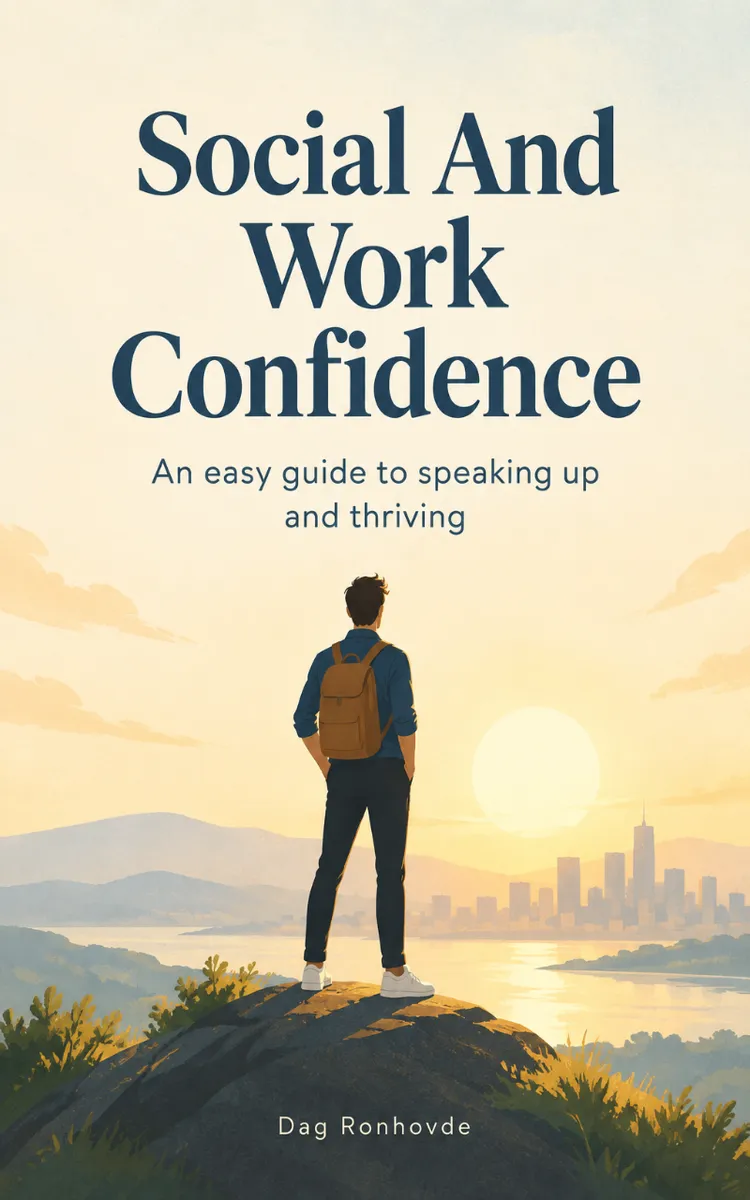
Read the first chapter
The whole of chapter one, free. About 6 min. Turn the pages with the arrows, your keyboard, or a swipe.
Chapter 1
Rewriting Your Confidence Story
The Story You Tell Before You Speak
What do you say to yourself in the ten seconds before you walk into a meeting, join a group conversation, or introduce yourself to someone new?
Maybe it sounds like, “Don’t say anything stupid.” Maybe it’s, “They already know more than I do.” At work, the story might be, “If I ask this question, people will think I’m not capable.” In social settings, it may be, “I’m awkward, so I’d better stay quiet.”
That private commentary can feel like a fact. It isn’t. It’s a confidence narrative: a repeated explanation about who you are, what other people think, and what will happen if you speak up. The problem isn’t that you have a story. The problem is that an old story may still be running moments that require a new one.
Are you responding to today’s situation - or obeying yesterday’s story?
From “This Is Who I Am” to “This Is What I’m Practicing”
Old Belief: My confidence level is a fixed part of my personality. I’m either naturally confident or I’m not.
New Reality: Confidence grows when I notice the story guiding my behavior and replace it with one that is honest, useful, and believable.
This shift matters because your inner story affects what you notice. If you expect people to judge you, a neutral expression can look like disapproval. If you expect to fail in meetings, a pause before answering can feel like proof that you’re losing credibility. Your brain starts collecting evidence for the conclusion it already expects.
That doesn’t mean confidence is “all in your head.” Your body may still tense up. Your voice may shake. The point is that a believable new story gives you room to act while those sensations are present. You don’t need to tell yourself, “I’m the most confident person here.” If that feels ridiculous, your mind will reject it. Try, “I can contribute one useful thought,” or, “I don’t need to impress this person; I can be curious.”
Picture a team meeting where you usually stay silent. Your old story says, “I need a perfect answer, or people will see I don’t belong.” The Confidence Story Swap changes it to, “My job is to add something clear, even if it isn’t polished.” You might ask one focused question or offer a short observation. The meeting hasn’t become risk-free. You’ve simply stopped making perfection the price of participation.
How the Old Narrative Keeps the Wheel
Confidence stories usually hide inside quick thoughts, not dramatic declarations. You may not consciously say, “I am socially incapable.” You may simply rehearse your sentence five times, avoid eye contact, decline an invitation, or wait for someone else to speak first. Those actions keep the story alive because they prevent you from gathering new evidence.
The Confidence Story Swap has two parts. First, name the old story without arguing with it. Second, write a replacement that is both kinder and credible. “Everyone will love me” is too broad. “I can handle a quiet moment and continue the conversation” gives you something solid to stand on.
Look for these signs that the old narrative is running your life:
1. You edit yourself before anyone has asked you to. You have a useful point in a discussion, then remove it because it might sound obvious, inconvenient, or imperfect.
2. You treat discomfort as a warning. A racing heart becomes “I shouldn’t do this,” rather than “My body knows this matters, and I can still choose my next step.”
3. You collect mistakes but dismiss progress. One awkward sentence stays with you all evening, while the fact that you introduced yourself or spoke in the meeting barely counts.
4. You use fixed labels instead of describing a skill in progress. “I’m bad at networking” closes the door. “I’m learning how to start short conversations” leaves it open.
A confidence story becomes powerful when it describes a practice, not a permanent identity.
Questions That Expose Your Current Story
1. What sentence appears in your mind immediately before you speak in a group? Write the exact words, even if they sound harsh. “Don’t draw attention to yourself” tells you more than the vague label “I’m shy.”
2. What does this story encourage you to do - and avoid? Perhaps it helps you prepare carefully, but also keeps you from asking for clarification. Notice both sides; old stories often began as attempts to protect you.
3. What evidence do you use to prove the story is true? If you think, “People don’t want to hear from me,” you may remember one interrupted comment. Also record the colleague who asked for your opinion or the friend who kept the conversation going.
4. What would you say to a capable coworker who had the same fear? You probably wouldn’t tell them, “You’re hopeless.” You might say, “Your idea doesn’t need to be perfect to be useful.” That response may be closer to the truth you need.
5. What is one believable replacement story for your next social or work moment? Keep it specific: “I can introduce myself and ask one question,” or, “I can give my recommendation and let others respond.” A useful story should point toward an action.
The Seven-Day Confidence Story Swap
For the next 7 days, catch one old confidence story each day and swap it for a believable working story.
• Before one social or work interaction, write the old sentence in your phone’s notes app. - Name the behavior it creates: staying silent, over-explaining, avoiding eye contact, cancelling, or waiting for permission. - Write a replacement beginning with “I can,” “I’m learning to,” or “I don’t need to.” - Take one small action that matches the replacement story. - Afterward, record what actually happened in two lines. Include facts, not a verdict about yourself.
Example:
• Old story: “If I speak up, I’ll sound unprepared.” - New story: “I can share one clear point and adjust if someone adds information.” - Action: Offer one recommendation during Tuesday’s meeting. - Result: “I spoke for thirty seconds. Two people responded. Nobody asked me to leave the building.” (A modest win, perhaps, but a real one.)
Expected difficulty: Medium
You’ll know it’s working when...
• You catch the old story earlier, before it turns into avoidance. - Your replacement sentence feels believable rather than sugary. - You take small actions while still feeling nervous. - Your after-action notes include evidence that is more balanced. - You recover faster from an awkward moment instead of turning it into a character judgment.
The goal isn’t to create a perfect week. Some days, you’ll notice the story after the meeting, while replaying your answer on the drive home. That still counts. Awareness often arrives late before it arrives on time.
Your Confidence Story Is Not Your Fate
You can change the story that shapes your behavior, one believable sentence and one brave action at a time.
• You learned to separate your confidence narrative from your fixed identity. - You saw why believable reframes work better than exaggerated positive statements. - You identified signs that an old story is directing your choices. - You created the Confidence Story Swap as a seven-day practice for social and workplace moments.
The next time your mind says, “This is just who I am,” pause before accepting the verdict. Ask what story is speaking, what it is trying to protect, and what a more useful truth would sound like. Then give that new truth a chance to become real through action. Confidence doesn’t arrive fully formed; it grows each time your behavior gives your mind better evidence.
End of chapter one. 7 more chapters in the full book.
Swipe or use the arrows to turn the page

What's inside: 8 chapters
- 1. Rewriting Your Confidence Story
- 2. Challenging Mind-Reading Defaults
- 3. Building Boundaries Without Guilt
- 4. The Two-Second Presence Reset
- 5. Asking Better Questions at Work
- 6. Turning Rejection Into Data
- 7. Practicing Confident Micro-Behaviors
- 8. Integrating Purpose With Performance
About this book
"Social And Work Confidence" is a self-help book by Dag Ronhovde with 8 chapters and approximately 11,386 words. Building self-confidence in social settings and workplace.
This book was created using Inkfluence AI, an AI-powered book generation platform that helps authors write, design, and publish complete books. It was made with the AI Self-Help Book Writer.
Frequently Asked Questions
What is "Social And Work Confidence" about?
Building self-confidence in social settings and workplace
How many chapters are in "Social And Work Confidence"?
The book contains 8 chapters and approximately 11,386 words. Topics covered include Rewriting Your Confidence Story, Challenging Mind-Reading Defaults, Building Boundaries Without Guilt, The Two-Second Presence Reset, and more.
Who wrote "Social And Work Confidence"?
This book was written by Dag Ronhovde and created using Inkfluence AI, an AI book generation platform that helps authors write, design, and publish books.
How can I create a similar self-help book?
You can create your own self-help book using Inkfluence AI. Describe your idea, choose your style, and the AI writes the full book for you. It's free to start.
Write your own self-help book with AI
Describe your idea and Inkfluence writes the whole thing. Free to start.
Start writingCreated with Inkfluence AI


