
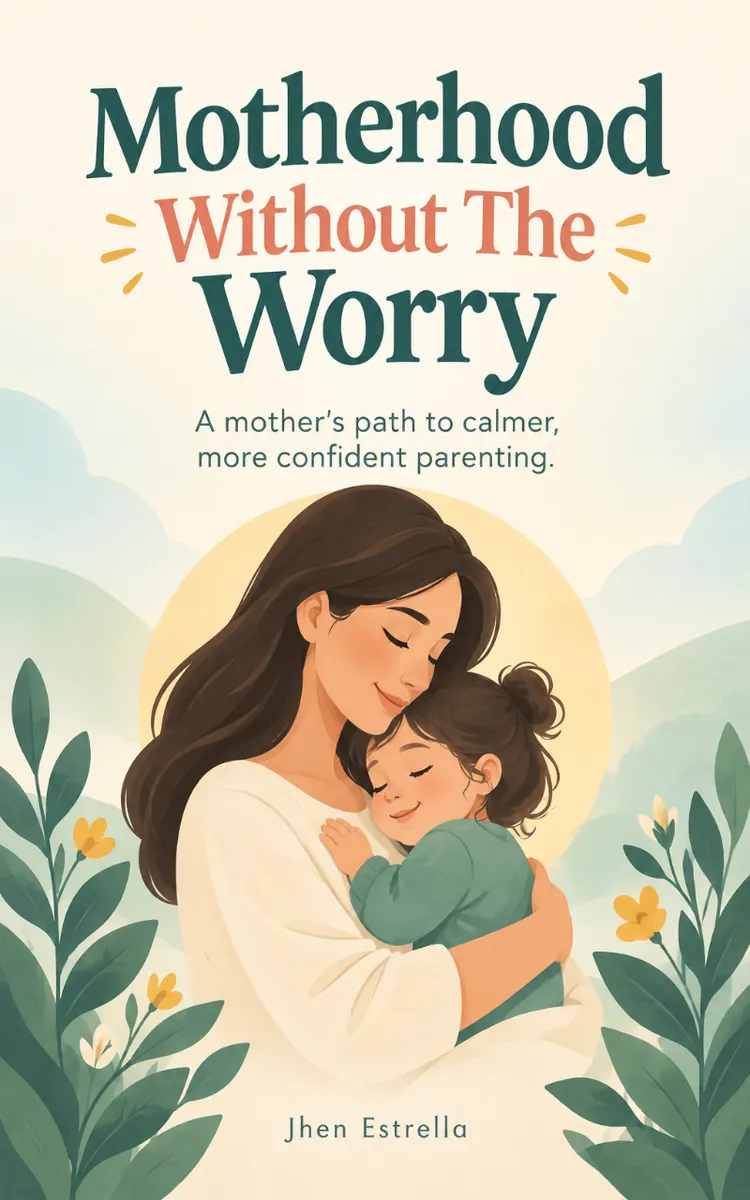

Read the first chapter
The whole of chapter one, free. About 7 min. Turn the pages with the arrows, your keyboard, or a swipe.
Chapter 1
Separating Anxiety from Motherhood
When the Thought Feels Like a Verdict
At 6:42 on a Tuesday morning, Mara stood in the kitchen with one child crying over the wrong-colored cup and the other refusing to put on socks. Her toast had gone cold. A message from school sat unopened on her phone. She could feel the familiar rush begin: I’m already failing today. What kind of mother can’t handle breakfast?
Then she noticed the lunchbox on the counter. It was packed. The children were dressed. Nobody was in danger. The morning was hard, but it wasn’t proof of anything. Mara had a choice: let the thought become a verdict, or treat it as what it was - a frightened alarm sounding in a tired body.
She took one breath, crouched beside her youngest, and said, “You wanted the blue cup. I know. We’re going to use the green one today.” It didn’t magically make the morning peaceful. But it stopped one anxious thought from deciding who she was.
The question isn’t whether anxious thoughts appear; it’s whether you let them define you as a mother.
Three Mothers, Three Anxious Stories
The Midnight Checker - Nia
Nia wakes at 1:13 a.m. and checks that her daughter is breathing. Then she checks again ten minutes later. By morning, she’s ashamed. She tells herself, A confident mother wouldn’t be this afraid. Her anxiety becomes evidence against her, even though it began with love and exhaustion.
The Playground Replayer - Tessa
At the park, Tessa snaps, “Stay where I can see you!” Her son rolls his eyes, and she feels awful. That evening, she replays the moment while washing dishes. I’m too controlling. I’m damaging him. One sharp sentence becomes a complete story about her character.
The School-Message Watcher - Jo
Jo sees a note from her child’s teacher: “Could we talk tomorrow?” Her stomach drops. Before she knows what the conversation is about, she has imagined a learning problem, a social problem, and a future full of regret. She spends the evening trying to prepare for disasters that haven’t happened.
What all these have in common:
• An ordinary parenting moment triggers a frightening thought. - The thought feels urgent and believable. - The mother treats the thought as proof that she’s failing. - Shame adds a second layer of pain. - The original situation is often much smaller than the story anxiety creates.
The anxious mind is trying to protect you, not give you a fair report card. It scans for danger, notices uncertainty, and fills in missing information with the worst explanation it can find. That can be useful when your toddler runs toward the street. It’s less useful when a teacher asks for a conversation or your child has a difficult bedtime.
The Motherhood Identity Compass gives you a steadier way to find your direction. Instead of asking, What does this thought say about me? you ask, What matters to me here, and what is one grounded action I can take? The compass doesn’t erase fear. It helps you stop mistaking fear for failure.
Why Anxiety Feels Like Proof
An anxious thought often arrives with physical force. Your chest tightens. Your stomach turns. Your mind speeds up. Because the feeling is intense, the thought seems important - and because it seems important, it feels true. But intensity isn’t accuracy.
There’s a difference between an experience and a fact. I’m afraid I’ll miss something important is an experience. I am neglectful is a conclusion. I keep picturing an accident is an experience. My child isn’t safe with me is a conclusion. When you separate the two, you create a small but powerful pause. In that pause, you can respond to your child instead of defending yourself against an accusation your mind invented.
Anxiety also loves all-or-nothing labels. A rushed morning becomes I’m disorganized. Losing patience becomes I’m a bad mother. Forgetting library day becomes I can’t be trusted. These labels feel tidy, but motherhood isn’t tidy. A mother can be loving and impatient, careful and forgetful, confident at breakfast and overwhelmed by dinner. You’re a whole person, not a single parenting moment.
You may need this shift if:
1. You treat worry as a warning that you’ve done something wrong. 2. You replay small parenting moments long after they’re over. 3. You look for reassurance, feel better briefly, then need it again. 4. You believe a “good mother” should rarely feel afraid, irritated, or unsure.
An anxious thought is something you are experiencing, not a final judgment about who you are as a mother.
Try naming the experience in plain language: “I’m having the thought that I’m failing.” That wording may feel awkward at first. It’s meant to. It gently puts space between you and the thought. You’re not arguing with it or forcing yourself to feel positive. You’re noticing it without handing it the steering wheel.
Finding Your Direction with the Motherhood Identity Compass
Use these prompts slowly. You don’t need perfect answers. A few honest lines are enough.
1. What anxious thought has been acting like proof that I’m failing as a mother? Write the exact sentence, not a softened version. For example: “If my child is upset, I’m doing something wrong.”
2. What happened just before this thought appeared? Include practical details such as lack of sleep, a difficult transition, a text from school, or your child’s fever. Context often shows why the alarm sounded.
3. What part of the thought is an experience, and what part is a conclusion? “My heart is racing” is an experience. “I can’t handle motherhood” is a conclusion. Separating them helps you see where anxiety added its own meaning.
4. What kind of mother do I want to be in this specific moment? Choose a quality you can practice now: patient, honest, steady, curious, or willing to repair. Don’t choose “perfect.” Perfect isn’t an action.
5. What is one small action that points in that direction? You might put your phone down, apologize for raising your voice, check the actual facts, or sit beside your child for two quiet minutes. The goal is not to feel fearless. It’s to act from your values while fear is present.
You can draw a simple compass in your notebook. At the top, write the quality you want to practice. Around it, add one fact, one feeling, one need, and one next action. This turns a swirling thought into something you can work with.
The Seven-Day Thought-to-Compass Challenge
Challenge name: Seven Days of Steadier Motherhood
Difficulty level: Gentle, with moments of emotional honesty
For seven days, practice separating anxious thoughts from your identity. Use a note on your phone or a small piece of paper. Keep each entry under three minutes. This is not another task to perform perfectly.
• Day 1 - Notice the sentence. Write down one anxious thought exactly as it appeared. Add, “I’m having the thought that…” - Day 2 - Name the trigger. Record what came before it: time, place, body feeling, and situation. - Day 3 - Sort experience from conclusion. Make two short columns. In one, write what you know. In the other, write what anxiety is predicting. - Day 4 - Choose your compass point. Pick one quality - steady, kind, brave, patient, or honest - and decide how it could look in one parenting moment. - Day 5 - Take a ten-minute fact check. Before seeking reassurance or replaying the situation, ask what evidence you actually have. If a message says, “Can we talk?” don’t write the rest of the conversation for it. - Day 6 - Practice repair. If anxiety led you to snap, overcheck, or withdraw, make one simple repair. Say, “I was overwhelmed and spoke sharply. I’m sorry. Let’s try again.” - Day 7 - Review without grading yourself. Read your notes and look for patterns. Ask, “What helped me return to myself?” rather than “Did I do this perfectly?”
Celebrate when...
• You catch an anxious thought before acting on it. - You write “I’m having the thought that…” at least once. - You identify one fact anxiety had ignored. - You make a values-based choice or repair without waiting to feel completely calm.
The point of this challenge isn’t to produce seven flawless days. You may forget an entry, lose patience, or decide that writing “I’m failing” is all you can manage. That still counts as noticing. Each time you see the thought as an experience, you strengthen the space between fear and identity.
A Kinder Way to Know Yourself as a Mother
You are not required to feel calm all the time to be a good mother; you are learning to recognize anxiety without letting it write your identity.
• Anxious thoughts can feel true without being facts. - A difficult moment is information about what happened, not a complete description of who you are. - The Motherhood Identity Compass helps you move from self-judgment toward values and one grounded action. - Repair, reflection, and repeated practice build a steadier sense of yourself.
Mara’s kitchen was still noisy after she chose the green cup. Tessa still had moments when her voice came out sharper than she wanted. Jo still felt nervous before the teacher meeting. The goal was never to become mothers who never worry. It was to become mothers who can hear worry without confusing it with identity.
That distinction gives you room to breathe - and room to meet the next parenting moment as yourself, not as the worst thing your anxious mind has said.
End of chapter one. 4 more chapters in the full book.
Swipe or use the arrows to turn the page

What's inside: 5 chapters
- 1. Separating Anxiety from Motherhood
- 2. Releasing the Need to Control
- 3. Calming Anxiety in the Moment
- 4. Asking for Help Without Guilt
- 5. Building Resilience Through Imperfect Days
About this book
"Motherhood Without The Worry" is a self-help book by Jhen Estrella with 5 chapters and approximately 7,548 words. Managing maternal anxiety while raising children.
This book was created using Inkfluence AI, an AI-powered book generation platform that helps authors write, design, and publish complete books. It was made with the AI Self-Help Book Writer.
Frequently Asked Questions
What is "Motherhood Without The Worry" about?
Managing maternal anxiety while raising children
How many chapters are in "Motherhood Without The Worry"?
The book contains 5 chapters and approximately 7,548 words. Topics covered include Separating Anxiety from Motherhood, Releasing the Need to Control, Calming Anxiety in the Moment, Asking for Help Without Guilt, and more.
Who wrote "Motherhood Without The Worry"?
This book was written by Jhen Estrella and created using Inkfluence AI, an AI book generation platform that helps authors write, design, and publish books.
How can I create a similar self-help book?
You can create your own self-help book using Inkfluence AI. Describe your idea, choose your style, and the AI writes the full book for you. It's free to start.
Write your own self-help book with AI
Describe your idea and Inkfluence writes the whole thing. Free to start.
Start writingCreated with Inkfluence AI


