

Read the first chapter
The whole of chapter one, free. About 6 min. Turn the pages with the arrows, your keyboard, or a swipe.
Chapter 1
The Beach House Inheritance
The kitchen window rattles whenever the wind comes off the water, a loose metal catch tapping the glass with the patience of a metronome. I set Roy’s phone beside the toaster and watch the screen wake: 212 unheard messages.
Outside, the dunes are the color of old paper. A gull lands on the roof and walks heavily overhead. The rented beach house has been empty long enough for the rooms to acquire a thin, closed-up smell - dust, pine cleaner, the faint mineral damp of winter. I have been here since noon with two grocery bags, one suitcase, and the account information sent by Roy’s attorney.
My objective is narrow enough to hold. I will play the messages in order. I will transcribe them exactly. I will not skip ahead to find the last one, or delete the first one, or turn the phone face down when Roy says something I do not want to hear.
I write these rules on the back of a receipt and place it under the phone.
The first forty messages are already marked in the account as played. They are not mine. A technician, perhaps, or someone at the carrier, has opened them to confirm that they exist. The phone begins at forty-one.
I press play.
For a moment there is only the soft mechanical hiss of the recording. Then Roy says, “Charlotte, it’s me.”
His voice is older than the one I remember, but not changed enough to be safe. It comes through the small speaker with a papery distortion, as if he is speaking from inside a drawer.
“I was looking through the box in the hall closet,” he says. “The one with your school things. You know, the box you told me to throw out, which I did not throw out because I am constitutionally incapable of throwing out anything that might become useful in a future emergency.”
A pause. Something knocks in the background.
“There’s a picture in here from when you were little. You’re sitting on the porch at the beach place, wearing that red bathing suit. Your mother took it. You’ve got a scrape on your left knee, and you’re holding the crab net.”
I stop writing.
The beach house makes a long settling sound. Somewhere above me, a pipe clicks.
Roy continues. “You always said you hated the water after the crab incident, but that isn’t right. You loved the water. You were in it all day. I had to drag you out because your lips were blue and you were furious with me. You said I was ruining your life.”
His laugh arrives lightly, almost apologetically.
“I told you that was a bit dramatic for a six-year-old. Anyway, I found the picture. Call me when you get this.”
The message ends.
I do not move. The phone screen returns to its dark reflection, showing the kitchen behind me in miniature: the white cabinets, the rental’s brass fruit bowl, my own face blurred by glass.
The founding story is simple. At six, I am pulled from the Atlantic by Roy after he lets me go too far. He is angry, not frightened. He tells me I am reckless. Later, when I refuse to swim, he calls me difficult. When I refuse again, he says I am punishing him. The story has been useful because it has an architecture. There is the water, there is his negligence, there is my fear, and there is the moment he chooses his pride over my safety. I have told it so often that I can move through it without touching anything.
But Roy says my mother took the picture.
My mother died when I was eight. In the story, she is not at the beach that day. She is already gone from the house, already elsewhere in the long sequence of leaving and not returning. The beach belongs to Roy and me. It is the place where he fails me.
I pick up the receipt and turn it over. The ink from the grocery store has bled through the paper.
“Play it again,” I say.
The house gives no answer. The refrigerator starts with a low shudder, and the phone’s screen remains dark.
I press the button twice before the message begins. This time I listen for the details I have not permitted myself to hear: the scrape of Roy’s chair, the faint clink of glass, the breath he takes before saying mother. He does not hesitate over the word. He does not say maybe. He says it as if the fact has been waiting in the box.
I open the transcription file on my laptop. The cursor blinks beneath the heading I have typed: 41.
I write:
“Charlotte, it’s me.”
Then I stop. The rest will not enter cleanly. I can hear his voice, but the words have begun to separate from it. Red bathing suit. Left knee. Crab net. Mother.
My phone rings.
The number is local and unfamiliar. I let it ring once, twice, then answer.
“Hello?”
A woman says, “Is this Charlotte Duke?”
“Yes.”
“This is from the estate office. I’m calling about the beach house.”
I look around the kitchen. The rental agreement is folded beside the sink, its pages lifting whenever the heat comes on.
“What about it?”
“The owner says there’s a problem with the lock on the back door. He needs someone to let the locksmith in.”
“I’m here.”
“Today?”
“Yes.”
There is a pause in which I hear paper being moved. “He can come in an hour.”
“I’ll be here.”
When I hang up, the phone offers me the next message. The blue play triangle sits beneath Roy’s name.
The back door does not lock. The deadbolt turns halfway and catches. I pull it toward me, shoulder against the wood, while the wind pushes from the other side. Sand has gathered along the threshold in a narrow, damp ridge. I brush it away with my fingers and try again.
The bolt slides into place.
For several minutes I stand with my hand on the knob, listening to the house. It is not quiet here. The ocean presses and withdraws beyond the dunes. The roof ticks. The refrigerator cycles. Every sound is ordinary and therefore difficult.
At four, the locksmith arrives in a gray van. He is young enough to call me ma’am without irony and carries a black case that opens into rows of tools.
“Old house,” he says.
“It’s a rental.”
“Old rental house.” He kneels at the door. “These things swell in winter.”
“Can you fix it?”
He examines the strike plate. “I can make it behave.”
“That’s not the same thing.”
“No,” he says. “It’s usually better.”
He replaces two screws and files the plate. Metal dust gathers on the floor like pepper. I stand beside the kitchen counter holding Roy’s phone, though the screen is dark.
The locksmith tests the door three times.
“There,” he says. “Now it’s secure.”
After he leaves, I lock it myself. The bolt moves without resistance.
I return to the table and open the transcription file. Under the unfinished message, I type a note in the margin:
The story may be wrong about the beach. Mother was there.
The sentence looks accusatory. I delete it and write it again.
The story is incomplete.
That looks worse.
I save the file under a new name: 212 VOICEMAILS - ORDERED. The account asks whether I want to continue from message forty-one. I select yes.
Roy’s next voicemail begins with him clearing his throat.
“Charlotte, it’s me. I know I said I’d stop calling, but I have a question about the insurance card…”
I put my fingers on the keyboard.
The wind strikes the window. The loose catch begins tapping again.
I let the message play.
End of chapter one. 39 more chapters in the full book.
Swipe or use the arrows to turn the page


What's inside: 40 chapters
- 1. The Beach House Inheritance
- 2. Transcription Rules I Can’t Keep
- 3. Roy’s First Defensive Joke
- 4. The Address That Isn’t Mine
- 5. I Divorced the Version of Him
- 6. The Call That Won’t Connect
- 7. A Question Roy Won’t Answer
- 8. Salt Air and the Unsent Apology
- 9. The Name He Uses for Me
- 10. A Kitchen Memory With No Exit
- 11. The Argument in Reverse
- 12. A Snow Day He Still Mentions
- 13. When Roy Sounds Like a Child
- 14. The Message That Goes Missing
- 15. Roy’s Complaint About Silence
- 16. A Wrong Number, a Right Feeling
- 17. The Divorce That Didn’t End
- 18. A Receipt for Love
- 19. The First Time He Laughs
- 20. Message 118: The Diagnosis He Won’t Share
- 21. The Math of Love and Absence
- 22. A Joke That Lands Like a Warning
- 23. The Day Roy Stops Arguing
- 24. The Beach Town He Describes
- 25. Her Estrangement Story Breaks Again
- 26. The Phone Battery That Dies
- 27. A Small Detail That Feels Like Proof
- 28. Roy’s Observations Turn Tender
- 29. A Complaint About His Own Body
- 30. The Day Charlotte Stops Listening
- 31. A Method for Surviving the Transcript
- 32. The Room Where He Didn’t Come
- 33. Roy’s Quietest Observation Yet
- 34. The One Line That Rewrites Everything
- 35. Voicemail 103: The Laughing Farewell
- 36. The Account’s Last Full Words
- 37. The Silence Between Breath and Hang-Up
- 38. Counting Down to 212
- 39. Bernadette’s Number in the Margins
- 40. Nineteen Seconds, Then Bernadette
About this book
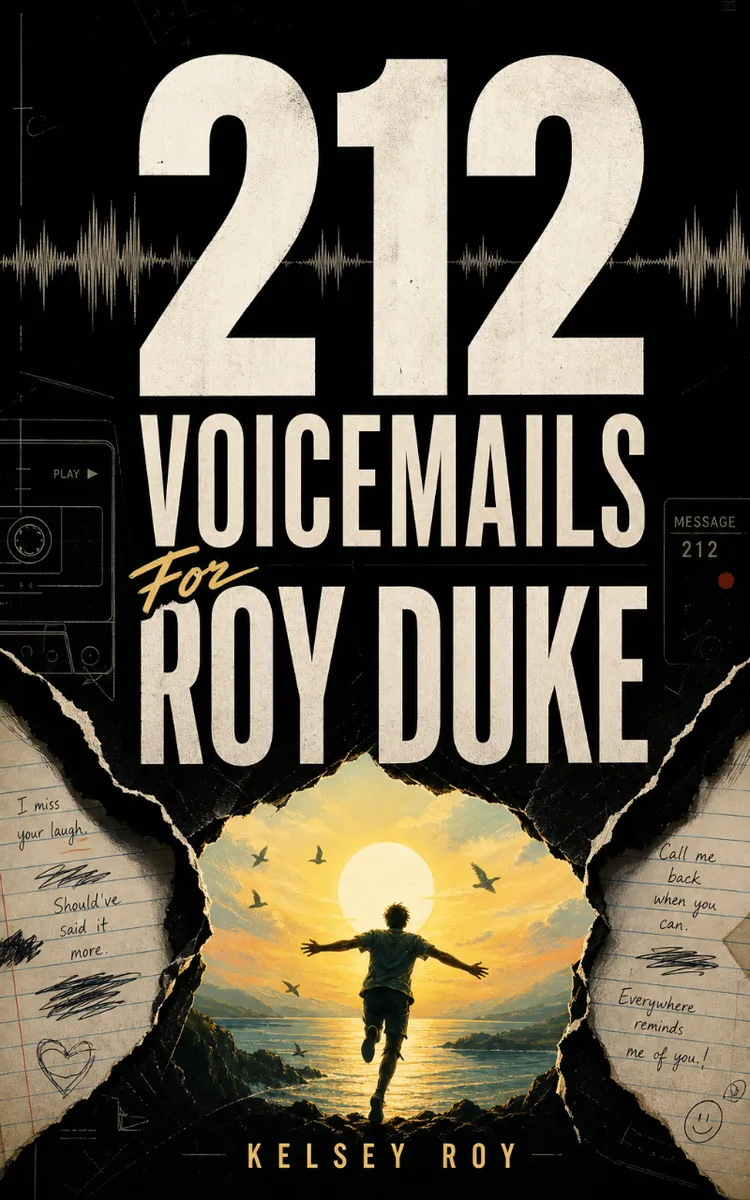
"212 Voicemails For Roy Duke" is a fiction book by Kelsey Roy with 40 chapters and approximately 60,314 words. Autofiction novel built from transcribed voicemails and commentary..
This book was created using Inkfluence AI, an AI-powered book generation platform that helps authors write, design, and publish complete books. It was made with the AI Novel Writer.
Frequently Asked Questions
What is "212 Voicemails For Roy Duke" about?
Autofiction novel built from transcribed voicemails and commentary.
How many chapters are in "212 Voicemails For Roy Duke"?
The book contains 40 chapters and approximately 60,314 words. Topics covered include The Beach House Inheritance, Transcription Rules I Can’t Keep, Roy’s First Defensive Joke, The Address That Isn’t Mine, and more.
Who wrote "212 Voicemails For Roy Duke"?
This book was written by Kelsey Roy and created using Inkfluence AI, an AI book generation platform that helps authors write, design, and publish books.
How can I create a similar fiction book?
You can create your own fiction book using Inkfluence AI. Describe your idea, choose your style, and the AI writes the full book for you. It's free to start.
Write your own fiction book with AI
Describe your idea and Inkfluence writes the whole thing. Free to start.
Start writingCreated with Inkfluence AI


