

Read the first chapter
The whole of chapter one, free. About 8 min. Turn the pages with the arrows, your keyboard, or a swipe.
Chapter 1
Duplicate Claim Denial
Duplicate Claim Denial - Same Service, Same Patient
The printer spits the claim face down, as if it has already been reprimanded.
I catch it before it slides beneath the neighboring cubicle wall. The paper is warm from the machine, its toner raised slightly where the patient name sits in the corner, black and official. Around me, the denials bullpen makes its usual weather: keyboard clatter, the shrill cough of the copier, a chair wheel ticking against a partition. Fluorescent tubes buzz overhead with the confidence of insects that have found a permanent home.
I am thirty-eight, fourteen years into medical billing, and my immediate goal is to clear twelve claims before lunch without creating a compliance event.
This is not ambition. This is Tuesday.
I turn the page over.
The patient’s name is Marla Venn.
For several seconds, the name does not become a person. It remains a string of letters attached to a member number, a date of service, a facility identifier, and a denial code indicating that the claim has been submitted more than once. Duplicate claim. Same service. Same patient. The claim is asking to be removed from the world because the world has already received one.
Then Marla Venn becomes a girl in a navy marching-band jacket, standing behind me in the cafeteria line and saying, You have got to stop reading while you walk.
I stop reading.
“Rose?” Dana calls from the next row. “You asleep over there?”
“No.”
“Your screen’s been blank for, like, a full minute.”
“It’s not blank. It’s loading.”
“Your monitor is off.”
I press the power button. The screen wakes to the work queue, a grid of unpaid obligations.
Dana leans around the partition. She is wearing one silver hoop and one plastic badge clip shaped like a sunflower. “Everything okay?”
“Fine.”
The word comes out with the clean, hard sound of a denial.
Marla Venn. There were not many Venns in our county, and fewer girls who had a scar across the left eyebrow from walking into a locker door during sophomore year. Marla claimed it was a locker. Everyone knew it was her stepfather’s belt buckle. This was before people had better language for things, or before we believed language could do anything once the thing had happened.
The claim is for behavioral health services. The place of service is a residential program. The billed level is partial hospitalization. The denial says the submission duplicates a claim already processed for the same dates.
I pull up the first claim.
The system warns me that accessing patient information outside assigned work may trigger an audit. The warning is a gray rectangle with a yellow triangle, the universal workplace symbol for Please Decide Whether You Are About to Become a Problem.
I click Cancel.
Then I click the claim again.
The compliance alarms are not actual alarms. No siren descends from the ceiling. No security person emerges from behind the vending machines. There is only the record of my access, preserved somewhere beneath layers of software and managerial optimism. I know this because I have spent fourteen years being told that every action is tracked, generally by people who cannot locate the tracking.
I search the patient name by last name only, then add the birth month listed on the claim. Venn. September.
Three results appear.
The first is a man in his sixties. The second is a child. The third is Marla Venn, date of birth matching the claim, address in the town where we went to school.
I stare at the address.
For one year, Marla lived in a yellow house with a porch that sagged in the middle. She had a dog named Tax, because her father said the dog took everything and gave nothing back. At lunch she traded her fruit cup for my cookies. She had a laugh that started as a cough and ended as an accusation.
I do not need to know the address. I know it.
“Rose,” Dana says again. “You want me to take that queue?”
“No.”
“Because you’re doing the face.”
“What face?”
“The face where you look like the claim insulted your family.”
“It’s a duplicate.”
“That’s not usually a family matter.”
I close the patient record. The claim remains open.
The proper process is simple. Verify the patient identifiers. Compare dates of service. Confirm the provider and billed units. If the claims are duplicates, uphold the denial. If they are not, route the second claim for correction. The proper process is a small fenced yard, and I have always been good at staying inside it.
I open the clinical attachment.
The document is a composite of assessments, progress notes, medication lists, and treatment goals, assembled into a single gray file that takes too long to load. The patient’s name appears on every page. Marla Venn. The age is right. The diagnosis is generalized anxiety disorder with recurrent major depression. The note describes panic episodes, self-harm urges, inability to remain safe without supervision, and a recent discharge from inpatient care.
The level of care is not wrong.
The denial is wrong.
I read the clinical rationale twice, because sometimes a sentence becomes less stupid if given another chance. It does not. The claim has been denied as a duplicate because the initial submission carried one service date incorrectly. The corrected claim was submitted with the same date range and a different control number. The system has decided that a changed control number is evidence of repetition rather than correction.
A duplicate is not always a duplicate. Sometimes it is an apology wearing a new barcode.
I call the clinical review line.
A recorded voice tells me my call may be monitored for quality assurance, which is comforting because quality is such a lonely concept.
After three menus, a woman answers. “Clinical review.”
“Hi. This is Rose Cooke with denials. I’m looking at a claim that appears to have denied as duplicate, but the second submission is a corrected claim. The original has an incorrect service date.”
“Can I have the claim number?”
I read it.
“Patient date of birth?”
I read that too.
“Patient full name?”
I hesitate for less than a second. “Marla Venn.”
The woman types. “What’s your question?”
“I need the claim reviewed as a corrected submission, not a duplicate.”
“Was the original claim denied?”
“Yes.”
“Then the corrected claim would need to be resubmitted with the appropriate frequency indicator.”
“It has one.”
“Which one?”
“Seven.”
“Then it should process.”
“It didn’t.”
“I can’t speak to processing.”
“Can you speak to review?”
“I can submit a request.”
“To whom?”
“Clinical review.”
“You are clinical review.”
There is a pause. Somewhere behind her, a phone rings and continues ringing.
“I can submit it to the clinical review queue,” she says.
“Thank you.”
“Anything else?”
I look at the attachment. Marla’s name is printed at the top of the assessment, clean and indifferent.
“No.”
I hang up and type the note.
CORRECTED CLAIM. ORIGINAL CONTAINED INCORRECT SERVICE DATE. CURRENT SUBMISSION INCLUDES FREQUENCY INDICATOR 7. REQUEST REPROCESSING.
I do not type that the patient used to sit beside me in chemistry and draw tiny coffins on her notebook margins. I do not type that I once watched her cry behind the gym because a boy named Aaron had called her unstable, and that she had laughed afterward as if the word were a joke she had invented. I do not type that I recognize the shape of her life from one page of clinical language.
Recognition is not a protected health information category. It is worse. It has no field.
Dana appears at my elbow holding a paper cup of coffee. “You really are doing the face.”
“I’m working.”
“You’re always working.”
“That’s why they pay me.”
“They pay you to process claims.”
“Same thing.”
She looks at the screen. I angle it away.
“I didn’t ask,” she says.
“You were looking.”
“I was looking at the color of the screen.”
“It’s blue.”
“Very nice blue.”
Dana returns to her cubicle. Her chair squeaks as she sits. The bullpen resumes its low mechanical speech.
I route the claim to clinical review. The system asks whether I am sure. I click Yes.
A green banner appears: CASE QUEUED.
For half a minute, I feel the small satisfaction of a person who has pushed a box onto the correct conveyor belt. Then an alert flashes in the upper corner.
FAST TRACK: OWNERSHIP PRIORITY.
The claim has been pulled into an expedited denial batch.
I click the alert. A message from Operations appears, written in the cheerful grammar of a threat.
Please prioritize rapid resolution of duplicate submissions. Claims in this category should not remain pending beyond current business day. If documentation does not clearly support separate services, proceed with denial disposition.
I read it again.
The clinical record clearly supports the level of care. The billing record clearly supports correction. The message does not care about either distinction. It wants the claim gone before it learns anything more expensive.
Dana rolls her chair back toward me. “What now?”
“Nothing.”
“That’s your least convincing answer.”
I print the claim. The printer wakes, shudders, and begins producing evidence.
On the page, Marla’s name looks smaller than it did on the screen. I place it beneath the keyboard, where the fluorescent light cannot reach it directly. The case remains queued, but the queue has been marked urgent by people who do not have to read the reason for urgency.
My screen refreshes.
FAST TRACK DENIAL RECOMMENDED.
I move the mouse over the button. The cursor becomes a hand.
For fourteen years, I have understood that the hand is not mine. It belongs to the system, to the queue, to the person who designed the button and the person who decided buttons were enough. Still, my finger rests on it.
Behind me, the copier coughs out another claim.
Marla Venn waits in the queue with her correct date, her wrong denial, and a life reduced to attachments.
I leave the button untouched.
For now, that is the most I can do without making the record of my recognition larger than the record of her care.
End of chapter one. 39 more chapters in the full book.
Swipe or use the arrows to turn the page


What's inside: 40 chapters
- 1. Duplicate Claim Denial
- 2. Timely Filing Limit Exceeded
- 3. Service Not Medically Necessary
- 4. Authorization Not On File
- 5. Medical Necessity Not Proven
- 6. Duplicate Payment Reversal
- 7. Appeal Request Missing
- 8. Level of Care Not Supported
- 9. Duplicate Documentation
- 10. (Late, Again)
- 11. (No Need, No Proof)
- 12. (Permission Missing)
- 13. (Second Copy, Same Fate)
- 14. (Nothing Submitted)
- 15. (Not Enough, Ever)
- 16. (Wrong Intensity)
- 17. (Unnecessary, Unsaid)
- 18. (Reversal as Policy)
- 19. (Permission Theater)
- 20. (Deadline as Character)
- 21. Care Reduced
- 22. Same Story, Different Witness
- 23. Missing Proof, Full Confidence
- 24. Silence in the Queue
- 25. Unprovable by Design
- 26. Wrong Level, Wrong World
- 27. Reversal of Hope
- 28. Proof That Won’t Arrive
- 29. Lost in Transit
- 30. Provider Credentialing Mismatches
- 31. Incompatible ICD-10/CPT Combinations
- 32. No Evidence of Progress
- 33. Failing to Identify Secondary Payer
- 34. Coordination of Benefits Issues
- 35. Bundling and Unbundling Errors
- 36. Place of Service Errors
- 37. Behavioral Health Carve-Out
- 38. Failure To Align Rates With Fee Schedules
- 39. Terminated Coverage
- 40. Plan Exclusions For Services
About this book
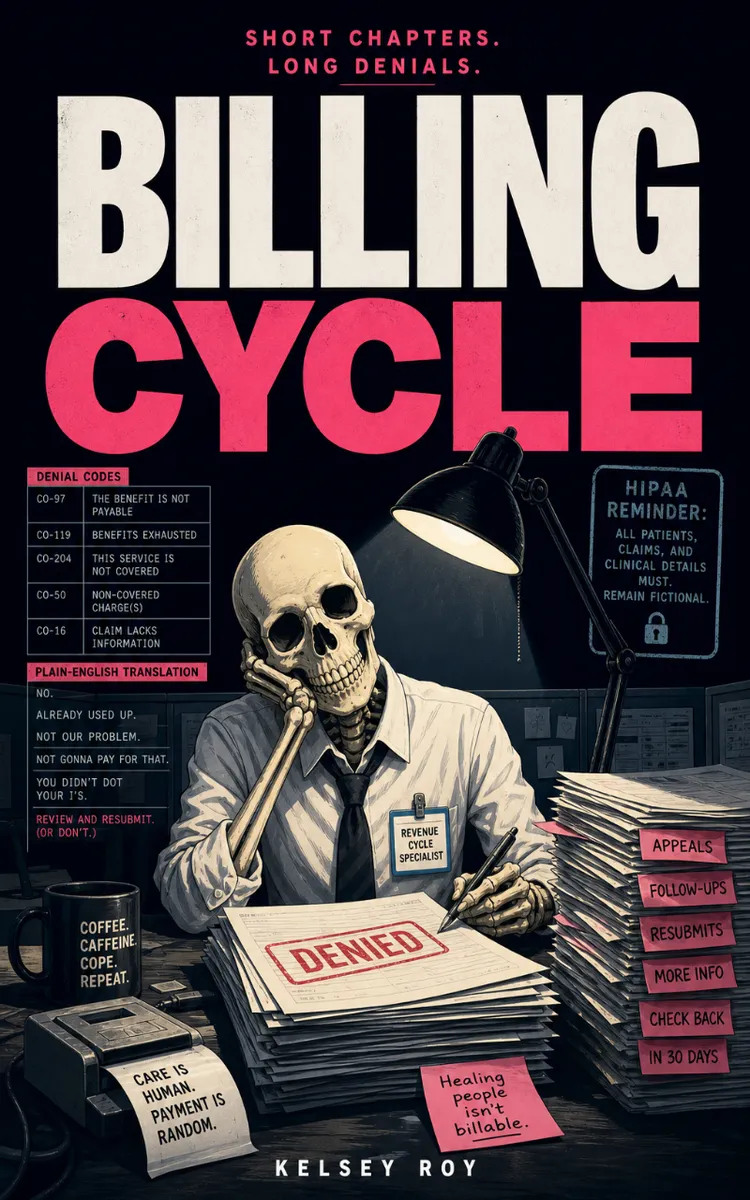
"Billing Cycle" is a fiction book by Kelsey Roy with 40 chapters and approximately 96,509 words. Autofiction novel about medical billing, denial codes, and personal reckoning..
This book was created using Inkfluence AI, an AI-powered book generation platform that helps authors write, design, and publish complete books. It was made with the AI Novel Writer.
Frequently Asked Questions
What is "Billing Cycle" about?
Autofiction novel about medical billing, denial codes, and personal reckoning.
How many chapters are in "Billing Cycle"?
The book contains 40 chapters and approximately 96,509 words. Topics covered include Duplicate Claim Denial, Timely Filing Limit Exceeded, Service Not Medically Necessary, Authorization Not On File, and more.
Who wrote "Billing Cycle"?
This book was written by Kelsey Roy and created using Inkfluence AI, an AI book generation platform that helps authors write, design, and publish books.
How can I create a similar fiction book?
You can create your own fiction book using Inkfluence AI. Describe your idea, choose your style, and the AI writes the full book for you. It's free to start.
Write your own fiction book with AI
Describe your idea and Inkfluence writes the whole thing. Free to start.
Start writingCreated with Inkfluence AI


