

Read the first chapter
The whole of chapter one, free. About 9 min. Turn the pages with the arrows, your keyboard, or a swipe.
Chapter 1
The 80% Human Line
The Line Between Instrument and Shortcut
Nia is twenty-two, works from a bedroom, and is building her first AI-assisted EP. The software can produce a convincing vocal texture before she has written a chorus, yet the finished track may still depend on hours of arranging, editing, recording, and rejection. The strange part is that the machine’s most impressive contribution may be the least important evidence of authorship.
Generative tools have made output visible while leaving labor largely invisible. A listener hears three minutes of music, not the discarded generations, the rewritten melody, the altered drum pattern, or the decision to remove an attractive passage because it did not belong. That gap creates the central problem: when does AI function as an instrument inside a human composition, and when does it become a shortcut that merely disguises the absence of composition?
The answer is not found in the presence or absence of software. Digital Audio Workstations and loop libraries such as Splice already changed the meaning of “original” by making pre-generated material ordinary in music production. A loop becomes part of a new work when a producer flips it - reshapes it, places it in a different context, and gives it a new function. Generative AI extends that old argument into a more uncertain territory because it can supply not only fragments, but arrangements, voices, images, and complete stylistic surfaces.
The question is therefore less “Was AI used?” than “Where did human agency remain visible in the making?”
If the audience cannot see the labor, what makes them trust that it was there?
From Loops to Conductors
The history of recorded music contains many technologies that unsettled older ideas of authorship. Sampling, synthesizers, drum machines, and DAWs each separated the final sound from the physical act of performance. A producer no longer needed to play every note in real time, and a composer could build a piece from materials made elsewhere. Yet these tools did not automatically erase authorship. Their legitimacy depended on arrangement, judgment, transformation, and the recognizable presence of a person making choices.
Generative AI enters this history as a more autonomous instrument. A loop library offers a limited piece of material. A generator can propose a vocal line, a harmonic movement, or an entire song. That difference matters because the tool appears capable of crossing the boundary between suggestion and completion. The producer may begin with a prompt rather than a melody, and the prompt can produce something that already sounds finished.
The conductor model describes the human role that emerges from this condition. The AI supplies sonic or visual elements, but the practitioner remains responsible for the work’s vision, arrangement, and refinement. The conductor is not simply pressing play. The role involves deciding what belongs, what must be changed, what should be discarded, and how separate materials should become one deliberate statement.
This is why output volume can be misleading. A creator who generates hundreds of passages may have produced more files but less authorship than someone who develops one fragment through sustained attention. Quantity records machine activity. It does not record intention.
The distinction is familiar to anyone who has edited a photograph, mixed a track, or assembled a short video from stock material. The raw ingredients may be available to many people. The work begins to acquire a particular identity through selection and transformation. Generative systems complicate that process by offering an almost limitless supply of ingredients, along with the temptation to treat selection itself as sufficient creative labor.
The 80% Agency Ledger
The 80% human rule is best understood as a psychological threshold rather than a laboratory measurement. It expresses a judgment about where the center of creative labor sits. When human vision, arrangement, and refinement exceed 80% of the total labor involved, AI is more plausibly functioning as a tool within the work. When the machine supplies nearly everything and the human merely accepts the first usable result, the same software begins to resemble a shortcut.
The 80% Agency Ledger makes that distinction easier to see by separating labor from agency. Labor includes the hours spent editing, recording, arranging, mixing, rewriting, and refining. Agency concerns the decisions that give those hours direction: the choice of emotional tone, the rejection of a technically polished but empty passage, the reshaping of a generated voice, or the decision to leave an imperfection intact.
These two forms of contribution overlap, but they are not identical. A creator can spend hours making minor technical adjustments while exercising little artistic judgment. Another can make a small number of decisive interventions that transform the meaning of a generated passage. The ledger therefore follows not only how much work occurred, but who determined the work’s identity.
Nia’s EP offers a useful case. Suppose an AI system proposes a vocal texture that becomes the starting point for one track. Nia changes the melody, records her own guide vocal, cuts the generated phrases into smaller pieces, rebuilds the rhythm beneath them, and removes the cleanest section because it makes the song sound emotionally false. She then rearranges the track, mixes it, and connects it to the EP’s larger sequence. The generated material remains part of the process, but it does not remain the work’s governing intelligence.
A different version would look very different. Nia could enter a broad prompt, accept a complete song, make a few volume adjustments, and release it under her name. The file might sound more polished than the first version. Its apparent quality would not resolve the authorship question. If the human contribution is limited to approval, the creator has acted more like a selector of machine output than a conductor of a composition.
The ledger also explains why “human-made” cannot be reduced to visible handwork. Writing every note manually is not the only form of authorship, just as touching every instrument is not the only form of musicianship. What matters is whether the person’s choices organize the material into an intentional whole. Agency can be expressed through editing, subtraction, sequencing, and refusal as much as through initial creation.
The Audience Hears the Difference
Audience trust does not depend solely on technical quality. Listeners have long accepted rough recordings, unstable timing, breath, distortion, and other imperfections when those details appear connected to a person’s presence. Musical imperfection can signal effort, circumstance, and vulnerability. A perfectly controlled result may be impressive while remaining difficult to believe.
Generative systems disturb that relationship because they can imitate the surface signs of feeling without possessing the human history behind them. They can produce a trembling vocal, a nostalgic chord progression, or a carefully damaged texture. The result may resemble emotional evidence while offering no clear account of how that evidence came to exist.
This creates a problem of audience trust. Listeners are not simply judging whether a track sounds good. They are also judging whether the work’s emotional claims have been honestly presented. A song that suggests intimate experience carries a different weight when its central performance was generated and undisclosed. Transparency does not automatically make a work meaningful, but concealment can make its meaning unstable.
The same issue appears in visual media. A generated image may contain the familiar marks of documentary photography - uneven light, a human expression, the accidental detail at the edge of a frame - without having been made through an encounter with a real place or person. The image can imitate evidence while severing the event that evidence normally records.
The counterintuitive finding is this: the more complete an AI-generated work appears at first hearing, the less its polish can prove about human authorship. A rough passage may contain more evidence of a creator’s decisions than a flawless one. This matters because conventional ideas of quality often reward smoothness, while trust may depend on traces of resistance: the point where someone struggled, chose, changed, or stopped.
For Nia, a cracked note might be more important than the synthetic vocal texture that initially attracted her. If she keeps the crack because it carries the song’s emotional tension, she has made an authorial decision that the generator did not make for her. The imperfection becomes not a defect in the production, but a record of judgment.
Nia’s Bedroom Studio
Nia’s working environment is ordinary in a way that makes the ethical question unusually clear. Her studio is a bedroom rather than a commercial facility: a computer, headphones, a microphone, software, and enough storage for a growing collection of versions. The physical setting contains none of the traditional signals of authorship associated with a band room, a recording studio, or a concert stage. Her authorship must be inferred from the structure of the work and the account she gives of its making.
An AI-assisted EP can preserve that account through process records: early drafts, edited stems, arrangement changes, and notes about why a generated section was retained or discarded. These materials are not valuable because they turn creativity into bookkeeping. They matter because they show where the human decisions accumulated. A listener who knows that Nia rebuilt a chorus from fragments, replaced the generated lead, and sequenced the tracks around a recurring motif hears the EP differently from a listener told only that it was “made with AI.”
The difference is not a demand that every artist expose every private working file. It is a question of proportion and representation. If the machine supplied the central performance, describing the work as entirely human-made creates one impression. If it supplied an exploratory sketch that Nia transformed through sustained composition, the description carries another. Audience trust depends on that distinction being available.
Nia’s case also shows why the 80% human threshold cannot be treated as a rigid ownership test. The percentage is not a device for measuring minutes with a stopwatch. It is a way of asking whether the creator’s labor and agency remain the dominant forces in the finished work. Her EP becomes hers not because AI is absent, but because the machine’s contributions are subordinated to a human-defined structure.
That structure includes choices the audience may never consciously identify: the order of tracks, the length of silence between them, the recurring sound that returns in altered forms, and the decision to leave one vocal phrase less polished than the rest. Such choices are easy to overlook precisely because they do not announce themselves. They are the quiet evidence of a conductor at work.
What the Ledger Cannot Measure
The 80% Agency Ledger does not produce a final verdict that everyone will accept. Authorship is not a substance that can be weighed, and audience trust is not a fixed response that can be guaranteed by disclosure. Two works may use similar amounts of generated material while creating very different relationships with their listeners. One may feel deliberate and accountable; the other may feel like an unexamined output.
What the ledger reveals is that the meaningful boundary lies between assistance and surrender. AI becomes a tool when it expands the field of human decisions. It becomes a shortcut when it replaces those decisions while leaving the creator with the credit.
The distinction may eventually matter less as a legal category than as a cultural one. Communities decide what they regard as authentic through shared expectations about effort, honesty, and responsibility. The 80% line is an attempt to name those expectations before they disappear beneath an endless supply of finished-looking media.
Human beings have always used instruments that changed what making could mean. The unresolved question is whether generative systems will remain instruments in the hands of conductors, or whether audiences will learn to hear completion itself as evidence of nothing. Somewhere between the generated first note and the human decision to keep it, authorship is still taking shape.
End of chapter one. 19 more chapters in the full book.
Swipe or use the arrows to turn the page


What's inside: 20 chapters
- 1. The 80% Human Line
- 2. Receipts or Pitchforks
- 3. Prompting Isn’t Composition
- 4. The Ghost of Authorship Bias
- 5. Participatory Discrepancies That Make Groove
- 6. Why Frequencies Don’t Hit Right
- 7. Spectral Fingerprints for Algorithmic Audio
- 8. Analog Emulation as Emotional Glue
- 9. The Cold-Progression Trap
- 10. The Data Center Isn’t Weightless
- 11. Water Cooling and Hidden Inequity
- 12. GPU Extraction and Rare-Earth Gravity
- 13. Consent in the Training Dataset
- 14. LoRA: Your Style DNA, Not a Copy
- 15. Datamoshing for Driftwave Melt
- 16. Cloudpunk Without the Slop Label
- 17. C2PA: The Nutrition Label for Content
- 18. AI Info Tags and Platform Consequences
- 19. Human-Only Spaces and Fair Verification
- 20. Analog Soul: The Conductor’s Final Move
About this book
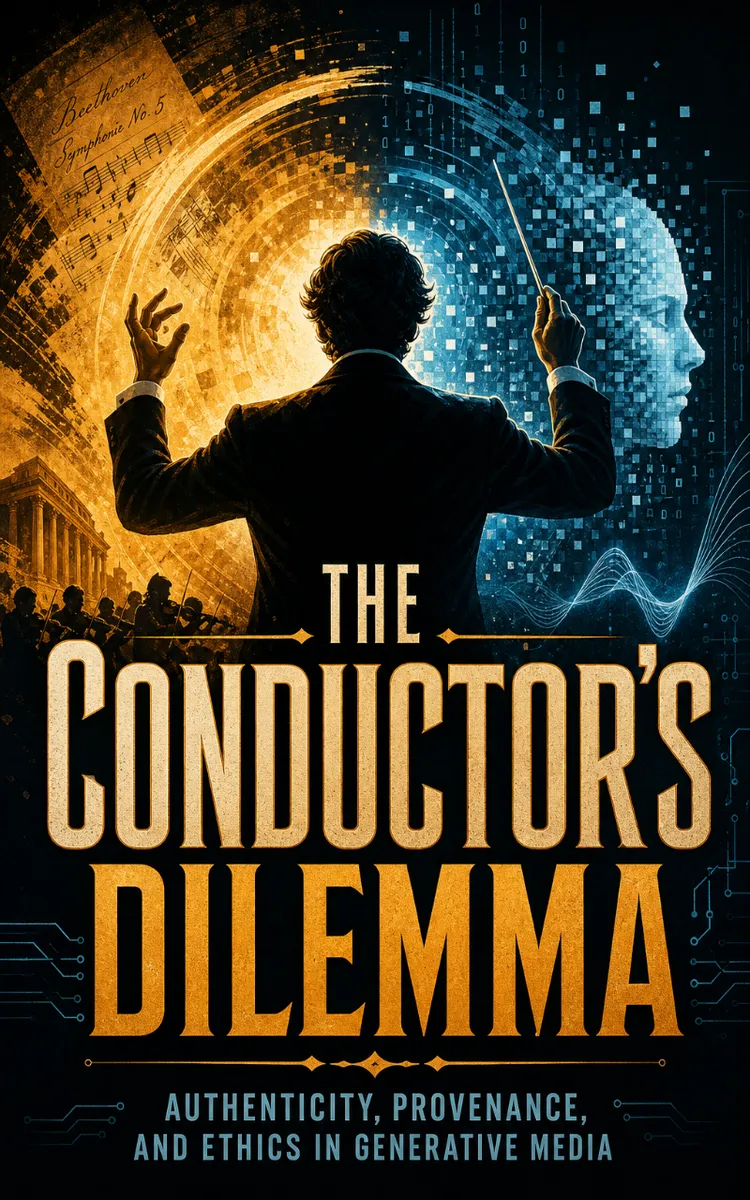
"The Conductor’s Dilemma" is a curiosity book by 12matt3r with 20 chapters and approximately 35,791 words. Ethics, authenticity, and environmental impact of generative AI creativity.
This book was created using Inkfluence AI, an AI-powered book generation platform that helps authors write, design, and publish complete books.
Frequently Asked Questions
What is "The Conductor’s Dilemma" about?
Ethics, authenticity, and environmental impact of generative AI creativity
How many chapters are in "The Conductor’s Dilemma"?
The book contains 20 chapters and approximately 35,791 words. Topics covered include The 80% Human Line, Receipts or Pitchforks, Prompting Isn’t Composition, The Ghost of Authorship Bias, and more.
Who wrote "The Conductor’s Dilemma"?
This book was written by 12matt3r and created using Inkfluence AI, an AI book generation platform that helps authors write, design, and publish books.
Write your own curiosity book with AI
Describe your idea and Inkfluence writes the whole thing. Free to start.
Start writingCreated with Inkfluence AI


