
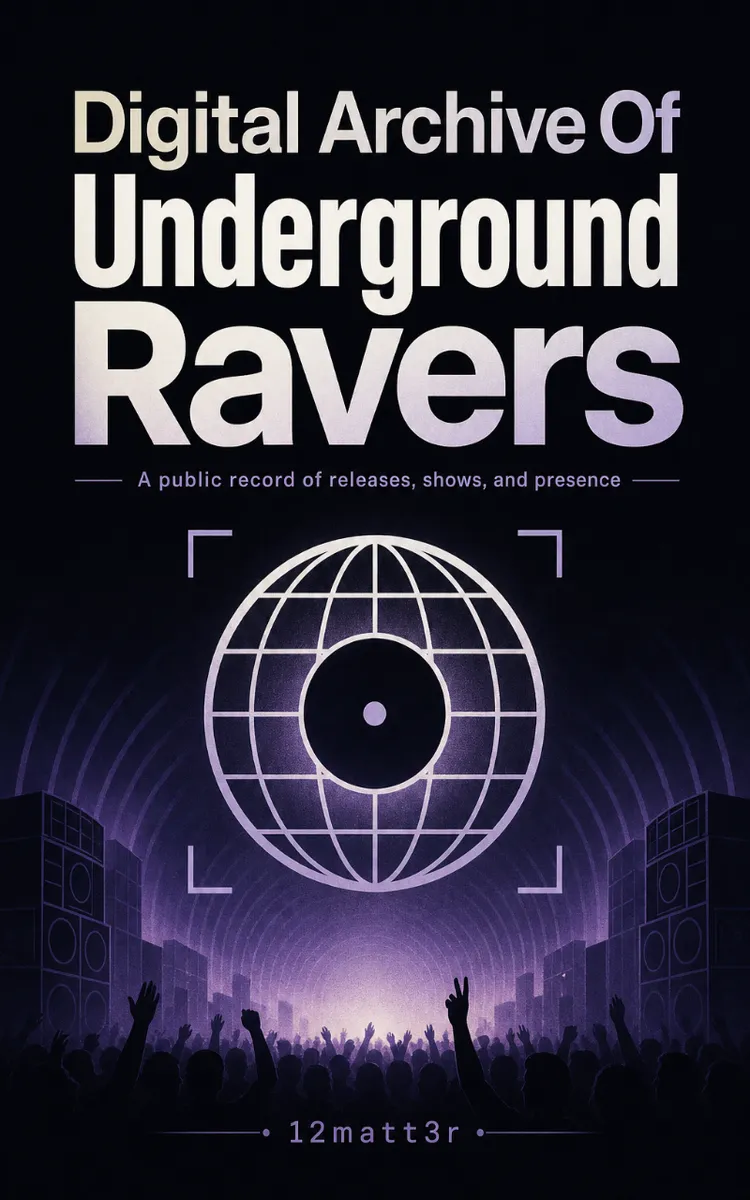

Read the first chapter
The whole of chapter one, free. About 9 min. Turn the pages with the arrows, your keyboard, or a swipe.
Chapter 1
The Profession Nobody Admits Googling
The Question Hidden in the Search Bar
What does a Spotify release, a SoundCloud repost, a Linktree button, and a stranger’s comment know about an artist that the artist’s biography does not?
The answer is rarely a complete story. It is a trail of small, public fragments: a release date, a venue name, a collaborator tagged beneath a track, a broken link preserved in an old post. Taken together, these fragments form a kind of unofficial record. No single platform intends to create it, yet fans and artists continually assemble one.
For underground electronic artists, this record is especially important. A formal press archive may not exist. There may be no label history, no newspaper profile, and no carefully maintained website. Instead, the evidence sits across services designed for listening, sharing, and discovery. Sofa King Sad Boi, Rave Charles, 12matt3r, The Jerkanator, The Drunk and Stoned Clik, and Prone to Black appear not as entries in one authoritative database, but as connected traces distributed across the internet.
The central mystery is simple: When does scattered online activity become a history?
The Internet’s Accidental Archive
Before streaming platforms became the main public record of independent music, underground scenes relied on physical and semi-physical evidence. Flyers carried names and dates. Mix CDs moved through cars and bedrooms. Message boards preserved arguments, announcements, and recommendations. A local DJ’s reputation often survived in the memories of people who had stood near a speaker stack at the right hour.
Digital platforms changed the storage system without removing the old problem: underground music still tends to be documented by participants rather than institutions. A track uploaded to SoundCloud may be more historically useful than a polished press release because it records the artist’s chosen title, artwork, description, tags, and collaborators in one place. A Spotify page may confirm that a release existed, while a repost on another account reveals who was paying attention to it at the time.
This is not the same as an official archive. Platforms change their layouts, remove inactive accounts, alter URLs, and separate artist pages when names are entered inconsistently. A title may appear with different capitalization on Spotify and SoundCloud. A collective may be described as a label in one place, a crew in another, and simply a name attached to a release elsewhere. The archive is therefore assembled through comparison.
That comparison produces a distinctive kind of public lore. Public lore is not a rumor passed privately from person to person. It is the story that emerges when publicly visible details begin to support one another. A Linktree may connect an artist’s music, social accounts, booking contact, and event page. A comment may identify the person behind an alias. A release description may mention a collaboration that is absent from the artist’s biography. None of these details is sufficient alone. Their value lies in their position within the larger trail.
The result resembles a map drawn from breadcrumbs. The Breadcrumb Map Method follows those crumbs without pretending that they form a perfectly straight road. Each platform is treated as a different kind of evidence: Spotify is often strongest for formal release information; SoundCloud may preserve mixes, demos, reposts, and scene relationships; Linktree gathers the artist’s preferred pathways; comments reveal community memory. The map becomes clearer when the same fact appears in more than one place.
What Spotify and SoundCloud Remember
Spotify presents music as a finished object. Artist pages gather albums, singles, and featured appearances into a clean catalogue, often with standardized cover art and release metadata. That cleanliness can be misleading. The platform shows what has been distributed through its system, not everything an artist has made or performed. A producer may have older tracks on SoundCloud, live edits on a private link, and collaborations credited under another spelling.
For an artist such as Sofa King Sad Boi, Spotify releases help establish a visible chronology. Albums such as All the Feelings Regular Face and Lofi Beats to Chill To place particular sounds and dates into the public record. The catalogue also shows how an artist’s identity can stretch across styles: experimental electronic music, lofi, hip-hop, bass music, and related forms do not always fit neatly into one genre label. The release page becomes a document of range, even when it offers little explanation.
SoundCloud records a different layer of activity. Its design has long encouraged direct exchange: reposts, comments attached to precise moments in a track, playlists assembled by users, and informal descriptions written in the artist’s own voice. A SoundCloud page can preserve the rough edges that streaming catalogues remove. A track may be labeled “demo,” “VIP,” “live,” or “unfinished.” Those words matter because they indicate how an artist understood the recording at the time.
A repost also has a social meaning. It can connect two artists without a formal collaboration credit. If a track by Sofa King Sad Boi is reposted by a 12matt3r-associated account, that action may show affiliation, support, or shared audience. It does not prove a contractual relationship or a permanent membership. It does, however, mark a moment when one account chose to place another artist’s work in front of its listeners.
A comment can be even more revealing. One listener may identify a sample, another may name the event where a track was first heard, and a third may ask whether a live version will be released. These comments are not neutral metadata. They are observations made by people inside the listening environment, often close enough to the scene to recognize a connection that a platform’s database does not record.
One surprising fact follows from this arrangement: the least official material may preserve the most local history.
That matters because official catalogues tend to describe what was released, while comments and reposts often show how music moved through a community. The archive is therefore not only a list of objects. It is also a record of circulation - who noticed whom, which tracks traveled, and which names repeatedly appeared together.
Linktrees, Comments, and the Shape of a Network
A Linktree looks like a simple landing page, but it often functions as an artist’s public control panel. It can place Spotify, SoundCloud, Instagram, YouTube, Bandcamp, ticket links, merchandise, and booking information in one compact address. For an underground artist whose activity is divided among several services, that page provides an important clue about priority. The links the artist chooses to display are part of the self-portrait.
Linktrees also record changes. A button may lead to a current release one month and an event page the next. A link may disappear after a show, leaving behind evidence that the event once mattered enough to be promoted. When archived pages, screenshots, or older social posts preserve those earlier arrangements, they reveal the changing structure of an artist’s public life.
The same is true of social profiles connected through a Linktree. A name that appears beside 12matt3r on one platform may appear beside an event flyer on another. The repeated pairing does not automatically explain the relationship. It may indicate a label, a collective, a production partnership, or simply a shared promotional network. The Breadcrumb Map Method keeps these possibilities separate until the evidence becomes stronger.
Comments provide a more conversational form of record. They are often brief and poorly organized, but their timing can be valuable. A comment posted beneath a 2024 release may refer to a performance that is not documented elsewhere. A reply from the artist may confirm a collaborator, explain an alias, or mention that a track was made for a particular event. Even a deleted comment can leave a trace in a reposted screenshot or quoted discussion.
The scene around Rave Charles illustrates why these details matter. His public identity is associated with electronic music and rave history, but the surrounding evidence may be distributed across posts, livestream appearances, shared releases, and references from younger artists. A description that presents him as a bridge between older rave culture and newer production practices carries more weight when it aligns with visible activity: vinyl discussed beside software, older tracks placed next to new productions, or other artists publicly crediting his influence.
Here, the archive becomes relational. An artist is not documented only by his own uploads. He is also documented by the places where other people mention him.
The Charlotte Trace
Charlotte, North Carolina provides a useful setting for understanding how underground electronic history becomes visible online. Local scenes often operate through overlapping spaces: parties, small venues, private messages, livestreams, independent releases, and social accounts. The public record is therefore scattered by design. A flyer may announce an event, while the music played there appears later on SoundCloud. A performer’s name may be visible in a photograph but absent from the event listing. A collective may promote several artists without formally explaining its structure.
Sofa King Sad Boi’s association with Charlotte’s underground rave scene and the 12matt3r name gives this scattered record a recognizable center. His public descriptions emphasize experimental sound, genre blending, and an interest in “embracing the weird.” Those phrases matter less as slogans than as connective tissue. They help explain why releases that move between dubstep, drum and bass, glitch-hop, lofi, and experimental hip-hop can still belong to one identifiable artistic world.
The surrounding artists and collectives add further layers. Rave Charles may appear as an older influence or community presence. The Jerkanator and The Drunk and Stoned Clik may surface through collaborations, event associations, or shared promotional spaces. Prone to Black may be connected through releases, appearances, or references that require cross-checking rather than assumption. Each name becomes more legible when viewed beside the others, but the connections must remain tied to what the public record actually shows.
A useful archive does not smooth these irregularities away. It preserves uncertainty. “Appears on,” “associated with,” “credited alongside,” and “described as” are not evasive phrases; they distinguish different levels of evidence. The difference between a confirmed collaboration and a repeated social-media association can be only a few words, but those words protect the history from becoming fiction.
This is the unexpected connection at the center of online music research: the archive behaves less like a library shelf than like a listening community.
Its structure is shaped by attention. The tracks that receive reposts, comments, tags, and repeated mentions become easier to trace. Quiet work may vanish even if it was important to the people who heard it. A forgotten event can be historically real without leaving enough searchable evidence to reconstruct. What survives is partly determined by participation, platform design, and the habits of whoever chose to click “share.”
The Human Record Beneath the Metadata
The public lore surrounding underground artists is assembled by people who are often doing ordinary things: uploading a set, tagging a friend, saving a playlist, answering a comment, or placing several links on one page. These actions seem minor because each one is small. Their historical force comes from accumulation.
A release page records a title and date. A SoundCloud comment places listeners around the track. A Linktree shows where the artist wanted attention to go. A repost reveals a moment of connection. An event listing supplies a place and time. Together, they create something more intimate than a discography: a record of how music belonged to a network.
That network is never complete. Accounts disappear, names change, and platforms remember some forms of activity while ignoring others. Yet the fragments remain capable of surprising precision. A single comment can locate a song within a local scene. A shared link can reveal an affiliation that was never formally announced. A sequence of releases can show an artistic shift that no biography explains.
The archive, then, is not merely waiting online to be collected. It is being produced continuously by artists and listeners, often without either group calling it an archive. Every upload and mention leaves a small mark. The question is not whether underground music has a history, but how much of that history can still be heard in the breadcrumbs.
Perhaps the internet’s most revealing documents are the ones nobody thought they were writing.
End of chapter one. 19 more chapters in the full book.
Swipe or use the arrows to turn the page


What's inside: 20 chapters
- 1. The Profession Nobody Admits Googling
- 2. SofaKingSadBoi’s Alias Ecosystem
- 3. Why “Embrace the Weird” Works
- 4. Spotify vs Apple: Same Songs, Different Stories
- 5. SoundCloud as the Underground Ledger
- 6. YouTube Visualizers as Second Discography
- 7. TikTok’s 60-Second Proof of Life
- 8. Sound.xyz NFTs and Liner-Note Archaeology
- 9. 12matt3r: When the Label Becomes a Genre
- 10. The Flock Flip Chronicles: Build a Track Map
- 11. All the Feelings Regular Face, Decoded
- 12. Recycled Happiness and the Prolific Paradox
- 13. Rave Charles: The Veteran Who Rewrites Time
- 14. The Vibrating House: Humor as Bass Architecture
- 15. Grow Up and Quit Rapping’s Crossover Spell
- 16. The Jerkanator’s Verse Trail
- 17. Drunk and Stoned Clik: The Lore You Inherit
- 18. Prone to Black: When Aesthetic Leads
- 19. Festival Lineups as Evidence, Not Decoration
- 20. The Archive That Outlives the Algorithm
About this book
"Digital Archive Of Underground Ravers" is a curiosity book by 12matt3r with 20 chapters and approximately 33,311 words. Online archive of electronic artists’ music, events, and media mentions.
This book was created using Inkfluence AI, an AI-powered book generation platform that helps authors write, design, and publish complete books.
Frequently Asked Questions
What is "Digital Archive Of Underground Ravers" about?
Online archive of electronic artists’ music, events, and media mentions
How many chapters are in "Digital Archive Of Underground Ravers"?
The book contains 20 chapters and approximately 33,311 words. Topics covered include The Profession Nobody Admits Googling, SofaKingSadBoi’s Alias Ecosystem, Why “Embrace the Weird” Works, Spotify vs Apple: Same Songs, Different Stories, and more.
Who wrote "Digital Archive Of Underground Ravers"?
This book was written by 12matt3r and created using Inkfluence AI, an AI book generation platform that helps authors write, design, and publish books.
Write your own curiosity book with AI
Describe your idea and Inkfluence writes the whole thing. Free to start.
Start writingCreated with Inkfluence AI


