
Read the first chapter
The whole of chapter one, free. About 8 min. Turn the pages with the arrows, your keyboard, or a swipe.
Chapter 1
The Fear Tax of Uncertainty
When the Watcher Is Nowhere
What changes when a person cannot tell whether anyone is watching? The answer is not simply caution. It is the gradual replacement of private judgment with an internal monitor - an unseen observer that edits speech, movement, association, and even thought before any external authority needs to intervene.
Jeremy Bentham’s Panopticon was designed as a prison, but its most durable feature was psychological rather than architectural. A central inspection tower made surveillance possible without making it visible. Prisoners did not need proof that the guard was looking. They needed only the possibility. Digital systems have extended that possibility across ordinary life, where the observer may be a platform, employer, border agency, police department, data broker, or an intelligence system whose rules are difficult to see.
The result is a new form of pressure: the Uncertainty Loop Model. Observation creates uncertainty; uncertainty produces self-monitoring; self-monitoring generates more data; and that data makes future observation easier. The loop does not require a guard at every window. It requires only that people believe the windows might be connected.
How much freedom survives when uncertainty becomes a permanent social atmosphere?
Bentham’s Architecture of Doubt
Bentham described the Panopticon in the late eighteenth century as a circular institution built around a central watchtower. Cells faced inward, their occupants exposed to the tower, while the inspector’s position remained concealed. The arrangement solved an old logistical problem: one observer could supervise many people without constantly moving among them.
Its deeper innovation was not efficiency but ambiguity. A prisoner could not know when inspection occurred. The rational response was to behave as though inspection were always occurring. Surveillance became continuous in effect even when it was intermittent in fact.
That distinction matters. A visible guard produces obedience during the guard’s presence. An uncertain guard produces conduct shaped around possible observation. The first is an event; the second becomes a habit.
The Panopticon also separated power from direct contact. The prisoner did not need to see the inspector, hear an order, or receive a threat. The building itself carried the instruction. Its design transformed uncertainty into discipline, and discipline into something that appeared to originate inside the individual.
Digital surveillance inherits this structure while removing its walls. A person may know that a phone records location, that a platform logs searches, or that a workplace system measures activity. Yet the precise boundaries remain unclear. Which message is retained? Which location is inferred? Which association is scored? Which phrase changes the ranking of an application, a feed, or a security review?
The lack of an answer is not a gap in the system. It is part of its force.
The Uncertainty Loop
The Uncertainty Loop Model begins with a simple condition: people encounter systems whose observation is possible but not fully legible. A camera may use facial recognition, or it may merely record. A platform may classify a user, or it may only store a pattern for later analysis. An intelligence service may possess a record, or another agency may be able to request it. The individual rarely knows which possibility is active.
That ambiguity changes behavior before any punishment occurs. A journalist may avoid contacting a controversial source through a monitored channel. A worker may leave a political opinion unspoken in a company system. A migrant may hesitate before searching for legal information. A citizen may decide that a joke, photograph, or meeting is not worth the risk of being misunderstood by an automated classifier.
The system then receives the residue of those decisions: fewer visible dissenters, fewer unusual searches, fewer connections that might attract attention. Data gathered from a population that has already begun editing itself can look like evidence of consensus. The archive does not merely describe behavior. It helps produce the behavior it later appears to measure.
A striking reversal follows: surveillance does not need to identify every dissenter to suppress dissent. It only needs to make dissenters uncertain about being identifiable. That changes the conventional picture of control. The important question is not only what authorities know, but what people believe authorities might know. Fear operates in the space between confirmed observation and imagined observation.
The loop becomes stronger as systems become more opaque. Oracle’s databases can hold records at immense scale; Palantir’s Gotham can connect records that once remained separated inside institutional silos. The ordinary person does not need to understand the underlying architecture to feel its consequences. A driver’s license, location history, purchase record, relationship network, and online activity may exist in different places, yet their possible combination is enough to alter conduct.
A single record can be harmless. A pattern can become a judgment.
From Visible Cells to Invisible Records
The first Panopticon had a physical center. Digital surveillance has many centers, and they may not resemble centers at all. A cloud database, an application programming interface, a government contract, and an analytics dashboard can form a chain of observation distributed across companies and jurisdictions.
This distribution makes responsibility difficult to locate. Oracle may store data. A public agency may supply it. Palantir may fuse it into an operational picture. A police department, border authority, or military unit may act on the result. For the person being watched, these distinctions are largely invisible. The experience is a single pressure: information about ordinary life has become available to institutions that do not need to explain the entire chain.
The Five Eyes intelligence alliance - linking the United States, United Kingdom, Canada, Australia, and New Zealand - offers a geopolitical example of how uncertainty travels across borders. Data collection, legal authority, and operational use need not occur in the same country. That separation can make surveillance harder to contest because the person affected may not know which institution holds the record or which legal system governs its use.
The same uncertainty appeared in the case of Kim Dotcom, whose New Zealand home was raided in 2012 as part of a United States-led copyright prosecution. The operation became entangled with questions about unlawful Government Communications Security Bureau surveillance and the wider reach of intelligence cooperation. Whatever one thinks of Dotcom’s business or legal case, the episode exposed a central feature of modern observation: the watched person may confront a network of agencies and technical systems rather than one identifiable watcher.
For the public, the lesson is not limited to one raid. It is that legal visibility and technical visibility can diverge. A person may be physically present in one country while the relevant data, request, analysis, or authority sits elsewhere. Uncertainty becomes a cross-border instrument.
The Human Mind Under Possible Observation
The brain is highly sensitive to social evaluation, but it does not require certainty to respond. Possible observation can be enough to change posture, language, and risk tolerance. This is why people behave differently when they believe a camera is present, even when they do not know whether it is recording. The cue does not need to prove surveillance; it only needs to make surveillance plausible.
That response is not irrational. In ordinary social life, anticipating judgment helps people coordinate. We adjust our behavior around a supervisor, a stranger, a child, or a crowd because other people’s reactions matter. Digital systems exploit the same capacity while removing the cues that normally allow judgment to be interpreted. A human observer has a face, a context, and a known relationship. An automated observer may have none of these.
Karen Hao has documented how artificial intelligence systems can classify people and behavior while presenting their decisions as technical outputs. The danger is not only that a system may be wrong. It is that people may begin to anticipate the system’s categories. They learn that certain words, faces, movements, or affiliations could be treated as signals, even when no one can explain precisely how.
That anticipation produces what might be called behavioral narrowing. People remain free to act, but the range of actions that feel safe contracts. The public square still exists; fewer people enter it without rehearsing how they might appear inside an unseen record.
Chris Hedges has described the merging of corporate and state power as a defining feature of the contemporary political order. The Panopticon’s modern form depends on that merger. Private companies collect the ordinary traces of life; public institutions obtain, purchase, request, or build upon them. The boundary between commercial convenience and state visibility becomes difficult to see, and uncertainty flourishes in the blur.
The Quiet Case of Self-Censorship
The clearest evidence of the Panopticon’s psychological reach often appears in what never happens. A meeting is not attended. A source is not contacted. A search is abandoned. A post is rewritten until it says almost nothing. These acts leave weak or invisible traces, yet they are among surveillance’s most consequential effects.
The pattern can be seen in communities that depend on communication across political or legal boundaries. Activists, journalists, migrants, and dissidents often treat ordinary digital tools as potential records rather than neutral channels. The question is not merely whether a message is encrypted. It is whether metadata reveals who communicated, when, from where, and in what pattern. A conversation can remain unread while still becoming suspicious through its surrounding information.
The Nym Network, associated with Harry Halpin, addresses this problem through mixnets designed to obscure network metadata and packet timing. Its relevance to the Panopticon is conceptual as much as technical. If surveillance depends on making relationships visible, then hiding the structure of communication challenges the assumption that observation must be continuous and traceable.
Yet even privacy tools exist within the Uncertainty Loop. Their use may itself appear unusual. A person may worry that choosing a protective system creates a new signal. The individual is left calculating not only what is exposed, but how efforts to avoid exposure might be interpreted.
That is the final refinement of digital self-censorship: people need not be directly prohibited from protecting themselves. They may simply be made unsure what protection will look like from the outside.
The Freedom to Be Unremarkable
The Panopticon reveals something unsettling about human nature: people do not require constant coercion to regulate themselves. They require a credible possibility that their conduct may later be inspected, categorized, or misunderstood.
In the digital age, the most powerful watcher may be the one no one can clearly locate. It lives in databases, contracts, models, and institutional relationships, turning uncertainty into a quiet form of governance. And somewhere inside that silence remains the question that Bentham’s architecture first posed: when no one knows whether the guard is looking, who is finally deciding how to behave?
End of chapter one. 4 more chapters in the full book.
Swipe or use the arrows to turn the page

What's inside: 5 chapters
- 1. The Fear Tax of Uncertainty
- 2. Oracle’s Silent Citizen Ledger
- 3. Palantir Gotham’s Kill-Chain Mapping
- 4. Dotcom’s Raid and the Five Eyes Boundary
- 5. NYM Mixnets Break the Metadata Spell
About this book
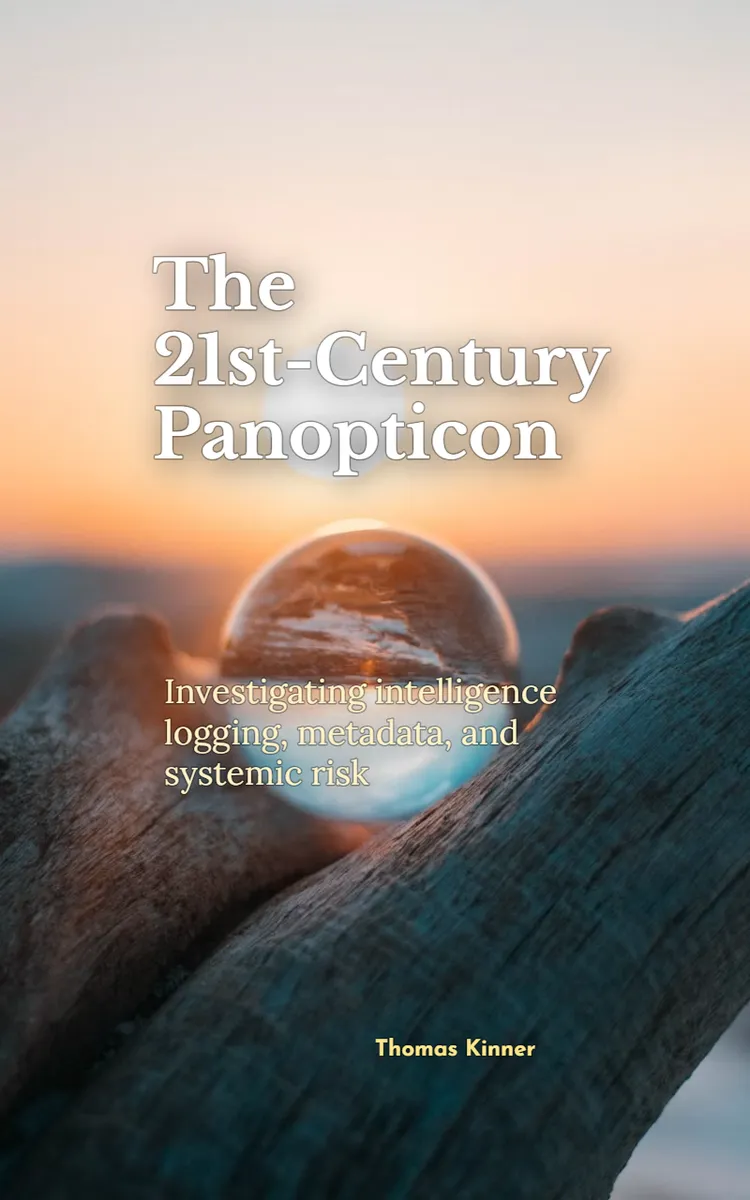
"The 21st-Century Panopticon" is a curiosity book by Thomas Kinner with 5 chapters and approximately 9,351 words. Digital mass surveillance systems, intelligence logging, and systemic risk.
This book was created using Inkfluence AI, an AI-powered book generation platform that helps authors write, design, and publish complete books.
Frequently Asked Questions
What is "The 21st-Century Panopticon" about?
Digital mass surveillance systems, intelligence logging, and systemic risk
How many chapters are in "The 21st-Century Panopticon"?
The book contains 5 chapters and approximately 9,351 words. Topics covered include The Fear Tax of Uncertainty, Oracle’s Silent Citizen Ledger, Palantir Gotham’s Kill-Chain Mapping, Dotcom’s Raid and the Five Eyes Boundary, and more.
Who wrote "The 21st-Century Panopticon"?
This book was written by Thomas Kinner and created using Inkfluence AI, an AI book generation platform that helps authors write, design, and publish books.
Write your own curiosity book with AI
Describe your idea and Inkfluence writes the whole thing. Free to start.
Start writingCreated with Inkfluence AI


