
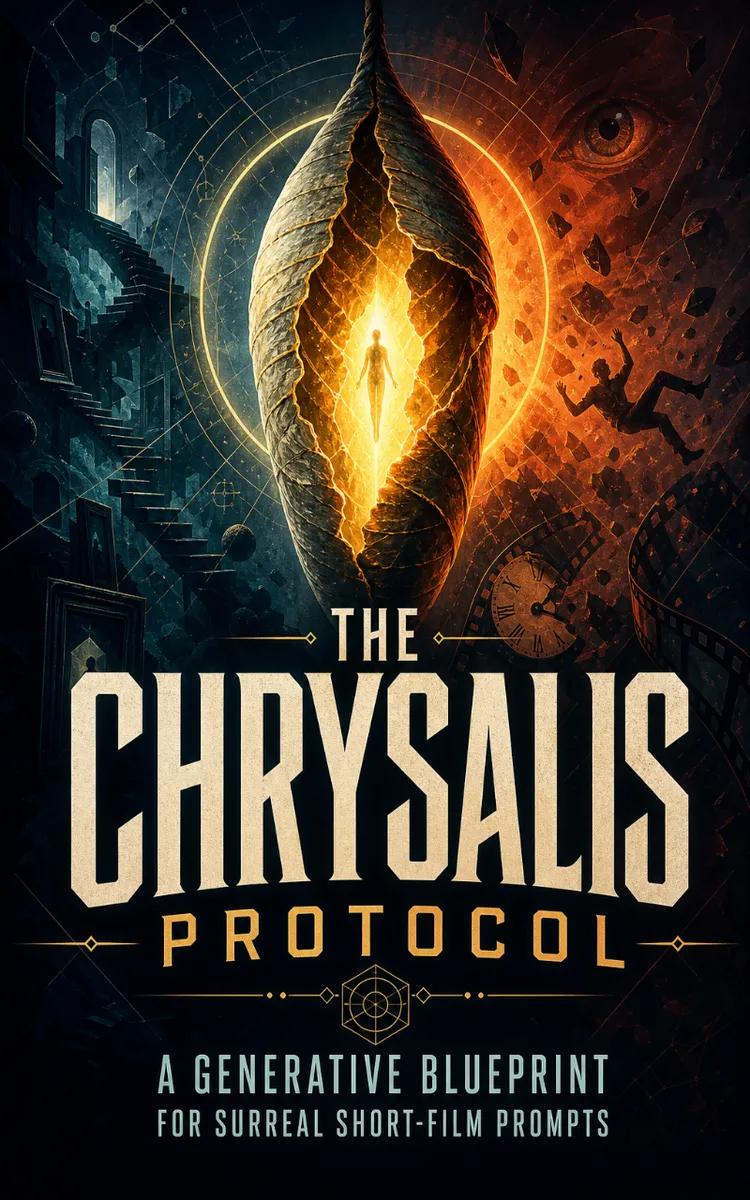

Read the first chapter
The whole of chapter one, free. About 9 min. Turn the pages with the arrows, your keyboard, or a swipe.
Chapter 1
Clinical Surrealism Visual Lexicon
Why the Clinical Lexicon Map Controls the Image
Mina, a 31-year-old cinematography student, tested a prompt for a humanoid figure with a head made of broken digital noise. Her first version read: “A strange dream creature in a scary futuristic room.” The result looked like a standard fantasy image. The subject had dramatic lighting, decorative fog, and no clear visual system. The prompt named a mood, but it did not specify the evidence of that mood.
Clinical Surrealism solves this problem by placing two controlled vocabularies in the same prompt. The first vocabulary describes a sterile technical record: negative fill, neutral exposure, measured framing, hard surface, subtle vignette, mild chromatic aberration. The second vocabulary introduces dream logic: disintegrating head, impossible anatomy, reversed gravity, duplicated object, endless corridor. The technical language controls the image. The surreal language breaks its logic.
This balance matters because generative models often follow the strongest familiar pattern. If a prompt contains only “surreal,” the model may produce colorful fantasy, random distortion, or decorative weirdness. If it contains only camera and lighting terms, the model may produce a clean but ordinary shot. After building a Clinical Lexicon Map, you will know how to select, combine, and test both keyword groups without allowing either group to take over.
Build the Clinical Lexicon Map
The Clinical Lexicon Map divides prompt language into four working zones. Each zone answers a different production question. Use the zones in order, because each one prevents a specific failure.
1. Subject anomaly identifies what breaks reality. Write one physical contradiction rather than several unrelated oddities. “Humanoid figure with a rectangular slab of iridescent digital noise in place of a head” gives the model a concrete object and a clear replacement. “A mysterious nightmare being” does not.
2. Clinical description records the anomaly as if a technical instrument observed it. Use terms such as sterile, cataloged, isolated, neutral, calibrated, surface detail, controlled exposure, and specimen framing. This language removes theatrical emotion from the description. The result should feel documented, not performed.
3. Cinematic control defines how the camera and light record the subject. Specify the lens, camera position, angle, movement, light direction, and image finish. For example: “static medium shot, 50mm lens, eye-level camera, cool overhead fluorescent light, negative fill on camera-left, subtle vignette, restrained contrast.”
4. Dream pressure adds the visual condition that makes the shot impossible. Select one main pressure: gravity-reversed room, duplicated shadow, hallway folding into itself, object growing from a wall, face replaced by moving texture, or reflection acting independently. One dominant pressure keeps the image readable.
The map works through tension, not random mixing. “Clinical” does not mean dull, and “surreal” does not mean uncontrolled. The clinical layer tells the model how to render the anomaly. The dream layer tells the model what rule to violate. Ask yourself: can you point to the exact word that creates the technical look and the exact word that creates the impossible event? If not, the prompt needs a clearer split.
Use a restrained keyword set. A useful starting specification contains one subject anomaly, three clinical terms, three cinematic controls, and one dream pressure. This creates enough direction for a ten-second clip without filling the prompt with competing instructions.
| Map zone | Function | Example terms | Why it matters | |---|---|---|---| | Subject anomaly | Defines the central abnormal object | disintegrating slab-head, transparent rib cage, duplicated hand | Gives the model a visible subject | | Clinical description | Removes emotional and decorative language | sterile, isolated, cataloged, neutral exposure | Keeps the image observational | | Cinematic control | Fixes the recording method | 50mm lens, static frame, overhead fluorescent light | Prevents random camera behavior | | Dream pressure | Breaks one physical rule | reversed gravity, endless corridor, independent reflection | Produces surreal tension with a readable cause |
Construct the prompt as a specification, not a poem. Compare these two versions:
Do this: “Clinical surrealism, isolated humanoid specimen, head replaced by a slowly disintegrating slab of iridescent digital noise, static medium shot, 50mm lens, eye-level camera, cool overhead fluorescent light, negative fill on camera-left, neutral gray examination room, one reflection moving half a second late, restrained color, subtle vignette.”
Not this: “A haunting dream figure emerges from a strange world, surrounded by mysterious energy and unsettling beauty.”
The first version gives the model objects, measurements, placement, light, and one impossible behavior. The second version gives emotional labels without a stable visual structure. Use emotional words only when they describe a visible result, such as “oppressive” supported by a close lens, compressed space, and hard overhead light.
Acronyms can also weaken the map when they replace plain instructions. Write “chromatic aberration,” meaning a colored edge shift caused by lens behavior, instead of assuming a reader or model will understand “CA.” Write “high dynamic range,” meaning a broad range from dark shadow to bright highlight, only when the image actually needs that range. In most Clinical Surrealism prompts, controlled exposure produces a more reliable result than a pile of technical abbreviations.
The practical takeaway is simple: build every prompt from a visible anomaly, a sterile record, a camera specification, and one broken rule. That four-part structure forms the working unit of the Clinical Lexicon Map.
Apply the Map to a Ten-Second Shot
Mina needs a ten-second opening clip for a sequence about the Block Noise Siren. She wants the first image to establish the entity without making it look like a superhero, monster, or music-video performer. She chooses a clinical examination room because the setting supports the sterile language. She chooses one surreal event - the head surface loses pixels and reforms - because the audience needs one readable anomaly.
Follow her construction in this order:
1. Set the subject. Mina writes: “full-body humanoid figure, matte gray protective garment, head replaced by a rectangular slab of iridescent digital noise.” The garment gives the model a stable body shape, while the slab creates the central contradiction. Expected outcome: the model treats the entity as a recognizable figure with one abnormal head.
2. Set the clinical record. She adds: “isolated specimen, sterile examination room, neutral gray walls, cataloged observation, no decorative objects.” These terms remove fantasy decoration and keep attention on the entity. Expected outcome: the setting looks like a controlled facility rather than a dream landscape.
3. Set the camera. She specifies: “static full-body shot, 50mm lens, eye-level camera, centered composition, no camera shake.” A 50mm lens gives a natural view with limited distortion. Expected outcome: the figure remains stable enough for later transformation.
4. Set the light and finish. She adds: “cool overhead fluorescent light, negative fill on both sides, mild halation around highlights, subtle vignette, restrained saturation.” Negative fill means dark material blocks light from one side, increasing shape definition. Halation means a soft glow around bright edges. Expected outcome: the image gains clinical depth without becoming glossy or theatrical.
5. Add one dream pressure. Mina finishes with: “the head sheds small rectangular fragments upward, but the body remains completely still.” This gives the surreal event a direction and a contrast. Expected outcome: the viewer sees an impossible physical process while the rest of the frame remains controlled.
Her assembled prompt reads:
> Clinical surrealism, isolated full-body humanoid specimen in a sterile examination room, matte gray protective garment, head replaced by a rectangular slab of iridescent digital noise, neutral gray walls, no decorative objects, static full-body shot, 50mm lens, eye-level camera, centered composition, cool overhead fluorescent light, negative fill on both sides, mild halation around highlights, subtle vignette, restrained saturation, the head sheds small rectangular fragments upward while the body remains completely still, technical observation, no fantasy ornament, no text, no extra limbs.
Mina renders three versions, changing only the dream pressure. Version one sheds fragments upward. Version two sheds fragments downward. Version three allows the fragments to orbit the head. She selects the upward version because it creates a clear visual direction and leaves the body readable. This controlled comparison matters: changing several keyword groups at once would make it impossible to identify the cause of a better or worse result.
Quick checklist
• Name one physical anomaly. - Add three to five sterile or technical terms. - Specify lens, camera position, and camera movement. - Give the light a direction and a quality. - Choose one broken physical rule. - Remove decorative objects that do not support the anomaly. - Add “no extra limbs” or another needed constraint when the subject has complex anatomy. - Render small variations by changing one keyword group at a time. - Keep the version with the clearest anomaly and the most stable composition.
A prompt passes the map when a viewer can answer three questions after one glance: What is the subject? What technical environment records it? What single rule has failed? If the viewer cannot answer one of these, revise that zone before adding more surreal language.
Correct the Lexicon Before It Spreads
A weak keyword can affect every later prompt, especially when the film uses a repeated entity. Fix the language at the map stage rather than trying to repair inconsistent generations clip by clip.
The surreal words overpower the clinical words
Terms such as nightmare, terrifying, magical, psychedelic, and beautiful carry broad visual associations. They can produce smoke, glowing colors, fantasy costumes, or dramatic expressions. Those results may look interesting, but they do not establish Clinical Surrealism.
Do this: Replace broad mood words with visible conditions: “neutral gray room, centered specimen framing, cool fluorescent light, one reflection moving late.”
Not this: “A terrifying psychedelic nightmare in a mysterious laboratory.”
The fix works because the model receives objects and behavior instead of a general emotional command.
The technical words create an ordinary product image
A prompt can contain accurate lens and lighting terms yet produce a clean studio portrait. This happens when the surreal layer has no physical action or replacement. “Clinical, sterile, 50mm, neutral exposure” describes a method but not an anomaly.
Do this: Add one direct contradiction: “the face is replaced by a rotating block of black-and-cyan noise,” or “the shadow points toward the light.”
Not this: “Make the subject strange and unusual.”
The direct contradiction gives the model a visual task. Keep the camera stable so the impossible detail remains easy to see.
Too many anomalies compete in one frame
A slab-head, reversed gravity, duplicate body, melting floor, living reflection, and endless staircase may all appear in one prompt. The model then distributes attention across them. It may remove the head, add extra limbs, or turn the room into decorative chaos.
Do this: Use one primary anomaly and one supporting behavior. For Mina’s shot, the slab-head is primary and the upward-shedding fragments are supporting behavior.
Not this: “The figure has three heads, six arms, a melting floor, a floating room, a reversed shadow, and a staircase inside its chest.”
The one-anomaly rule protects continuity. Later clips can transform the slab, the room, or the shadow in sequence. The viewer can follow a controlled failure instead of receiving a new visual system every ten seconds.
The map uses adjectives without a recording method
Words such as cold, oppressive, and uncanny do not tell the model where to place the camera or light. They may alter color while leaving composition unstable.
Do this: Translate each desired effect into a camera or lighting instruction: “oppressive” becomes “14mm lens placed close to the face, compressed distance, hard overhead light”; “detached” becomes “static centered frame, eye-level camera, neutral exposure.”
Not this: “Make the shot feel oppressive and detached.”
The translation turns intention into a controllable specification. Once the image responds correctly, retain the technical terms as part of the Clinical Lexicon Map.
Clinical Surrealism succeeds when the prompt behaves like a laboratory record for an impossible event. Keep the record precise, keep the contradiction visible, and let each frame break only the rule you chose. That discipline gives the wider Chrysalis Protocol a stable visual language: the machine can distort reality without losing the evidence of what changed.
End of chapter one. 7 more chapters in the full book.
Swipe or use the arrows to turn the page


What's inside: 8 chapters
- 1. Clinical Surrealism Visual Lexicon
- 2. Frame-Bleed Morphing Continuity Rule
- 3. Audio-Visual Pulse Synchronization
- 4. Prompt Weighting and Negative Prompts
- 5. Camera Grammar for Dream Disorientation
- 6. Act-Based Arc Planning for 180 Clips
- 7. Metanarrative: The Digital Ghost Interface
- 8. Iteration Workflow for Generative Mutations
About this book
"The Chrysalis Protocol" is a how-to guide book by 12matt3r with 8 chapters and approximately 15,931 words. A step-by-step generative prompt system for a surreal film.
This book was created using Inkfluence AI, an AI-powered book generation platform that helps authors write, design, and publish complete books. It was made with the AI Ebook Generator.
Frequently Asked Questions
What is "The Chrysalis Protocol" about?
A step-by-step generative prompt system for a surreal film
How many chapters are in "The Chrysalis Protocol"?
The book contains 8 chapters and approximately 15,931 words. Topics covered include Clinical Surrealism Visual Lexicon, Frame-Bleed Morphing Continuity Rule, Audio-Visual Pulse Synchronization, Prompt Weighting and Negative Prompts, and more.
Who wrote "The Chrysalis Protocol"?
This book was written by 12matt3r and created using Inkfluence AI, an AI book generation platform that helps authors write, design, and publish books.
How can I create a similar how-to guide book?
You can create your own how-to guide book using Inkfluence AI. Describe your idea, choose your style, and the AI writes the full book for you. It's free to start.
Write your own how-to guide book with AI
Describe your idea and Inkfluence writes the whole thing. Free to start.
Start writingCreated with Inkfluence AI


