
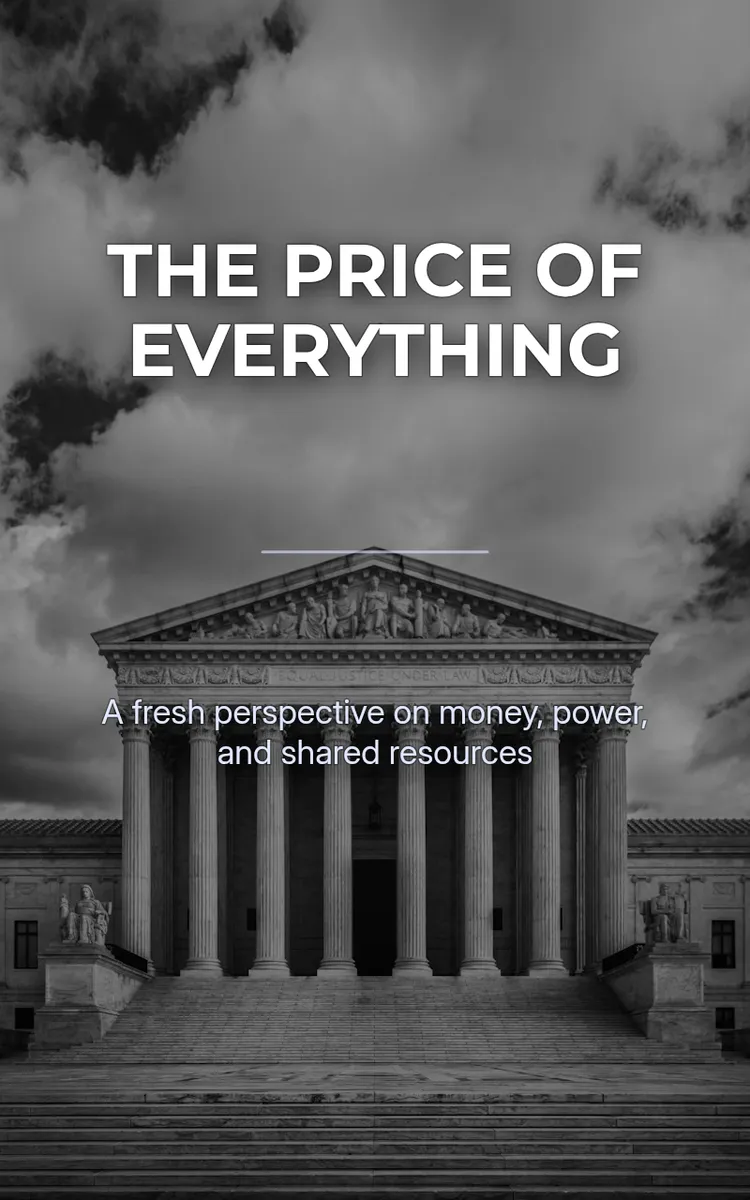
Read the first chapter
The whole of chapter one, free. About 8 min. Turn the pages with the arrows, your keyboard, or a swipe.
Chapter 1
The Price of Water
When the Tap Stops Being Free
At 6:17 on a summer morning, a homeowner turns a handle and hears only air. The river outside the town is still moving, clouds are still crossing the sky, and the water cycle has not failed; what has failed is the chain of pipes, pumps, permits, electricity, and payments that turns moving water into water at a kitchen sink.
Water is among the most abundant substances on Earth, yet access to it is organized through some of society’s most powerful institutions. A mountain stream may belong to no one in the physical sense, while the right to divert it belongs to a city, a farm, a company, or a person holding an old legal document. The water keeps circulating. The authority over it does not.
The Watershed-to-Wallet Map follows that transformation. It begins with rain and snow, moves through rivers, reservoirs, treatment plants, meters, and bills, and ends with a question about who gets to decide when a necessity becomes a commodity.
When does water stop being part of nature and become someone else’s property?
The Water That Moves Without Permission
Water has no permanent address. It evaporates from oceans, rises into the atmosphere, condenses into clouds, falls as rain or snow, enters soil, runs through streams, and eventually returns to the sea. A molecule in a glass may once have passed through a glacier, a wheat field, or a municipal sewer. Nature does not issue invoices for these journeys.
Human settlements began changing the meaning of water when they tried to keep it in one place. Ancient communities in Mesopotamia built canals to move river water toward crops. The Roman aqueducts carried water across long distances by using carefully calculated slopes, sometimes over bridges that remain visible today. These systems did more than solve a practical problem. They made water a matter of administration. Someone had to decide where a channel would run, who would maintain it, and whose fields would receive water first.
The same pattern appears in modern cities, only hidden beneath roads and buildings. A reservoir captures runoff. A treatment plant filters and disinfects it. Pumps push it uphill. Pipes carry it under streets. A meter records its passage. Each stage adds labor, energy, equipment, maintenance, and legal responsibility. The water itself remains part of the natural cycle, but the route to a household has become an engineered service.
That distinction explains why people can say, with equal accuracy, that water is free and that water is expensive. A person may collect rain in a barrel without paying for the rain, but the barrel, roof, storage tank, filter, and permission to use them may all involve costs. A city bill does not usually charge for the existence of water. It charges for the system that makes water available on demand and removes it afterward.
The bill is therefore a map of infrastructure as much as a price tag. It can include treatment, distribution, sewage collection, debt on construction projects, staff, electricity, repairs, and fees created by regulation. A household pays not only for what comes through the faucet but also for the hidden network that must be ready when the faucet opens.
Pipes Turn Geography Into Power
The modern water system grew alongside industrial cities. In nineteenth-century London, cholera outbreaks helped expose the danger of mixing drinking water with human waste. The response involved sewers, filtration, pumping stations, and new forms of public administration. Clean water became a public-health project, but it also became a political one. Whoever controlled the pipes controlled the conditions under which neighborhoods could grow and businesses could operate.
Pipes do not merely carry water across space. They rearrange the value of space. A parcel near a reliable main has a different economic future from one beyond the network. A factory needs water for production and wastewater removal. A housing development requires connections before homes can be occupied. Fire protection depends on pressure and storage. The presence of a pipe can raise land values; its absence can leave a community dependent on wells, tanks, or deliveries.
The underground system is also a quiet form of power because it is difficult to see. A broken bridge is obvious. A corroded water main can fail beneath a busy street with little warning. Residents may notice only the brown water, the low pressure, or the sudden road closure. Decisions made decades earlier about pipe materials, maintenance, and expansion continue to shape who receives dependable service now.
In many places, the cost is not shared evenly. Older neighborhoods may contain aging mains that leak or break more often, while newer developments receive modern infrastructure financed through fees paid by incoming residents. Rural communities may face high per-household costs because long distances separate homes from treatment facilities. In informal settlements, residents may pay more per container to private vendors than connected households pay through a municipal network.
A strange economic reversal follows: the people with the least reliable access may pay the highest price for each usable volume of water. The reason is not that water becomes rarer at the tap. It is that unreliable systems force people to buy it in small amounts, transport it themselves, store it, and absorb the time lost waiting for it.
Permits, Rights, and the Legal Shape of a River
Water law often begins with a fiction that is useful precisely because rivers refuse to behave like property. A river crosses boundaries, changes course, floods, evaporates, and disappears underground. Legal systems nevertheless need to assign rights to take water from it.
In the eastern United States, water rights historically developed around the idea that landowners beside a stream had certain claims to its use. In the drier West, many jurisdictions adopted versions of prior appropriation, often summarized as “first in time, first in right.” Under that system, an earlier recognized user may have priority during shortages over someone who arrived later, even if the later user is a growing town with more residents.
These rules were shaped by farming, mining, and settlement. They allowed people to plan around water, but they also carried old assumptions into new conditions. A document describing a diversion may grant authority to take water even when the river’s physical behavior has changed. Climate patterns, population growth, and environmental protections can collide with rights created under very different circumstances.
Permits add another layer. A permit may authorize a company to withdraw groundwater, a farmer to divert surface water, or a city to build a reservoir. The permit does not create the rain. It creates a recognized claim to interfere with the natural movement of water. That claim can become valuable, transferable, and politically defended.
The legal map rarely matches the watershed map. A watershed follows gravity: rain falling on one slope drains toward one river system, while rain on the other side may travel elsewhere. Political boundaries follow surveys, treaties, property lines, and history. When a city imports water from another basin, it is not merely buying a liquid. It is buying access to a different geography.
Los Angeles offers a clear example. Its growth depended on bringing water from distant sources, including the Owens Valley, through the Los Angeles Aqueduct, completed in 1913. The project transformed the city’s capacity to expand while profoundly altering the valley that supplied it. Water moved toward economic opportunity, and the landscape left behind absorbed the consequences. The aqueduct made distant water part of Los Angeles’s urban wealth, but distance did not erase the conflict over who had the stronger claim.
The Surprise: Scarcity Is Often Manufactured by Connection
The counterintuitive fact is that a water shortage can exist in a place where water is physically present. A city may sit beside a river and still lack safe drinking water; a rainy region may impose restrictions because its treatment plants, pipes, storage, or legal rights cannot handle demand.
This changes the usual meaning of scarcity. Scarcity is not always the absence of a resource. It can be the result of a broken connection between a resource and the people permitted to use it. The decisive question becomes less “How much water exists?” and more “Which infrastructure and institutions stand between the water and the household?”
Flint, Michigan, made that distinction painfully visible. In 2014, the city changed its water source to the Flint River without applying corrosion control treatment. Lead from aging pipes and plumbing entered the drinking water. Water was present; what was missing was protection from the system’s chemistry and the institutional failure to respond adequately.
The episode also showed how price operates beyond the monthly bill. Residents paid through bottled water, damaged trust, health fears, time spent seeking reliable supplies, and the loss of confidence in a basic public service. A cheap or supposedly temporary decision at the system level shifted costs onto households that had the least ability to absorb them.
Water’s price, then, is not limited to what a meter records. It can appear as rent, land value, political influence, transport, illness, delay, or the cost of replacing a service that should have been dependable. The farther a person stands from the source of authority, the harder those costs can be to see.
A Community at the Edge of the Pipeline
In the Navajo Nation, many households have lived without a connection to a public water system even while major water infrastructure serves nearby cities and mines. Homes may depend on hauling water in containers, traveling long distances to fill tanks, or buying bottled water for drinking. The problem is not simply a dry landscape. It is the expense of extending and maintaining infrastructure across a vast area, combined with historical decisions about land, rights, development, and public investment.
A water-hauling trip turns an invisible municipal service into a physical burden. Water must be found, purchased or collected, transported, stored, and protected from contamination. The household pays in fuel, vehicle wear, time, and uncertainty. A connected home receives water through a pipe; an unconnected home must perform the work that the pipe normally performs.
The contrast is especially revealing because the region is not outside the water economy. Water rights, energy projects, livestock, mining operations, and municipal demands all create formal claims on the same broader system. The absence of a household connection does not mean the area lacks value to institutions. It means the infrastructure has been directed elsewhere, according to priorities that have accumulated over generations.
That is the central tension in the Watershed-to-Wallet Map. Nature supplies movement without a cashier, but society decides which movements become dependable services. Pipes make water convenient, permits make it claimable, scarcity makes it negotiable, and unequal investment determines who pays the most for the least security.
A society’s water system reveals what it considers worth connecting. The river may be shared by gravity, but access to the river is arranged by money, law, and power. Somewhere beneath every ordinary faucet is a history of decisions about whose needs count - and how much a flowing part of Earth is allowed to cost.
End of chapter one. 39 more chapters and about 68,813 words in the full book.
Swipe or use the arrows to turn the page


What's inside: 40 chapters
- 1. The Price of Water
- 2. Who Owns the Sunlight?
- 3. The Grocery Store’s Hidden Land
- 4. A Forest With a Price Tag
- 5. The Rent Hidden in Land
- 6. When Nature Becomes a Number
- 7. The Commons We Forgot
- 8. How a Fence Invented Property
- 9. The First Debt Was a Promise
- 10. Coins Made Authority Portable
- 11. Why Gold Still Feels Real
- 12. Paper Money Runs on Belief
- 13. The Bank Creates the Number
- 14. Interest Charges for Waiting
- 15. Inflation’s Quiet Transfer
- 16. The Tax You Never See
- 17. Scarcity Can Be Manufactured
- 18. The Price of Being Poor
- 19. Work Without a Wage
- 20. The Job That Sells Access
- 21. Why Money Resembles Religion
- 22. The Morality of Owing
- 23. The Gospel of Endless Growth
- 24. The State’s Money Machine
- 25. Borders Decide Who Gets Paid
- 26. Colonialism’s Unpaid Invoice
- 27. Who Owns the Seeds?
- 28. The Ocean’s Invisible Landlord
- 29. Carbon Credits Sell Permission
- 30. The Mineral Beneath Your Phone
- 31. When Care Becomes a Market
- 32. The Algorithm Sets Your Rent
- 33. The Wealth That Never Moves
- 34. A Crisis Makes Fortunes
- 35. The Commons Can Be Governed
- 36. Cooperatives Change the Owner
- 37. Universal Services Break the Toll
- 38. A Budget Is a Moral Map
- 39. What Would You Make Free?
- 40. The Earth Was Never for Sale
About this book
"The Price Of Everything" is a nonfiction book by Jessie McLaughlin with 40 chapters and approximately 68,813 words. How money shapes society, controls people, and assigns value to Earth's resources.
This book was created using Inkfluence AI, an AI-powered book generation platform that helps authors write, design, and publish complete books.
Frequently Asked Questions
What is "The Price Of Everything" about?
How money shapes society, controls people, and assigns value to Earth's resources
How many chapters are in "The Price Of Everything"?
The book contains 40 chapters and approximately 68,813 words. Topics covered include The Price of Water, Who Owns the Sunlight?, The Grocery Store’s Hidden Land, A Forest With a Price Tag, and more.
Who wrote "The Price Of Everything"?
This book was written by Jessie McLaughlin and created using Inkfluence AI, an AI book generation platform that helps authors write, design, and publish books.
Write your own nonfiction book with AI
Describe your idea and Inkfluence writes the whole thing. Free to start.
Start writingCreated with Inkfluence AI


