

Read the first chapter
The whole of chapter one, free. About 7 min. Turn the pages with the arrows, your keyboard, or a swipe.
Chapter 1
Recognize You Beyond the Body
The First Separation: Awareness Beyond the Flesh
What remains of you when your body is asleep, still, or no longer able to do what it once did? Notice the question before rushing to answer it. Your body changes every day. It grows, heals, tires, gains strength, loses strength, and eventually returns to the earth. Yet something in you is present through every change, quietly aware of it.
That awareness is the doorway to the first identity shift. You aren’t being asked to hate your body, neglect it, or pretend pain doesn’t matter. This house of flesh and bone deserves care. But it must not be mistaken for the whole of who you are. The body is temporary. Consciousness is the deeper reality you’re learning to recognize and remember.
This Chapter Is For You If...
• You’ve been measuring your identity by your age, appearance, health, strength, or physical ability. - Fear of aging, illness, sleep, or death has begun to define your choices. - You care for your body responsibly but sense that your identity must reach beyond its condition. - You’re ready to practice noticing awareness itself, rather than only the body and its changing story.
The shift you can expect is simple but powerful: instead of saying, “I am this body,” you begin to say, “This body is the temporary form through which I’m experiencing life.” That change won’t erase ordinary responsibilities. It will change the place from which you meet them.
The Core Truth: You Are the Awareness Using the Body
You are not the temporary body; you are the immortal consciousness aware of the body.
Look closely at your own experience. You can notice your hands, which means your hands are something you observe. You can notice your breathing, your heartbeat, your tension, and your tiredness. You can notice a thought such as, “I’m afraid of getting older.” If you can observe these things, they cannot be the whole of the observer.
The body sleeps, but awareness returns and knows, “I slept.” The body changes, but awareness recognizes the change. A photograph from ten years ago shows a body that was once yours, yet you don’t feel that your entire self disappeared when that body changed. There has been continuity beneath the physical alterations. That continuity is not your hair color, muscle tone, height, or medical record. It is the conscious presence that has witnessed them.
Consider Talia, a 34-year-old hospice nurse. Her work brings her close to bodies in their final stages. She sees breathing slow, skin change, strength leave, and familiar features become still. She doesn’t treat those bodies as worthless. She washes them, comforts families, and handles each person with dignity. But her work has taught her something direct: the body can be present while the person’s familiar expression, voice, and movement are gone.
Talia began noticing how often she also reduced herself to her body. After a twelve-hour shift, she would say, “I’m nothing but exhausted.” When a back injury kept her from exercising, she thought, “I’m losing myself.” Her Three-Lens Identity Test helped her separate the layers: the body was tired, the mind was worried, but awareness was still present and capable of witnessing both. She still rested and followed medical advice. She simply stopped calling temporary conditions her permanent identity.
In Practice, This Means...
• You describe bodily conditions accurately without turning them into definitions: “My knee hurts,” rather than “I am broken.” - You care for the body as a sacred temporary house, not as the final measure of your worth. - You pause before obeying fear about aging, illness, or death. - You return to the awareness witnessing each sensation, thought, and change.
Use the Three-Lens Identity Test Each Day
The Three-Lens Identity Test gives you a practical way to separate awareness from the body without drifting into vague spiritual language. Use it when you wake, during the middle of the day, and before sleep.
1. Morning: identify the body lens. Before reaching for your phone, notice three physical facts. Perhaps your shoulders are tight, your mouth is dry, and your legs feel heavy. Name them plainly: “Tight shoulders. Dry mouth. Heavy legs.” Don’t add a verdict such as “I’m failing” or “I’m too old.” You’re observing the body, not becoming its condition.
2. Morning: identify the mind lens. Notice the first strong thought or emotion. It might be, “I don’t have enough time,” or “I’m worried about my health.” Say quietly, “A thought is present,” or “Fear is present.” This creates space between awareness and the mental story attached to the body.
3. Midday: identify the awareness lens. Stop for sixty seconds. Feel your feet on the floor and notice that sensations and thoughts are appearing within your awareness. Ask, “What is aware of this body right now?” Don’t force an image or a grand answer. Rest in the simple fact that you are aware.
4. Midday: make one decision from the deeper identity. If your body is tired, you may choose water, food, a stretch, or a break. If fear is loud, you may delay a reactive message for ten minutes. The point isn’t to override the body. It’s to let awareness guide the body instead of letting every sensation command you.
5. Evening: review one moment of mistaken identity. Write one sentence about where you confused a temporary condition with your whole self. For example: “I felt pain in my back and called myself useless.” Rewrite it: “Pain was present, and awareness remained present too.”
6. Before sleep: release the body consciously. As you lie down, notice the body becoming still. Say, “This body is entering sleep. I remain the awareness in which this experience appears.” Let the words be a reminder, not a performance. Sleep gives you a daily lesson: the body can become unconscious while your deeper continuity isn’t destroyed.
Practice this for seven days. Use a small note in your phone titled “Three Lenses.” Record only one line at each check-in. The goal is not to become detached from life. It’s to stop handing your entire identity to whatever the body happens to be doing at that moment.
A Grounded Shift in Talia’s Day
Before: Talia finishes a demanding hospice shift with aching feet and a stiff lower back. She looks in the mirror and thinks, “I’m worn out. I’m losing my youth. This is what I am now.” The physical discomfort is real, but her conclusion turns a temporary body-state into a permanent identity. She carries that belief into the evening, snaps at someone she loves, and goes to bed afraid of decline.
Action: Talia uses the Three-Lens Identity Test in the staff parking lot. First, she names the body: “My feet ache. My back is tight. My eyes are tired.” Next, she names the mind: “Fear about aging is present.” Then she asks, “What is aware of these sensations and thoughts?” For one minute, she feels her hands on the steering wheel and notices that awareness is present before, during, and after each thought.
She doesn’t deny the body. She goes home, drinks water, follows the stretching plan her clinician gave her, and rests. But she changes her language. Instead of saying, “I’m falling apart,” she says, “This body needs care tonight. The awareness I am is not reduced to its condition.”
Result: The back pain doesn’t vanish through a spiritual statement. That isn’t the test. The result is that Talia responds wisely instead of panicking. She cares for the body without worshiping its condition. Her fear becomes something she can witness, rather than a command she must obey. Over time, this distinction gives her steadier presence with patients and with herself.
Time to Reflect on What You Call “Me”
1. Which bodily change most easily makes you say, “This is who I am”? It may be weight, hair loss, pain, fatigue, illness, or reduced strength. Write the exact sentence you use, then separate the condition from the awareness noticing it.
2. When your body is tired, do you treat tiredness as an instruction or an identity? Tiredness may instruct you to rest, but it doesn’t prove that you are weak, useless, or finished. Let the body provide information without letting it write your entire name.
3. What did you know about yourself before you formed an opinion about your appearance? Don’t search for a childhood memory. Notice the immediate sense of being present. That simple presence is closer to your true identity than any mirror can show.
4. What fear about death becomes louder when you identify only with the body? Be honest without dramatizing it. You may discover that the fear is not only about physical ending, but about believing that the end of the body must mean the end of you.
5. What will you do differently today because awareness is deeper than the body? Choose one action: rest without self-condemnation, care for an injured area, interrupt a fearful thought, or spend five quiet minutes noticing awareness. A real shift shows up in behavior.
Make the Separation Today
Set a timer for seven minutes today. Sit somewhere quiet, place both feet on the floor, and complete the Three-Lens Identity Test: name three body sensations, name one thought or emotion, then rest with the question, “What is aware of all this?” Write one final sentence: “The body is changing, and awareness is present.”
Time needed: 7 minutes.
You will know it worked when... you can describe one physical sensation without turning it into a judgment about your entire identity. That small separation is the beginning of staying awake. The body will continue to sleep, change, decay, and die in its appointed time. Your task is to remember that you are more than the house - and to live today from the consciousness within it.
End of chapter one. 18 more chapters in the full book.
Swipe or use the arrows to turn the page


What's inside: 19 chapters
- 1. Recognize You Beyond the Body
- 2. Awaken the Immortal Observer
- 3. Stop Identifying With Sensations
- 4. Grasp the Soul’s Ever-Presence
- 5. Remember Who You Are Daily
- 6. Practice Detachment Without Numbness
- 7. Reclaim Lordship Over Earth
- 8. Transform Fear Into Awake Presence
- 9. Let Death Teach Identity
- 10. Release Shame From Your Self-Story
- 11. Choose Thoughts That Serve Awakening
- 12. Build Inner Stillness in Motion
- 13. Practice Forgiveness as Conscious Release
- 14. Turn Suffering Into Spiritual Information
- 15. Align Your Actions With Immortal Values
- 16. Strengthen Memory Through Gratitude
- 17. Stay Awake When Identity Tries to Revert
- 18. Live as Immortal Consciousness Now
- 19. The Quiet Return
About this book
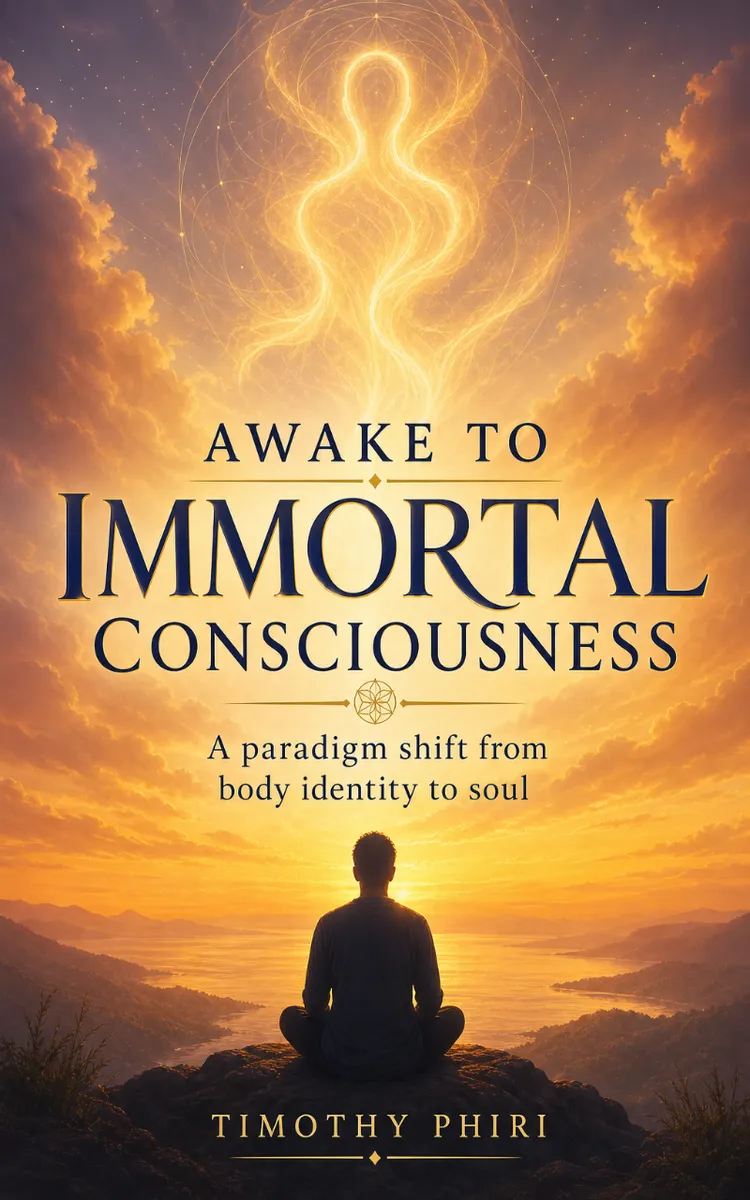
"Awake To Immortal Consciousness" is a inspirational book by Timothy Phiri with 19 chapters and approximately 30,025 words. Shifting identity from mortal body to immortal consciousness.
This book was created using Inkfluence AI, an AI-powered book generation platform that helps authors write, design, and publish complete books. It was made with the AI Inspirational Book Writer.
Frequently Asked Questions
What is "Awake To Immortal Consciousness" about?
Shifting identity from mortal body to immortal consciousness
How many chapters are in "Awake To Immortal Consciousness"?
The book contains 19 chapters and approximately 30,025 words. Topics covered include Recognize You Beyond the Body, Awaken the Immortal Observer, Stop Identifying With Sensations, Grasp the Soul’s Ever-Presence, and more.
Who wrote "Awake To Immortal Consciousness"?
This book was written by Timothy Phiri and created using Inkfluence AI, an AI book generation platform that helps authors write, design, and publish books.
How can I create a similar inspirational book?
You can create your own inspirational book using Inkfluence AI. Describe your idea, choose your style, and the AI writes the full book for you. It's free to start.
Write your own inspirational book with AI
Describe your idea and Inkfluence writes the whole thing. Free to start.
Start writingCreated with Inkfluence AI


