
Read the first chapter
The whole of chapter one, free. About 10 min. Turn the pages with the arrows, your keyboard, or a swipe.
Chapter 1
Why Test Scores Suddenly Fell
The Day the Numbers Turned Around
In 2004, researchers examining intelligence-test results from Norway noticed something that should have seemed impossible. Younger men were no longer scoring higher than the generation before them. The long climb had stopped, and in some groups the scores had begun to fall.
For most of the twentieth century, this was not what the numbers did. Across many countries, each new generation tended to perform better on intelligence tests than the one preceding it. The pattern became known as the Flynn effect, after the political scientist James Flynn, who drew wide attention to the phenomenon. It was one of the most dependable findings in modern psychology: measured cognitive performance rose across time, even though human biology could not be changing that quickly.
Then the line bent downward.
The reversal did not arrive with a single dramatic event. It appeared in military records, school assessments, population surveys, and long-running research programs. Some declines were small. Some were concentrated in particular kinds of reasoning. Some disappeared when researchers changed the test or adjusted for education. The central puzzle is therefore not simply whether scores fell, but what kind of falling we are looking at.
When a population appears to become less intelligent, are we witnessing a change in minds - or a change in the measuring stick?
The Century of Rising Scores
The story begins with a peculiar feature of intelligence tests: they are built to compare people, but they also record history. A test designed in one decade does not float above its time. It reflects the schooling, language, habits, technologies, and assumptions of the people who take it.
When the same test is given to later generations, the results often rise. A question that once required careful thought may become familiar through ordinary life. Sorting shapes, following diagrams, handling written instructions, or identifying patterns can all become easier in a society that provides more schooling, better nutrition, smaller families, wider access to print, and more practice with abstract symbols.
That rise was visible across countries during much of the twentieth century. The gains were not limited to one narrow ability. In many settings, people improved on tasks involving abstract reasoning, visual patterns, and problem-solving. The change was too large and too widespread to be explained by a few unusually bright children. Something in the environment was altering how whole populations performed.
The result created a tempting interpretation: perhaps humanity was becoming smarter in a broad, permanent sense. But intelligence tests do not measure a single substance inside the brain. They sample abilities under particular conditions. A person’s score can be shaped by familiarity with formal testing, comfort with timed tasks, language, health, motivation, and the kinds of problems repeatedly encountered in daily life.
This is why the Flynn effect was always more interesting than a simple tale of progress. It showed that performance on cognitive tests could shift substantially within a few generations. It also suggested that the environment had more power over measured intelligence than many people had assumed.
A useful comparison is physical fitness. If a population becomes better fed and more accustomed to organized exercise, average running times may improve. That does not mean human muscles have evolved into a new species. It means bodies are operating under different conditions. Cognitive tests are not identical to running tracks, but the principle is similar: performance reflects both the person and the setting.
By the late twentieth century, however, the conditions that had supported rising scores were no longer moving in one direction. Education continued to expand, but other influences changed. Childhood became more screen-centered. Reading habits shifted. Work and leisure demanded different forms of attention. Public health improved in some areas while problems such as sleep loss and childhood obesity became more visible. The same societies that had produced decades of rising scores were now producing a more complicated cognitive environment.
Norway and the Reversal
The clearest early warning came from Norway, where researchers had access to an unusually valuable source of evidence: intelligence-test results from men assessed for military service. Norway’s conscription system created repeated cohorts tested under broadly comparable conditions. Because military records covered large numbers of people born in different years, they offered something rare in social science - a long view of cognitive performance within one national population.
For decades, the scores rose. Then, among men born after the mid-1970s, the direction changed. The decline was not merely a statistical blip in one small sample. It appeared across several measures, including forms of reasoning that had previously shown strong gains.
The Norwegian evidence mattered because it weakened an obvious explanation. If the scores had fallen only because fewer people were attending school, education would have been a plausible culprit. But the decline appeared even as educational opportunities expanded. Nor could it be dismissed as a change in who was tested: the military records covered a broad share of the male population, not just volunteers for a research project.
Other countries produced related findings. British data showed that gains on some intelligence measures had slowed or reversed among later-born groups. Evidence from several nations suggested that the reversal was strongest in certain abilities, especially those involving abstract problem-solving and novel reasoning. Verbal knowledge did not always move in the same direction. This unevenness became important: a population might retain or increase its store of learned information while becoming less practiced at solving unfamiliar problems.
That distinction is easy to miss in everyday life. A person can know more facts than a grandparent and still perform worse on a timed pattern test. Modern life supplies enormous quantities of information, but information and reasoning are not interchangeable. Knowing how to find an answer online is not the same as holding several possibilities in mind and working through them without assistance.
The Norwegian records also showed why age matters. Intelligence-test scores are often compared across people of different ages, but age brings its own effects. Younger adults may be faster on some tasks; older adults may possess greater vocabulary and accumulated knowledge. A decline across birth cohorts is not the same as an individual becoming less capable with age. The first compares generations at similar stages of life. The second follows one person across the lifespan.
That difference is central to the Score-Reversal Audit, the framework used to examine whether an apparent decline is genuine. The audit asks what was tested, who was tested, when they were born, how old they were at testing, and whether the same pattern appears across different measures. Without those checks, a falling line can tell several incompatible stories.
The Score-Reversal Audit
The first question is whether the test itself remained stable. A test may be described as “the same” while its instructions, scoring rules, translation, or testing conditions have changed. Even small differences can matter when researchers are comparing average scores across decades.
The second question concerns the sample. A national military cohort is not the same as a voluntary online survey. Schoolchildren, job applicants, prisoners, and university students each represent different slices of a population. If the composition of the tested group changes, average performance can change even when the wider population does not.
A third question is whether the decline appears on several kinds of tasks. Suppose scores fall on abstract matrix problems but remain steady on vocabulary. That pattern does not prove that general intelligence has declined. It may indicate a shift in the specific habits that support abstract, unfamiliar problem-solving. Conversely, if many unrelated measures move downward across carefully matched cohorts, the case for a broader population change becomes stronger.
The fourth question is whether the result survives statistical correction. Researchers may adjust for education, socioeconomic background, health, and other factors. Those corrections can clarify the picture, but they do not automatically reveal the “true” score. Every adjustment rests on assumptions. If education is included as a control, for example, the analysis may remove part of the very social change that helped shape cognitive performance.
The fifth question is historical. A score is never just a number; it is a number produced by a particular culture. A test question requiring mental rotation may favor people accustomed to diagrams, maps, and technical drawings. A verbal task may favor people who read long texts. A processing-speed task may reflect not only mental speed but also familiarity with rapid visual decisions.
This is where statistical illusion enters. A decline can be created by changes in sampling, test exposure, or the relationship between test tasks and everyday life. But the opposite illusion is also possible: researchers may explain away a real shift by blaming the instrument. If people across multiple countries, tested with different tools, show similar declines in comparable abilities, “the test changed” becomes an increasingly weak answer.
The audit therefore does not ask whether a single number is real. It asks whether the pattern is stable under pressure. Does it remain when the sample changes? Does it appear in more than one measure? Does it survive different ways of handling education and age? Does it match other evidence about reading, attention, memory, or school performance?
The surprising finding is that the strongest evidence for a real reversal often comes from its unevenness. Scores do not have to fall everywhere for a population shift to be genuine. A generation may improve at familiar, technology-supported tasks while declining at forms of reasoning that require sustained attention and mental manipulation.
That matters because “people are getting less intelligent” is too blunt to describe what the data show. The more precise possibility is that societies are cultivating some cognitive abilities while neglecting or displacing others. The reversal may be less like a power failure than a change in which circuits are being used.
The People Behind the Line
The Norwegian conscripts were not abstract data points when they arrived for assessment. They were young men moving through a national system that recorded height, health, education, and cognitive performance before military service. Their results accumulated over decades, cohort by cohort, creating a portrait of changing performance that no single classroom or family could have seen.
A young man tested in the 1980s belonged to a society different from the one encountered by a conscript tested years later. The earlier cohort had grown up with fewer digital devices and less constant electronic media. The later cohort had more years of formal education and greater access to information, yet the average performance on some reasoning tasks was lower. The contradiction is precisely what makes the records valuable. They prevent an easy story in which more schooling automatically produces better scores.
The records also show why social change must be treated as a bundle rather than a single cause. Family size, classroom practice, leisure, nutrition, sleep, media, and work all changed at different speeds. A child born into a highly educated society may receive more instruction but less unbroken reading time. A teenager may become skilled at navigating complex interfaces while having fewer opportunities to solve problems without prompts, search engines, or rapid feedback.
No single cohort can reveal which influence mattered most. But a population record can reveal that the old upward pattern has ended. It can also show that the change is not confined to people who failed at school or lacked access to education. The reversal, where it appears, crosses the boundaries that ordinary explanations often rely on.
The result is a more unsettling picture of intelligence. Human beings do not simply possess a fixed level of mental ability that tests uncover. They develop habits of attention, memory, language, and reasoning inside particular environments. When those environments change, the average expression of ability can change with them.
What a Falling Score Can Mean
The phrase “reverse Flynn effect” sounds as though history has simply gone into reverse. The evidence is less tidy. Some countries, age groups, and tests show declines; others show stability or continued gains. The size and timing of the change vary. That variation is not a nuisance to be ignored. It is a clue that social conditions matter.
A falling score may represent a real change in population performance, a mismatch between old tests and new habits, or both at once. These explanations are not mutually exclusive. A test can remain technically sound while measuring abilities that modern life exercises less often. At the same time, changes in education or health can affect the underlying performance the test is designed to capture.
The most responsible conclusion is therefore neither panic nor dismissal. The reversal is not proof that every aspect of human thinking is deteriorating. Nor is it harmless noise produced by flawed statistics. It is a signal that the relationship between minds, institutions, and daily life has shifted.
For much of the last century, rising test scores encouraged a reassuring belief: each generation would be cognitively better equipped than the last. The reversal removes that assumption. It leaves behind a harder question about what a society is actually training its members to notice, remember, and reason through.
A test score is a small window, but windows can reveal changes in the landscape. The mystery is not only why the numbers fell. It is what kind of world made the fall possible - and what else may be changing outside the frame.
End of chapter one. 39 more chapters and about 69,554 words in the full book.
Swipe or use the arrows to turn the page


What's inside: 40 chapters
- 1. Why Test Scores Suddenly Fell
- 2. The Flynn Effect Runs Backward
- 3. What IQ Tests Actually Measure
- 4. The Puzzle That Got Easier
- 5. When Gains Stop at the Top
- 6. The Countries That Turned First
- 7. A Drop Is Not a Diagnosis
- 8. The Cohort Hidden in the Average
- 9. Screens, Swipes, and Attention
- 10. The Reading Recession
- 11. Schooling Without Deep Practice
- 12. The Knowledge We Outsource
- 13. Sleep Debt in the Classroom
- 14. Stress That Narrows Thought
- 15. Pollution Inside the Brain
- 16. The Nutrition Signal
- 17. Childhood Starts Before School
- 18. The Vocabulary Gap Widens
- 19. When Math Becomes Memorized
- 20. The Vanishing Mental Map
- 21. The Test Itself Keeps Changing
- 22. Averages Hide Unequal Declines
- 23. The Rural-Urban Score Divide
- 24. Migration Changes the Sample
- 25. The Pandemic’s Cognitive Shadow
- 26. Why Experts Disagree on Causes
- 27. The Heritability Trap
- 28. Genes Meet Changing Environments
- 29. The Fertility Story Under Scrutiny
- 30. When Incentives Distort Scores
- 31. The Skills Tests Never Count
- 32. Can AI Make Us Less Sharp?
- 33. The Attention Economy’s Hidden Cost
- 34. How to Read a Cognitive Trend
- 35. What Would Change Our Minds?
- 36. Rebuilding the Conditions for Thought
- 37. Teaching Transfer, Not Test Tricks
- 38. A Smarter Definition of Progress
- 39. The Reversal Is Not Destiny
- 40. What a Society Trains Its Mind to Do
About this book
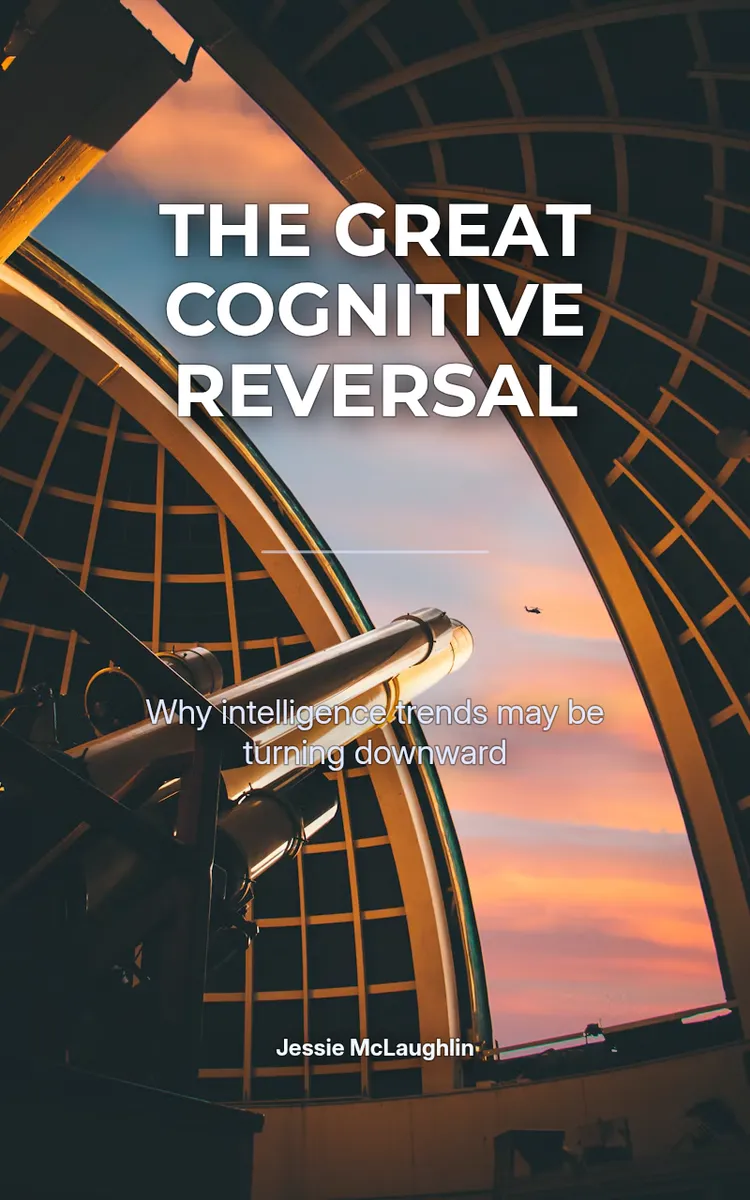
"The Great Cognitive Reversal" is a nonfiction book by Jessie McLaughlin with 40 chapters and approximately 69,554 words. The possible decline in measured intelligence known as the reverse Flynn effect.
This book was created using Inkfluence AI, an AI-powered book generation platform that helps authors write, design, and publish complete books.
Frequently Asked Questions
What is "The Great Cognitive Reversal" about?
The possible decline in measured intelligence known as the reverse Flynn effect
How many chapters are in "The Great Cognitive Reversal"?
The book contains 40 chapters and approximately 69,554 words. Topics covered include Why Test Scores Suddenly Fell, The Flynn Effect Runs Backward, What IQ Tests Actually Measure, The Puzzle That Got Easier, and more.
Who wrote "The Great Cognitive Reversal"?
This book was written by Jessie McLaughlin and created using Inkfluence AI, an AI book generation platform that helps authors write, design, and publish books.
Write your own nonfiction book with AI
Describe your idea and Inkfluence writes the whole thing. Free to start.
Start writingCreated with Inkfluence AI


