
Read chapter 4
The whole of chapter four, free. About 5 min. Turn the pages with the arrows, your keyboard, or a swipe.
Chapter 4
Prologue
There is a specific kind of quiet that exists before a question is asked. It is the moment when the mind stops racing and settles, like sediment drifting to the bottom of a disturbed pond. In that stillness, thought has the room to breathe. It is where ideas take shape, where connections are made, and where true understanding begins to grow.
In our current world, that quiet is becoming harder to find. We live in an environment designed for speed, constant updates, and the relentless pull of the next notification. It is easy to feel as though we are constantly reacting to the world rather than participating in it. We scroll through streams of information, we click on links that promise answers, and we consume content at a pace that leaves little room for reflection. Often, we finish a task or a video or an article and realize that while we have been busy, we have not necessarily been thinking.
This book is an invitation to reclaim that missing space. It is not a call to abandon the tools of the modern age, for technology offers wonders we could scarcely imagine a few generations ago. Instead, this is a guide for developing a different kind of relationship with those tools. It is about learning to use them with intention, ensuring that they serve our goals rather than dictating our attention. This is the practice of unplugged intelligence.
Consider the way a magnifying glass works. On its own, sunlight is warm and diffuse. It touches everything, but it changes very little. However, when you introduce a lens and hold it steady, that same light focuses into a single point of intense energy. That focus is what allows you to start a fire or see the minute details of a leaf. Your mind functions much the same way. When your attention is scattered across a dozen tabs, notifications, and incoming messages, your thinking remains diffuse. You are processing information, but you are not necessarily building understanding. By learning to narrow your focus, you can apply your mental energy with precision.
The chapters that follow outline a journey toward this kind of clarity. It begins with the simple act of slowing down. We often equate speed with intelligence, assuming that the person who answers first or scrolls fastest is the most capable. But the deepest thoughts rarely come from the quickest reactions. They come from the ability to pause, to separate what you know from what you guess, and to identify the specific pieces of a problem that need to be solved.
Throughout this book, you will encounter strategies for building a mental architecture that can withstand the noise of the digital age. You will learn how to approach a book not just as a collection of pages, but as a conversation with an idea. You will explore how to treat a video or a digital tutorial as a starting point for action, rather than an end in itself. You will discover how to handle the inevitable moments of distraction, finding your way back to your center when your focus begins to drift.
One of the most vital skills you will cultivate is the ability to ask the right questions. We are frequently presented with information that claims to be true, but in an age of abundant content, the origin of that information matters. Asking where something comes from, whether the full message is being presented, and how we know what we know are not just academic exercises. They are essential habits for navigating the world with confidence. These practices help you distinguish between what is fact, what is opinion, and what might be misinformation.
You will also find guidance on the importance of communication. Words are tools, and like any other tool, they are most effective when they are sharp, precise, and used for a clear purpose. Whether you are writing a set of instructions, explaining a concept to a friend, or organizing your own thoughts in a journal, the way you use language shapes your ability to be understood. You will learn how to choose the right words to build bridges between your mind and the minds of others.
Crucially, this book emphasizes that you are not in this alone. While much of our digital life is solitary, learning is a social act. You will explore the value of collaborative thinking, the role of a trusted guide, and the importance of creating spaces, both physical and digital, where curiosity is encouraged and mistakes are viewed as necessary steps in the process of discovery. You will learn to manage your tools, ensuring that your devices remain servants to your curiosity rather than masters of your time.
Life does not happen on a screen. It happens in the messy, tactile, and unpredictable world around us. Balancing the digital and the physical is perhaps the most important challenge of our time. By making room for play, for conversation, and for quiet contemplation, you ensure that your digital habits enhance your life rather than diminish it. You will find that when you step away from the constant stream of data, you return to it with a sharper mind and a clearer sense of purpose.
The path ahead is not about achieving perfection. It is about developing habits. It is about understanding that your mind is a muscle that strengthens with practice, challenge, and reflection. Every time you choose to pause, every time you verify a claim, every time you put down a device to engage with a book or a person, you are strengthening your capacity for independent thought.
This book is organized into fourteen specific stages of development. Each stage builds upon the last, providing you with a framework for thinking, questioning, and growing. It is a toolbox for the mind, designed to be returned to whenever you feel overwhelmed or unsure of your next step. Whether you are a student, a professional, or simply someone trying to find a bit more focus in a loud world, these pages are meant to serve as a guide.
As you begin this journey, remember that your curiosity is your greatest asset. It is the engine that drives all learning. Protect it, nurture it, and give it the space it needs to thrive. The digital world offers us a vast library of information, but it cannot give us the ability to think. That is a task that belongs entirely to you. By taking ownership of your attention, you are not just becoming a better thinker; you are reclaiming your ability to see the world as it truly is.
Take a deep breath. Clear your desk. Open your mind to the possibility that the most important technology you will ever use is the one you were born with. It is time to unplug, focus, and begin.
End of chapter four. 21 more chapters and about 23,988 words in the full book.
Swipe or use the arrows to turn the page
What's inside: 25 chapters
- 1. Preface
- 2. Acknowledgments
- 3. Introduction
- 4. Prologue
- 5. Chapter 1. Give Your Mind Time to Think
- 6. Chapter 2. Make Room for a Good Book
- 7. Chapter 3. A Video Can Be a Beginning
- 8. Chapter 4. Find Your Place After a Distraction
- 9. Chapter 5. Ask “How Do We Know?”
- 10. Chapter 6. What to Do When a Message Is Wrong
- 11. Chapter 7. Find the Words You Need
- 12. Chapter 8. Make Your Tools Work for You
- 13. Chapter 9. Try, Ask, and Try Again
- 14. Chapter 10. Make Room for Life Off the Screen
- 15. Chapter 11. Show What You Understand
- 16. Chapter 12. Keep Your Curiosity Going
- 17. Chapter 13. My Wonder Club Activity Journal
- 18. Chapter 14. A Small Word Toolbox
- 19. Epilogue
- 20. A Note to Readers
- 21. About the Author
- 22. Notes for Grown-Ups
- 23. Glossary
- 24. Discussion Guide
- 25. Closing Credits
About this book
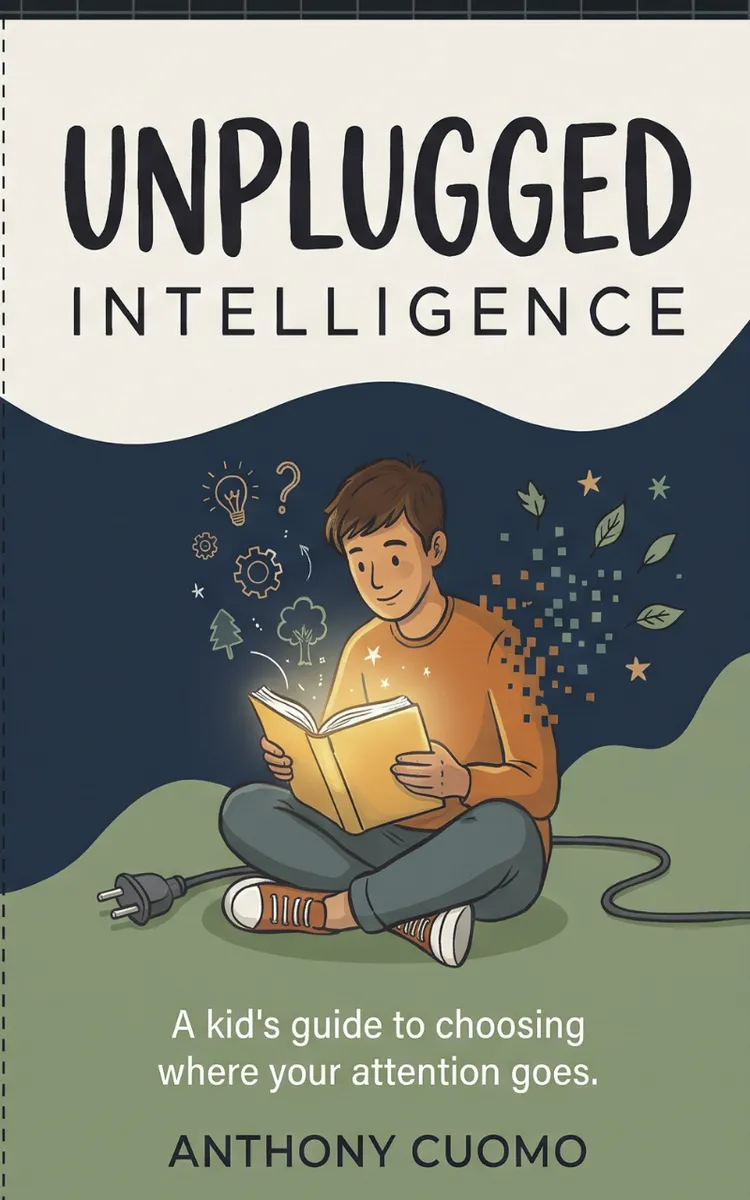
"Unplugged Intelligence audio" is a self-help book by Anonymous with 25 chapters and approximately 23,988 words. It covers key insights and practical takeaways on the topic.
This book was created using Inkfluence AI, an AI-powered book generation platform that helps authors write, design, and publish complete books. It was made with the AI Self-Help Book Writer.
Frequently Asked Questions
What is "Unplugged Intelligence audio" about?
"Unplugged Intelligence audio" is a self-help book by Anonymous covering key insights and practical takeaways on the topic.
How many chapters are in "Unplugged Intelligence audio"?
The book contains 25 chapters and approximately 23,988 words. Topics covered include Preface, Acknowledgments, Introduction, Prologue, and more.
Who wrote "Unplugged Intelligence audio"?
This book was written by Anonymous and created using Inkfluence AI, an AI book generation platform that helps authors write, design, and publish books.
How can I create a similar self-help book?
You can create your own self-help book using Inkfluence AI. Describe your idea, choose your style, and the AI writes the full book for you. It's free to start.
Write your own self-help book with AI
Describe your idea and Inkfluence writes the whole thing. Free to start.
Start writingCreated with Inkfluence AI


